阿特斯

Search documents
2025年储能市场半年度行情展望:内需承压外需向上,政策预期扰动市场
Guo Tai Jun An Qi Huo· 2025-06-20 05:25
1. Report Industry Investment Rating No relevant content provided. 2. Core Viewpoints of the Report - In the first half of 2025, the global energy storage market continued its high - growth trend, but there were significant differences among regions. China had remarkable performance, with new energy storage installations from January to May reaching 18.62GW/47.57GWh, a year - on - year increase of 112%. The US market maintained strong growth, with new installations of 2346MW, a year - on - year increase of 59%. The European market was highly differentiated, with Germany's new installations from January to May at 1278MW/2038MWh, a year - on - year decrease of 16%, Italy's Q1 new installations at 266MW/497MWh, a year - on - year decrease of 46%, and the UK's Q1 new installations at 419MW/959MWh, a year - on - year increase of 109% [2][79]. - The global new energy storage installation forecast for 2025 was slightly adjusted downward, with an expected increase of 228.4GWh, a year - on - year growth of 21%. Although lower than the previous forecast, the overall growth rate remained at a high level [3][79]. - In the domestic market, the cancellation of the mandatory energy storage allocation policy and the end of the "531" rush - to - install wave were expected to suppress the installation rhythm in the second half of the year. However, with sufficient中标 project reserves, some projects could continue to be promoted in the form of independent energy storage, and the risk of a significant decline was relatively controllable. The domestic new energy storage installations for the whole year of 2025 were expected to reach 107.4GWh, a slight year - on - year increase of 0.2%, including 97.2GWh for large - scale front - of - the - meter energy storage and 10.2GWh for behind - the - meter energy storage [3][79]. - The overseas energy storage market remained highly prosperous, with strong growth in the US, Europe, and emerging markets. In the US, the impact of policy disturbances was relatively small, the project reserve continued to increase, and the expected improvement in the project completion rate was anticipated. The new installations for the whole year of 2025 were expected to reach 48.9GWh, a year - on - year increase of 32%, including 43.6GWh for front - of - the - meter energy storage and 5.4GWh for behind - the - meter energy storage. In Europe, driven by continuous energy transformation, large - scale energy storage installations continued to grow, and the decline in household energy storage was expected to narrow. The new installations for the whole year were expected to reach 29.8GWh, a year - on - year increase of 36%, including 16.3GWh for large - scale front - of - the - meter energy storage and 13.4GWh for behind - the - meter energy storage. In emerging markets, project reserves in Chile, Australia, the Middle East, etc., continued to expand, large - scale projects advanced steadily, and India had significant growth potential driven by the mandatory energy storage allocation policy. The new installations for the whole year were expected to reach 42.3GWh, a year - on - year increase of 83% [4][80]. 3. Summary according to the Directory 3.1 2025 First - Half Energy Storage Market Review: Continued High Prosperity with Regional Differences 3.1.1 China: Surge in "531" Rush - to - Install Demand and Continued Price Decline - From January to May 2025, domestic new energy storage installations reached 18.62GW/47.57GWh, with a capacity scale increasing by 112.9% year - on - year. The main driver was the rush - to - install wave caused by the centralized grid - connection of new energy in May, which released energy storage demand. In May alone, new installations were as high as 8.99GW/23.13GWh, a year - on - year surge of 412.9%. The grid - side was the main source of growth [8]. - Lithium iron phosphate batteries still dominated the energy storage market. In Q1 2025, new lithium - battery energy storage installations reached 5.2GW/12.6GWh, with a power proportion of 96.5%. Other new energy storage technologies accounted for less than 1% [10]. - The overall utilization efficiency of energy storage in Q1 2025 significantly rebounded. The average daily utilization hours of energy storage reached 2.82 hours, an increase of 0.34 hours year - on - year; the average daily equivalent charge - discharge times were 0.67 times, an increase of 0.04 times year - on - year; the average utilization rate index reached 47%, a 6 - percentage - point increase year - on - year [10]. - The price of energy storage systems continued to fall. By May 2025, the price of 2 - hour energy storage systems dropped to 0.55 yuan/Wh, a record low, with an annual decline of 21%; the price of 2 - hour energy storage EPC dropped to 0.946 yuan/Wh, a cumulative annual decline of 24% [12]. 3.1.2 US: Monthly Improvement in Completion Rate and Continued High - Growth Year - on - Year - According to EIA data, from January to March 2025, new front - of - the - meter large - scale energy storage installations in the US reached 2346MW, a year - on - year increase of 59%. The core driver of this rapid growth was the continuous improvement in project completion rate, which reached 48% in Q1 and showed a monthly upward trend, with the single - month completion rate in March rising to 53%, compared with only 29% in the same period of 2024 [16]. - In terms of behind - the - meter energy storage, in 2024, new household energy storage installations in the US reached 797MW/3028MWh, a year - on - year increase of 64%; new commercial and industrial energy storage installations reached 120MW/334MWh, a year - on - year increase of 11% [18]. 3.1.3 Europe: Decline in Installations in Germany and Italy, and Explosive Growth in the UK - In the first half of the year, Germany's energy storage installations declined year - on - year, mainly due to the weakness of household energy storage, while large - scale energy storage performed well. From January to May 2025, new energy storage installations in Germany were 1278MW/2038MWh, a year - on - year decrease of 16%. New household energy storage installations were 995MW/1501MWh, a significant year - on - year decrease of 28%, but the recent decline in the number of BAFA building energy subsidy applications had narrowed. New commercial and industrial energy storage installations were 43MW/91MWh, a year - on - year decrease of 12%. New front - of - the - meter large - scale energy storage installations reached 240MW/446MWh, a significant year - on - year increase of 97% [22]. - According to the Italian Photovoltaic Association, in Q1 2025, new energy storage installations in Italy were 266MW/497MWh, a year - on - year decrease of 46.4%. The decline was mainly due to insufficient project reserves in the large - scale energy storage capacity market and the continuous pressure on household energy storage due to subsidy withdrawal. In contrast, the UK's energy storage installations maintained strong growth. In Q1 2025, new installations reached 419MW/959MWh, a year - on - year increase of 109%, driven by the gradual grid - connection of previously postponed large - scale energy storage projects [24]. 3.2 2025 Second - Half Energy Storage Market Outlook: Short - Term Domestic Demand Weakness, with Overseas Demand Supporting Industry Prosperity 3.2.1 China: Policy Uncertainty, with New Installations Revised Down to 107.4GWh - The cancellation of the mandatory energy storage allocation policy had an impact on the large - scale energy storage market. Although the cancellation might lead to a decline in energy storage penetration, the decline was expected to be limited in the short term due to the support of large - scale previously won projects. The policy implementation rhythm was inconsistent across regions, and some areas still retained mandatory energy storage requirements in local policies, so the possibility of a cliff - like decline in energy storage installations in 2025 was low [26][27][28]. - After the cancellation of the mandatory energy storage allocation policy, some power - side energy storage projects might transform into independent energy storage, and the average charge - discharge time of front - of - the - meter energy storage was expected to drop to 2.3 hours in 2025. The front - of - the - meter large - scale energy storage installation forecast for 2025 was adjusted to 42GW/97GWh, with the power scale increasing by 9.5% year - on - year and the capacity scale decreasing by 1.8% year - on - year [33]. - In the long term, the domestic large - scale energy storage market was still promising, with the driving logic shifting from policy - oriented to profitability - driven. The energy storage arbitrage space was expected to expand, and the power spot market construction was advancing rapidly, which would open up access channels for independent energy storage arbitrage [34][35]. - Affected by policy uncertainty, the overall growth rate of behind - the - meter energy storage might be lower than expected. The new installation scale in 2025 was expected to be about 4.6GW/10GWh, a year - on - year increase of 24%. Policy changes and price declines had a negative impact on the profitability and installation rhythm of behind - the - meter energy storage [38][39]. - The annual energy storage installation rhythm in 2025 was expected to be "high in the first half and low in the second half." The energy storage installation volume in Q4 was expected to decline by about 36% year - on - year, while the installation performance in the first half, especially Q2, was stronger, with an expected year - on - year growth rate of 62% [42]. 3.2.2 US: High - Level Project Planning Scale, with Limited Impact of Tariffs on Terminal Installations - In 2025, the new energy storage installations in the US were expected to reach 15.6GW/48.9GWh, a year - on - year increase of 32%, including 13.4GW/43.6GWh for front - of - the - meter large - scale energy storage, 0.3GW/0.9GWh for commercial and industrial energy storage (a year - on - year increase of 143%), and 1.9GW/4.5GWh for household energy storage (a year - on - year increase of 47%) [43]. - The overall energy storage project planning scale in the US remained stable, and the project completion rate was expected to improve. Although there were uncertainties in policies, the risk of project cancellation was mainly expected to be released in 2026 [44]. - For behind - the - meter energy storage, the growth of commercial and industrial energy storage was limited by policy uncertainty, while the long - term growth space of household energy storage was restricted by the net metering policy [46]. - The impact of tariff policies on terminal energy storage installations in the US was relatively limited. The previous "rush - to - export" effect had buffered the impact, and the release of domestic production capacity and the export space of Chinese energy storage batteries also reduced the risk of supply shortages [47][48]. 3.2.3 Europe: Continued Explosion of Large - Scale Energy Storage, with Narrowed Decline in Behind - the - Meter Energy Storage - Driven by the rapid development of front - of - the - meter large - scale energy storage, the European energy storage market was on an upward trend. The new energy storage installations in 2025 were expected to reach 30GWh, a year - on - year increase of 36%, including 16GWh for front - of - the - meter energy storage (an 86% year - on - year increase), 4GWh for commercial and industrial energy storage (a 67% year - on - year increase), and 10GWh for household energy storage (a 9% year - on - year decrease) [52]. - The core driving force for the growth of front - of - the - meter large - scale energy storage in Europe was the increasing demand for grid regulation due to the continuous penetration of renewable energy. Governments in various countries introduced a series of subsidy policies to support the development of large - scale energy storage [52][54]. - For behind - the - meter energy storage, the demand for household energy storage remained weak, but the year - on - year decline was expected to narrow. Commercial and industrial energy storage was expected to achieve high growth, but was restricted by factors such as a single profit model and insufficient government subsidies [57][58]. - In Germany, the energy storage market showed structural differentiation, with large - scale energy storage expected to accelerate and household energy storage remaining sluggish. In Italy, the new energy storage installations were expected to show a "slow - start and then - accelerate" trend. In the UK, large - scale energy storage dominated, and the installations were expected to maintain steady growth, with the growth rate expected to accelerate in 2026 [60][61][63]. 3.2.4 Emerging Countries: Steady Progress of Large - Scale Projects, with Diverse Demand - **Chile**: Although the energy storage project operation rhythm was slow in the first half of the year, some projects were successfully put into operation as expected. The new energy storage installation capacity for the whole year was expected to reach 4.3GWh, a year - on - year increase of 83%. The project planning was active, and many domestic enterprises had made breakthroughs in the Chilean market [68]. - **Middle East**: Major energy storage projects were advancing steadily, and the annual installation scale was expected to remain at around 20GWh. Driven by energy - transformation goals, many large - scale projects were expected to be implemented [70][71]. - **Australia**: Although the revenue of large - scale energy storage decreased in 2025, the investment in energy storage projects in Q1 remained high. Affected by the approaching general election, the new installation scale in Q1 was relatively limited, but the construction progress was expected to accelerate after the election, and the new installation for the whole year was expected to be 10GWh [73]. - **India**: In February 2025, India introduced a mandatory energy storage allocation policy, which was expected to start contributing significant increments from 2026. The new photovoltaic installations in 2026 might exceed 40GW, driving the energy storage demand to reach 8GWh [78].
消失的巨头LP又回来了
3 6 Ke· 2025-06-20 02:07
Core Insights - Alibaba has re-emerged as a Limited Partner (LP) in the investment landscape, marking a significant shift after a period of reduced activity among internet giants [2][4] - The establishment of a new fund, "无限启航海河(天津)创业投资合伙企业," with an investment of approximately 140 million RMB, indicates Alibaba's renewed commitment to venture capital [2][4] - This move is seen as part of Alibaba's strategic adjustment, focusing on core business areas after divesting non-core assets and raising over 20 billion RMB [4] Investment Landscape - The overall LP investment in private equity funds in China has seen a decline, with a total subscription scale of approximately 1.48 trillion RMB in 2024, down 19.57% year-on-year [5][6] - Despite the challenges in fundraising, there is a resurgence of interest from industry LPs, with many looking to invest in emerging technologies such as AI and renewable energy [6][7] - Recent data shows that industry LPs are increasingly returning to the market, with significant participation from companies like Ningde Times and Kanglong Chemical [6][7] Market Sentiment - The sentiment in the venture capital market is improving, with industry leaders expressing optimism about 2025 being a new starting point for investment in future industries [7][8] - The return of major LPs like Alibaba is viewed as a positive signal for the venture capital ecosystem, potentially leading to increased investment activity [8]

科创新能源ETF(588830)早盘冲高涨超2%领涨全市场,固态电池行情持续火热
Xin Lang Cai Jing· 2025-06-20 02:01
固态电池方面:近期,固态电池迎密集利好催化,行情表现火热。首先,行业大会近期将密集召开。6 月19日—20日,第五届中国国际固态电池科技大会暨2025先进电池材料与智能装备技术展在合肥举办。 接下来的会议还有首届硫化锂与硫化物固态电池论坛、2025第四届固态电池大会暨硅基负极产业创新大 会等。其次,固态电池设备端近期也迎多重利好消息,赢合科技、信宇人、长安汽车、上汽集团等多家 头部大厂公布了固态电池相关进展。 据统计,固态电池概念股有近60只,年内股价表现整体优于大盘,科恒股份、信宇人、金龙羽、金银河 的股价涨幅居前,均超50%。从资金面来看,本周以来,33只概念股获杠杆资金加仓,其中比亚迪、杉 杉股份、容百科技、亿纬锂能、宁德时代、先导智能获杠杆资金加仓金额居前。 光伏方面:知情人士表示,光伏三季度将迎来更大力度减产,预计开工比例将环比降低10%-15%左右; 低价销售将审计核查。 截至2025年6月20日 09:36,上证科创板新能源指数(000692)成分股骄成超声(688392)上涨6.83%,海优新 材(688680)上涨6.47%,万润新能(688275)上涨5.67%,芳源股份(688148), ...
光储融合渐成趋势,储能与科技巨头组CP
Hua Xia Shi Bao· 2025-06-19 14:37
Core Insights - The SNEC photovoltaic exhibition highlights the strong trend of integration in the photovoltaic and energy storage industries, with companies actively collaborating and integrating resources [2] - The integration of photovoltaic and energy storage is seen as an inevitable trend, with expectations for a decrease in storage costs over the long term [2][3] - The energy storage sector is experiencing significant growth, with installed capacity projected to reach between 500 GWh and 800 GWh in the next three years [4] Industry Trends - The photovoltaic industry faces challenges due to its intermittent nature, making energy storage a crucial solution for stabilizing power generation and consumption [3] - By the end of 2024, the cumulative installed capacity of new energy storage projects in China is expected to reach 73.76 million kW, a 130% increase compared to the end of 2023 [3] - Major companies in the photovoltaic sector, such as Trina Solar, Jinko Solar, and others, are accelerating their investments in energy storage solutions to navigate industry cycles [4] Strategic Collaborations - Haibo Sichuang has deepened its strategic cooperation with Huawei Digital Energy, focusing on integrating photovoltaic and energy storage technologies [5][6] - The collaboration aims to enhance the efficiency and stability of clean energy utilization through joint innovation in technology and solutions [6] - The partnership is positioned to leverage digital technology and power electronics to create a robust ecosystem for energy solutions [6][7]

消失的巨头LP又回来了
FOFWEEKLY· 2025-06-19 09:59
互联网巨头以LP身份出手了。 作者丨FOFWEEKLY 本期推荐阅读5分钟 本期导读: 这两年,一级 市场上围绕 "找钱难" 的讨论层出不穷。尤其是那些不带招商诉求的市场化资金,更是成 为GP争相追逐的稀缺资源。 从上市公司出资数据来看,整体作为LP的出资数据未见太多起色,曾经活跃的互联网巨头们,近两年在 LP领域近乎销声匿迹。 而值得关注的是, 近日,一则工商信息,打破了这份沉寂, 一家互联网巨头又一次现身了,且是作 为LP的身份出手 。 阿里巴巴又做LP 这一看似普通的新基金成立事件, 实则暗藏深意。 有外界人士猜测:此举或是阿里巴巴在新环境下的核心应对逻辑,被视为其战略调整的 关键落子 。 回顾2025年初至今,阿里巴巴进行了一系列引人瞩目的资产处置:以131亿港元出售高鑫零售(大 润发母公司)控股权予德弘资本,以约74亿元转让银泰商业股权…… 这些动作,在外界看来,正是展现出了阿里巴巴逐步退出非核心资产,聚焦核心业务的战略决心。 而大刀阔斧的"瘦身"为其回笼了超过200亿人民币的资金。 沉寂多年的互联网巨头回来了。 曾几何时,互联网与产业巨头的战略投资部收缩、战投基金解散、非核心资产剥离的消息不绝于 ...

山西证券研究早观点-20250619
Shanxi Securities· 2025-06-19 04:01
Core Insights - The report highlights a structural decline in prices across the photovoltaic industry, particularly in battery cells, modules, and polysilicon, driven by weak demand and high inventory levels in Europe [4][5][6] - The report suggests a cautious outlook for the short term, with expectations of continued price declines in battery cells and modules due to low terminal demand and overstocking [4][5] - Key companies recommended for investment include Aiko Solar, Longi Green Energy, and others focusing on new technologies and supply-side improvements [4][6] Market Trends - The average price of N-type battery cells (182-183.75mm) is reported at 0.240 CNY/W, down 2.0% from the previous week, while the price for 182*210mm N-type battery cells remains stable at 0.265 CNY/W [4] - The average price of 182mm TOPCon double-glass modules is stable at 0.68 CNY/W, with a notable premium for BC modules [4] - The price of photovoltaic glass has decreased, with 3.2mm coated glass priced at 19.5 CNY/㎡, down 2.5% [4] Polysilicon and Wafer Prices - The average price for dense polysilicon is reported at 35.0 CNY/kg, remaining stable, while granular silicon has decreased by 1.4% to 34.0 CNY/kg [5] - The average price for N-type wafers (182-183.75mm) is stable at 0.93 CNY/piece, while the price for 182*210mm wafers has decreased by 1.9% to 1.05 CNY/piece [5] Investment Recommendations - Companies to actively monitor include Xinyi Solar, GCL-Poly Energy, Tongwei Co., and others, focusing on various strategic directions such as overseas expansion and domestic substitution [6]
华泰证券今日早参-20250619
HTSC· 2025-06-19 00:54
今日早参 2025 年 6 月 19 日 易峘 首席宏观经济学家 邮箱:evayi@htsc.com 易峘 首席宏观经济学家 邮箱:evayi@htsc.com 今日热点 宏观:陆家嘴论坛:货币政策对内搞活市场,对外加快开放 6 月 18 日(周三),2025 年陆家嘴论坛在上海开幕。开幕式上,央行行长潘 功胜宣布 8 项金融开放措施,聚焦金融基础设施、数字金融、跨境贸易和监 管创新,显示央行搞活国内金融市场、加大对外开放的政策取向。 风险提示:国内金融开放进度不及预期;全球金融市场超预期波动。 研报发布日期:2025-06-19 研究员 常慧丽 SAC:S0570520110002 SFC:BJC906 易峘 SAC:S0570520100005 SFC:AMH263 宏观:6 月 FOMC:联储等待关税影响显现 北京时间 6 月 19 日(周四)凌晨,联储如期按兵不动,基准利率维持在 4.25%-4.5%,增长预测下调、通胀和失业率预测上调,2025 年维持 2 次降 息指引,但 2026 年降至 1 次。决议声明删除了委员会"认为失业率和通胀 上升风险增加"的表述;将经济前景不确定性的判断由"进一步上行 ...
山西证券研究早观点-20250618
Shanxi Securities· 2025-06-18 02:44
Core Insights - The report highlights the emergence of new investment opportunities in the 3D printing sector, particularly driven by the popularity of LABUBU, which is expected to boost demand for PLA materials [7][9][10] - The report discusses the impact of geopolitical tensions on commodity prices, particularly in the energy sector, and suggests that these tensions may lead to increased volatility in oil and gas prices [10][14] - The report emphasizes the importance of monitoring macroeconomic indicators, such as inflation and employment data, which are expected to influence monetary policy decisions by the Federal Reserve [6][10] Market Trends - The domestic market indices showed slight declines, with the Shanghai Composite Index closing at 3,387.40, down 0.04% [4] - The new materials sector experienced a 0.68% increase, outperforming the ChiNext Index by 0.47% [9] - The report notes a significant drop in coal imports, with a 17.75% year-on-year decrease in May, indicating a tightening supply [17][20] Industry Commentary Chemical Raw Materials - The report indicates that the demand for PLA is set to rise due to the popularity of LABUBU, which has sparked interest in 3D printing [7][9] - The prices of key materials such as amino acids and vitamins remained stable, with some minor fluctuations noted [9] Power Equipment and New Energy - The report discusses advancements in smart elderly care robots and their potential applications in various settings, highlighting a strategic partnership between Kepler and Hanwei Technology Group [10] - The report also mentions the National Energy Administration's initiatives to explore off-grid hydrogen production, which could reshape the energy landscape [10] Basic Chemicals - The report notes that the contract price for potassium fertilizer has increased to $346 per ton, up from $273 per ton last year, reflecting rising global commodity prices [12][14] - The report suggests that geopolitical tensions may disrupt the supply of certain chemicals, particularly those imported from Iran and Israel [14][15] Coal - The report highlights a slight increase in coal production, with a total output of 1.985 billion tons from January to May, marking a 6.0% year-on-year increase [17] - The report anticipates a potential rebound in coal prices during the summer, driven by seasonal demand [20] Home Appliances - The report indicates that the home appliance sector is transitioning from explosive restocking to stable demand, with export growth slowing [21][22] - Rising shipping costs are impacting the industry, with significant increases in freight rates observed across various shipping routes [21][22] Investment Recommendations - The report recommends focusing on companies involved in the production of PLA and those benefiting from the growth of the 3D printing market, such as Haizheng Biomaterials and Jindan Technology [7][9] - In the coal sector, companies like Shanxi Coal International and Jincheng Anthracite Mining are highlighted as potential investment opportunities due to their positioning in a recovering market [20] - The report suggests monitoring companies in the home appliance sector, particularly those with strong dividend yields and limited downside potential, such as Midea Group and Gree Electric Appliances [22]
储能2025年中期策略
2025-06-18 00:54
Summary of Key Points from the Conference Call Industry Overview - The conference call primarily discusses the energy storage industry, focusing on developments in China, the United States, Europe, and emerging markets [1][2][5]. Core Insights and Arguments - **China's Energy Storage Market**: - By the end of 2025, China's electrochemical energy storage installations are expected to reach 54 GW, with a total storage capacity of 150 GWh, representing a year-on-year growth of approximately 30% [7]. - The cancellation of mandatory energy storage requirements for photovoltaic and wind power connections has not deterred developers from investing in energy storage to stabilize renewable energy revenues [2][3]. - The first quarter of 2025 saw a slight decline in installations, but a surge in the second quarter is anticipated due to a rush to install systems, with prices stabilizing around 0.4 yuan per watt [4]. - **U.S. Energy Storage Market**: - In 2024, the U.S. energy storage capacity reached 37 GWh, with large-scale storage accounting for 34 GWh, a year-on-year increase of over 30% [8]. - The U.S. is expected to see a 40% year-on-year growth in energy storage installations in 2025, reaching approximately 48 GWh [9]. - The impact of tariffs on energy storage is limited, as downstream customers bear the additional costs, and domestic companies' shipment targets remain largely unaffected [10]. - **European Energy Storage Market**: - In 2024, Europe saw a significant increase in energy storage installations, with a total of 22 GWh, and large-scale storage growing by 280% to 12 GWh [13]. - For 2025, Europe is projected to add approximately 9 GW of large-scale storage capacity, an 80% increase year-on-year, and 18 GWh in total capacity, a 50% increase [14][20]. - **Emerging Markets**: - Emerging markets like Australia, Chile, and South Africa are experiencing rapid growth in energy storage demand, driven by power shortages and climate disasters [21]. - The cost advantage of solar plus storage systems in Africa is notable, with a levelized cost of electricity around $0.35 per kWh, compared to $0.51 per kWh for diesel generation [22]. Other Important Insights - **Investment Opportunities**: - Significant investment opportunities exist in the commercial and industrial sectors, particularly in regions with peak and valley pricing mechanisms, such as the Yangtze River Delta and Pearl River Delta [6]. - The potential for explosive growth in the commercial sector is highlighted, especially in provinces with aggressive policies supporting energy storage projects [6]. - **Technological Developments**: - The development of grid-forming storage technology is becoming a clear trend, with companies that excel in AC-side design and integration likely to gain a competitive edge [25]. - The integration capabilities of companies like Huawei and Sungrow are emphasized as critical for success in the evolving market [26]. - **Global Energy Installation Forecast**: - Global energy installation capacity is expected to reach 270 GWh in 2025, with the highest growth anticipated in emerging markets at 75%, followed by Europe at 51%, the U.S. at 40%, and China at 37% [26]. This summary encapsulates the key points discussed in the conference call, providing a comprehensive overview of the current state and future expectations of the energy storage industry across various regions.
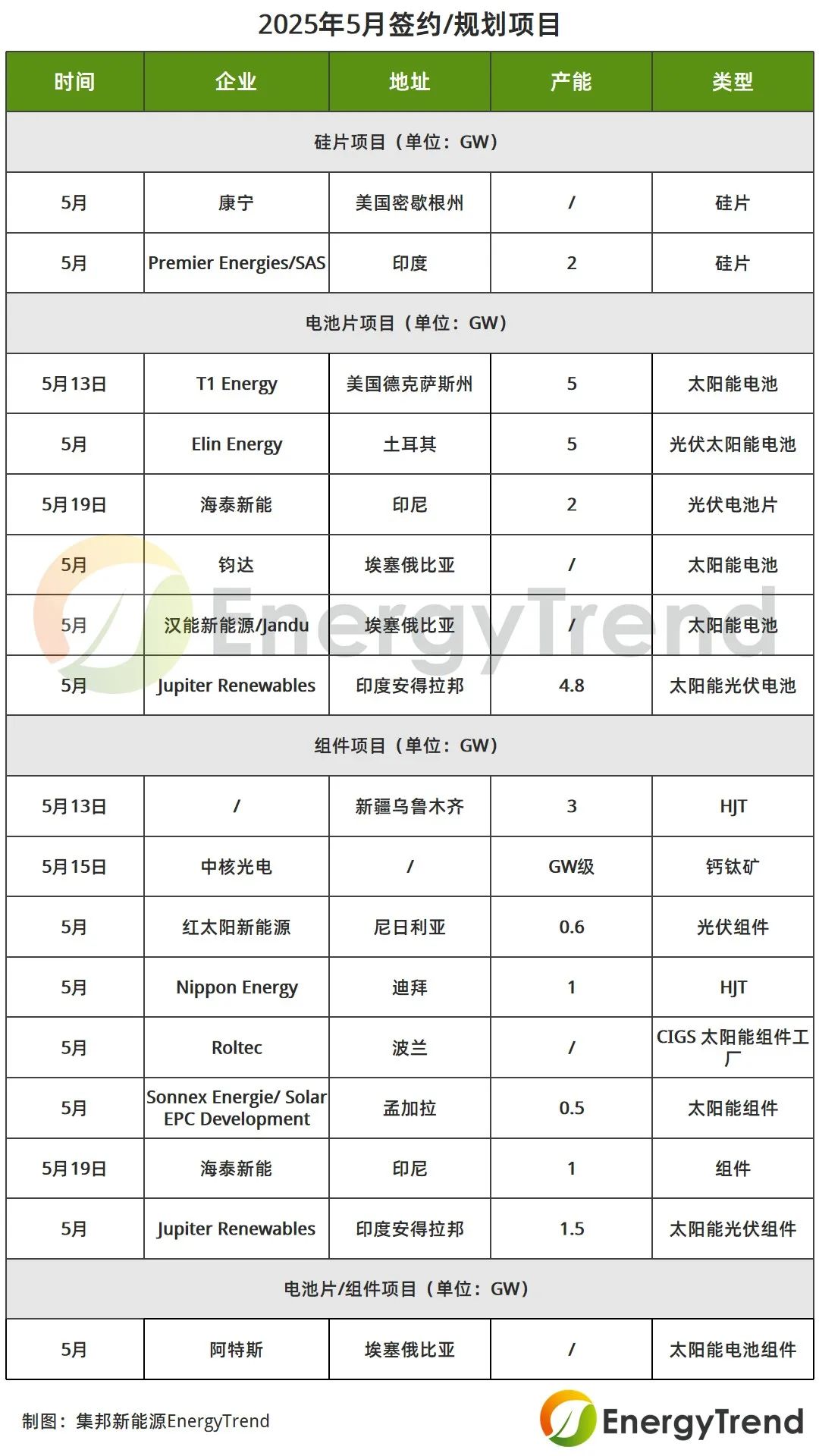
集邦新能源:5月全球光伏产业延续蓬勃发展态势 总投资额超222亿元
智通财经网· 2025-06-17 11:31
Core Viewpoint - The global photovoltaic (PV) industry is experiencing robust growth, with a total project scale of 31.2GW and an investment exceeding 22.2 billion yuan as of May 2025, driven by technological advancements and market expansion [1] Project Overview - The total scale of signed/planned PV projects in May 2025 is 31.2GW, with over 22.2 billion yuan in investments [1] - Domestic projects focus on HJT, BC, and perovskite technologies, with a total investment of 1.33 billion yuan in Xinjiang, Anhui, and Jiangsu [1] - Overseas projects show a significant increase in planned project numbers and scale, although the production scale has decreased [1] Signed/Planned Projects - In May 2025, there are 17 signed/planned PV projects totaling 27.4GW, with 2 domestic projects (4GW) and 15 overseas projects (23.4GW) [1] - The battery and module segments remain the main investment focus, with planned capacities of 16.8GW and 8.6GW respectively, and 2GW new planning in the silicon wafer segment [1] Investment Highlights - Corning announced a $1.5 billion investment to expand its silicon wafer production capacity in Michigan, USA [5] - T1 Energy signed a non-binding cooperation agreement to build a 5GW solar cell factory in Texas, USA [5] - Elin Energy is investing $400 million in a 5GW battery factory in Turkey, with production expected to start in Q4 2026 [5] Production Projects - In May 2025, there are 4 PV projects that have commenced production, with 2.6GW (92.9%) of the production capacity located overseas [9] - The production scale for battery and module segments is 1.5GW and 1.3GW respectively [9] Emerging Markets - New emerging bases for PV projects are being established in Indonesia and Ethiopia, contributing to the diversification of the PV industry landscape [17]