
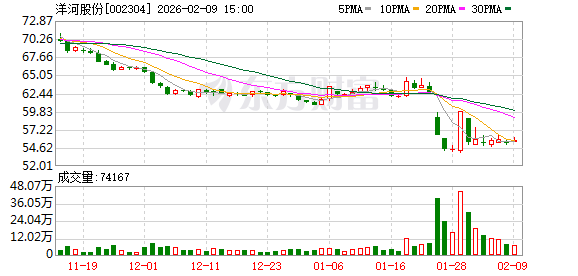
洋河股份

Search documents
A股上市公司“马”力全开:生肖酒上新,金饰、玩具爱上“马元素”
Sou Hu Cai Jing· 2026-02-10 08:09
Group 1 - Several A-share listed companies are launching "Year of the Horse" themed products as the 2026 Spring Festival approaches [3][6] - Kweichow Moutai has introduced a new marketing plan focusing on a pyramid product structure to meet diverse consumer needs, emphasizing premium and zodiac wines [3] - Other liquor companies like Wuliangye and Yanghe are also releasing zodiac-themed products, available on major e-commerce platforms [6] Group 2 - The demand for gold jewelry has significantly increased with the upcoming Year of the Horse, leading to seasonal growth in customer traffic and order volume for companies like Cuihua Jewelry [6][8] - Qingdao Kingwang has launched a new ceramic fragrance gift box for the Year of the Horse, available on Tmall [8] - Various companies are implementing special marketing activities for the Year of the Horse, such as Senma's interactive online events and in-store experiences [8]








史上最长春节假期将至!食品饮料ETF天弘(159736)盘中获600万份净申购,机构:重视板块春节旺季催化
2 1 Shi Ji Jing Ji Bao Dao· 2026-02-10 06:19
Group 1 - The core viewpoint of the articles highlights the mixed performance of the stock indices, particularly the decline in the Consumer Food and Beverage Index, while certain stocks within the index, such as Jinhe Industrial and New Nuo Wei, showed positive movements [1] - The Consumer Food and Beverage ETF Tianhong (159736) experienced a net subscription of 6 million shares, with a transaction value of 16.99 million yuan and a real-time premium rate of 0.12% [1] - The ETF tracks the Consumer Food and Beverage Index and has a high allocation to leading stocks in the high-end and mid-range liquor sectors, as well as key players in beverages, dairy, condiments, and beer [1] Group 2 - The upcoming nine-day Spring Festival holiday is expected to significantly boost consumer spending, particularly in core categories such as liquor, home goods, and appliances [2] - The Ministry of Commerce and other departments have launched a special consumption promotion plan for the Spring Festival, focusing on cultural traditions and family gatherings to stimulate spending [2] - Huachuang Securities suggests that the food and beverage sector will benefit from the Spring Festival, with rising prices for Moutai and stable sales feedback for Wuliangye, indicating a concentration of demand in leading brands during the holiday season [2]
春节跟踪-白酒系列经销商电话会
2026-02-10 03:24
Summary of Conference Call on Baijiu Industry Industry Overview - The conference call focused on the Baijiu industry, particularly the performance of major brands during the 2026 Spring Festival period, comparing it to the previous year. Key Points Moutai (茅台) - Moutai's sales are expected to complete 40% of the annual plan before the festival, with payment progress accelerating by 5% year-on-year [1] - The price of Moutai remains around 1,700 RMB, with a significant reduction of 35% in the supply of non-standard products [1][3] - Post-festival, Moutai prices may slightly decrease, potentially down to around 1,500 RMB, depending on market demand [8] Wuliangye (五粮液) - Wuliangye's payment rate is at 60%, with expected shipments close to 60% before the festival [4] - The price range is between 790-800 RMB, showing significant year-on-year growth [4] - The brand's sales are boosted by digital empowerment and promotional activities, with a projected increase of 40% in sales volume compared to last year [4][20] Guojiao 1573 (国窖 1,573) - Guojiao 1573's payment collection is below expectations, with most distributors achieving less than 10% of the target [5] - The price remains firm at 840-850 RMB, but has decreased by over 30% year-on-year due to high social inventory [5] Langjiu (郎酒) and Shede (舍得) - Langjiu has completed payments ahead of schedule, with prices stable at around 650 RMB, showing slight improvement in sales [6] - Shede's sales are slower, with a year-on-year decline of 10% [6] Jiangsu Market Performance - Jiangsu's overall Baijiu market performance is disappointing, with Yanghe's sales significantly affected by inventory issues and product transitions [24] - Yanghe's overall payment is only about half of last year's, with specific products like Hai Zhi Lan underperforming [24][27] Price Trends - Yanghe's product prices are stable with slight increases, but some products have seen declines due to market conditions [25] - The overall price trend in Jiangsu shows a mix of stability and slight increases, with some products experiencing significant drops [25] Market Dynamics - The Baijiu market is experiencing a polarization, with some brands like Water Well performing well in certain regions while others struggle due to poor distributor performance [22] - The overall expectation for post-festival demand is mixed, with Moutai expected to see a 10% increase, while Wuliangye may see a slight decline due to previous inventory control measures [31] Inventory and Sales Performance - Inventory levels for various brands are high, with Guojiao 1573 and others facing challenges in moving stock [15][16] - The overall sales performance in the Baijiu market shows a decline in many segments, with some brands like Water Well facing significant challenges due to structural issues in distribution [22][23] Additional Insights - The conference highlighted the importance of digital tools and promotional strategies in driving sales for brands like Wuliangye [4] - The impact of last year's inventory control policies on current sales dynamics was discussed, indicating a shift in market strategies [32]
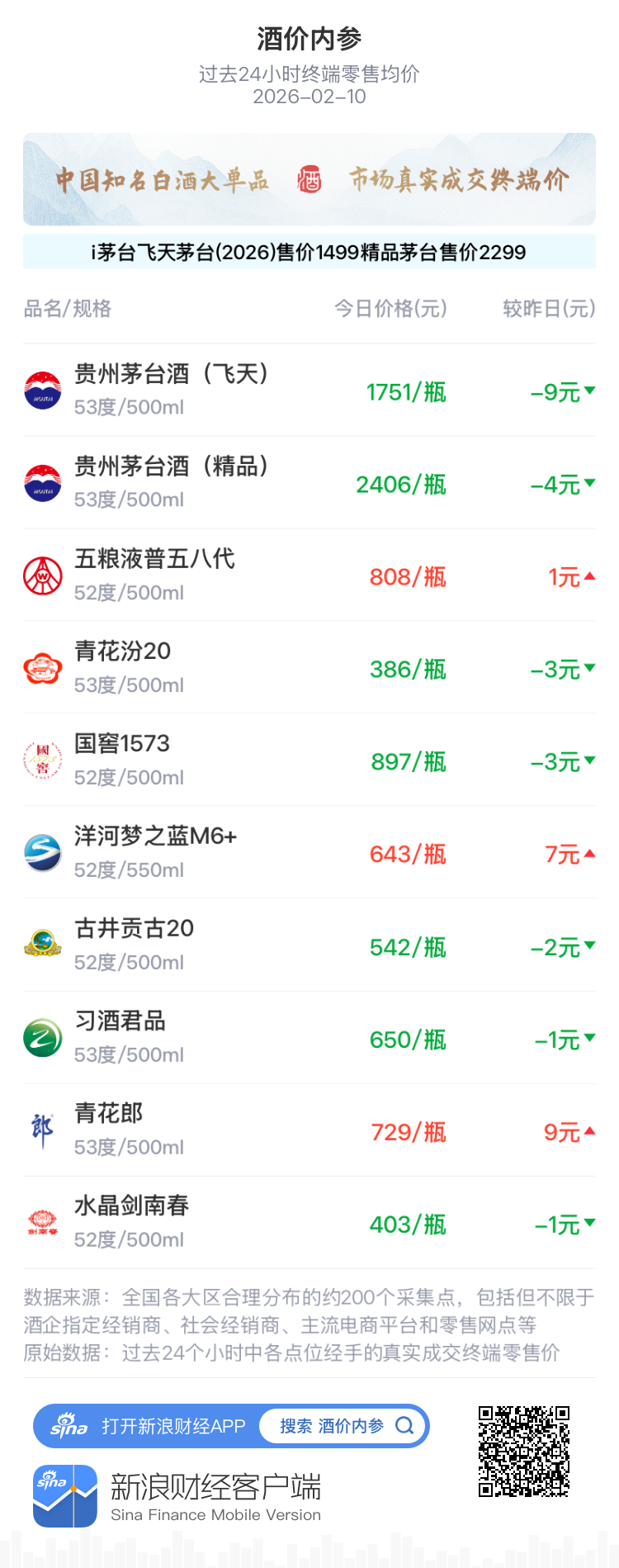
酒价内参2月10日价格发布,习酒君品微跌1元
Xin Lang Cai Jing· 2026-02-10 01:24
Core Viewpoint - The Chinese liquor market is experiencing a slight decline in retail prices for the top ten products, indicating a structural differentiation while maintaining a high-level consolidation trend [1][6]. Price Movements - Among the top ten products, seven saw price declines while three experienced increases. The notable price increases include: - Qinghua Lang rose by 9 yuan per bottle - Yanghe Dream Blue M6+ increased by 7 yuan per bottle, marking five consecutive days of price growth due to pre-festival consumption and channel replenishment support - Wuliangye Pu 58th generation saw a minor increase of 1 yuan per bottle [1][7] - Conversely, the price declines included: - Feitian Moutai decreased by 9 yuan per bottle - Premium Moutai fell by 4 yuan per bottle after a period of strong price increases - Guojiao 1573 and Qinghua Fen 20 both dropped by 3 yuan per bottle - Ancient Well Tribute 20 decreased by 2 yuan per bottle - Xijiu Junpin and Crystal Jian Nan Chun both saw minor declines of 1 yuan per bottle [1][7]. Data Collection Methodology - The daily data for liquor prices is sourced from approximately 200 collection points across various regions, including designated distributors, social distributors, e-commerce platforms, and retail outlets. The aim is to provide an objective, real, and scientifically traceable dataset regarding well-known liquor market prices [2][7]. Market Dynamics - The introduction of new sales channels for Feitian Moutai and Premium Moutai has begun to show a magnetic influence on their market retail prices. The iMoutai platform started selling Feitian Moutai at 1499 yuan per bottle and Premium Moutai at 2299 yuan per bottle, which has contributed to price adjustments [2][7]. - Bernstein's recent report highlights a positive outlook on Moutai's RTM (Route to Market) channel reform, indicating a shift from passive pricing to active value chain control. Moutai has implemented dynamic contracts to replace fixed quotas, allowing for flexible price and volume adjustments [8]. Profitability and Inventory Management - Moutai's wholesale price has stabilized and rebounded, with the 500ml Feitian Moutai now priced approximately 28% higher than traditional wholesale channels, enhancing profit margins. The company has reduced the supply of high-end variants by 30%-50%, leading to a significant recovery in wholesale prices [8]. - The expected inventory of aged liquor by 2027 is projected to reach 64,000 tons, providing a solid foundation for price management. Currently, the channel profit margin for Feitian Moutai stands at 25%, significantly higher than competitors, ensuring channel loyalty and price system resilience [8].


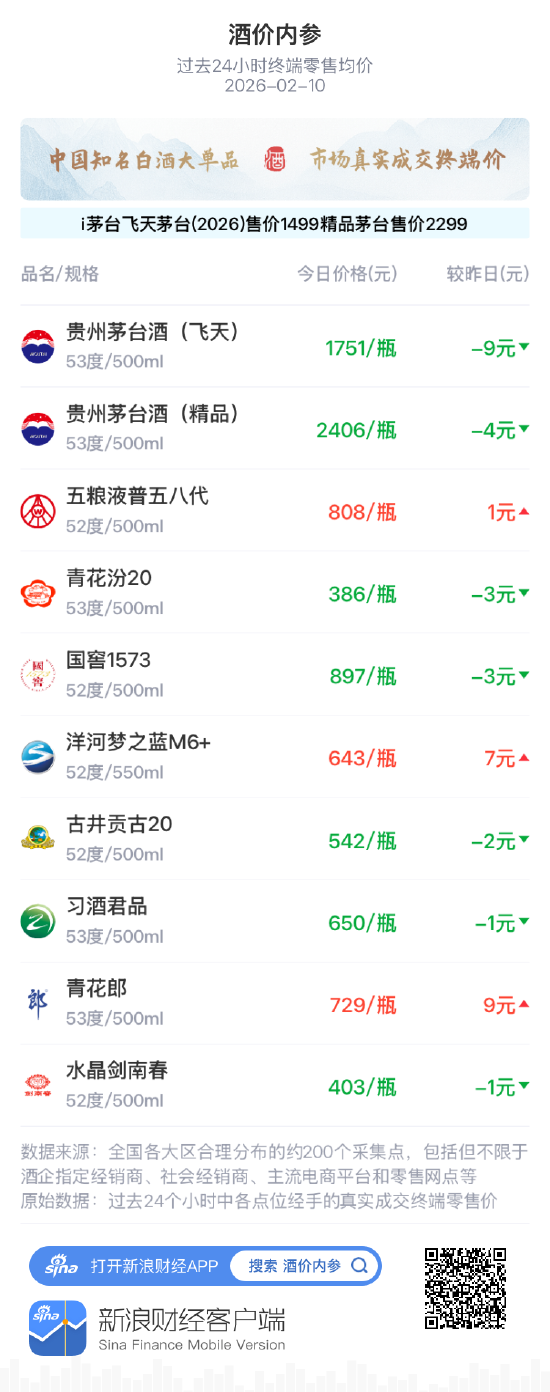
酒价内参2月10日价格发布,水晶剑南春微跌1元
Xin Lang Cai Jing· 2026-02-10 01:24
Core Viewpoint - The Chinese liquor market is experiencing a slight decline in retail prices for the top ten products, indicating a structural differentiation while maintaining a high-level consolidation trend [1][6]. Price Changes - The overall retail price for the top ten liquor products is 9,215 yuan, down 6 yuan from the previous day [1][6]. - Among the top ten products, seven saw price declines while three experienced increases [1][7]. - The price increases were led by Qinghua Lang, which rose by 9 yuan per bottle, and Yanghe Dream Blue M6+, which increased by 7 yuan per bottle, marking five consecutive days of price growth [1][7]. - Conversely, Feitian Moutai dropped by 9 yuan per bottle, and the premium Moutai decreased by 4 yuan per bottle, following a period of strong price increases [1][7]. Data Collection Methodology - The price data is sourced from approximately 200 collection points across various regions, including designated distributors, social distributors, e-commerce platforms, and retail outlets, aiming to provide an objective and traceable overview of the liquor market [2][7]. Market Dynamics - The introduction of new sales channels for Feitian Moutai and premium Moutai has begun to show a magnetic influence on their retail prices [2][8]. - Bernstein's report highlights the successful channel reform of Kweichow Moutai, transitioning from passive pricing to active value chain control, which has led to a stabilization and rebound in wholesale prices [8]. - The implementation of dynamic contracts instead of fixed quotas allows for flexible price and volume adjustments, contributing to a significant increase in profit margins [8]. Future Outlook - The expected inventory of aged liquor by 2027 is projected to reach 64,000 tons, providing a solid foundation for price management [8]. - The profit margin for Feitian Moutai is currently at 25%, significantly higher than competitors, ensuring channel loyalty and resilience in the pricing system [8].
酒价内参2月10日价格发布 名酒终端价高位小幅整理
Xin Lang Cai Jing· 2026-02-10 01:21
Core Insights - The average retail price of the top ten Chinese liquor products slightly decreased on February 10, with a total price of 9,215 yuan, down 6 yuan from the previous day, indicating a structural differentiation in the market while maintaining a high-level consolidation trend [1][4] Price Movements - Among the top ten products, seven saw price declines while three experienced price increases [1] - The price of Qinghua Lang rose by 9 yuan per bottle, leading the increases, while Yanghe Dream Blue M6+ increased by 7 yuan per bottle, marking its fifth consecutive rise due to pre-holiday consumption and channel replenishment support [1][4] - Conversely, Feitian Moutai fell by 9 yuan per bottle, and the premium Moutai dropped by 4 yuan per bottle, reflecting a normal technical correction after a period of strong price increases [1] - Other notable declines included Guojiao 1573 and Qinghua Fen 20, both down by 3 yuan per bottle, and Guhua Gong Gu 20 down by 2 yuan per bottle [1]
今年,哪些行业能过上好日子?
虎嗅APP· 2026-02-10 00:25
A股这7大板块,勾勒出中 国经济全貌 出品 | 妙投APP 作者 | 妙投团队 编辑 | 丁萍 头图 | AI制图 幸福的人大致相同,不幸的人各有各的不幸。 银河证券研报显示,截至1月31日,2956家A股上市公司已披露2025年年报业绩预告,披露率为54%。其中 电机、地面兵装、个护用品、风电设备预喜率 (包括扭亏、续盈、略增、预增等情形) 超过70%,汽车行 业超过50%,受益于AI算力需求的电子和通信行业,预喜率分别达到45%和37%。这些大体上属于科技、高 端制造、新消费等领域。 而传统行业,大多较为一般。 煤炭、房地产、轻工制造、建筑装饰、食品饮料、社会服务、石油石化等行业预喜率较低,均低于25%; 焦炭、体育、林业、农业综合、厨卫电器、油气开采、白酒行业预喜率更是均为0%;传统行业中预喜率较 高的,主要是非银金融、有色金属、钢铁、公用事业等少数行业。 展望2026年,有些业绩不错的行业,有望继续保持成长。而有些2025年经营惨淡的行业,也有边际复苏的 机会,或者有复苏的预期。 这句话放到宏观经济各个层面中来看,也是如此。有的行业经历着良好的增长,有的行业在期待着复苏的 曙光。 2025年到现在,无 ...

陪伴团圆时刻 点亮梦想之光
Ren Min Ri Bao· 2026-02-09 21:56
Core Viewpoint - Yanghe Dream Blue M6+ has been a partner of the Spring Festival Gala for seven consecutive years, showcasing its commitment to cultural heritage and consumer engagement during the Chinese New Year [2][3] Group 1: Brand Engagement and Cultural Integration - Yanghe Dream Blue M6+ will celebrate the New Year with global Chinese audiences during key moments on New Year's Eve, emphasizing its role in family reunions and cultural traditions [2] - The company has introduced new Spring Festival gift boxes featuring zodiac paper-cut elements and has supported local cultural activities, enhancing the festive experience for consumers [2] - Yanghe has launched a promotional campaign called "Yanghe 'Biao' Fortune, Full Power" with a chance for consumers to win limited edition products, further enriching the New Year experience [2] Group 2: Corporate Social Responsibility and Brand Strategy - Yanghe has established a brand culture strategy focused on national pride and community support, contributing to the development of a strong aerospace and maritime nation [3] - The company has set up the "Dream Blue Public Welfare Fund" and has been involved in educational support initiatives for over 20 years, helping students achieve their dreams [3] - The brand aims to create a sense of unity and celebration during the New Year, reinforcing its commitment to both individual and collective aspirations [3]
36度微醺难救百亿民酒:牛栏山预亏1.88亿,光瓶酒大王遇中年危机
Sou Hu Cai Jing· 2026-02-09 15:54
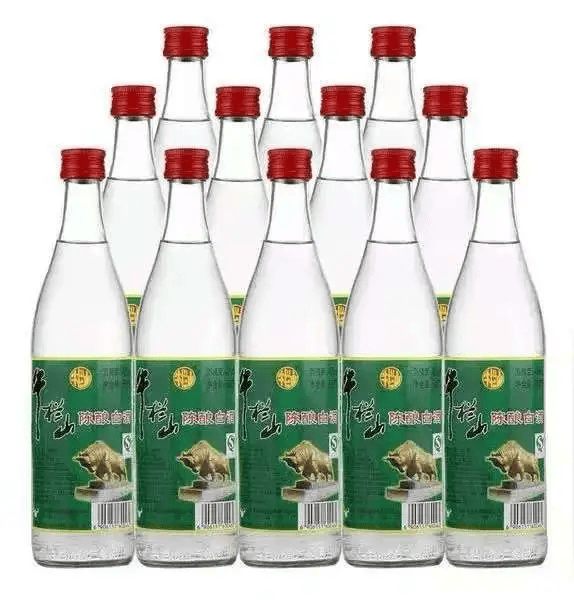
Core Viewpoint - The traditional liquor brand Niulanshan is facing significant challenges despite the booming market for light bottle liquor, with a projected net loss of 116 million to 188 million yuan in 2025, marking a shift from profit to loss for the company [2] Group 1: Company Performance - In the first three quarters of 2025, Niulanshan's revenue decreased by 19.79% to 586.9 million yuan, and its net profit attributable to shareholders plummeted by 79.85%, with a net loss exceeding 19.3 million yuan in the fourth quarter, representing the worst performance in recent years [2] - The white liquor segment, which accounts for 78.51% of the company's revenue, is identified as the main culprit for the poor performance [2] Group 2: Market Challenges - The implementation of new national standards for liquor in 2022 has led to a crisis for Niulanshan's flagship product, "Bai Niu Er," which was reclassified as "flavored liquor" due to the addition of food flavoring, resulting in a dramatic drop in sales from 416,900 kiloliters to 246,400 kiloliters in 2023, with a further decline of 33.05% in the first half of 2025 [3] - The light bottle liquor market has shifted from a "blue ocean" to a "red ocean," with competitors like Fenjiu and Luzhou Laojiao entering the market and attracting quality-seeking consumers, while Niulanshan's low-price strategy struggles to maintain its market share [3] Group 3: Distribution and Consumer Trends - Long-term reliance on a "big merchant system" has led to price transparency and frequent low-price diversion by distributors, resulting in a 23.36% decline in distribution revenue in 2025 [4] - The traditional consumer base of Niulanshan, primarily blue-collar workers, has been negatively impacted by the real estate sector's adjustments, while younger consumers prefer lower-alcohol, visually appealing, and situational drinks, making it difficult for traditional high-alcohol light bottle liquor to attract their attention [4] Group 4: Strategic Response - In early 2026, Niulanshan launched a new product, the 36-degree Jinbiao Niulanshan light-flavored liquor, targeting younger consumers with a price range of 58-78 yuan, which received positive feedback online shortly after its launch [5] - Industry experts suggest that Niulanshan faces dual pressures of cyclical and structural challenges and must implement brand segmentation, transparency in production processes, and channel reforms to overcome its difficulties [5] - The pork business of its parent company, Shunxin Agriculture, has seen a reduction in losses in 2025, but it is insufficient to offset the drag from the liquor business [5] Group 5: Industry Context - The challenges faced by Niulanshan reflect a broader anxiety within the liquor industry during a period of deep adjustment, highlighting the need to balance tradition and innovation amid consumer upgrades and the rise of younger demographics [6] - The story of Niulanshan illustrates that there are no permanent national liquors, only enduring consumer demands, and the current crisis presents an opportunity for brand rejuvenation through product innovation and channel transformation [6]

2026年2月:中国酒类行业展望
Zhong Cheng Xin Guo Ji· 2026-02-09 11:21
Investment Rating - The report maintains a stable investment rating for the Chinese liquor industry, indicating that the overall credit quality of the industry is not expected to change significantly in the next 12 to 18 months [5]. Core Insights - The liquor industry is closely tied to macroeconomic conditions and per capita income levels. Recent years have seen consumption pressures due to economic slowdown, low investment, and policy restrictions, leading to negative revenue and profit growth for large-scale enterprises [6][8]. - The white liquor sector has been experiencing a continuous decline in production since 2017, with a "volume and price drop" scenario expected to persist into 2025 due to high inventory and slow market movement [6][14]. - The beer industry remains stable with high market concentration, but faces challenges from reduced consumption in dining and entertainment venues. The trend towards product premiumization and innovation continues to drive growth [5][26]. - Overall, the liquor industry is under pressure from weak economic recovery and consumption policies, with expectations of continued downward pressure on revenue and profits in the future [10][39]. Summary by Sections Key Points - The liquor industry's demand is significantly affected by macroeconomic conditions and per capita income. Recent economic factors have led to a decline in revenue and profit growth for large-scale enterprises [6][9]. - White liquor production has been decreasing since 2017, with a projected "volume and price drop" scenario continuing into 2025 due to high inventory levels and slow market activity [14][25]. - The beer industry maintains a high concentration level, with stable production capacity utilization. However, the reduction in dining and entertainment venues has negatively impacted beer consumption [26][37]. Analytical Approach - The analysis focuses on the credit fundamentals of the liquor industry, examining key indicators affecting consumption since 2025, including disposable income, consumer confidence, and policy adjustments [7]. Industry Fundamentals - The liquor industry's demand is closely linked to macroeconomic conditions and disposable income levels. Recent years have seen consumption pressures due to economic slowdown and policy restrictions [8][9]. - The white liquor sector has been facing a continuous decline in production, with a significant drop in output expected in 2025 due to high inventory and slow market movement [14][25]. Financial Performance - Since 2025, white liquor enterprises have generally experienced significant declines in operating performance, while beer companies have benefited from optimized product structures [39][40]. - The overall debt levels of liquor companies are low, and while debt service indicators have declined, they remain favorable. Group companies have access to financing channels that support their debt repayment capabilities [39][40].