美的集团

Search documents
珠三角地区企业参访,深圳、佛山企业参访
Sou Hu Cai Jing· 2025-12-16 10:16
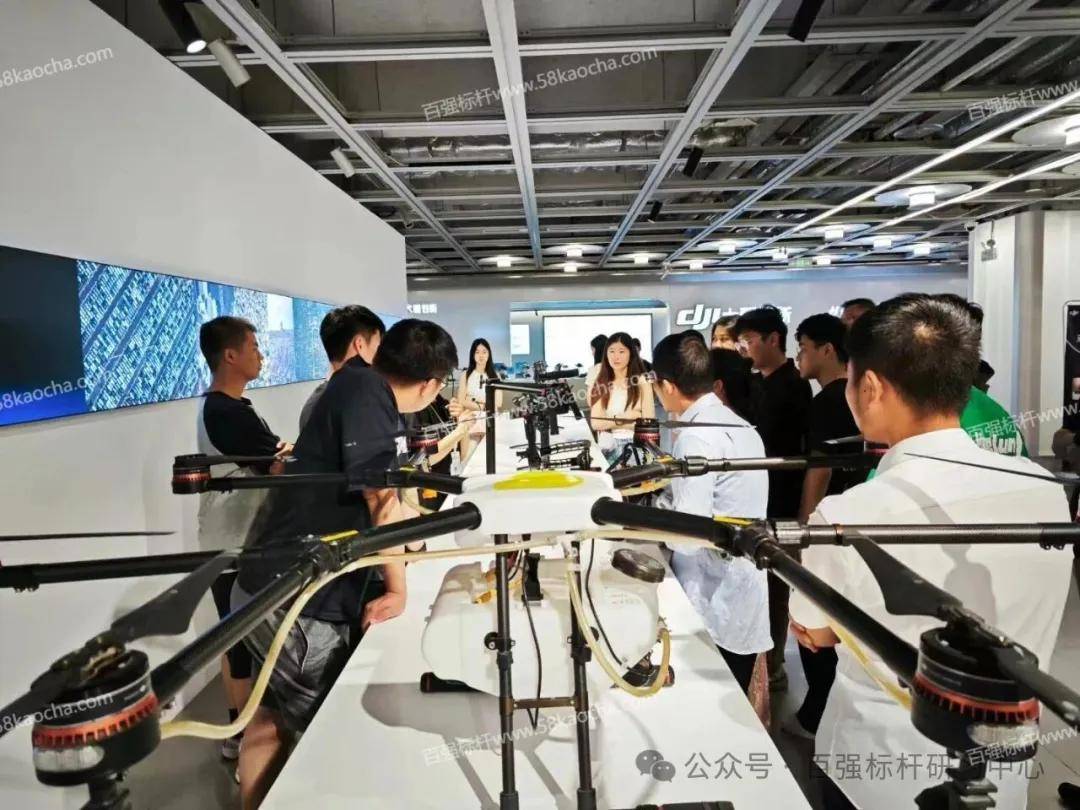
Core Insights - The Pearl River Delta (PRD) is a leading area for China's reform and opening-up, showcasing top global manufacturing, technological innovation, and industrial clusters [1] - The visit focuses on four key areas: smart manufacturing, digital economy, green energy, and cross-border e-commerce, aiming to help participants gain insights into industry trends and connect with quality resources [1] Group 1: Benchmark Enterprises - The PRD is home to several benchmark enterprises, including Huawei, Tencent, BYD, and DJI, which are among the world's top 500 companies [3] - Participants will learn about strategic layouts, technological breakthroughs, and ecosystem construction from these leading companies, including Huawei's "1+N" strategy and Tencent's industrial internet transformation [3] Group 2: Advanced Technologies - Research and development investments are significant, with Huawei's annual R&D expenditure exceeding 100 billion yuan, making it a leader in global patent numbers [5] - Key technological methodologies include BYD's innovative materials for blade batteries and the collaborative model between industry and academia exemplified by Dongguan Songshan Lake Material Laboratory [5] Group 3: Knowledge System Upgrade - The visit provides a comprehensive understanding of strategic frameworks and management methodologies from leading companies, covering areas such as strategic planning, technology development, and global expansion [6] - This approach helps avoid the limitations of fragmented learning, enabling participants to build a complete cognitive system from macro trends to micro implementations [6] Group 4: Practical Experience - The visit emphasizes actionable solutions, such as Midea's "T+3" flexible production model, which can reduce delivery cycles by 30%, and OPPO's AI visual inspection technology, which can improve yield rates by 20% [8] - Participants will receive internal training materials and tools from leading companies, facilitating the rapid transformation of benchmark experiences into productivity [8] Group 5: Brand Influence - Participating companies will receive the "Pearl River Delta Benchmark Enterprise Learning Base" certification, enhancing their brand credibility and market competitiveness [9] - The visit serves as an accelerator for corporate upgrades, helping participants seize opportunities in the PRD economic wave for leapfrog development [9] Group 6: Resource Networking - The event creates a three-dimensional resource platform connecting government, capital, and industry chains, allowing participants to engage with local investment and technology agencies [10] - Post-visit, participants can join the "Pearl River Delta Enterprise Alumni Association" to continue receiving industry updates and invitations to internal sharing sessions, fostering a long-term value network [10]



山东省市场监督管理局公布2025年家用电动洗衣机产品质量省级监督抽查结果
Zhong Guo Zhi Liang Xin Wen Wang· 2025-12-16 08:56
Core Viewpoint - The Shandong Provincial Market Supervision Administration has released the results of the provincial quality supervision sampling inspection for household electric washing machines for 2025, indicating compliance and non-compliance issues among various manufacturers [3][5]. Group 1: Inspection Results - A total of 30 batches of household electric washing machines were sampled, with 5 batches from the production stage and 25 from the sales stage [3]. - The inspection was conducted based on multiple national standards related to safety, noise limits, energy efficiency, and other performance criteria [4]. - One batch from Heze Jinba Trading Co., Ltd. was found non-compliant due to issues with stability and mechanical hazards, with the manufacturer, Henan Xinfly Smart Home Technology Co., Ltd., contesting the results but ultimately failing the re-inspection [5]. Group 2: Compliance Standards - The inspection adhered to standards such as GB 4706.1—2005 for general safety requirements, GB 4706.24—2008 for specific requirements for washing machines, and GB 12021.4—2013 for energy efficiency and water efficiency limits [4]. - Key inspection criteria included protection against electric shock, input power and current, leakage current, noise levels, and washing performance metrics [4]. Group 3: Manufacturer Details - The non-compliant product was identified as a washing machine model produced by Henan Xinfly Smart Home Technology Co., Ltd., with the specific model being XPB110-1 [6]. - The inspection results also included a summary table of compliant products from various manufacturers, including Qingdao Haier and Hisense, indicating a range of models and compliance statuses [6][7].



中央定调提振新消费,港股新消费指数全新升级!
Xin Lang Cai Jing· 2025-12-16 08:49
Group 1 - The central economic work conference emphasizes the importance of boosting consumption and expanding domestic demand, indicating a favorable policy environment for new consumption growth [4][5] - Structural policies are expected to enhance consumer capacity through fiscal subsidies, tax incentives, and social security improvements, particularly benefiting the elderly consumption sector [4] - The new consumption sectors, including service consumption, digital consumption, and green consumption, are set to receive significant policy support for development [4] Group 2 - Tax data shows strong growth momentum in new consumption areas, with retail sales of communication devices and home appliances increasing by 20.3% and 26.5% year-on-year, respectively [4] - The "event economy" and "silver economy" are gaining traction, with sports services and elderly care services seeing year-on-year growth of 29.7% and 33.6% [5] - Cultural tourism consumption is also thriving, with revenues from artistic performances and travel services growing by 15.6% and 10.8% year-on-year [6] Group 3 - The Hong Kong stock market offers a more balanced distribution of new consumption sectors, making it a focal point for investment in consumer stocks [7] - The newly revised CSI Hong Kong Stock Connect Consumption Theme Index aims to enhance precision and representation by focusing on 50 consumer-related securities [9] - The index upgrade includes stricter liquidity requirements and weight limits for individual stocks, ensuring better representation of the new consumption sector [12][13]

“扩大内需”战略定调,大消费板块掀涨停潮
Huan Qiu Wang· 2025-12-16 08:11
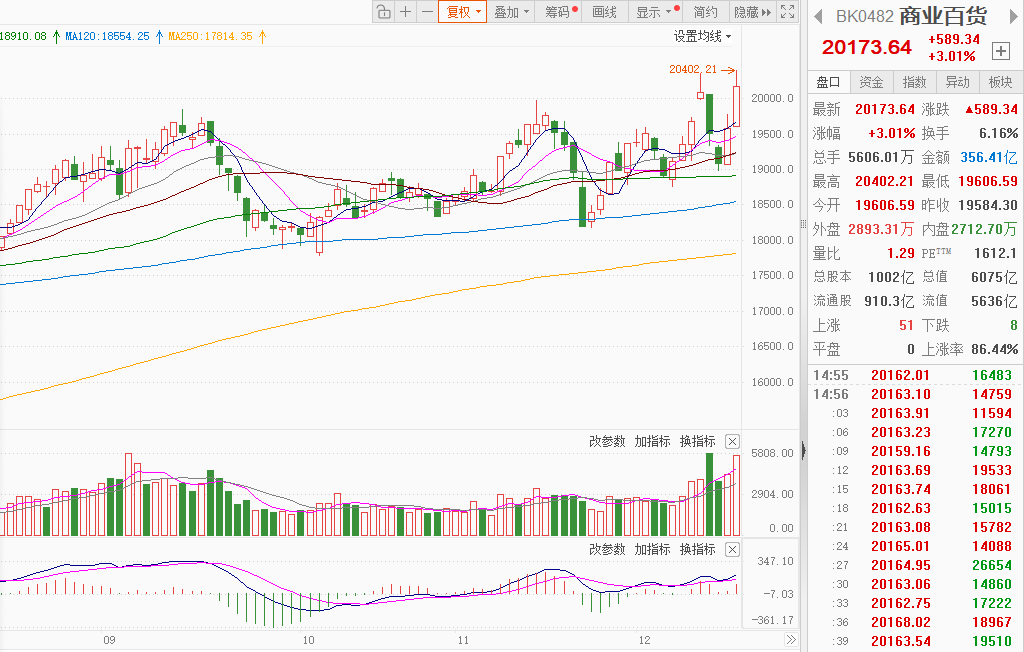
Core Viewpoint - The consumer sector experienced a significant rally on December 16, driven by supportive policies aimed at expanding domestic demand, which has been elevated to a strategic priority for the economy [1][4]. Group 1: Policy Support - The article emphasizes that expanding domestic demand is crucial for economic stability and security, and it is not merely a temporary measure but a strategic initiative [1]. - The National Development and Reform Commission highlighted the need to unleash consumer potential through various measures, including special actions to boost consumption and plans to increase residents' income [1][4]. - The Central Economic Work Conference has prioritized "maintaining demand as the main driver and building a strong domestic market" as a key task for the upcoming year, reflecting the government's commitment to boosting consumption [1]. Group 2: Market Dynamics - The consumer sector's attractiveness is underscored by its current low valuation after a prolonged adjustment period, indicating a significant technical rebound demand [3]. - For instance, the food and beverage sector has a current price-to-earnings (P/E) ratio of 20.8, with a percentile ranking of only 13.04%, compared to over 64 times at its peak in February 2021, highlighting its investment value [3]. - Major consumer companies like Kweichow Moutai, Midea Group, and Haier Smart Home reported year-on-year profit growth in the first three quarters, demonstrating strong operational resilience [3]. Group 3: Investment Opportunities - A number of consumer stocks are showing characteristics of a "golden pit," where stock prices have declined despite strong earnings growth, presenting potential investment opportunities [3]. - Examples include leading condiment company Haitian Flavoring, which saw its stock price drop over 18% while achieving a 10.54% increase in net profit, and TCL Technology, which experienced a 16% decline in stock price with an 18.45% rise in net profit [3]. - Other companies like Xiangyuan Cultural Tourism, Xueda Education, and Bear Electric also fit this profile, offering potential for value investors [3]. Group 4: Future Outlook - Recent initiatives by the Ministry of Commerce and financial regulators to expand and upgrade rural consumption, along with credit support, open new avenues for market expansion [4]. - Analysts expect that the focus on expanding domestic demand will lead to more specific policies in the future, enhancing investor confidence in the consumer sector [4]. - The outlook for traditional consumption is anticipated to improve, while new consumption trends may experience rotation, but overall, the consumer sector is expected to maintain sustainability underpinned by both policy and market fundamentals [4].




兴证策略张启尧:十大外资如何看2026年A股?
Xin Lang Cai Jing· 2025-12-16 07:57
Economic Outlook - The GDP growth forecast for 2026 has been adjusted to 4.4%, with a quarterly increase expected in Q1 to 6.5% and a slight decrease in H2 to 3.6% [1] - The fiscal deficit is projected to expand by 1 percentage point in 2026, with a total budget deficit of 4% and special government bonds amounting to approximately 4.8 trillion yuan [9] - Inflation is expected to remain low, with CPI projected to rise slightly to 0.4% and PPI potentially turning positive by the end of 2026 [11] Stock Market Projections - The target levels for major indices by the end of 2026 are set at 100 points for MSCI China, 5200 points for CSI 300, and 16000 points for MSCI Hong Kong, indicating potential increases of 20%, 13%, and 20% respectively [2] - The expected EPS growth for MSCI China is around 15% for 2026, with a significant contribution from the consumer discretionary sector [4][6] Key Investment Themes - The four main investment themes identified are anti-involution, AI, overseas expansion, and structural recovery in domestic demand [1][6] - The easing of price wars among major companies is anticipated to improve profit margins, particularly in the consumer discretionary sector [4] - The demand for AI infrastructure is expected to drive performance for Chinese tech hardware suppliers, with significant capital expenditure growth projected for major cloud service providers [5] Industry Insights - The "anti-involution" policy is expected to enhance profit margins and return on equity (ROE) across various sectors, particularly in industries facing excessive competition [5] - The structural recovery in sectors such as healthcare, information technology, and communication services is showing signs of broadening, with over one-third of sub-sectors currently in a revenue expansion phase [3] - The automotive, consumer electronics, and AI-related hardware sectors are projected to see significant improvements in overseas revenue contributions [7] Policy Environment - The policy landscape is expected to support consumption and investment, with a focus on structural rebalancing between services and manufacturing [1][9] - Monetary policy is anticipated to remain moderately accommodative, with expectations of interest rate cuts and reserve requirement ratio reductions [9][15] - The government is likely to implement targeted measures to stimulate consumption, particularly in service and green sectors [9][10]
山东省市场监督管理局公布2025年电风扇产品质量省级监督抽查结果
Zhong Guo Zhi Liang Xin Wen Wang· 2025-12-16 07:57
Core Points - The Shandong Provincial Market Supervision Administration announced the results of the provincial quality supervision sampling inspection for electric fans in 2025, with a total of 31 batches inspected [3][5] - The inspection covered production, sales, and online sales channels, with 1 batch from production, 20 from sales, and 10 from online sales [3] - The inspection was based on multiple national standards related to electromagnetic compatibility, safety, energy efficiency, and noise limits for household appliances [4] Inspection Results - One batch of electric fans sold by Qingdao Bolu Industrial and Trade Co., Ltd. failed to meet relevant standards, specifically in output air volume and energy efficiency [5] - The Shandong Provincial Market Supervision Administration has instructed relevant departments to handle the non-compliance results according to the Product Quality Law and related regulations [5] Standards and Regulations - The inspection adhered to various standards including GB 4343.1-2018, GB 4706.1-2005, and GB 12021.9-2021, which cover electromagnetic compatibility, safety requirements, and energy efficiency for electric fans [4] - Specific items tested included protection against electric shock, input power and current, heat generation, leakage current, stability, mechanical hazards, noise, and energy efficiency ratings [4]


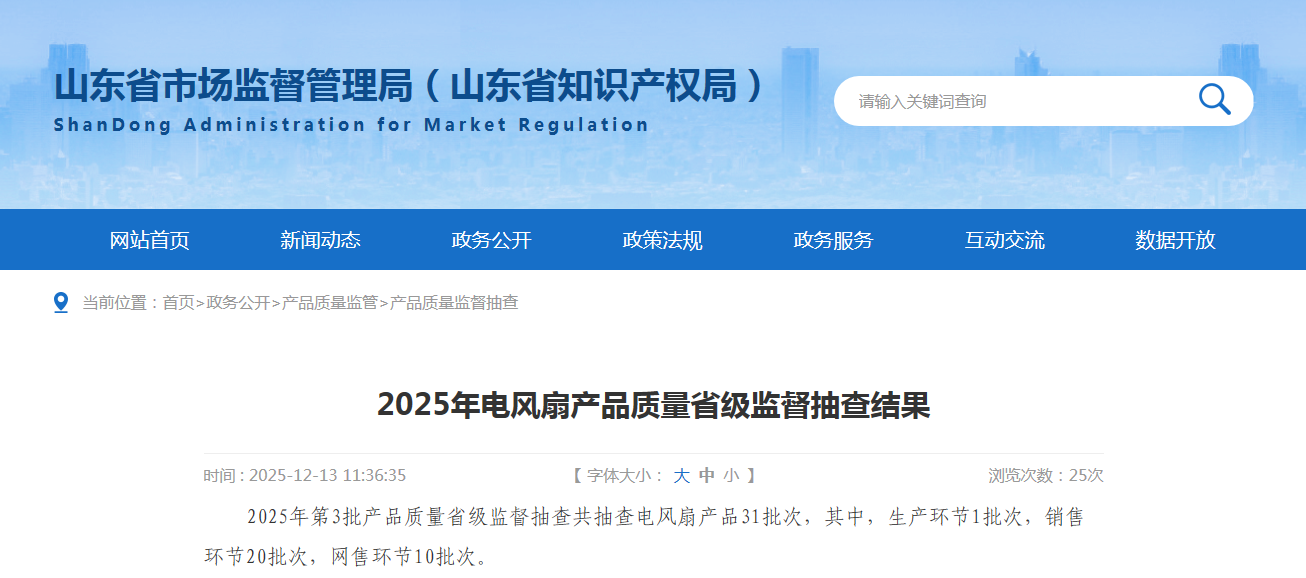
山东省市场监督管理局公布2025年家用燃气灶产品质量省级监督抽查结果
Zhong Guo Zhi Liang Xin Wen Wang· 2025-12-16 07:52
Core Viewpoint - The Shandong Provincial Market Supervision Administration announced the results of the provincial quality supervision sampling inspection for household gas stoves in 2025, revealing that one batch of products failed to meet relevant standards, specifically regarding combustion conditions [3]. Group 1: Inspection Results - A total of 90 batches of household gas stoves were sampled, with 80 from sales channels and 10 from online sales [3]. - The inspection was conducted based on standards such as GB 16410-2020 and GB 30720-2014, focusing on parameters like gas tightness, thermal load, combustion conditions, and efficiency [3]. - One batch from Linqu Haoyu Kitchen and Bath Store was found non-compliant, specifically failing on combustion conditions [3]. Group 2: Compliance and Actions - The Shandong Provincial Market Supervision Administration has mandated relevant market supervision departments to handle the non-compliant products according to the Product Quality Law and related regulations [3]. - The inspection results include a summary table of both compliant and non-compliant products, detailing the names, manufacturers, and inspection outcomes [4][5].


智能家居信息安全异构融合检测平台投入应用 筑牢行业安全防线
Zhong Guo Jing Ji Wang· 2025-12-16 07:33
Core Insights - The smart home industry faces challenges in information security testing, including limited coverage of traditional tools, low testing efficiency, and difficulty in identifying malicious attacks [1] - The State Administration for Market Regulation has developed a "Heterogeneous Fusion Detection Platform for Smart Home Information Security," which integrates a large model for quality safety to provide comprehensive security testing support for smart appliances, security systems, and wearable devices [1] Group 1 - The platform utilizes over 5,000 historical testing data points and more than 200 standards to train specialized vertical models, enabling the automatic generation and execution of test cases [1] - It includes over 10 standard detection modules covering more than 100 testing items and is compatible with 10 communication protocols, supporting 12 types of smart products for "plug-and-play" testing, improving efficiency by 20 times compared to traditional manual testing [1] - The platform has been piloted in over 10 representative companies, including Haier, Midea, and Xiao Tian Cai, where it identified 12 vulnerabilities with high and medium risks in smart cameras and proposed lightweight end-cloud collaborative security solutions [1] Group 2 - Future plans include adapting the platform for emerging products such as smart robots and low-altitude aircraft, aiming to create a full-chain intelligent service platform for "targeted detection - intelligent early warning - precise disposal" [2] - This initiative seeks to shift the quality safety of smart products in China from a "passive response" to "active prevention" approach, strengthening the foundation for industrial safety development [2]
不耍花枪,是真干活!美的“六臂超人形机器人”年底上岗
Xin Hua Wang· 2025-12-16 06:36
Core Insights - The article highlights the launch of Midea's humanoid robot "Mei Luo U," which is set to enhance production efficiency by 30% at its Wuxi high-end washing machine factory by the end of the year [1][4][8] - Midea's approach combines technology research and practical application, demonstrating a significant shift from traditional manufacturing to intelligent manufacturing through substantial investments and strategic planning over the past decade [3][9] Group 1: Product and Technology - The "Mei Luo U" robot features six arms and a wheeled base, allowing for complex movements and tasks such as precise part handling and quality inspections, marking a breakthrough in humanoid robot technology for industrial applications [6][10] - Midea's robots have been operational in its Jingzhou factory for over six months, performing tasks like 3D quality inspections and equipment checks, showcasing their integration into the production line [7][8] Group 2: Strategic Development - Midea's investment in robotics began with the acquisition of KUKA for approximately 30 billion RMB in 2017, which has since enabled the company to develop core technologies in robot motion control and mechanical design [9][10] - The establishment of various research institutions, including the Central Research Institute and the Blue Orange Laboratory, has facilitated Midea's advancements in robotics, leading to the rapid development of multiple humanoid robot models [10][14] Group 3: Future Plans and Market Expansion - Midea aims to create fully automated "dark factories" and expand its intelligent manufacturing model to more production bases, indicating a commitment to further automation in industrial settings [13][14] - The company is also preparing to introduce its "Mei La" series of robots for commercial and household applications, with plans for deployment in 2026, reflecting a broader vision for integrating robotics into everyday life [12][14]


铝成本更低,小米等19家企业抱团铝代铜,董明珠硬刚:没有100%把握之前格力绝不跟进【附白色家电行业市场分析】
Qian Zhan Wang· 2025-12-16 06:30
Group 1 - A total of 19 air conditioning companies, including Haier, Midea, Hisense, TCL, and Xiaomi, have signed a self-regulatory agreement to promote the breakthrough of aluminum replacing copper technology, with Gree Electric being the only major company absent from this initiative [2] - The cost of copper accounts for 20% of the total cost of a single air conditioner, while the cost of aluminum is only 1/10 of that of copper, indicating potential for significant price reductions if aluminum can effectively replace copper [2] - Copper has superior thermal conductivity, corrosion resistance, and long-term reliability compared to aluminum, with copper's thermal conductivity being 1.7 times that of aluminum and copper pipes having an average lifespan of 15-20 years compared to aluminum pipes' lifespan of less than 8 years [2] Group 2 - China's copper demand has been steadily increasing, reaching 11.6983 million tons in 2023, a year-on-year increase of 4.09% [3] - The air conditioning industry consumes approximately 850 million kilograms of copper annually, accounting for about 21% of China's total copper demand [5] - The production of white goods, including refrigerators, air conditioners, and washing machines, has shown a fluctuating upward trend from 2012 to 2023, with air conditioner production reaching 157.056 million units in the first half of 2024, a year-on-year increase of 13.8% [5] Group 3 - Gree Electric's CEO, Dong Mingzhu, has stated that the company currently has no plans to adopt aluminum replacing copper technology due to concerns over quality and reliability, emphasizing that quality is the primary consideration over cost [6][8] - Gree Electric's Vice President, Hu Yusheng, confirmed during an earnings briefing that the company will not pursue aluminum replacing copper until performance, quality, and reliability can be fully guaranteed [6] - Dong Mingzhu has expressed that the rising copper prices do put pressure on Gree, but the company prioritizes responsibility towards the country, shareholders, and employees over merely focusing on cost [8]