
博时基金

Search documents
产品创新 投研升级 出海拓展 公募行业多点突破“新棋局”
Shang Hai Zheng Quan Bao· 2026-02-02 18:45
Core Insights - The public fund industry in China is focusing on high-quality development and reform, as emphasized by the China Securities Regulatory Commission (CSRC) during the 2026 system work meeting [2][7] Product Innovation - The public fund sector is witnessing continuous product innovation, with a dual focus on equity products and absolute return products like FOFs [2][3] - In January, 123 new funds were established, with a total issuance scale of 120.21 billion yuan, of which 95 were equity funds totaling 81.24 billion yuan [2] - Active equity funds have shown a resurgence, with notable issuances such as the GF Research Smart Mixed Fund at 7.22 billion yuan, marking the first active equity fund to exceed 7 billion yuan since November 2022 [2][3] Investment Trends - The current investment direction aligns closely with market trends, including cloud computing ETFs, AI ETFs, and funds focused on consumer and digital economy themes [3] - FOFs have gained traction, with a total issuance of 19.94 billion yuan in January, and 14 products still in the issuance phase as of February 2 [3] Research and Team Dynamics - The public fund industry is shifting towards a team-based research model, moving away from the traditional star fund manager approach [5] - Newer fund managers are emerging, as seen in the establishment of the Ruiyuan Research Balanced Fund, which was managed by a team of less-known managers rather than established stars [5][6] Long-term Investment Ecosystem - The CSRC aims to deepen reforms in the public fund sector, focusing on long-term investment strategies and risk management tools to foster a "long money, long investment" market ecosystem [7] - Analysts predict that by 2030, the public fund scale could exceed 50 trillion yuan, driven by deeper financial asset allocation and the entry of long-term capital [7] International Expansion - Leading public funds are increasingly looking to expand internationally, with products like the Southern Dongying CSI A500 ETF being listed on exchanges in Singapore and Hong Kong [8] - Strategic partnerships are being formed, such as the collaboration between Huatai and Korean investment firms to enhance their presence in the Hong Kong ETF market [8]


公募1月份调研近4000次 脑机接口技术突破受关注
Zheng Quan Ri Bao· 2026-02-02 16:41
Core Insights - Public fund institutions have significantly increased their research activities in January, focusing on AI computing power, high-end medical technology, and new energy as the three core investment themes [1][3][5] Group 1: Research Activity - A total of 156 public fund institutions participated in A-share research in January, covering 486 stocks across 17 industries, with a total of 3,992 research instances [1] - Leading institutions such as Bosera Fund, Huaxia Fund, and Penghua Fund conducted the most research, with Bosera Fund leading at 116 instances [2] - The most researched stocks included Zhongji Xuchuang in the communications sector with 61 instances, followed by Aipeng Medical and Xiangyu Medical in the medical sector with 57 and 47 instances respectively [2] Group 2: Industry Focus - The electronics industry was the most researched, with 603 instances covering 71 stocks, followed by the machinery equipment industry with 591 instances covering 67 stocks [2][3] - Other industries such as medical biology, electric equipment, and basic chemicals also saw significant research activity, each exceeding 276 instances [3] Group 3: Emerging Trends - Brain-computer interfaces have emerged as a key focus within the high-end medical sector, driven by technological breakthroughs and commercial progress [4] - Companies like Aipeng Medical and Meihai Medical are actively engaging in brain-computer interface developments, with Aipeng Medical discussing advancements in brainwave technology [4] - The year 2026 is anticipated to be pivotal for the commercialization of invasive brain-computer interfaces, with several companies already in clinical stages [4]



A股大跌,原因来了!公募最新研判
Zhong Guo Ji Jin Bao· 2026-02-02 11:13
Core Viewpoint - The recent adjustment in A-shares is attributed to a combination of technical corrections and emotional releases, rather than systemic risks, with a continued positive outlook for the spring market driven by economic recovery and liquidity easing [1][2][4]. Market Adjustment Reasons - The primary disturbance in the market is linked to the nomination of Kevin Warsh as the next Federal Reserve Chairman by President Trump, which is interpreted as a hawkish stance advocating for "rate cuts + balance sheet reduction," leading to a stronger dollar and impacting commodity prices [2][3]. - The direct trigger for the adjustment was the significant drop in international precious metals markets, particularly gold and silver, which negatively affected the A-share market, especially in the non-ferrous metals sector [2][3]. Market Structure and Performance - Despite the overall market decline, certain sectors such as electric grid equipment, liquor, and banking showed resilience and strength, indicating a structural differentiation rather than a complete market downturn [2][4]. - The market is expected to enter a phase of consolidation, with a focus on verifying corporate earnings and fundamental performance as the Chinese New Year approaches [4][5]. Future Market Outlook - The spring market rally is anticipated to continue, supported by domestic policies aimed at stabilizing expectations and expanding domestic demand, with a focus on sectors like consumption and technology [4][6]. - The market is likely to experience a balanced structural feature, with opportunities in previously lagging sectors such as consumption and finance, as well as in technology growth stocks that are supported by industry trends [6][7]. Investment Focus Areas - Investment strategies should consider sectors with clear industry trends and low macroeconomic dependence, such as computing power and energy storage, as well as undervalued high-beta index sectors like non-bank financials [6][7]. - Post-earnings announcement, the market may focus on themes such as commercial aerospace, AI applications, and sectors experiencing price increases like petrochemicals and construction materials [7].
百亿份额大逃亡!四季度这15只主动权益基金被卖得最狠
市值风云· 2026-02-02 10:24
Core Viewpoint - The public fund industry is still in a "de-inventory" cycle, with continuous net outflows observed for 11 consecutive quarters, particularly in active equity funds [1][32]. Group 1: Active Equity Fund Performance - In Q4 2025, active equity funds saw a total share decline of 4.4%, although this was a slight improvement compared to Q3 [3]. - A total of 15 active equity funds experienced a reduction of over 1 billion shares in Q4 2025, indicating significant sell-offs [4]. - The fund "泉果旭源三年持有期混合A" (016709.OF) faced the largest redemption, with a drop of 55.2 million shares, marking it as the most sold active equity fund in the market [10][12]. Group 2: Reasons for Fund Redemptions - The primary reason for the massive sell-off of "泉果旭源三年持有期混合A" was the end of its three-year lock-up period, leading investors to cash out despite a 46.3% annual gain [12][14]. - Other funds with similar lock-up mechanisms, such as "博时汇兴回报一年持有期混合" (011056.OF) and "易方达品质动能三年持有混合A" (014562.OF), also saw significant redemptions of 12.6 million and 10.4 million shares, respectively [14][16]. Group 3: Performance of Notable Fund Managers - Notable fund managers like 傅鹏博, 张坤, and 谢治宇, who were once considered top performers, faced significant redemptions in Q4 2025, with funds like "兴全趋势LOF" (163402.SZ) and "兴全合润LOF" (163406.SZ) losing 15.7 million and 10.6 million shares, respectively [17][21]. - The performance of these funds was lackluster, with "兴全趋势" only slightly increasing by 0.1% and "兴全合润" declining by 3.8% in Q4, leading to a loss of investor confidence [18][25]. Group 4: Market Sentiment and Fund Strategy - The trend of "赎旧买新" (selling old funds to buy new ones) remains prevalent, as investors seek better-performing options, leading to outflows from established funds [29]. - Funds that maintained a conservative strategy, such as "富国稳健增长混合A" (010624.OF), faced redemptions of 11.6 million shares due to underperformance in a bullish market [30]. - Newer funds like "华商致远回报混合A" (024459.OF) and "鹏扬研究精选混合A" (023362.OF) also experienced significant outflows shortly after their launch, reflecting a highly opportunistic market sentiment [31].
ETF主力榜 | 科创AIETF博时(588790)主力资金净流入2.87亿元,居可比基金第一-20260202
Xin Lang Cai Jing· 2026-02-02 08:43
与此同时,该基金最新成交量为9.34亿份,最新成交额突破8.30亿元,居可比基金第一。 科创AIETF博时(588790.SH),场外联接(A类:023520;C类:023521;E类:023989)。 2026年2月2日,科创AIETF博时(588790.SH)收跌3.92%,主力资金(单笔成交额100万元以上)净流 入2.87亿元,居可比基金第一。(数据来源:Wind) ...
可转债周报(2026.1.26-2026.2.1):小盘风格承压之下,转债估值仍有支撑-20260202
Dong Fang Jin Cheng· 2026-02-02 07:53
1. Report Industry Investment Rating - There is no information provided regarding the report industry investment rating in the given content. 2. Core Viewpoints of the Report - Last week, the equity market style switched, with the small - cap style continuing to weaken. The convertible bond market adjusted with reduced volume, showing anti - decline properties, and the Wind Convertible Bond Weighted Index outperformed the Wind Convertible Bond Underlying Stock Weighted Index by 0.43 pcts. Convertible bond ETFs had a net subscription of 2.545 billion yuan, supporting the convertible bond valuation. [2] - In the short term, convertible bonds are expected to follow the underlying stocks in volatile consolidation, maintaining a structural market with rapid rotation. Large - cap and dividend convertible bonds are expected to continue to dominate. However, during the wide - range volatility period, convertible bonds have an asymmetric advantage. After the performance announcements, the risk - aversion sentiment in small - and micro - cap stocks will gradually ease, and the regulatory attitude will warm up. Before the Spring Festival, a new round of favorable and policy - game market is expected to start, with the market style switching back to small - cap dominance, which will drive the convertible bond market. [2] 3. Summary by Relevant Catalogs Policy Tracking - On January 27, the State Council issued the "Regulations for the Implementation of the Drug Administration Law of the People's Republic of China", which will come into force on May 15, 2026. It supports the development of new industrial formats, promotes the implementation of pharmaceutical innovation results, and improves various aspects of drug management. [3] - On January 29, the State Council issued the "Guidelines on Performance Comparison Benchmarks for Publicly Offered Securities Investment Funds", proposing 12 policy measures and identifying key service consumption areas such as transportation and household services, and strengthening support for cultivating new growth points in service consumption. [2][3] Secondary Market - **Equity Market**: Last week, major equity market indices closed down. The Shanghai Composite Index, Shenzhen Component Index, and ChiNext Index fell 0.44%, 1.62%, and 0.09% respectively. Overseas, the Fed's hawkish nomination and the sharp adjustment in the precious metal market affected the global capital market. Domestically, although the profits of industrial enterprises above designated size increased in 2025, the January PMI index declined, and the market risk preference decreased. The small - and micro - cap stocks weakened, and the large - cap dividend stocks strengthened. [6] - **Convertible Bond Market**: Major convertible bond market indices followed the decline. The CSI Convertible Bond Index, Shanghai Convertible Bond Index, and Shenzhen Convertible Bond Index fell 2.61%, 2.56%, and 2.61% respectively, with an average daily trading volume of 9.0209 billion yuan, a marginal decrease of 308.6 million yuan from the previous week. Convertible bond ETFs showed differentiation, with a net subscription of 2.545 billion yuan in total, supporting the valuation. [7] - **Structural Analysis**: The large - cap style in the convertible bond market was dominant due to its anti - decline property. The median prices of convertible bonds and their underlying stocks were still at a high level, the conversion value quantile decreased, and the median valuation level increased slightly. The trading activity of underlying stocks decreased, while that of convertible bonds increased. [9] - **Industry Analysis**: All industries' convertible bonds fell. Construction materials, agriculture, forestry, animal husbandry, and fishery, food and beverage, and public utilities had relatively small average declines, while national defense and military industry and computer industries had larger average declines. The valuation of convertible bonds in different industries was differentiated. [10] - **Individual Bond Analysis**: Most convertible bonds rose. Baichuan Convertible Bond 2 led the rise with an increase of over 12%, while high - position convertible bonds such as Xinzhi Convertible Bond and Hangyu Convertible Bond had significant declines. [13] - **Price and Valuation**: The arithmetic average and median of convertible bond prices decreased. The arithmetic average of the conversion premium rate increased, and the median decreased. The arithmetic average and median of the pure - bond premium rate decreased. [24] Primary Market - **Issuance and Listing**: No new convertible bonds were issued last week. Lianrui Convertible Bond and Naipu Convertible Bond 02 were listed, and several convertible bonds were redeemed early and delisted. As of last Friday, the convertible bond market's outstanding scale was 55.2588 billion yuan, a decrease of 4.596 billion yuan from the beginning of the year and 3.682 billion yuan from the previous week. [30] - **Conversion**: Ten convertible bonds had a conversion ratio of over 5%, one more than the previous week. Some bonds had announced early redemption or were about to trigger the strong - redemption condition. [33] - **Approval Progress**: Star Semiconductor's convertible bond issuance was approved by the exchange. One convertible bond passed the review of the Issuance Examination Committee, with a total scale of 1.5 billion yuan. As of last Friday, eight convertible bonds were approved by the CSRC to be issued, with a total scale of 6.164 billion yuan. [34] - **Clause Tracking**: One convertible bond announced a downward revision of the conversion price, and two announced early redemption. Some bonds announced not to revise the conversion price downward or were about to trigger the downward - revision condition, and many bonds were expected to trigger the early - redemption condition. [35]
1月公募FOF业绩爆发!多只基金涨超30%,新品发行再提速
Mei Ri Jing Ji Xin Wen· 2026-02-02 07:49
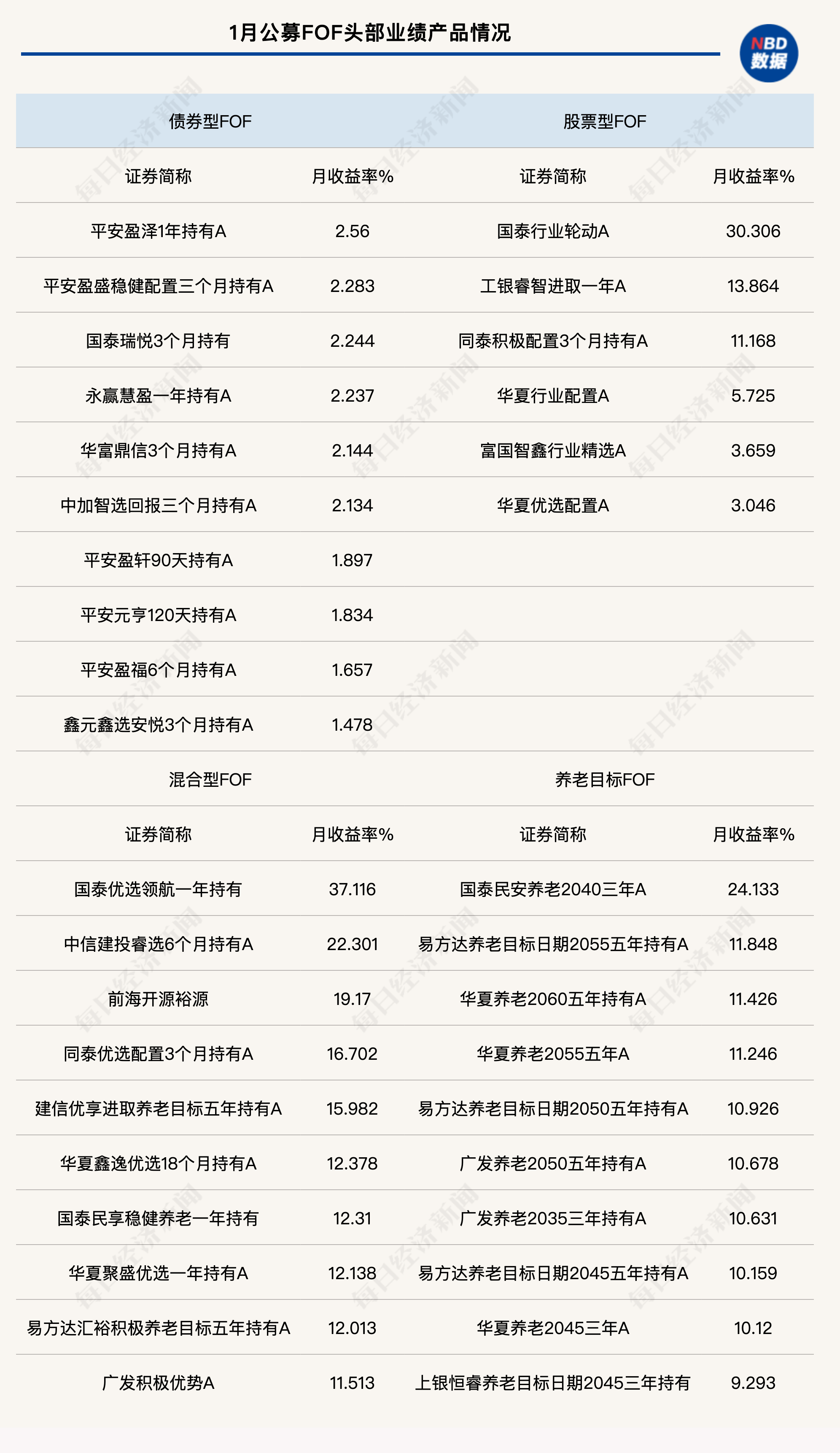
Core Viewpoint - In January, the global asset allocation logic shifted from valuation recovery to profit-driven, with A-shares continuing an upward trend supported by policies, funding, and valuation [1][2]. Group 1: A-share Market Performance - The A-share market showed a steady upward trend in January, with the Shanghai Composite Index rising by 3.76%, the ChiNext Index by 4.47%, and the Shenzhen Index by 5.03% by the end of January [2]. - The non-ferrous metals sector led the gains with a 22.59% increase, followed by media, oil and petrochemicals, construction materials, and basic chemicals with respective increases of 17.94%, 16.31%, 13.31%, and 12.72% [2]. Group 2: Fund Performance - Public FOFs (funds of funds) performed well, with some products achieving monthly returns exceeding 30%. For instance, the Guotai Industry Rotation A fund had a monthly return of 30.31%, while the Guotai Preferred Navigation fund reached 37.12% [3][5]. - A total of 35 FOFs had monthly performance exceeding 10%, with 4 funds surpassing 20% [3]. Group 3: Market Trends and Predictions - Analysts noted that the core drivers of asset performance in January were cross-year capital reallocation and sentiment recovery, with expectations of a "spring excitement" in the stock market in the first quarter [3][7]. - The transition from valuation-driven to profit-driven narratives in global asset allocation is expected to continue, with a focus on sectors showing clear performance improvements, particularly in technology and cyclical industries [7]. Group 4: Fund Issuance and Research Activity - The issuance of public funds accelerated in January, with a significant number of FOFs focusing on themes like technological innovation and high-end manufacturing, reflecting market interest in economic transformation opportunities [6][7]. - A total of 156 public fund institutions participated in A-share research activities in January, covering 486 stocks across 30 first-level industries, indicating high research engagement [7].
ETF策略指数跟踪周报-20260202
HWABAO SECURITIES· 2026-02-02 07:43
1. Report Industry Investment Rating - Not provided in the content 2. Core Viewpoints - The report presents several ETF strategy indices constructed by Huabao Research and tracks their performance and positions on a weekly basis, aiming to help investors convert quantitative models or subjective views into practical investment strategies [11] 3. Summary by Relevant Catalog 3.1 ETF Strategy Index Tracking - **Overall Performance**: The table shows the performance of various ETF strategy indices last week. The Huabao Research Quantitative Windmill ETF Strategy Index had the highest weekly excess return of 2.56%, while the Huabao Research SmartBeta Enhanced ETF Strategy Index had the lowest weekly excess return of -2.76% [12] 3.1.1 Huabao Research Size Rotation ETF Strategy Index - **Strategy**: It uses multi - dimensional technical indicator factors and a machine - learning model to predict the return difference between the Shenwan Large - Cap Index and the Shenwan Small - Cap Index. It outputs weekly signals to predict the strength of the indices in the next week and determines positions accordingly to obtain excess returns [13] - **Performance**: As of 2026/1/30, the excess return since 2024 was 29.34%, the excess return in the past month was 5.89%, and the excess return in the past week was - 1.86%. The index's positions include 50% in the CSI 500ETF and 50% in the CSI 1000ETF [13][17] 3.1.2 Huabao Research SmartBeta Enhanced ETF Strategy Index - **Strategy**: It uses price - volume indicators to time self - built Barra factors and maps timing signals to ETFs based on their exposure to 9 major Barra factors to achieve market - outperforming returns. The selected ETFs cover mainstream broad - based index ETFs and some style and strategy ETFs [17] - **Performance**: As of 2026/1/30, the excess return since 2024 was 20.15%, the excess return in the past month was - 2.11%, and the excess return in the past week was - 2.76%. The index's positions are mainly in several science - innovation and growth - style ETFs [17] 3.1.3 Huabao Research Quantitative Windmill ETF Strategy Index - **Strategy**: It starts from a multi - factor perspective, including the grasp of medium - to - long - term fundamentals, tracking of short - term market trends, and analysis of the behavior of various market participants. It uses valuation and crowding signals to indicate industry risks and multi - dimensionally digs out potential sectors to obtain excess returns [20] - **Performance**: As of 2026/1/30, the excess return since 2024 was 51.39%, the excess return in the past month was 6.51%, and the excess return in the past week was 2.56%. The index's positions are mainly in commodity - related and financial - related ETFs [20][25] 3.1.4 Huabao Research Quantitative Balance ETF Strategy Index - **Strategy**: It adopts a multi - factor system, including economic fundamentals, liquidity, technical analysis, and investor behavior factors, to construct a quantitative timing system for trend analysis of the equity market. It also builds a prediction model for market large - and small - cap styles to adjust the equity market position distribution and obtain excess returns through comprehensive timing and rotation [24] - **Performance**: As of 2026/1/30, the excess return since 2024 was - 10.24%, the excess return in the past month was 0.48%, and the excess return in the past week was - 0.36%. The index's positions include bonds and equity - based ETFs [24][27] 3.1.5 Huabao Research Hot - Spot Tracking ETF Strategy Index - **Strategy**: It uses strategies such as market sentiment analysis, tracking of major industry events, investor sentiment and professional opinions, policy and regulatory changes, and historical analysis to track and dig out hot - spot index target products in a timely manner, constructing an ETF portfolio that can capture market hot spots and providing short - term market trend references for investors [27] - **Performance**: As of 2026/1/30, the excess return in the past month was 6.21%, and the excess return in the past week was 3.21%. The index's positions are mainly in commodity, Hong - Kong - stock, and short - term financing ETFs [27][30] 3.1.6 Huabao Research Bond ETF Duration Strategy Index - **Strategy**: It uses bond market liquidity and price - volume indicators to screen effective timing factors and predicts bond yields through machine - learning methods. When the expected yield is below a certain threshold, it reduces the long - duration positions in the bond investment portfolio to improve long - term returns and drawdown control [30] - **Performance**: As of 2026/1/30, the excess return in the past month was 0.40%, and the excess return in the past week was 0.14%. The index's positions are mainly in bond - related ETFs [30][33]
黄金崩盘!美联储换帅引发市场恐慌,你的黄金资产还安全吗?
Sou Hu Cai Jing· 2026-02-02 07:35
周一开盘,金银价格继续大幅下挫,市场陷入一片恐慌。美国总统特朗普提名凯文·沃什出任美联储主席的消息如同重磅炸弹,瞬间引爆 市场对鹰派政策的强烈预期,贵金属市场因此遭到恐慌性抛售。受此影响,商品黄金相关ETF甚至以跌停开盘,这一罕见景象让投资者 措手不及。 沃什的提名意味着什么?他向来以鹰派立场著称,主张紧缩货币政策。市场普遍预期,一旦他正式执掌美联储,加息步伐可能会加快, 这对黄金这一不生息资产来说无疑是重大利空。黄金价格应声暴跌,创下了近期的新低。 对于许多黄金投资者而言,这个周一无疑是"黑色星期一"。黄金ETF的跌停开盘让无数投资者措手不及,尤其是那些刚刚在高位买入的投 资者,面临着巨大的账面亏损。市场情绪极度恐慌,抛售潮此起彼伏。 黄金ETF的跌停开盘在历史上都较为罕见,这充分反映了市场对美联储政策转向的担忧。投资者们纷纷抛售黄金,转而寻求更为安全的 资产,或者干脆暂时离场观望。这种恐慌情绪的蔓延,进一步加剧了黄金价格的下跌。 凯文·沃什的提名之所以引发如此大的市场震动,主要是因为他长期以来一直被视为鹰派人物。他在担任美联储理事期间曾多次投票支持 加息,对通胀保持高度警惕。他的政策理念与现任主席鲍威尔有 ...

冠农股份股价跌5.06%,博时基金旗下1只基金重仓,持有5600股浮亏损失3080元
Xin Lang Cai Jing· 2026-02-02 06:14
Group 1 - The stock price of Guannong Co., Ltd. dropped by 5.06% to 10.31 CNY per share, with a trading volume of 201 million CNY and a turnover rate of 2.47%, resulting in a total market capitalization of 8.011 billion CNY [1] - Guannong Co., Ltd. is located in Korla City, Xinjiang, and was established on December 30, 1999, with its listing date on June 9, 2003. The company specializes in deep processing, trade, warehousing logistics, and supply chain services of Xinjiang specialty agricultural products such as tomatoes, cotton, and sugar beets [1] - The main business revenue composition of Guannong Co., Ltd. is 68.69% from industrial operations, 27.37% from commercial activities, and 3.94% from services and other sectors [1] Group 2 - According to data from the top ten heavy stocks of funds, one fund under Bosera Asset Management holds shares in Guannong Co., Ltd. The Bosera National Index 2000 ETF (159505) held 5,600 shares in the fourth quarter, accounting for 0.43% of the fund's net value, making it the sixth-largest heavy stock [2] - The Bosera National Index 2000 ETF (159505) was established on November 23, 2023, with a latest scale of 11.9159 million CNY. Year-to-date returns are 10.47%, ranking 1120 out of 5580 in its category; the one-year return is 64.19%, ranking 627 out of 4286; and since inception, the return is 62.42% [2] - The fund manager of Bosera National Index 2000 ETF (159505) is Tang Yibing, who has been in the position for 3 years and 197 days, with a total asset scale of 10.541 billion CNY. The best fund return during his tenure is 98.91%, while the worst is -41.93% [2]
