
极氪

Search documents
技术铸魂 口碑破局:极氪开辟中系豪华新范式
Mei Ri Jing Ji Xin Wen· 2026-01-22 11:19
Core Insights - The luxury car market in China is undergoing significant changes, with traditional luxury brands struggling to maintain their historical premium pricing while new energy brands face challenges in competition and consumer decision-making [1][3] Group 1: Market Dynamics - Traditional luxury brands are finding it difficult to sustain their market positions due to reliance on historical pricing strategies, while new energy brands are caught in a "price war" and struggle with consumer choices between brand perception and technical specifications [1] - Zeekr, under the "One Geely" strategy, reported impressive results with annual deliveries of 224,133 units and a global cumulative delivery of nearly 650,000 units, achieving an average selling price exceeding 300,000 yuan [1] Group 2: Product Strategy - Zeekr's luxury breakthrough is attributed to its commitment to fully self-developed technology, creating a competitive edge with advanced technologies like the Haohan-S luxury hybrid architecture and Haohan AI digital chassis [4] - The Zeekr 9X is highlighted as a major player in the luxury SUV market, with a high average price of 538,000 yuan and over 70% of high-end models sold to customers previously owning traditional luxury brands [5] Group 3: Technology and Consumer Benefits - Zeekr's strategy of technology democratization allows flagship technologies to be accessible in lower-priced models, enhancing the overall product matrix and addressing consumer charging anxiety with over 2,000 self-built charging stations [7] - The introduction of the "Zeekr User Service Charter" and initiatives like the "Mystery Experience Officer" program aim to enhance user experience and brand transparency, fostering a strong relationship with consumers [8] Group 4: Brand Reputation and Market Position - Zeekr's focus on user experience and brand building has led to a significant increase in its Net Promoter Score (NPS), positioning it among the top brands in consumer confidence [9] - The Zeekr 9 series has not only dominated the domestic market but has also gained international recognition, being showcased at CES and expanding its delivery footprint to over 50 countries [9]

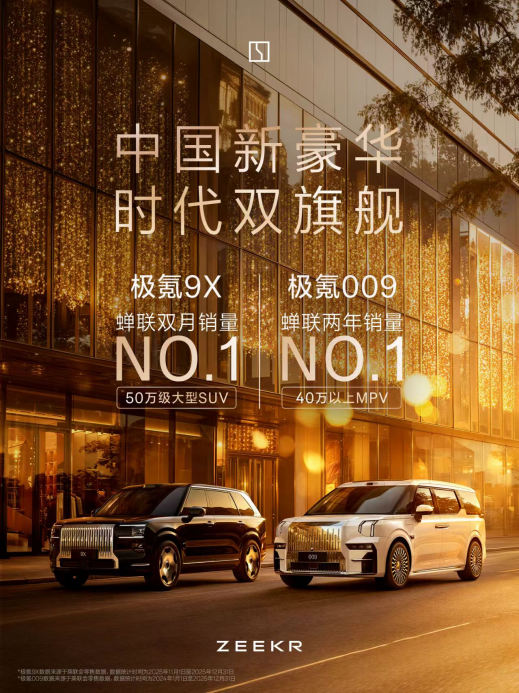
中国,为什么要让新能源车“减肥”?
虎嗅APP· 2026-01-22 10:18
Core Viewpoint - The article discusses the increasing weight of electric vehicles (EVs), particularly SUVs, and the implications of this trend on the industry, safety, and resource utilization. It highlights the need for the industry to adopt measures to reduce vehicle weight in response to new energy consumption standards set by the government [4][9][47]. Group 1: Industry Trends - By 2025, China's production and sales of new energy vehicles (NEVs) are projected to reach 16.626 million and 16.49 million units, respectively, marking a year-on-year growth of 29% and 28.2%, maintaining the global lead for 11 consecutive years [4]. - The average weight of new energy vehicles is 20%-30% heavier than traditional fuel vehicles, with some models exceeding 3 tons [14][11]. - The implementation of national energy consumption standards is pressuring the industry to reduce vehicle weight [8][49]. Group 2: Causes of Increased Weight - The primary reason for the increased weight of EVs is the battery, with electric versions of vehicles like the BMW X3 weighing significantly more due to larger battery packs [17][15]. - The trend of "oil-to-electric" conversions has led to redundant weight as manufacturers retrofit existing fuel vehicle platforms with batteries, resulting in additional structural reinforcements [20][22]. - The growing number of features and configurations in EVs, such as larger interiors and added amenities, contributes to the overall weight increase [25][27]. Group 3: Negative Consequences - Heavier vehicles pose safety risks, as increased weight affects braking efficiency and can lead to greater wear on components [34][35]. - The additional weight results in higher energy consumption, creating a cycle where increased battery capacity leads to heavier vehicles and diminished returns on range improvements [39][40]. - The inefficient use of resources in battery production exacerbates environmental concerns, contradicting the eco-friendly principles of EVs [45][46]. Group 4: Regulatory Response - The new national standard for electric vehicle energy consumption, effective from January 1, 2026, aims to bind energy consumption limits to vehicle weight, making it more challenging for manufacturers to rely on simply adding battery capacity [47][48]. - This standard encourages a shift away from the "stacking batteries" approach, promoting a focus on weight reduction and efficiency [49]. Group 5: Solutions for Weight Reduction - Upgrading materials, such as using aluminum and composite materials, can significantly reduce vehicle weight while maintaining strength [55][56]. - Structural optimization through advanced manufacturing techniques, like large-scale die-casting, can streamline production and reduce weight [58]. - System integration strategies can minimize redundant components, effectively lowering overall vehicle weight without compromising performance or safety [60][66].
英伟达的汽车“生意经”
3 6 Ke· 2026-01-22 02:42
Core Insights - NVIDIA is redefining the next decade of smart automotive technology through a comprehensive approach that integrates cloud simulation and in-vehicle inference [1][2] Group 1: NVIDIA's Transformation - NVIDIA has evolved from a chip supplier to a comprehensive provider of autonomous driving solutions, offering not just vehicle chips (AGX) but also cloud training (DGX) and simulation (OVX) capabilities [2][3] - The company has opened its core AI models and datasets to lower industry barriers and expand its ecosystem, driving demand for computational power and reshaping industry standards [2][3] Group 2: Three Pillars of NVIDIA's Strategy - NVIDIA's automotive strategy is built on three key components: DGX for AI model training, OVX for simulation, and AGX for in-vehicle inference [3][8] - DGX serves as a training factory, utilizing a supercomputing cluster of thousands of GPUs to process vast amounts of driving data, including real-world videos and virtual simulations [4][9] - OVX creates a digital twin of the real world, allowing for extensive testing of autonomous driving algorithms in a risk-free environment [5][6][7] - AGX represents NVIDIA's well-known in-vehicle computing chips, with performance increasing from tens of TOPS to over a thousand TOPS, becoming standard in flagship models from various automakers [8][11] Group 3: Business Model Evolution - NVIDIA's revenue model has shifted from solely selling hardware to providing engineering services, where they assist automakers in optimizing algorithms on NVIDIA's platform [12][13] - This service model fosters a mutually beneficial relationship, allowing automakers to enhance their development capabilities while providing NVIDIA with valuable feedback for product improvement [13] Group 4: Open Source Strategy - In early 2025, NVIDIA announced the open-sourcing of its Alpamayo series, which includes a 100 billion parameter model and a comprehensive simulation framework, aimed at accelerating the development of autonomous driving technologies [16][17] - This strategic move lowers industry barriers, addresses the scarcity of high-quality data, and positions NVIDIA as a leader in defining the next generation of technology frameworks [18] Group 5: Market Dynamics and Competitive Edge - The demand from the Chinese market significantly drives NVIDIA's accelerated pace in the automotive sector, with local automakers pushing for rapid development and deployment of advanced features [21] - NVIDIA's confidence in its competitive position stems from its comprehensive engineering capabilities and the extensive ecosystem it has built over years, which is difficult for competitors to replicate [24] - The company's strategy is to become an architect and enabler of the AI-driven mobility era, moving beyond being just a supplier to defining new rules in the automotive industry [24]


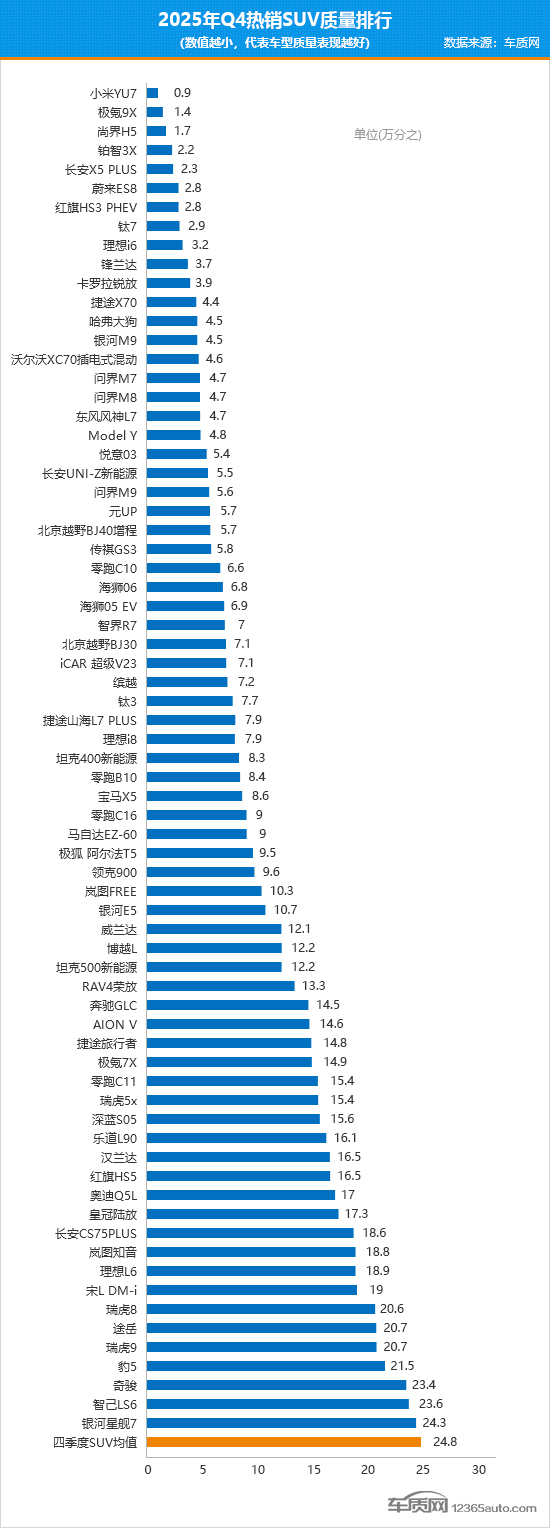
2025四季度国内热销SUV质量排行:小米YU7第一,投诉销量比为万分之0.9
Xin Lang Cai Jing· 2026-01-21 12:53
Core Insights - The report from the third-party automotive quality complaint platform Chezhizhong indicates a significant decrease in quality complaints for domestic SUVs in Q4 2025, with a total of 11,984 complaints received, reflecting a quality complaint-to-sales ratio of 24.8 per ten thousand units, a notable improvement from Q3 [1][4]. Group 1: Quality Performance - The average quality complaint-to-sales ratio for domestic SUVs in Q4 2025 is 24.8 per ten thousand units, which shows a substantial recovery in overall quality performance compared to Q3 [1][4]. - Among the 358 models analyzed, 71 models performed better than the average complaint ratio of 24.8 per ten thousand units [1][4]. Group 2: Top Performing Models - The top-performing SUV in terms of quality is the Xiaomi YU7, with a complaint ratio of 0.9 per ten thousand units [1][4]. - The second and third positions are held by the Zeekr 9X and the Shangjie H5, with complaint ratios of 1.4 and 1.7 per ten thousand units, respectively [1][4]. - Other notable models in the top eight include the Toyota Platinum 3X, Changan X5 Plus, NIO ES8, Hongqi HS3 PHEV, and the Fangcheng Bao Titanium, with complaint ratios ranging from 2.0 to 3.0 per ten thousand units [1][4].





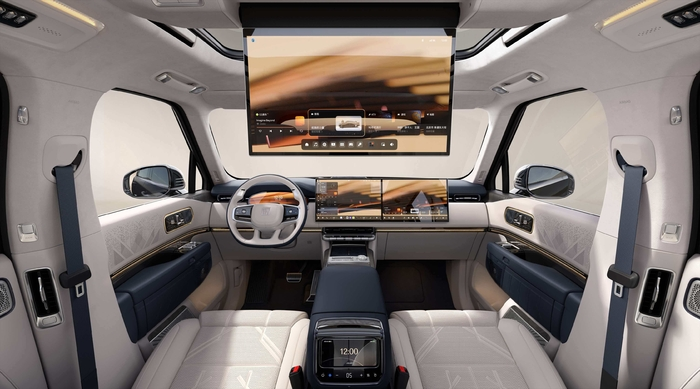
韩面板大厂宣布成功打入极氪9X :供应3款车载OLED屏
Xin Lang Cai Jing· 2026-01-21 12:42
Core Insights - Samsung Display will supply OLED panels for ZEEKR's flagship SUV model, the ZEEKR 9X, marking an expansion into the Chinese market after focusing on the European high-end automotive sector [1][5]. Group 1: Product Details - The ZEEKR 9X features a 16-inch Central Information Display (CID) and a Passenger Information Display (PID), designed to function as a single large screen while also allowing independent use [3][7]. - The 17-inch Rear Seat Entertainment (RSE) screen, developed in collaboration with ZEEKR, can move up to 88 centimeters between the second and third rows, enhancing viewing angles for rear passengers [3][7]. Group 2: Market Expansion - Samsung Display has recently extended its market focus to China, adding partnerships with ZEEKR and other companies, and will supply OLED for the ZEEKR MPV 009 model in 2024 [4][8]. - In the automotive display market, OLED's share was only 6.1% last year but is projected to rise to 20.7% by 2030, with global sales reaching $860.17 million, of which Samsung Display accounted for $577.15 million, representing a 67.1% market share [4][8]. Group 3: Future Outlook - The head of Samsung Display's automotive business stated the company will continue to introduce high-performance products with differentiated value and strengthen partnerships with global automotive clients to lead the growth of the automotive OLED market [4][8].

长安福特年销量首次跌破10万辆红线;三星显示:向极氪9X供应三款车载OLED屏丨汽车交通日报
创业邦· 2026-01-21 10:19
Group 1 - Changan Ford's annual sales have fallen below 100,000 units for the first time, with wholesale sales at 121,500 units and retail sales at 99,400 units in 2025, marking a significant decline from 247,000 units in 2024 [2] - By the end of 2025, China's electric vehicle charging infrastructure reached 20.092 million units, a year-on-year increase of 49.7%, with public charging facilities at 4.717 million units and private charging facilities at 15.375 million units [2] - Samsung Display announced it will supply three types of vehicle-mounted OLED screens for the Zeekr 9X SUV, with the first supply expected in 2024 and full supply starting in the second half of 2025 [2] Group 2 - Analysts suggest that Hyundai Motor may see a significant valuation boost from its investment in Boston Dynamics, with projections estimating Boston Dynamics' valuation could reach 53.3 trillion KRW by 2027, potentially increasing Hyundai's valuation by 14.4 trillion KRW [2] - Another report estimates that by 2035, Boston Dynamics' valuation could reach approximately 128 trillion KRW, which would provide a valuation boost of about 35 trillion KRW to Hyundai [2]

三重赛道博弈:中资企业跨境上市的路径抉择与现实考量
Sou Hu Cai Jing· 2026-01-21 09:24
2026年的全球资本市场,中资企业跨境上市早已告别"美股为主、港股补充"的单一逻辑。随着纳斯达克 规则趋严、港交所审核拥堵,伦敦证券交易所借规则改革异军突起,形成三大市场鼎足之势。这场选择 背后,不再是简单的估值比拼,而是合规成本、监管适配与企业发展阶段的深度匹配。 网络 图片来源于 但320余家企业排队申报的现状,导致审核周期普遍超一年,对高速成长期的科技、生物医药企业而 言,上市窗口的延误可能意味着估值缩水。成本方面,港股7000万-8000万港元的总费用对中小企业压 力不小,而传统行业三年累计8000万港币利润的要求,也让不少初创企业望而却步。不过18A、18C章 的豁免通道,仍为未盈利生物科技和特专科技企业保留了机会,关键在于能否满足高市值与研发投入占 比要求。 伦交所凭借2024年规则改革,成为跨境上市的"新选项"。其核心变革在于废除三年财务记录要求,建 立"披露监管"导向的统一上市板块,只要满足3000万英镑市值和10%公众持股比例,未盈利创新企业即 可申报。 重大交易无需股东大会批准、关联交易"披露即合规"的规则,大幅提升了企业运营效率,尤其适配有海 外并购需求的中企。但权力下放也意味着责任加重 ...

加拿大“开门”,国产电动车打响北美破冰第一战
3 6 Ke· 2026-01-20 01:07
Core Viewpoint - The Chinese electric vehicle (EV) industry is experiencing significant growth globally, with exports expected to reach 2.615 million units in 2025, a year-on-year increase of 103.7%. However, the North American market remains largely inaccessible due to high tariffs imposed by the U.S. and Canada [1][3]. Group 1: Market Dynamics - Canada has recently opened its market to Chinese EVs, allowing an annual import quota of 49,000 units, which will gradually increase to 70,000 units over five years [3][5]. - The tariff on Chinese EVs has been reduced to a standard rate of 6.1%, marking a significant shift in trade relations [5][14]. - The U.S. has shown ambiguous support for Chinese car manufacturers, with former President Trump suggesting that they should build factories in the U.S. [5][14]. Group 2: Canadian Economic Context - Canada's decision to engage with China stems from its own economic challenges, as it seeks to diversify its trade partnerships and reduce reliance on the U.S. [7][14]. - The Canadian automotive market is facing internal issues, including a 41% decline in EV sales after the removal of subsidies, making Chinese EVs a more attractive option [15][19]. - The Canadian government has set ambitious targets for zero-emission vehicles, which local manufacturers are struggling to meet due to limited production capacity and high costs [19][21]. Group 3: Competitive Advantages of Chinese EVs - Chinese EVs benefit from a complete supply chain that allows for lower costs and higher efficiency, making them competitive in the global market [27][29]. - The rapid iteration of technology in the Chinese market enables quicker adaptation to consumer demands and local conditions, such as cold weather performance [34][36]. - Chinese manufacturers have developed specific technologies to address the challenges posed by cold climates, ensuring better battery performance and vehicle reliability in harsh conditions [34][36]. Group 4: Challenges Ahead - The limited quota of 49,000 units for Chinese EVs in Canada poses a challenge for scaling operations, requiring differentiation and brand building to capture market share [41][43]. - Brand recognition and consumer trust in North America are significant hurdles, necessitating substantial marketing efforts and time to establish credibility [43][45]. - Political uncertainties in the U.S. regarding tariffs and trade policies present a major risk for Chinese EV manufacturers looking to expand into the American market [45][47]. Group 5: Strategic Implications - The agreement between Canada and China may signal a shift in global trade dynamics, potentially encouraging other countries to pursue similar partnerships with China [49][52]. - The Canadian market serves as a testing ground for Chinese EVs, providing valuable data and experience that can be leveraged for future expansion into the U.S. [53][56]. - The evolving strategy for Chinese EVs may involve localizing production and technology in North America, moving beyond simple product exports to a more integrated approach [58][60].
和辉光电:公司产品拓展至多个AMOLED新兴领域
Zheng Quan Ri Bao Zhi Sheng· 2026-01-19 13:48
Core Viewpoint - The company is actively expanding its AMOLED product applications across various sectors, including consumer electronics, automotive, aviation, and smart home devices, while focusing on technological innovation to enhance product competitiveness [1] Group 1: Product Applications - The company's products are widely used in consumer electronics such as smart wearables, smartphones, tablets, and laptops [1] - The company has established a stable supply of automotive display products for well-known car manufacturers including SAIC, Geely, and NIO [1] - The company has developed the first domestic 27-inch 4K AMOLED panel for desktop monitors [1] Group 2: Industry Collaborations - The company is collaborating with leading European high-end automotive manufacturers on new projects [1] - The company's high-end AMOLED display panels have been adopted by a world-leading aircraft manufacturer in Europe [1] - The company has partnered with a well-known smart camera brand to develop AMOLED products for action cameras [1] Group 3: Future Outlook - The company aims to cover more application areas for AMOLED display products as technology continues to evolve [1] - The company will maintain its focus on the AMOLED sector, driven by technological innovation for product upgrades [1] - The company seeks to provide superior products and services, leading AMOLED display technology to new heights and invigorating the global display industry [1]

刚因“电芯”遭23亿天价索赔,欣旺达又卷入沃尔沃全球召回风波
Guo Ji Jin Rong Bao· 2026-01-19 13:00
Core Viewpoint - The recent recall of Volvo's electric vehicle EX30 due to battery safety issues has raised concerns about the responsibility of the battery supplier, A123, and has compounded existing sales pressures on Volvo [2][3][5]. Group 1: Volvo's Recall and Sales Performance - Volvo has initiated a global recall of its EX30 electric model due to high-voltage battery overheating risks, affecting markets including the US, Canada, South Africa, and Australia [2]. - In the UK, 10,440 units of the EX30 are confirmed to be affected, covering models from 2024 to 2026 [2]. - Volvo's global sales in 2024 are projected at 763,400 units, an 8% increase year-on-year, but sales in China, its largest market, have dropped to 156,400 units, the lowest in five years [4]. Group 2: Financial Impact and Battery Supplier Issues - In Q3 2023, Volvo's global sales fell to 160,500 units, a 7% year-on-year decline, with revenues of 86.4 billion Swedish Krona, down 6% [5]. - The recall has sparked controversy over battery supply responsibilities, with reports indicating that the problematic battery cells were produced by a joint venture involving A123 [5][6]. - A123's chairman stated that the battery packs were supplied through a different factory, distancing the company from direct responsibility for the issues [5]. Group 3: A123's Challenges and Market Position - A123 is facing significant challenges, including a recent lawsuit from Zeekr over battery quality issues, which has intensified scrutiny on the company's reliability [6][9]. - The company has seen a reduction in orders from key clients like Li Auto and Xiaomi, with the number of models supported by A123 for Li Auto dropping from 10 to 3 [9]. - A123's aggressive pricing strategy has led to declining profit margins, with a gross margin of only 9.77% in H1 2025, significantly lower than competitors [10]. Group 4: Financial Health and Future Outlook - A123 reported a loss of 1.87 billion Yuan in 2024, with cumulative losses exceeding 4.5 billion Yuan from 2023 to H1 2025 [10]. - The company's debt levels have risen sharply, with a debt-to-asset ratio of 67.62% and total liabilities reaching 67.9 billion Yuan [10]. - Concerns about ongoing litigation and financial losses may hinder A123's plans for an IPO in Hong Kong, which was anticipated for 2026 [10].
