赛力斯

Search documents
华为数百人团队驻场广汽 启境汽车合作模式首次揭秘
Zhong Guo Jing Ying Bao· 2025-11-22 15:17
Core Viewpoint - GAC Group's new high-end smart electric vehicle brand "Qijing" aims to target a younger, fashion-forward audience with a focus on high performance and technology, distinguishing itself from competitors in the market [2][3] Group 1: Brand Positioning and Strategy - Qijing is positioned as a high-performance, high-tech vehicle brand, emphasizing its unique identity and market segmentation [2] - The name "Qijing" symbolizes the exploration of new realms and aligns with Huawei's smart automotive strategy [3] - GAC Group has initiated a three-year "Panyu Action" to enhance its autonomous brand management and user-oriented transformation [3] Group 2: Collaboration Dynamics - The collaboration between GAC and Huawei has involved intense discussions and disagreements, which have ultimately led to productive outcomes in product development [2][5] - Over 200 Huawei team members are embedded with GAC to form a joint operational body, allowing for independent decision-making in product planning and marketing [4] - The partnership aims to create a "dream car" that excels in aesthetics, performance, and intelligence, with a commitment to not compromise on quality [5] Group 3: Product Development and Market Entry - Qijing plans to launch two new models in 2026, including a high-performance SUV and a stylish coupe, targeting the competitive 350,000 to 400,000 yuan market segment [8] - The first model, described as the "most beautiful hunting-style sedan," has completed extreme temperature testing and is set for a June 2024 launch [8] - GAC's strategy includes expanding its market presence, with plans to cover 70 cities in China by integrating new and existing markets [9]


赛力斯魔方技术平台2.0发布 引领AI汽车新时代
Yang Zi Wan Bao Wang· 2025-11-22 13:31
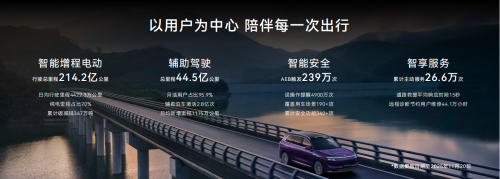
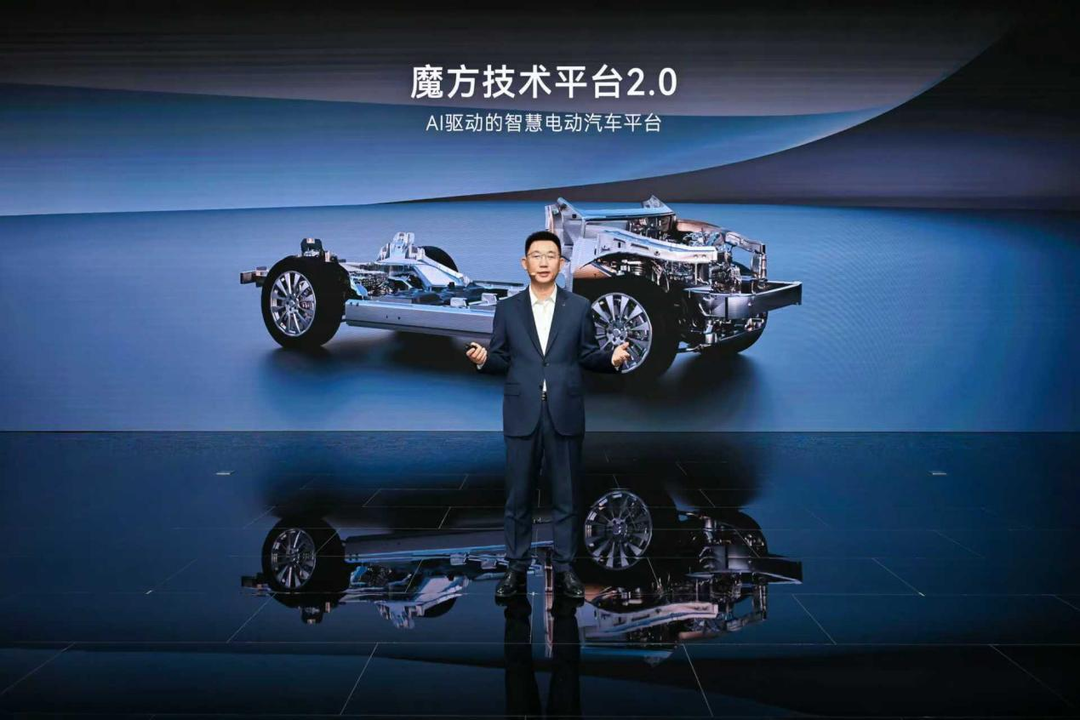
Core Viewpoint - The release of the Cyrus Magic Cube Technology Platform 2.0 marks a significant upgrade in the development of AI-driven smart electric vehicles, aiming to establish the brand as a leader in high-end and intelligent automotive solutions in China [1][3]. Group 1: Technology and Innovation - The new platform emphasizes panoramic intelligence and smart safety, upgrading aspects such as smart energy, intelligent chassis, EEA architecture, and smart space [1]. - The platform integrates AI technology to create a more emotional, intelligent, safe, and reliable mobility experience [3]. - The platform supports a high-pressure architecture that enhances the integration of range extension and electric drive, optimizing vehicle performance for economic efficiency [6]. Group 2: Safety and User Experience - The platform features a five-layer, fifteen-fold battery safety system, along with advanced technologies for noise reduction and vibration suppression, ensuring a quiet driving experience [7]. - The intelligent chassis has been upgraded to provide flexible control, comfort, and safety redundancy, incorporating advanced technologies for road and curve prediction [9]. - A comprehensive intelligent safety system is established, focusing on life protection, vehicle body protection, health care, and privacy protection [15]. Group 3: Market Position and Performance - Since its launch, the Wanjie brand has released several models, achieving over 900,000 users, with the Wanjie M9 and M8 leading their respective sales categories [18]. - The total mileage of assisted driving has exceeded 4.45 billion kilometers, indicating a significant increase in user confidence and safety [18]. - The brand's commitment to safety is demonstrated by 2.39 million AEB activations, preventing potential collisions [18]. Group 4: Ecosystem and Collaboration - The company is building an advanced intelligent testing system and collaborating with industry partners to create a comprehensive automotive ecosystem, enhancing data operations and computational capabilities [17]. - The platform's design allows for modular support across various vehicle types and sizes, promoting flexible production and adaptability to different user scenarios [13].

三花智控(002050):营收符合预期 控费、利息及减值冲回等推动利润率超预期
Xin Lang Cai Jing· 2025-11-22 08:29
Core Insights - The company reported a Q3 2025 revenue of 7.767 billion yuan, a year-on-year increase of 12.77% but a quarter-on-quarter decrease of 9.6% [1][2] - The net profit attributable to shareholders for Q3 2025 was 1.132 billion yuan, reflecting a year-on-year increase of 43.81% and a quarter-on-quarter decrease of 6.1% [1][2] - The company maintains a strong global leadership position in refrigeration and automotive parts, benefiting from high win rates and valuation premiums due to upcoming production orders [1][4] Revenue Performance - For the first three quarters of 2025, the company achieved a revenue of 24.03 billion yuan, up 16.86% year-on-year [2] - The refrigeration business is expected to generate approximately 4.58 billion yuan in Q3, a year-on-year increase of 9.8%, while the automotive parts business is projected to reach around 3.2 billion yuan, a year-on-year increase of 17% [3][4] Profitability Analysis - The gross margin for Q3 was approximately 28.02%, a slight decrease of 0.15 percentage points year-on-year [4] - Profitability improvements were driven by effective control of operating expenses, increased interest income, and a reversal of credit impairments [4] Future Outlook - The company expects revenues for 2025 to reach approximately 32.18 billion yuan, with year-on-year growth rates of 15.13%, 17.71%, and 18.77% projected for 2026 and 2027 [5] - The net profit forecast for 2025 is approximately 4.208 billion yuan, with significant growth anticipated in subsequent years [5]

直击2025广州车展|自主“百花齐放”:鸿蒙智行定下“200万辆”交付周期 长城坚持“油电同强”战略
Xin Lang Cai Jing· 2025-11-22 07:55
Core Insights - The Guangzhou Auto Show marks the end of 2025 and the beginning of a new year for the automotive market, showcasing a diverse range of domestic automakers with innovative strategies and products [1] Group 1: Electric Vehicle Developments - Seres, the first new energy vehicle company listed on both A-shares and Hong Kong stocks, announced over 900,000 deliveries and introduced the Seres Magic Cube Technology Platform 2.0, which includes upgrades in smart energy and intelligent chassis [2] - BYD remains a leading player in the Chinese automotive industry, showcasing luxury models like the U9 Xtreme supercar and plans to promote the "Yangwang" brand globally starting in early 2026 [2] - In October, new energy vehicle sales surpassed 50% of total new car sales for the first time, reaching 51.6%, indicating a significant shift towards electric vehicles [2] Group 2: Hybrid and Traditional Vehicles - The "Energy-saving and New Energy Vehicle Technology Roadmap 3.0" emphasizes that internal combustion engines will remain a key power source, with a projected one-third of new passenger car sales still involving internal combustion engines by 2040 [3] - The strategy of "oil-electric synergy" is gaining traction, with a focus on enhancing user experience through intelligent upgrades in traditional vehicles [3] Group 3: Traditional Automaker Strategies - Great Wall Motors is implementing a multi-brand strategy centered on "oil-electric synergy," featuring models like the Tank 500 with impressive performance metrics [4] - The Haval brand has developed a comprehensive product matrix based on hybrid technology, while the 2026 Great Wall Cannon series includes smart cockpit features [4] Group 4: New Energy Vehicle Startups - New energy vehicle startups like Huawei's Aito, Xiaomi, and others are increasingly prominent, with Aito achieving over 1 million cumulative deliveries and launching new models at the auto show [5] - Leap Motor introduced the A10 model, completing its product matrix and aiming for mainstream market coverage by mid-2026 [5] - Xiaopeng Motors is set to launch multiple super-range models in early 2026, while Li Auto plans to enhance its models with advanced features [6]
“AI定义汽车”加速落地 广州车展把“安全”推到舞台中央
Zhong Guo Jing Ying Bao· 2025-11-21 20:49
Core Insights - The 2025 Guangzhou International Auto Show, themed "New Technology, New Life," showcases the automotive industry's innovations and trends as it enters a new phase [2][10] - The exhibition covers an area of 220,000 square meters, featuring 1,085 vehicles, with 93 new car launches, and nearly 58% of the vehicles being new energy vehicles [2][4] Group 1: Domestic Brands - BYD and GAC Group prominently featured their products in a "pavilion-style" display, highlighting their latest achievements and innovations [3][4] - BYD's Han L and Tang L models received a significant OTA upgrade, enhancing their driving assistance capabilities and integrating with smart home devices [4][5] - GAC Group reported a 50% improvement in business efficiency and a reduction in new car development cycles from 26 months to 18-21 months due to the implementation of new systems [5] Group 2: Joint Venture Brands - Joint venture brands are signaling a push towards localization and increased investment in smart electric vehicles, aiming to regain consumer attention [3][9] - Dongfeng Nissan launched the new Teana with advanced smart features, positioning it as a leading intelligent fuel vehicle [9] Group 3: New Energy Vehicles - The exhibition highlighted the dominance of new energy vehicles, with significant participation from both domestic and joint venture brands [3][10] - Xpeng Motors showcased its new X9 extended-range MPV, which features advanced charging capabilities and a significant range, marking a milestone with the production of its one-millionth vehicle [8][9] Group 4: Safety and Technology - Changan and Seres emphasized safety at their presentations, with Seres unveiling its upgraded technology platform aimed at enhancing vehicle safety and performance [7] - Changan introduced a comprehensive safety value system that extends beyond physical protection to include proactive and intelligent safety measures [7] Group 5: Smart Mobility - GAC's subsidiary, Qiji Mobility, demonstrated its full-chain layout for autonomous driving, showcasing its Robotaxi services and AI data solutions [6] - The event provided opportunities for attendees to experience autonomous driving firsthand, bridging the gap between concept and reality [6]


机器人成广州车展“新主角” 车企用具身智能拓展新空间
Shang Hai Zheng Quan Bao· 2025-11-21 18:43
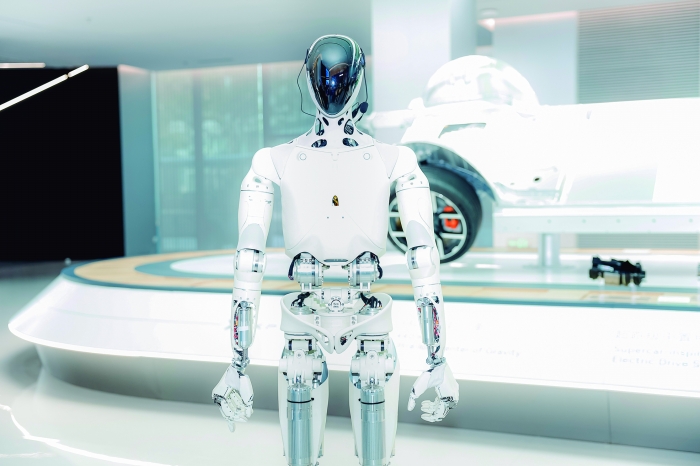
Core Insights - The Guangzhou International Auto Show is showcasing advancements in embodied intelligence, with companies like GAC Group and XPeng Motors presenting their latest humanoid robots [3][4][7] - The automotive industry is increasingly integrating embodied intelligence, with traditional manufacturers exploring this new field to create growth opportunities [3][10] - The demand for humanoid robots is expected to rise, with projections indicating that global annual production could reach 50 million units by 2050, generating significant revenue [9][10] Company Highlights - XPeng Motors unveiled its new humanoid robot, IRON, which features a highly human-like design and advanced capabilities, including 22 degrees of freedom in its hands and a total computational power of 2250 TOPS [7][8] - GAC Group's GoMate Mini robot is designed for practical applications, featuring 27 degrees of freedom and the ability to switch between different mobility modes, with a goal to achieve commercial viability by 2025 [4][6] - Both XPeng and GAC are focusing on the commercialization of humanoid robots, with XPeng planning to mass-produce IRON by the end of 2026 and GAC aiming for a robot industry chain value exceeding 10 billion yuan by 2030 [6][8] Industry Trends - The integration of embodied intelligence in the automotive sector is seen as a natural progression due to the similarities in technology and supply chains between electric vehicles and humanoid robots [10][11] - Major automotive companies, including Tesla, are heavily investing in humanoid robotics, with Tesla's Optimus robot expected to reach an annual production of 50,000 units by 2026 [9][10] - The market for humanoid robots is projected to be a $20 trillion opportunity, with significant growth anticipated as technology matures and production scales up [11]


赛力斯广州车展发布魔方技术平台2.0
Nan Fang Du Shi Bao· 2025-11-21 13:43
Core Insights - The article discusses the significant upgrade of the Seres Magic Cube Technology Platform to version 2.0, transitioning from software-defined to AI-defined, aimed at enhancing smart electric vehicles [2][4]. Group 1: Technology Platform Upgrade - The new Magic Cube Technology Platform 2.0 emphasizes panoramic intelligence and intelligent safety, with upgrades in smart energy, intelligent chassis, EEA architecture, and smart space [2]. - The platform's architecture has evolved from "distributed regional control" to "central vehicle control + regional control," supporting large model applications and end-to-end evolution, enabling sharp perception, smart decision-making, and efficient execution [4]. Group 2: Modular and Flexible Design - The platform's modular design allows it to support multiple vehicle types (sedans, SUVs, MPVs, off-road vehicles) and sizes (B-D class), facilitating flexible production [4]. - It also enhances support for active suspension, steer-by-wire, and multi-motor systems, allowing for more flexible spatial layouts and covering nine travel scenarios, including commuting and outdoor activities [4]. Group 3: Testing and Collaboration - The company has established an advanced intelligent testing system driven by scenarios, combining full-scene testing with simulation testing, utilizing over 100,000 test cases to deliver high-reliability products [5]. - Seres is actively collaborating with industry partners to build an automotive industry brain, achieving full-chain collaboration and innovative integration [5]. Group 4: Partnership with Huawei - The collaboration with Huawei since 2021 has been pivotal, leading to the development of comprehensive Huawei smart technologies, including advanced driver assistance systems that have attracted many users [5]. - As of now, the total mileage for the assisted driving feature has exceeded 4.45 billion kilometers, with an average daily increase of 11.75 million kilometers [5]. Group 5: Product Launch and User Base - The Wanjie brand has launched four major product series since its inception, with the Wanjie M9 and M8 leading in their respective sales categories [6]. - The cumulative user base for Wanjie has surpassed 900,000, indicating strong market acceptance and popularity [6].
押注启境,“境系列”首个品牌能否如愿俘获年轻人?
Xin Jing Bao· 2025-11-21 13:14
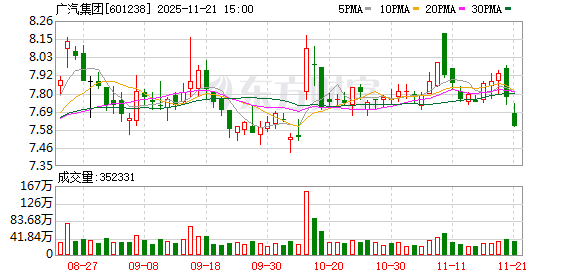
Core Viewpoint - GAC Group and Huawei's new brand Qijing aims to fill a gap in the market for stylish, safe, and intelligent vehicles, targeting young consumers in a competitive electric vehicle landscape [1][4]. Group 1: Brand Launch and Strategy - Qijing, as the first brand under Huawei's "Jing" series, was unveiled on November 20, with plans to differentiate itself through smart technology and product quality [1]. - The brand will launch two new models by 2026, with the first model, a shooting brake, set to be delivered in June 2024 [2]. - Qijing will operate through independent sales channels, avoiding Huawei's existing store model, and will recruit dealers across 30 new cities [2]. Group 2: Collaboration Dynamics - The collaboration between GAC and Huawei involves a deep integration of teams, with Huawei's product development and marketing processes being utilized to enhance Qijing's offerings [2][3]. - The partnership has been characterized by intense discussions, with both teams expressing strong opinions, indicating a dynamic and potentially innovative working relationship [2]. Group 3: Market Positioning and Challenges - Qijing is positioned as a high-end intelligent electric vehicle brand aimed at young consumers, differentiating itself from Huawei's previous collaborations that targeted business and high-end family users [4]. - GAC is undergoing significant reforms due to declining performance, with a 10.49% revenue drop and a net loss of 4.312 billion in the first three quarters of 2025, making the success of Qijing critical for its future [4]. - The brand faces stiff competition in the market segment above 300,000, where established players like Tesla and NIO dominate, necessitating a strong first impression with its initial model [5].
车展观察丨押注启境,“境系列”首个品牌能否如愿俘获年轻人?
Bei Ke Cai Jing· 2025-11-21 13:08
Core Viewpoint - GAC Group and Huawei's QianKun have launched a new automotive brand, Qijing, aimed at filling a market gap for stylish, safe, intelligent, and controllable vehicles targeting young consumers [1][2][4]. Market Context - The Chinese automotive market is becoming increasingly competitive, with the introduction of Qijing raising questions about the necessity of another brand amidst existing offerings [2][14]. - Qijing aims to differentiate itself in the crowded electric vehicle market, which includes strong competitors like Tesla and NIO, by focusing on intelligent features and product quality [17]. Brand Strategy - Qijing is positioned as a high-end intelligent electric vehicle brand, with a focus on appealing to younger consumers, a demographic previously overlooked by Huawei's other automotive collaborations [12][14]. - The brand's name, Qijing, was chosen to reflect a youthful and technological image, as suggested by Huawei's founder Ren Zhengfei [4][12]. Product Development - Qijing plans to launch two new models by 2026, with the first model, a shooting brake, set to be delivered in June 2024 [5][11]. - The brand has adopted Huawei's Integrated Product Development (IPD) and Integrated Product Marketing System (IPMS) to enhance product development and marketing processes [9]. Sales and Distribution - Unlike Huawei's previous sales strategies, Qijing will operate through independent sales channels and will not be sold in Huawei stores, with plans to recruit dealers across 30 new cities [6][8]. - The sales strategy includes a "1 (user center) + N (experience center)" model for network layout [6]. Collaboration Dynamics - The collaboration between GAC and Huawei has been described as intense, with discussions sometimes leading to heated debates, reflecting the different corporate cultures of the two companies [10]. - The partnership has accelerated the development timeline for new models, with significant milestones achieved in a short period [11]. Financial Context - GAC Group is currently undergoing significant reforms due to declining performance, with a 10.49% drop in revenue and a net loss of 4.312 billion yuan in the first three quarters of 2025 [15]. - The company is betting on the success of Qijing as a breakthrough strategy to improve its market position and achieve its goal of having 60% of total sales from its own brands by 2027 [16][17].
赛力斯多项领先技术成果亮相广州车展 引领行业发展
Jiang Nan Shi Bao· 2025-11-21 10:34
Core Insights - The article highlights the latest advancements and product showcases of the AITO brand and Seres at the Guangzhou Auto Show, emphasizing the launch of the Seres Cube Technology Platform 2.0, which is designed for AI-driven smart electric vehicles [1][3]. Group 1: Product Showcase - AITO's full range of models, including the M9, M8, new M7, and new M5, were displayed at the auto show, achieving over 900,000 total deliveries [2]. - The AITO M9 has surpassed 260,000 cumulative deliveries, setting a new record for vehicles priced over 500,000 yuan, while the M8 has exceeded 130,000 deliveries, maintaining its position as the best-selling model in the 400,000 yuan category [2]. - The new M7 received over 90,000 pre-orders within 41 days, with total deliveries exceeding 350,000 units, marking it as a phenomenon in the market [2]. Group 2: Technological Advancements - The Seres Cube Technology Platform 2.0 was officially launched, featuring upgrades in smart energy, intelligent chassis, EEA architecture, and smart space, all underpinned by panoramic intelligence and smart safety [3]. - The platform integrates AI capabilities, connecting with the HarmonyOS ecosystem and enhancing the vehicle's ability to interact intelligently with its environment [3]. - The intelligent chassis has been upgraded to provide better handling, comfort, and safety, while the electronic architecture has evolved to support large model applications and end-to-end development [3]. Group 3: Safety and User Experience - Seres emphasizes that "safety is the greatest luxury," implementing a comprehensive intelligent safety system that has prevented potential collisions 2.39 million times [4]. - The company collaborates with industry partners to create a more efficient and precise smart operation system, enhancing the overall user experience [4]. - AITO has achieved a total of 90 million users, with smart range-extended electric vehicles accumulating over 21.4 billion kilometers, of which 70% are electric driving [5]. Group 4: Service and Brand Recognition - AITO has established a comprehensive smart service system that addresses user needs throughout the entire vehicle lifecycle, with 266,000 proactive service interactions recorded [7]. - The brand has been recognized for its high-quality service, ranking first in the brand development confidence index for the first half of 2025, with the M9 achieving the highest net promoter score among new energy vehicles [7]. - Continuous technological advancements and service optimizations position Seres as a leader in the high-quality development of the automotive industry, focusing on safety, quality, reliability, performance, and value [7].