海天味业

Search documents
海天味业:2025年A股每股现金红利人民币0.30元
Xin Lang Cai Jing· 2026-01-30 10:42
海天味业公告,本次实施权益分派股权登记日,公司总股本5,851,824,944股(其中A股5,560,600,544 股,H股291,224,400股),扣除公司回购专用证券账户持有的A股5,289,491股后,以实际参与利润分配 的股份5,846,535,453股为基数,每股派发现金红利人民币0.30元(含税),共计派发现金红利人民币 1,753,960,635.90元(含税),其中A股共派发现金红利人民币1,666,593,315.90元(含税)。 ...

食品饮料行业双周报(2026、01、16-2026、01、29):市场波动短期增加,关注春节需求表现-20260130
Dongguan Securities· 2026-01-30 08:47
Investment Rating - The report maintains an "Overweight" rating for the food and beverage industry, expecting the industry index to outperform the market index by over 10% in the next six months [48]. Core Insights - The SW food and beverage industry index rose by 2.31% from January 16 to January 29, outperforming the CSI 300 index by approximately 2.26 percentage points [10][11]. - Approximately 61% of stocks in the industry recorded positive returns during the same period, with notable gainers including Guyue Longshan (+17.73%) and Zhongxin Niya (+16.55%) [14]. - The industry valuation is currently at a PE (TTM) of approximately 20.94 times, which is below the five-year average of 31 times [17]. Summary by Sections Market Review - The SW food and beverage industry outperformed the CSI 300 index, with a rise of 2.31% from January 16 to January 29, ranking tenth among the Shenwan first-level industries [10]. - Most sub-sectors outperformed the CSI 300 index, with the other liquor sector seeing the highest increase of 6.85% [11]. - About 61% of stocks in the industry achieved positive returns, with significant increases from stocks like Guyue Longshan and Zhongxin Niya [14]. Industry Data Tracking Liquor Sector - The price of Feitian Moutai increased to 1580 RMB per bottle, up 60 RMB from January 15, while the price of Guojiao 1573 rose to 850 RMB per bottle [20]. Seasoning Sector - The price of soybeans was 4188.20 RMB per ton, down 2.35% month-on-month, while the price of white sugar decreased to 5320.00 RMB per ton [23]. Beer Sector - The average price of barley was 2210.00 RMB per ton, up 5.00 RMB from January 15, and aluminum ingot prices rose to 24810.00 RMB per ton, an increase of 590.00 RMB [28]. Dairy Sector - The average price of fresh milk was 3.04 RMB per kilogram, a slight increase from the previous period [34]. Meat Products Sector - The average wholesale price of pork was 18.60 RMB per kilogram, up 0.60 RMB from January 15 [36]. Industry News - The retail sales of tobacco and alcohol grew by 2.7% in 2025, totaling 642.5 billion RMB [38]. - The beer import volume decreased by 9.2% in 2025, while exports increased by 14.4% [39]. - The average wholesale price index for national liquor decreased by 0.47% in mid-January [40]. - The revenue of the liquor, beverage, and refined tea manufacturing industry fell by 4.4% in 2025 [41]. Weekly Industry Outlook - Market volatility is expected to increase in the short term, with a focus on the performance of demand during the Spring Festival [45]. - The report suggests monitoring high-end liquor stocks like Guizhou Moutai and Shanxi Fenjiu, as well as other sectors benefiting from demographic policies [45][46].

AI这趟车,不上怕掉队,上了怕翻车
吴晓波频道· 2026-01-30 00:30
Core Viewpoint - China has been the most aggressive testing ground for industrial intelligence over the past decade and is set to build the world's most advanced artificial intelligence factory clusters in the next decade [2][43]. Group 1: AI in the Workplace - Employees have mixed feelings about AI, hoping it will reduce their workload while fearing job displacement, with 75% of decision-makers more concerned about missing AI opportunities than wasting money [3][4]. - Many manufacturing enterprises are hesitant to adopt AI due to uncertainty about implementation and fear of ineffective investments [4][6]. Group 2: Challenges in AI Adoption - The primary challenges faced by manufacturing companies in adopting AI include: - **Data Utilization**: Many factories invest heavily in data collection but end up with "dead" data that is outdated or inconsistent, making it difficult to train AI effectively [6][7]. - **Overwhelming Technology Choices**: The vast array of AI applications in manufacturing creates confusion, leading companies to either follow trends blindly or remain inactive [8]. - **High Cost of Trial and Error**: The unique nature of industrial applications means that the costs associated with failed AI implementations can be prohibitively high [9][10]. Group 3: Successful AI Implementation Strategies - Successful companies often start by addressing a specific, pressing issue rather than attempting to create a comprehensive smart factory from the outset [12][14]. - AI serves as a "super assistant" to human workers, solving problems that were previously difficult or costly to address [15]. Group 4: Case Studies - In the Hai Tian factory, AI has transformed traditional processes, such as selecting soybeans, by using advanced scanning technology to improve efficiency and accuracy [17][18]. - The Haier factory employs a VR welding training system that enhances safety and reduces training time by 30% [20]. - At the Zeekr factory, AI systems optimize collaboration between robots and workers, resulting in a 30% increase in assembly efficiency and a 25% reduction in defect rates [23]. Group 5: AI+Manufacturing Practical Training Camp - The "AI+Manufacturing" practical training camp aims to help enterprises understand and implement AI effectively by providing real-world case studies and expert guidance [28][30]. - Participants will engage in deep discussions with factory leaders and AI engineers to understand the rationale behind their AI implementations and the challenges faced [32]. - The camp emphasizes output, with each participant leaving with a personalized action plan tailored to their company's specific needs and constraints [34][35].


国泰海通:食饮获配比例回落 乳品、零食板块加配
智通财经网· 2026-01-30 00:00
投资建议:把握五条主线、重视供需出清下的拐点机会。1)具备价格弹性标的;2)饮料受益出行良好 景气度,重视低估值高股息;3)零食及食品原料成长标的;4)啤酒;5)调味品平稳、牧业产能去 化,餐供有望恢复。 智通财经APP获悉,国泰海通证券发布研报称,2025Q4食品饮料板块获配比例环比回落,细分来看白 酒、非白酒板块重仓环比下降,其他板块配比均呈环比回升,其中饮料乳品及休闲食品增幅居前。 2025Q4主动偏股类公募基金食品饮料重仓配置比例延续环比下行。从主动偏股类公募基金重仓配置比 例来看,2025Q4食品饮料重仓股配置比例环比-0.14pct至4.04%,位列各行业第九。其他前五获配板块 分别为电子、电力设备、通信、医药生物以及有色金属,对应2025Q4配置比例分别为21.47%(环 比-1.84pct)、9.87%(-0.32pct)、9.83%(+1.78pct)、9.16%(-1.92pct)及7.83%(+2.12pct)。 把握五条主线、重视供需出清下的拐点机会。1)具备价格弹性标的;2)饮料受益出行良好景气度,重 视低估值高股息;3)零食及食品原料成长标的;4)啤酒;5)调味品平稳、牧业产能去化 ...

国泰海通|食饮:食饮获配比例回落,乳品、零食板块加配——2025Q4机构持仓总结
国泰海通证券研究· 2026-01-29 14:05
Core Viewpoint - The allocation ratio of the food and beverage sector is expected to decline in Q4 2025, with a notable decrease in both the liquor and non-liquor segments, while other sectors such as beverages, dairy, and snacks show an increase in allocation [1][2]. Group 1: Investment Recommendations - Focus on five main investment lines: 1) Stocks with price elasticity; 2) Beverages benefiting from travel demand; prioritize low valuation and high dividend yields; 3) Growth stocks in snacks and food raw materials; 4) Beer; 5) Stable condiments and livestock capacity reduction, with a recovery expected in food service [2]. - The allocation ratio of actively managed equity public funds in the food and beverage sector decreased by 0.14 percentage points to 4.04%, ranking ninth among all sectors [2]. Group 2: Sector Analysis - In Q4 2025, the allocation ratio for liquor stocks decreased by 0.29 percentage points to 2.92%, driven by declines in leading liquor companies such as Wuliangye and Shanxi Fenjiu [3][4]. - Non-liquor segments, including food processing, beverage dairy, and snacks, saw an increase in allocation ratios, with notable gains in the dairy sector led by Yili and Mengniu, and in snacks led by companies like Wancheng Group and Ximai Foods [3][4]. - The condiment sector also experienced an increase in allocation, with significant rises in stocks like Angel Yeast and Zhongju High-tech, while Haitian Flavoring saw a decrease [4].

恒顺醋业再跨界,一瓶香醋可乐背后的增长焦虑
Bei Jing Shang Bao· 2026-01-29 12:19
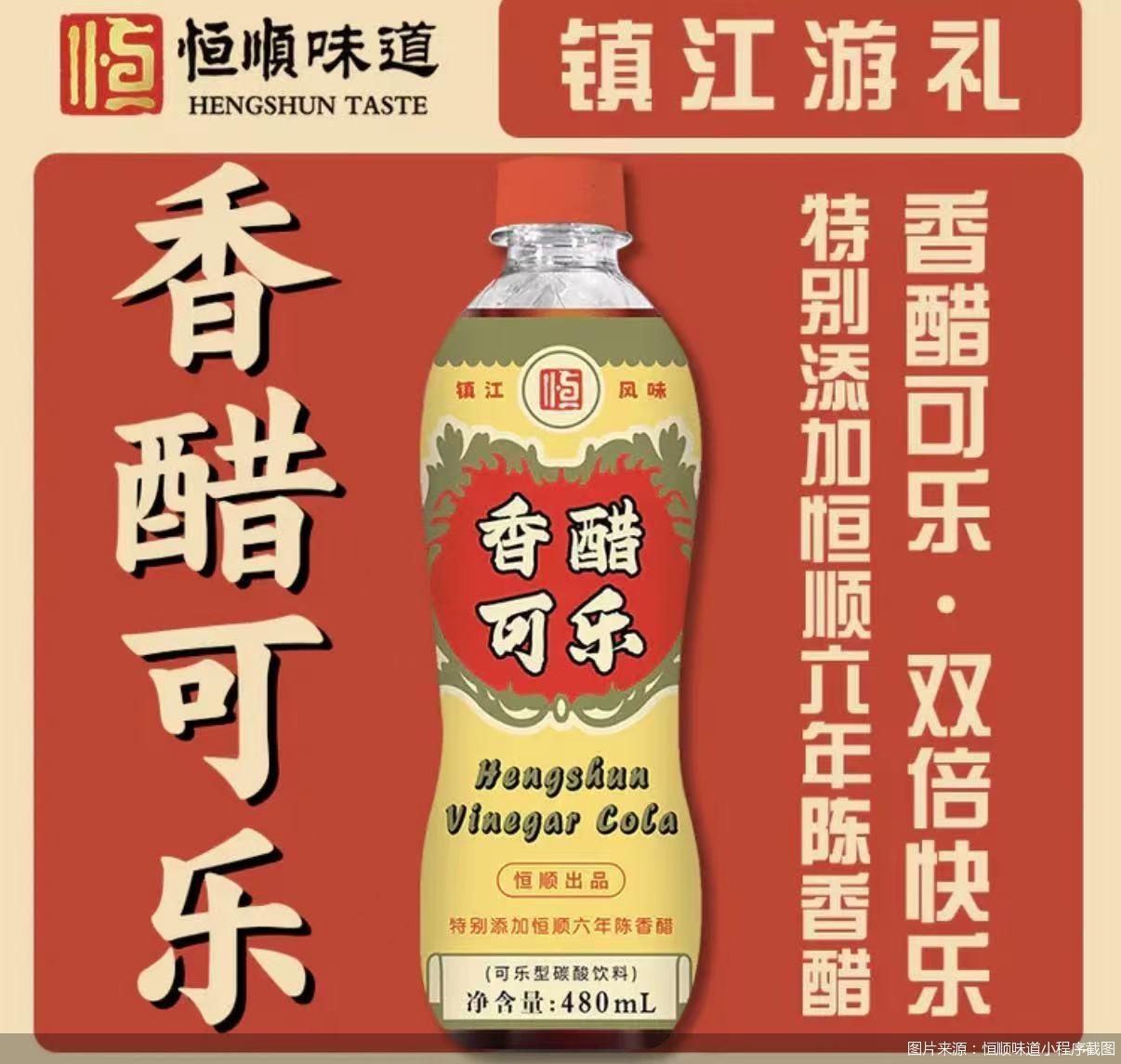
Core Viewpoint - Hengshun Vinegar Industry, known as the "first stock of vinegar," has ventured into the beverage market by launching a vinegar-flavored cola, aiming to attract younger consumers and diversify its product offerings [1][3]. Group 1: Product Launch and Market Reception - The new vinegar cola product is sold in packs of six 480ml bottles for 42 yuan, with 209 units sold as of the report date [3]. - Consumer reactions on social media are mixed, with some finding the taste unusual while others appreciate its uniqueness [3]. - This is not the first time Hengshun has expanded beyond traditional vinegar products; previous launches include a low-calorie sparkling vinegar drink and a series of creative ice creams [3]. Group 2: Company Background and Financial Performance - Hengshun Vinegar Industry, established in 1840 and publicly listed in 2001, primarily focuses on the research, production, and sale of vinegar and other condiments [4]. - The company has experienced fluctuating financial performance, with revenue growth rates of -6.45%, 12.98%, -1.52%, and 4.25% from 2021 to 2024, and net profit growth rates of -62.28%, 16.04%, -37.03%, and 46.54% during the same period [4]. - In the first three quarters of 2025, the company reported revenue of 1.628 billion yuan, a year-on-year increase of 6.3%, and a net profit of 142 million yuan, up 17.98% [4]. Group 3: Market Position and Strategic Direction - Vinegar products consistently account for over 60% of Hengshun's total revenue, but growth in this segment has slowed in recent years [5]. - The company plans to transition from a "vinegar industry" to a "flavor industry," focusing on a comprehensive condiment strategy and developing new products like vinegar beverages and functional products [5]. - The competitive landscape is intensifying, with local brands and major condiment companies increasing their presence in the vinegar market [5]. Group 4: Expert Opinions and Recommendations - Experts suggest that Hengshun's transition to a broader flavor strategy is appropriate, but recommend establishing independent sub-brands for new product categories to maintain the integrity of the main brand [6].

中国必选消费品1月价格报告:次高端及以上白酒分化加剧,本期无大众品折扣减小
Haitong Securities International· 2026-01-29 11:28
Investment Rating - The report assigns an "Outperform" rating to multiple companies in the consumer staples sector, including Guizhou Moutai, Wuliangye, Luzhou Laojiao, and others, indicating a positive outlook for these stocks [1]. Core Insights - There is an intensified divergence among mid-to-high-end baijiu products, with no discount contraction observed in food and beverage categories [1]. - The report highlights that the wholesale prices of various baijiu brands have shown stability or slight changes, with some brands experiencing price increases while others remain flat or decrease [3][4][35]. - Discounts on representative products in condiments, liquid milk, and soft drinks have widened compared to the end of December, indicating a shift in pricing strategies [19][32]. Summary by Relevant Sections Baijiu Pricing - Guizhou Moutai's wholesale prices for Feitian (case and single bottle) and Moutai 1935 are reported at 1600, 1580, and 630 yuan respectively, with changes of 0, -10, and -10 yuan compared to last month [35]. - Wuliangye's eighth-generation price is 830 yuan, reflecting a +10 yuan increase from the previous month [35]. - Luzhou Laojiao's Guojiao 1573 remains at 850 yuan, unchanged from last month [35]. Discount Trends - The average discount rate for condiments decreased from 87.1% to 85.0%, while liquid milk discounts fell from 62.8% to 61.4% [19][22]. - In contrast, discounts for beer, infant formula, and convenience foods remained stable, with beer discounts slightly increasing from 80.3% to 80.7% [20][22][32]. Company Ratings - The report lists several companies with an "Outperform" rating, including: - Guizhou Moutai - Wuliangye - Luzhou Laojiao - Qingdao Beer - China Feihe - Others [1].





2025Q4机构持仓总结:食饮获配比例回落,乳品、零食板块加配
GUOTAI HAITONG SECURITIES· 2026-01-29 09:34
Investment Rating - The report rates the food and beverage sector as "Overweight" [4][6]. Core Insights - The allocation ratio for the food and beverage sector has decreased quarter-on-quarter, with significant reductions in the allocation for both liquor and non-liquor segments. Conversely, other segments such as beverages, dairy products, and snacks have seen an increase in allocation [2][16]. - The report suggests focusing on five main investment lines, emphasizing opportunities arising from supply-demand clearing. Recommended stocks include Guizhou Moutai, Wuliangye, and Luzhou Laojiao for liquor; Eastroc Beverage and Nongfu Spring for beverages; and various companies in the snack and food processing sectors [6][32]. Summary by Sections 1. Sector Allocation Trends - The allocation ratio for food and beverage stocks among actively managed equity mutual funds has continued to decline for seven consecutive quarters, reaching 4.04% in Q4 2025, ranking ninth among all sectors [8][11]. - The allocation for liquor stocks decreased to 2.92%, driven by declines in leading brands such as Wuliangye and Shanxi Fenjiu [16][18]. 2. Sub-Sector Performance - Liquor and non-liquor segments saw a reduction in allocation, while other segments like snacks and dairy products experienced increases. The allocation for snacks rose to 0.26%, and dairy products to 0.44% [16][17]. - Specific stock movements include a decrease in holdings for major liquor brands, while dairy leaders like Yili and Mengniu saw increases in their allocation ratios [23][24]. 3. Individual Stock Analysis - Major liquor stocks such as Guizhou Moutai and Wuliangye experienced significant reductions in their mutual fund holdings, with Moutai down by 0.8% and Wuliangye down by 13.2% [19][20]. - In the beverage sector, Eastroc Beverage's holdings decreased by 4.16%, while Yili's increased by 3.42% [23][24]. - Snack companies like Wancheng Group and Ximai Foods saw increases in their allocation ratios, indicating a positive trend in the snack segment [26][27]. 4. Valuation and Earnings Forecast - The report includes a section on earnings forecasts and valuations, indicating a cautious outlook for the food and beverage sector amidst changing consumer preferences and market dynamics [32].


白酒爆发,17股涨停!吃喝板块午后暴拉,食品饮料ETF(515710)飙涨7.1%连收4根均线!
Xin Lang Cai Jing· 2026-01-29 09:30
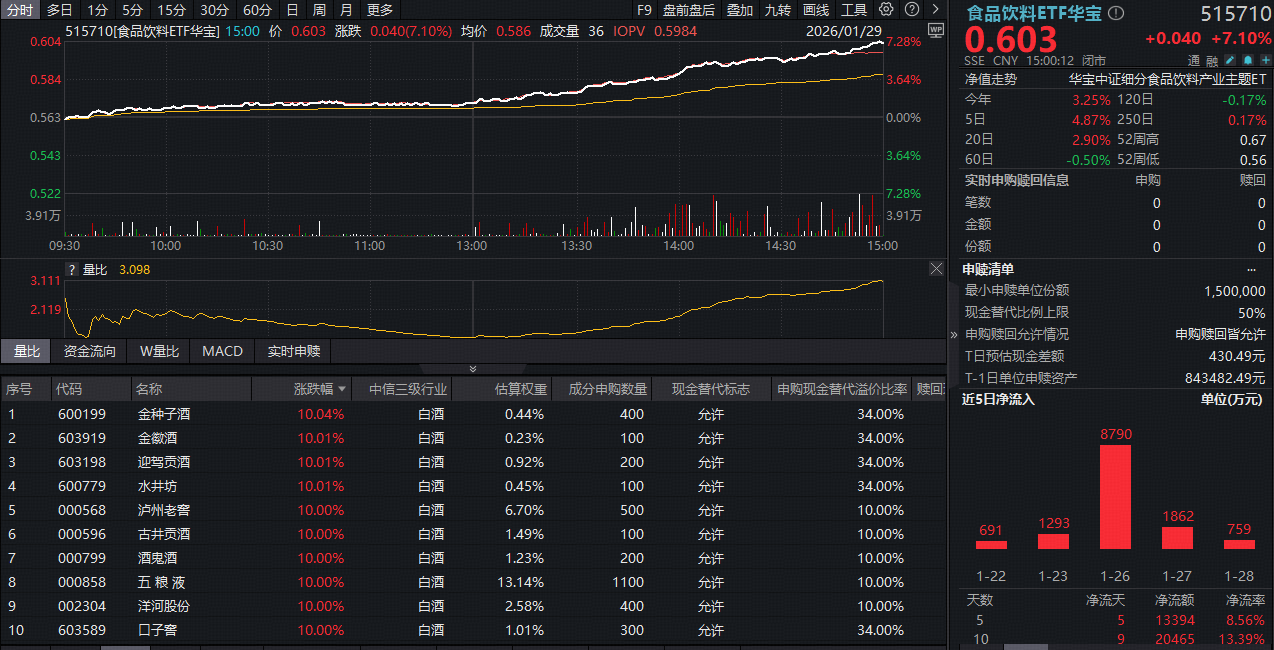
Core Viewpoint - The liquor sector experienced a significant surge on January 29, leading to an overall rise in the food and beverage sector, with the Huabao Food and Beverage ETF (515710) increasing by 7.1% by the end of the trading day, recovering multiple moving averages [1][4]. Group 1: Liquor Stock Performance - A wave of涨停 (limit-up) occurred among liquor stocks, with major players like Wuliangye, Luzhou Laojiao, and Yanghe all hitting the limit, while Kweichow Moutai surged by 8.61% [2]. - The price of various Flying Moutai products has seen notable increases since January 26, with the 2026 Flying Moutai original box (53 degrees/500ml) rising by 55 yuan, and the 2025 version also increasing by 55 yuan [4]. Group 2: Market Drivers - The recent recovery in Moutai sales is attributed to two main factors: the demand for high-end liquor during the Spring Festival and effective supply-demand adjustments by iMoutai, which has reached new consumer groups [4]. - The overall valuation of the food and beverage sector remains low, with the price-to-earnings ratio of the Huabao Food and Beverage ETF at 19.09 times, placing it in the 1.37% percentile of the last decade, indicating a favorable long-term investment opportunity [4]. Group 3: Future Outlook - According to Guojin Securities, the most challenging period for the liquor industry has passed, and external constraints on consumption are expected to ease, leading to a gradual stabilization in sales post-2026 Spring Festival [6]. - The Huabao Food and Beverage ETF is recommended for investors looking to gain exposure to core assets in the food and beverage sector, with approximately 60% of its portfolio allocated to leading high-end and mid-range liquor stocks [6].
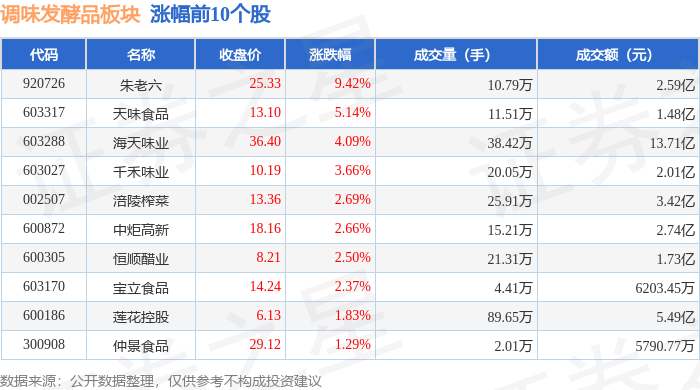
调味发酵品板块1月29日涨3.11%,朱老六领涨,主力资金净流入3.14亿元
Zheng Xing Xing Ye Ri Bao· 2026-01-29 09:03
Core Insights - The seasoning and fermentation sector experienced a 3.11% increase on January 29, with Zhu Laoliu leading the gains [1] - The Shanghai Composite Index closed at 4157.98, up 0.16%, while the Shenzhen Component Index closed at 14300.08, down 0.3% [1] Stock Performance - Zhu Laoliu (code: 920726) closed at 25.33, up 9.42% with a trading volume of 107,900 shares and a transaction value of 259 million [1] - Tianwei Food (code: 603317) closed at 13.10, up 5.14% with a trading volume of 115,100 shares and a transaction value of 148 million [1] - Haitian Flavoring (code: 603288) closed at 36.40, up 4.09% with a trading volume of 384,200 shares and a transaction value of 1.371 billion [1] - Qianhe Flavoring (code: 603027) closed at 10.19, up 3.66% with a trading volume of 200,500 shares and a transaction value of 201 million [1] - Other notable stocks include: - Haoling Zicai (code: 002507) closed at 13.36, up 2.69% [1] - Zhongju Gaoxin (code: 600872) closed at 18.16, up 2.66% [1] Capital Flow - The seasoning and fermentation sector saw a net inflow of 314 million from main funds, while retail funds experienced a net outflow of 183 million [2] - The main funds' net inflow and outflow for specific stocks include: - Haitian Flavoring: net inflow of 208 million, net outflow of 73.75 million from retail [3] - Lianhua Holdings: net inflow of 51.06 million, net outflow of 27.86 million from retail [3] - Zhu Laoliu: net inflow of 30.72 million, net inflow of 514.26 million from retail [3]