三星

Search documents
最高补贴2万元,汽车以旧换新补贴实施细则出炉|首席资讯日报
首席商业评论· 2026-01-01 04:42
Group 1 - The Ministry of Commerce and other departments have released the implementation details for the 2026 vehicle trade-in subsidy, offering a maximum subsidy of 20,000 yuan for consumers who scrap older vehicles and purchase new energy or low-emission vehicles [2] - The new revenue-sharing model for movies on iQIYI will take effect from January 15, 2026, covering both online story films and short window period films [3] - The National Development and Reform Commission has announced the early batch of "two heavy" project lists and central budget investments for 2026, totaling approximately 295 billion yuan, aimed at accelerating the pace of fund allocation and usage [4] Group 2 - Shenzhen Yujiang Technology Co., Ltd. has initiated the process for its A-share listing, with the underwriting broker being Guotai Junan Securities [5][6] - Xiaomi's chairman Lei Jun has postponed a New Year's live stream due to health issues, emphasizing the importance of health [7] - Weijing Medical has completed a B+ round financing of over 100 million yuan, with exclusive investment from Guotai Junan Innovation Investment Co., Ltd. and additional investment from strategic shareholder Kangji Medical [7] Group 3 - SoftBank has completed an additional investment of $22.5 billion in OpenAI, raising its total stake to approximately 11% [8] - Jin Xun Resources plans to globally issue 36,765,600 H-shares at a price of 30.00 HKD per share, with trading expected to begin on January 9, 2026 [9] - Changxin Technology has submitted its prospectus for listing on the STAR Market, reporting a revenue of 32.084 billion yuan for the first three quarters of 2025 [10] - OmniVision Technologies plans to globally issue 48,500,000 H-shares at a maximum price of 104.80 HKD per share, with trading expected to start on January 12, 2026 [11] Group 4 - The U.S. government has approved Samsung and SK Hynix to export chip manufacturing equipment to China in 2026, benefiting from exemptions from export restrictions [12]


三星坚持DDR4停产计划,2026年相关内存价格或持续上涨
Xin Lang Cai Jing· 2026-01-01 04:21
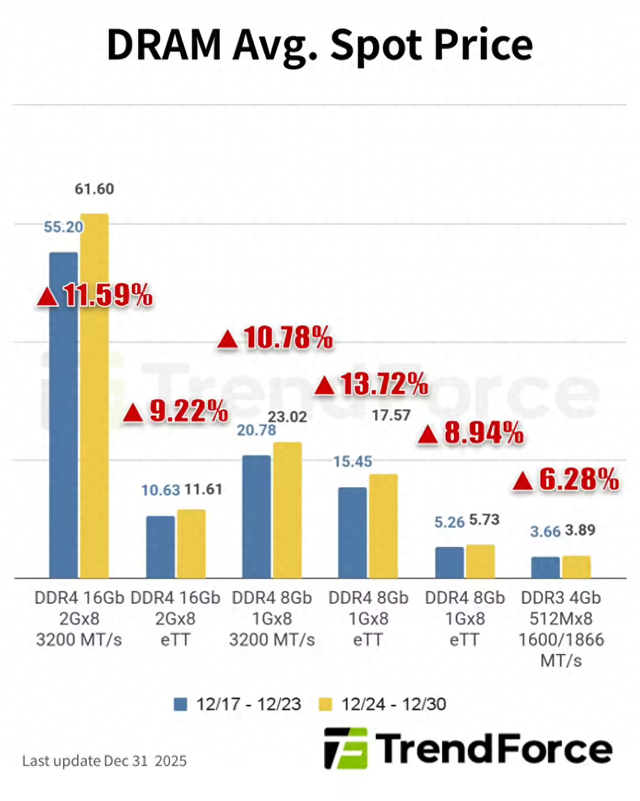
市场数据印证了价格上涨趋势。主流型号DDR4 1Gx8 3200MT/s芯片的现货均价,已从12月24日当周的 22.235美元,上涨6.80%至12月30日当周的23.746美元。 除DDR4内存外,NAND Flash市场也同步处于上涨通道。受2026年第一季度合约价格看涨的强烈预期影 响,NAND Flash现货价格进一步走高。本周,512Gb TLC晶圆的现货价格大涨13.35%,达到13.055美 元。目前,现货贸易商对后续价格走势持乐观态度,在出货环节坚持高价策略。(纯钧) 【环球网科技综合报道】1月1日消息,集邦咨询(TrendForce)近日发布行业报告指出,存储市场正面 临新一轮价格波动。全球存储行业巨头三星明确表示,不会推迟DDR4内存产品的停产(EOL)计划, 这一决策直接推动DDR4现货价格涨幅显著超过新一代DDR5产品,市场预计2026年DDR4价格或将持续 走高。 报告显示,三星的停产决定打破了市场对DDR4供应延续的预期,将引发深远行业连锁反应。随着停产 计划的推进,2026年DDR4内存供应量有望出现断崖式下跌。这种供应端的收缩将人为造成产品稀缺 性,可能导致DDR4价格出现倒 ...
256G比5090还贵!内存一年暴涨3倍,全球为奥特曼豪赌买单
猿大侠· 2026-01-01 04:12
Core Viewpoint - The global memory crisis is driven by the explosive demand from AI, leading to a threefold increase in memory prices over the past year, with significant implications for consumers and manufacturers alike [2][11][70]. Group 1: Price Surge and Market Impact - Memory prices have skyrocketed, with a 64GB memory stick that cost $350 two months ago now priced at $2,500 [3][6]. - The price of DDR5 contract memory has increased by 123% from the beginning of the year [20]. - The price of LPDDR5X memory chips for Apple's iPhone 17 series has risen from $25-$29 to approximately $70 within a year, indicating a 2-3 times increase [14][15]. Group 2: Supply Chain Dynamics - Major PC manufacturers like Lenovo and HP are securing pre-purchase agreements with memory suppliers to ensure access to memory for the upcoming year [19]. - The supply of traditional memory is being permanently redirected towards higher-profit AI products, leading to a significant reduction in the availability of mid-range memory for consumer electronics [30][44]. - Micron has announced its exit from the consumer memory business to focus on AI chip production, indicating a shift in production priorities among major memory manufacturers [46]. Group 3: AI's Role in Memory Demand - AI servers require significantly more memory, with DRAM needs being approximately eight times that of standard servers [33]. - AI is consuming 20% of global DRAM wafer capacity, exacerbating the supply shortage [48]. - The demand from AI is pushing the memory market into a structural shift, moving away from the previous cyclical fluctuations [69]. Group 4: Future Projections - The memory shortage is expected to persist until at least 2026, with significant implications for pricing and availability in the smartphone and PC markets [48][76]. - The rising costs of DRAM and NAND will force OEMs to either increase prices or reduce configurations, impacting consumer choices [75]. - 2026 is projected to be a year of increased technology product prices due to the competition for memory resources driven by AI data centers [78].


英伟达、AMD本月起或涨价,5090两千美元变五千
机器之心· 2026-01-01 03:42
Core Viewpoint - The price increase of GPUs by Nvidia and AMD is becoming a certainty, with expected adjustments starting in early 2026 [1][3]. Group 1: Price Increase Details - Nvidia and AMD plan to gradually raise prices for their GPUs in the coming months, with AMD starting in January and Nvidia in February [3]. - The price hike will initially affect consumer-grade GPUs, such as Nvidia's GeForce RTX 50 series and AMD's Radeon RX 9000 series, with the flagship RTX 5090 expected to rise from an official price of $1999 to around $5000 this year [4][6]. Group 2: Cost Structure and Drivers - The primary driver for the price increase is the rapid growth of memory costs within the GPU cost structure, with memory now accounting for over 80% of the overall manufacturing cost [7][8]. - The procurement cost of the 16GB GDDR7 memory used in the RTX 5070 Ti has surged from $65-80 in May 2025 to $210-260 by December 2025, complicating the maintenance of current GPU prices [8]. Group 3: Impact on AI and Other Products - The price increase will likely extend across all product lines, including GPUs used in AI data centers and servers, as new contracts signed in 2026 will reflect the increased memory prices [6][9]. - The flagship AI GPU H200 from Nvidia, priced between $30,000 and $40,000, is also expected to see further price increases this year due to rising memory costs [9]. Group 4: Market Reactions - Asus has announced a price increase for some products starting January 5, citing rising DRAM and storage costs driven by AI demand [10]. - Dell has previously indicated a price increase of 30%, reflecting similar market conditions [14].



中图科技第二次闯关科创板 拟募资10.5亿元
Zhong Guo Jing Ying Bao· 2026-01-01 01:42
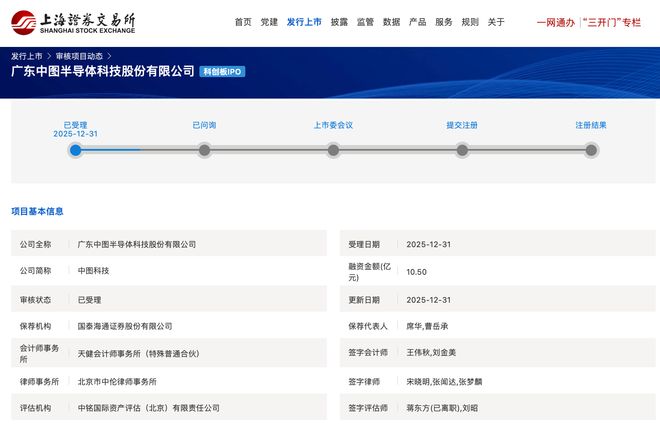
Core Viewpoint - Guangdong Zhongtu Semiconductor Technology Co., Ltd. (Zhongtu Technology) has received acceptance for its IPO on the Sci-Tech Innovation Board, aiming to raise approximately 1.05 billion yuan for various projects and working capital [1][2] Group 1: Company Overview - Zhongtu Technology is a leading global manufacturer of patterned substrate materials, with an annual production capacity exceeding 18 million pieces of 4-inch patterned substrates [1] - The company focuses on the research, production, and sales of patterned substrate materials required for Gallium Nitride (GaN) epitaxy, with key products including patterned sapphire substrates (PSS) and patterned composite material substrates (MMS) [1] - These materials are essential for upstream semiconductor applications, particularly in Mini/Micro LED, automotive lighting, and backlight displays [1] Group 2: Market Position and Clientele - According to industry research firm LEDinside, Zhongtu Technology holds approximately 32.76% of the global market share for patterned substrates in 2023 [1] - The company's direct clients include major LED chip enterprises such as Epistar, Seoul Viosys, Sanan Optoelectronics, and HC Semitek, indicating a strong presence in the market [2] - Zhongtu Technology's products are widely used in consumer electronics and new energy vehicles, with notable clients including Apple, Samsung, LG, Hisense, TCL, BYD, and NIO [2] Group 3: IPO Details - The funds raised from the IPO will be allocated to the industrialization of Mini/Micro LED and automotive LED chip patterned substrate projects, the establishment of a semiconductor substrate materials engineering research center, and to supplement working capital [1] - This marks Zhongtu Technology's second attempt to list on the Sci-Tech Innovation Board, having previously submitted an application in March 2020, which was voluntarily withdrawn in January 2022 [2]
英伟达为何斥资200亿美元收购Groq
半导体行业观察· 2026-01-01 01:26
Core Viewpoint - Nvidia's acquisition of Groq's technology and talent for $20 billion raises questions about the strategic rationale behind the deal, especially given the potential for antitrust scrutiny and the actual benefits derived from Groq's technology [1][2]. Group 1: Nvidia's Acquisition Details - Nvidia paid $20 billion for a non-exclusive license of Groq's intellectual property, including its Language Processing Unit (LPU) and associated software libraries [2]. - Groq will continue to operate independently, retaining its high-performance inference-as-a-service product, despite significant talent loss to Nvidia [2]. - The acquisition is seen as a move to eliminate competition, but the justification for the $20 billion price tag remains debatable [2]. Group 2: Technology Insights - Groq's LPU utilizes Static Random Access Memory (SRAM), which is significantly faster than the High Bandwidth Memory (HBM) used in current GPUs, potentially offering 10 to 80 times the speed [3]. - Groq's chip achieved a token generation speed of 350 tok/s in tests, and even higher at 465 tok/s when running mixed expert models [3]. - However, SRAM's low space efficiency means that running medium-sized language models would require hundreds or thousands of Groq's LPUs, raising questions about its practicality [4]. Group 3: Architectural Innovations - The key innovation from Groq is its "dataflow architecture," designed to accelerate linear algebra operations during inference, which could provide Nvidia with a competitive edge in chip performance [5][6]. - This architecture allows for continuous processing of data without waiting for memory, potentially overcoming bottlenecks that slow down GPU performance [6][7]. - Groq's LPU can theoretically achieve performance levels comparable to high-end GPUs, but practical performance may vary [7]. Group 4: Future Implications - Nvidia's collaboration with Groq could lead to new technology options for enhancing chip performance, particularly in inference optimization, an area where Nvidia has previously lacked a strong offering [8]. - The upcoming Rubin series chips from Nvidia are designed to optimize the inference pipeline, indicating a shift in architecture that could leverage Groq's technology [9]. - Groq's existing chip designs may not serve as excellent decoders, but they could be useful for speculative decoding, which enhances performance by predicting outputs from smaller models [9]. Group 5: Market Context - The $20 billion price tag for Groq's technology is substantial but manageable for Nvidia, given its recent operating cash flow of $23 billion [10]. - The acquisition may not immediately impact Nvidia's current chip production, as the company could be positioning itself for long-term strategic advantages [12].
存储暴涨!玩家自救
半导体行业观察· 2026-01-01 01:26
Core Viewpoint - The article discusses the significant increase in storage prices and the resulting impact on various consumer electronics, leading to a surge in prices for gaming consoles, laptops, and smartphones due to supply chain disruptions and heightened demand from AI applications [1][2]. Group 1: Impact on Consumer Electronics - By the end of 2025, global storage module prices are expected to have more than doubled compared to the beginning of the year, affecting various consumer devices [1]. - Gaming consoles and graphics cards are among the first to be impacted, with predictions of a price increase of 10% to 15% within the next one to two years [1]. - Laptop brands like Lenovo, Dell, and HP are forecasting a price increase of 15% to 20% by the second half of 2026 due to rising assembly costs [2]. - Xiaomi's upcoming flagship smartphone, the Xiaomi 17 Ultra, will also see a price increase attributed to high storage costs and supply instability, with IDC predicting an overall average price increase of 3% to 8% in the smartphone market [2]. Group 2: DIY Solutions and Consumer Adaptation - Some DIY enthusiasts are opting to assemble their own RAM modules as a response to rising prices, with reports of individuals successfully creating DDR5 modules at a cost comparable to market prices [3]. - Discussions on forums highlight the challenges of DIY storage solutions, particularly in sourcing stable chip components, indicating a community effort to explore low-cost upgrade options [4]. - As not everyone can assemble RAM, many consumers are choosing to maintain their existing devices, with a trend towards recycling old components and sharing upgrade strategies within communities [5]. Group 3: Market Adjustments and Consumer Behavior - The trend of extending device lifespans is becoming common among consumers, with companies like Framework promoting modular laptops that allow for easy upgrades and repairs [6]. - The article notes that while individual DIY solutions may not resolve the overall supply-demand imbalance, they reflect a broader consumer shift towards self-sufficiency in the face of resource scarcity [6].

特朗普批准韩企业向中国出口芯片制造设备
Sou Hu Cai Jing· 2026-01-01 00:49
2025年12月,全球科技行业的动荡再次升温——美国终于在2026年向三星和SK海力士松绑,批准它们 向中国出口芯片制造设备。可别以为这意味着美国对芯片出口政策的彻底放宽,实际上这只是局部的缓 解,一个隐藏着更多不确定性的暂时性措施。简而言之,韩国企业虽有了喘息之机,却也被迫在一个被 限制、要求和不确定性包围的环境中勉力前行。 文︱陆弃 让我们先回顾一下这一局面的背景。自2018年起,美国对中国的技术禁令日益加剧,芯片制造设备和技 术成为了禁令的"重头戏"。曾经被列入美国"经验证最终用户(VEU)"清单的三星和SK海力士,享有 可以免除出口许可证的特权——不再需要逐一申请许可证,只要符合相关条件,就可以将芯片设备送到 中国的工厂。然而,到了2025年,随着美国政府宣布撤销对三星和SK海力士的豁免,这一局面开始发 生变化。美国要求这些韩国巨头重新获得许可,并且每年审批一次。 然而,最新的消息显示,情况出现了"微调"。美国商务部放宽了这一限制,决定按年度批准这些企业出 口设备。换句话说,三星和SK海力士每年只需要提交设备需求清单,并等待美国政府的审批。这比之 前逐批审批的流程简便得多,但依然充满了复杂性和不确定性 ...
美韩芯片联合抬价,意外让中国存储芯片大赚80亿,国产芯片崛起了
Xin Lang Cai Jing· 2026-01-01 00:24
Core Viewpoint - Chinese memory chip companies are expected to achieve profits exceeding 2 billion yuan this year, a significant turnaround from a loss of nearly 6 billion yuan in the previous three quarters, primarily due to price increases driven by a collaboration between American and South Korean chip manufacturers [1] Group 1: Market Dynamics - The global memory chip market is dominated by the US and South Korea, with Japanese company Kioxia holding a secondary position in NAND flash storage, while US and South Korean companies monopolize the DRAM market [3] - The collaboration between US and South Korean chip manufacturers has historically led to price manipulation, resulting in substantial profits, as evidenced by past penalties imposed on them for such practices [3] Group 2: Impact of AI and Production Shifts - The rise of NVIDIA's dominance in AI chips has significantly impacted the memory chip market, as NVIDIA's demand for high-bandwidth memory (HBM) has led many manufacturers to shift production towards HBM chips, causing a sharp decline in DRAM production capacity [5] - As DRAM production capacity decreased, prices for DRAM memory modules nearly doubled, resulting in substantial profits for US and South Korean memory chip companies, while also benefiting Chinese memory chip firms, which are projected to achieve profitability for the first time since their establishment in 2016 [5] Group 3: Development of Chinese Memory Chip Industry - The Chinese memory chip industry has faced challenges since its inception in 2016, with one company facing lawsuits from US chip firms, while the other two have successfully developed their technologies [7] - Chinese NAND flash memory companies have focused on building their technology and patents from the ground up, achieving significant milestones such as mass production of 128-layer NAND flash chips and being the first to produce 232-layer NAND flash chips [7] - Despite facing obstacles due to restrictions on advanced chip equipment and materials from the US and its allies, Chinese memory chip companies have invested heavily, amounting to approximately 46 billion yuan, and are now beginning to see returns on their investments, moving towards independence from foreign memory chip reliance [9]
2025盘点:DeepSeek引领AI进化 国补激发消费活力 行业重塑带来更多可能
Xin Lang Cai Jing· 2025-12-31 16:07
Core Insights - The year 2025 has been pivotal for the digital 3C industry, marked by significant advancements in AI technology, policy support, and market dynamics, setting the stage for future developments in 2026 [1][15] Group 1: AI Developments - The launch of DeepSeek-R1 on January 20, 2025, showcased its competitive capabilities against top closed-source models with a training cost of approximately $6 million, challenging Silicon Valley's computational dominance [1][16] - DeepSeek's V3.2-Exp, released in September, introduced a sparse attention mechanism that halved API prices, while the December V3.2 version integrated logical reasoning with agent tool usage, achieving gold medal performances in international competitions [2][16] - DeepSeek's contributions to the 3C industry include promoting "open-source equity," enabling low-cost smart experiences on budget devices through cloud APIs, and leading a global shift towards efficiency in AI [2][16] Group 2: Policy Impact on Market - 2025 is defined as the "Year of National Subsidies" for the 3C market, with the introduction of a policy on January 8 that included subsidies of up to 500 yuan for mobile phones, tablets, and smartwatches, significantly boosting daily active users on e-commerce platforms [3][18] - The subsidy policy expanded in the second half of the year, with 14 provinces increasing the maximum subsidy to 700 yuan, resulting in a total retail sales increase of over 120 billion yuan [3][18] - The continuation of the subsidy policy into 2026 is expected to further include emerging categories like smart glasses, enhancing consumer access to mid-to-high-end products and shifting competition from parameter-based pricing to value-for-money battles [5][18] Group 3: Industry Challenges - The "Romashi incident" in June 2025 involved the recall of nearly 500,000 defective power banks due to safety concerns, leading to significant regulatory responses and the introduction of stricter safety standards in the power bank industry [19][21] - Following the incident, new regulations mandated that all power banks must carry a 3C certification, marking a shift away from low-cost models and ensuring consumer safety [21][22] Group 4: Growth of AI Glasses - 2025 marked a breakthrough year for the AI glasses industry, driven by policy support and market demand, with global shipments expected to reach 12.05 million units and the Chinese market alone surpassing 2.75 million units, reflecting a 107% year-on-year increase [8][22] - The emergence of numerous brands, including major players like Huawei and Xiaomi, indicates a competitive landscape with nearly 70 companies entering the market [10][24] Group 5: AI Assistant Developments - The launch of the "Doubao Phone" by ByteDance and ZTE on December 1, 2025, introduced an AI assistant capable of executing complex tasks across applications, marking a significant advancement in mobile technology [10][24] - The introduction of the AI assistant sparked a debate over app permissions and user data security, highlighting the tension between innovation and established app ecosystems [12][27]