万华化学

Search documents
合成橡胶早报-20251023
Yong An Qi Huo· 2025-10-23 00:48
Report Information - Report Title: Synthetic Rubber Morning Report [2] - Research Team: Energy and Chemicals Team of the Research Center [3] - Report Date: October 23, 2025 [3] Key Points BR (Butadiene Rubber) Futures Market - The closing price of the BR12 main contract on October 22 was 11,050, up 10 from the previous day and down 85 from the previous week [4]. - The open interest was 71,972, down 836 from the previous day and up 53,561 from the previous week [4]. - The trading volume was 79,454, down 44,237 from the previous day and up 2,550 from the previous week [4]. - The number of warehouse receipts was 8,920, up 300 from the previous day and up 170 from the previous week [4]. - The long - short ratio was 40.34, down 2 from the previous day and up 30 from the previous week [4]. Basis, Spread and Inter - Variety Spread - The basis between BR12 and BR01 was 25, up 5 from the previous day and unchanged from the previous week [4]. - The spread between BR01 and BR02 was 10, down 5 from the previous day and up 10 from the previous week [4]. - The spread between RU - BR was 4,100, down 10 from the previous day and up 335 from the previous week [4]. - The spread between NR - BR was 1,300, down 25 from the previous day and up 120 from the previous week [4]. Spot Market - The Shandong market price was 11,100, unchanged from the previous day and up 50 from the previous week [4]. - The Transfar market price was 10,950, unchanged from the previous day and up 50 from the previous week [4]. - The Qilu ex - factory price was 11,200, unchanged from the previous day and the previous week [4]. - The CFR Northeast Asia price was 1,475, unchanged from the previous day and down 25 from the previous week [4]. - The CFR Southeast Asia price was 1,700, unchanged from the previous day and the previous week [4]. Profit - The spot processing profit was 230, up 102 from the previous day and up 203 from the previous week [4]. - The import profit was - 1,277, down 2 from the previous day and up 255 from the previous week [4]. - The export profit was 1,803, up 2 from the previous day and down 47 from the previous week [4]. BD (Butadiene) Spot Market - The Shandong market price was 8,500, down 100 from the previous day and down 150 from the previous week [4]. - The Jiangsu market price was 8,500, down 25 from the previous day and down 50 from the previous week [4]. - The Yangzi ex - factory price was 8,600, unchanged from the previous day and the previous week [4]. - The CFR China price was 975, down 35 from the previous week [4]. Profit - The carbon - four extraction profit was 1,885 (data for October 20) [4]. - The butylene oxidative dehydrogenation profit was - 104, down 25 from the previous day and up 20 from the previous week [4]. - The import profit was 203 (data for October 22), up 234 from the previous week [4]. - The export profit was - 921, down 48 from the previous day and down 386 from the previous week [4]. Production Profit of Related Products - The butadiene - styrene production profit was 863, unchanged from the previous day and up 138 from the previous week [4]. - The ABS production profit was - 33 (data for October 20) [4]. - The SBS production profit was 175, down 300 from the previous day and down 810 from the previous week [4].
动态高分子论坛官宣︱2025(第三届)高分子循环再利用大会
DT新材料· 2025-10-22 16:05
Core Viewpoint - The 2025 Dynamic Polymer Forum focuses on the design and manufacturing of recyclable dynamic polymers, emphasizing their role in sustainable development through reversible chemical bonds that enable recycling, self-repair, and reprocessing [2][4]. Group 1: Event Overview - The forum is organized by DT New Materials and will take place from December 11-13, 2025, in Ningbo, Zhejiang [3]. - The event will feature a macro forum on polymer recycling, advanced recycling technologies, and case studies on the circular use of PCR/PIR polymers [18][19]. Group 2: Key Topics - Dynamic polymer chemistry and principles [5]. - High-performance dynamic polymer materials that can self-repair and be recycled under mild conditions [5]. - High-stability dynamic non-covalent supermolecular polymer materials [5]. - Dynamic polymer elastomer materials [5]. - Dynamic polymer gel materials [5]. Group 3: Specialized Topics - Macro forum on polymer recycling industry, discussing domestic and international recycling policies, regulations, and future development directions [6]. - Advanced recycling technologies for waste polymers, including various depolymerization methods [6]. - Case studies on the circular use of PCR/PIR polymers, focusing on regulatory impacts and technological advancements in recycling [7][8]. Group 4: Highlights of the Forum - Insights into global plastic recycling policies and China's 14th Five-Year Plan for plastic recycling [10]. - Sharing advancements in advanced recycling technologies for mixed low-value waste plastics and rubber [10]. - Discussion on balancing performance, compliance, and sustainability in recycled plastics across various industries [10]. - Exploration of dynamic polymers' sustainability and functionality through molecular structure design [10]. - Opportunities for collaboration and innovation among leading enterprises, top universities, and industry stakeholders [10]. Group 5: Agenda Overview - The agenda includes registration, a youth scientist forum, and various specialized sessions on polymer recycling and advanced technologies [11].

中石化,终于对这个热门材料动手了!
DT新材料· 2025-10-22 16:05
Core Viewpoint - The article discusses the recent developments in the production and application of cyclic olefin copolymers (COC) in China, highlighting investments, production capacities, and market trends in the COC industry. Group 1: Investment and Production Capacity - Sinopec (Tianjin) has filed for a fixed asset investment project for a COC facility, which includes a 850 tons/year NBE unit and a 1000 tons/year COC unit, with an operational time of 8000 hours per year, expecting a COC capacity of 1000 tons/year [2] - AkzoNobel plans to expand its production with a 20,000 tons/year fatty amine project and a new 10,000 tons/year high-transparency material project, set to enter production by June 30, 2025 [4] - Topkin Technology's first phase of 3000 tons/year SOOC® production has been successfully launched, with a total capacity of 10,000 tons/year expected after the second phase [4] - Liaoning Luhua Hongjin's COC facility has successfully produced 500 tons of COC and 1000 tons of NBE, with plans for further capacity expansion [5] Group 2: Market Trends and Applications - COC is a high-value thermoplastic engineering plastic with applications in optics, medical fields, and mobile devices, with global consumption expected to reach 90,000 tons in 2024, and China's consumption projected to grow to 29,000 tons by 2025 [3] - Japan currently dominates the global COC market, with major players including Japan's Zeon, Polyplastics, and Mitsui Chemicals, among others [3] - The article notes the increasing support from policies and investments in the COC sector, leading to significant advancements by various companies in production and technology [3][5]
中国企业出海进入市场的实践:共赢思维是开拓市场的钥匙
Shenwan Hongyuan Securities· 2025-10-22 13:15
Group 1: Mergers and Acquisitions - After the 2008 financial crisis, Chinese companies injected cash flow into struggling enterprises in developed countries through mergers and acquisitions, leading to a first wave of acquisitions[3] - From 2015 to 2018, overseas mergers and acquisitions peaked, with companies leveraging these to transform and quickly acquire core technologies[3] - By February 2023, state-owned enterprises had undertaken over 200 major overseas infrastructure projects, enhancing local livelihoods and infrastructure[14] Group 2: Joint Ventures and Local Partnerships - Companies prioritize partnerships that align with local government policies and economic expectations, as seen with SAIC's MG in India, where local partners hold 51% but SAIC retains 53% voting rights[3][51] - Successful overseas ventures require understanding local regulations and building capable local teams, as demonstrated by Chinese new energy vehicle companies collaborating with local educational institutions in Thailand[62] Group 3: Risks and Challenges - Key risks include uncertainties in overseas policies and compliance, market perception biases, exchange rate fluctuations, and supply chain vulnerabilities[5][65] - The geopolitical landscape has intensified risks associated with cross-border mergers, leading to a decline in Chinese companies' overseas acquisition amounts post-2018[40] Group 4: Market Entry Strategies - Companies can choose from various market entry strategies, including greenfield investments, brownfield acquisitions, or joint ventures, each with distinct cost, resource, and risk profiles[16][17] - The principle of "altruism and win-win" underpins the strategies of mergers, joint ventures, and local manufacturing, contrasting with the common perception of a purely transactional approach[4][10]
化工装置深挖系列三,丁二烯上下游配套与边际装置分析(下)
Hua Tai Qi Huo· 2025-10-22 11:18
1. Report Industry Investment Rating No relevant information provided. 2. Core Viewpoints of the Report The report analyzes the marginal devices of various downstream products of butadiene, including their current status, production capacity, and sourcing of raw materials. The four major demand areas for butadiene, namely cis - polybutadiene rubber, styrene - butadiene rubber, ABS, and SBS, account for 86.45% of the total butadiene demand. The analysis is carried out in descending order of the demand ratio of externally - sourced raw material devices [8]. 3. Summary According to the Catalog 3.1 Preface The previous part of the series analyzed the marginal devices and regional device balance of butadiene itself. This part focuses on the marginal devices of butadiene's downstream products. The four major demand areas for butadiene are cis - polybutadiene rubber, styrene - butadiene rubber, ABS, and SBS, accounting for 86.45% of the total demand. The analysis will be conducted in descending order of the demand ratio of externally - sourced raw material devices [8]. 3.2 Butadiene Downstream Device Analysis 3.2.1 Cis - Polybutadiene Rubber Device - **Status Analysis**: There are 38 sets of cis - polybutadiene rubber devices in China, with 5 shut down, 1 under construction, and 32 in production. The total production capacity of existing devices is 2.072 million tons. The production capacity of private enterprises is 0.54 million tons (26.06%), state - owned enterprises is 1.472 million tons (71.04%), and foreign - funded enterprises is 0.06 million tons (2.9%). All use the polymerization method [9]. - **Marginal Capacity Analysis**: Among the 2.112 million tons of in - production devices, the total production capacity of devices with self - owned butadiene is 1.23 million tons (59.36%), with state - owned devices accounting for 83%. The remaining over 40% of the devices need to source raw materials externally, mainly concentrated in East China, with a total production capacity of 0.842 million tons, and the capacity in East China accounting for 88.12% [13]. 3.2.2 ABS Device - **Status Analysis**: There are 28 sets of ABS polymer devices in China, with 2 shut down, 5 under construction, and 21 in production. The total production capacity of existing devices is 9.165 million tons. The production capacity of state - owned enterprises is 6.72 million tons (73.3%), private enterprises is 1 million tons (10.9%), and foreign - funded enterprises is 1.445 million tons (15.77%). The emulsion grafting method accounts for 90.67% of the production capacity, and the bulk method accounts for 9.33% [16]. - **Marginal Capacity Analysis**: Among the 9.165 million tons of in - production devices, the total production capacity of devices with self - owned butadiene is 2.34 million tons (25.53%), all of which are state - owned devices. The remaining 70% of the devices need to source raw materials externally, mainly concentrated in East China, with a total production capacity of 6.825 million tons, and the capacity in East China accounting for 64.1% [20]. 3.2.3 SBS Device - **Status Analysis**: There are 30 sets of SBS devices in China, with 1 shut down, 3 under construction, and 26 in production. The total production capacity of existing devices is 1.845 million tons. The production capacity of private enterprises is 0.44 million tons (23.85%), state - owned enterprises is 0.9 million tons (48.78%), and foreign - funded enterprises is 0.505 million tons (27.37%). The block anionic solution polymerization method accounts for 69.73% of the production capacity [25]. - **Marginal Capacity Analysis**: Among the 1.845 million tons of in - production devices, the total production capacity of devices with self - owned butadiene is 0.38 million tons (20.6%), with state - owned devices accounting for 65%. The remaining nearly 80% of the devices need to source raw materials externally, mainly concentrated in East and South China, with production capacities of 0.74 million tons and 0.655 million tons respectively, accounting for 39.59% and 39.25% [27]. 3.2.4 Styrene - Butadiene Rubber Device - **Status Analysis**: There are 29 sets of styrene - butadiene rubber devices in China, with 2 under construction, 25 in production, and 2 in long - term shutdown since 2018. The total production capacity of in - production devices is 1.765 million tons. The production capacity of private enterprises is 0.1 million tons (5.67%), state - owned enterprises is 1.615 million tons (91.5%), and foreign - funded enterprises is 0.05 million tons (2.83%). The emulsion polymerization method accounts for 68.19% of the production capacity [32]. - **Marginal Capacity Analysis**: Among the 1.765 million tons of in - production devices, the total production capacity of devices with self - owned butadiene is 1.055 million tons (59.77%), with state - owned devices accounting for 92.44%. The remaining 40% of the devices need to source raw materials externally, mainly concentrated in East China, with a total production capacity of 0.71 million tons, and the capacity in East China accounting for 84.5% [34]. 3.2.5 Nitrile Latex Device - **Status Analysis**: There are 47 sets of nitrile latex devices in China, with 8 shut down, 2 under construction, and 37 in production. The total production capacity of existing devices is 2.012 million tons. The production capacity of private enterprises is 1.122 million tons (55.77%), state - owned enterprises is 0.44 million tons (21.87%), and foreign - funded enterprises is 0.45 million tons (22.37%). All use the latex reactor device [38]. - **Marginal Capacity Analysis**: Among the 2.012 million tons of in - production devices, the total production capacity of devices with self - owned butadiene is 0.3 million tons (14.9%), all of which are state - owned devices. The remaining 85% of the devices need to source raw materials externally, mainly concentrated in East China, with private enterprises as the main force [41]. 3.2.6 SEBS Device - **Status Analysis**: There are 15 sets of SEBS devices in China, with 3 under construction and 12 in production. The total production capacity is 460,000 tons. The production capacity of private enterprises is 70,000 tons (15.22%), state - owned enterprises is 275,000 tons (59.78%), foreign - funded enterprises is 95,000 tons (20.65%), and Hong Kong, Macao, and Taiwan - funded enterprises is 20,000 tons (4.35%). The block anionic solution polymerization method accounts for 56.52% of the production capacity [46]. - **Marginal Capacity Analysis**: All SEBS devices in China need to source butadiene raw materials externally, mainly in East and South China. The device production capacity is small and scattered [49]. 3.2.7 Nitrile Rubber Device There are 5 sets of nitrile rubber devices in China, with a total production capacity of 285,000 tons. The production capacity of private enterprises is 185,000 tons (35.09%), and state - owned enterprises is 100,000 tons (64.91%). Private enterprise devices need to source raw materials externally, while the state - owned device has self - owned butadiene raw materials [52]. 3.2.8 Styrene - Butadiene Latex Device There are 9 sets of styrene - butadiene latex devices in China, with 1 under construction and 8 in production. The total production capacity is 245,000 tons. The production capacity of private enterprises is 190,000 tons (77.55%), state - owned enterprises is 50,000 tons (20.41%), and mixed - ownership enterprises is 5,000 tons (2.04%). The latex reactor device accounts for 100% of the production capacity [57]. 3.2.9 Pyridine - Butadiene Latex Device There are 5 sets of pyridine - butadiene latex devices in China, with 1 shut down and 4 in production. The total production capacity is 165,000 tons. The production capacity of private enterprises is 145,000 tons (87.88%), and foreign - funded enterprises is 20,000 tons (12.12%). The latex reactor device accounts for 100% of the production capacity [60]. 3.3 Summary - Cis - polybutadiene rubber: The total production capacity of devices with self - owned butadiene accounts for 59.36%, with state - owned devices accounting for 83%. The remaining over 40% of the devices need to source raw materials externally, mainly concentrated in East China, with a capacity accounting for 88.12% [65]. - ABS: The proportion of in - production devices with self - owned butadiene is 25.53%, all of which are state - owned devices. Nearly 75% of the devices need to source raw materials externally, mainly concentrated in East China, with a capacity accounting for 64.1%, and the remaining devices are distributed in South, Northeast, and North China [65]. - SBS: The total production capacity of devices with self - owned butadiene accounts for 20.6%, with state - owned devices accounting for 65%. Nearly 80% of the devices need to source raw materials externally, mainly concentrated in East and South China, accounting for 39.59% and 39.25% respectively, and the remaining devices are in Central, North, and Northeast China [65]. - Styrene - butadiene rubber: The total production capacity of devices with self - owned butadiene accounts for 59.77%, with state - owned devices accounting for 94.3%. 40% of the devices need to source raw materials externally, mainly concentrated in East China, with a capacity accounting for 84.5%, and the remaining devices are distributed in South, Northeast, and Central China [65]. - SEBS: All in - production devices need to source raw materials externally, mainly concentrated in East and South China, with capacity accounting for 39.19% and 31.08% respectively, and nearly 30% of the capacity in Central China [66]. - Nitrile latex: The total production capacity of devices with self - owned butadiene accounts for 14.9%, all of which are state - owned devices. 85% of the devices need to source raw materials externally, mainly concentrated in East China, with private enterprises as the main force [66].
PVC日报:震荡运行-20251022
Guan Tong Qi Huo· 2025-10-22 09:54
【行情分析】 上游西北地区电石价格稳定。目前供应端,PVC开工率环比减少5.94个百分点至76.69%,PVC开工 率减少较多,但仍处于近年同期偏高水平。国庆节后归来,PVC下游恢复幅度较大,PVC下游开工超 过国庆节前水平,但仍处于历年同期偏低水平。印度将BIS政策再次延期六个月至2025年12月24日执 行,中国台湾台塑11月份报价下调30-40美元/吨,8月14日,印度公示最新的进口PVC反倾销税,其中 中国大陆地区上调50美元/吨左右,四季度中国PVC出口预期减弱。不过,近期出口价格下降后,出 口签单暂未明显走弱。上周社会库存略有减少,目前仍偏高,库存压力仍然较大。2025年1-9月份, 房地产仍在调整阶段,投资、新开工、竣工面积同比降幅仍较大,投资、销售、施工等同比增速进 一步下降。30大中城市商品房周度成交面积环比继续回落,仍处于近年同期最低水平附近,房地产 改善仍需时间。氯碱综合利润仍为正值,PVC开工率同比往年偏高。同时新增产能上,50万吨/年的 万华化学8月份已经量产,40万吨/年的天津渤化8月份试生产后,预计9月底稳定生产,20万吨/年的 青岛海湾9月上旬已投产,目前接近满负荷生产,30万 ...
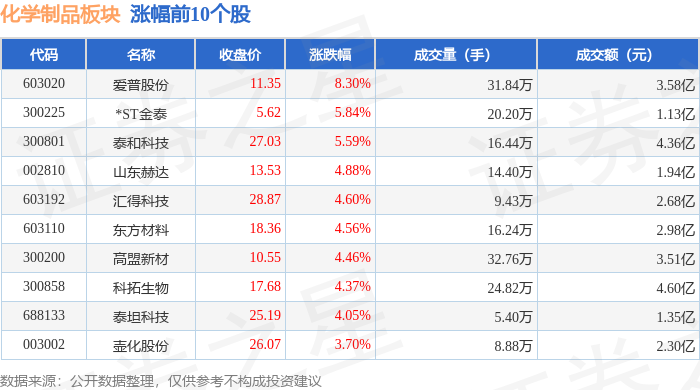
化学制品板块10月22日跌0.72%,博苑股份领跌,主力资金净流出9.18亿元
Zheng Xing Xing Ye Ri Bao· 2025-10-22 08:19
从资金流向上来看,当日化学制品板块主力资金净流出9.18亿元,游资资金净流入2.82亿元,散户资金净 流入6.36亿元。化学制品板块个股资金流向见下表: | 代码 | 名称 | 收盘价 | 涨跌幅 | 成交量(手) | 成交额(元) | | --- | --- | --- | --- | --- | --- | | 603020 | 爰普股份 | 11.35 | 8.30% | 31.84万 | 3.58亿 | | 300225 | *ST全泰 | 5.62 | 5.84% | 20.20万 | 1.13亿 | | 300801 | 泰和科技 | 27.03 | 5.59% | 16.44万 | 4.36 Z | | 002810 | 山东赫达 | 13.53 | 4.88% | 14.40万 | 1.94亿 | | 603192 | 汇得科技 | 28.87 | 4.60% | 9.43万 | 2.68 亿 | | 603110 | 东方材料 | 18.36 | 4.56% | 16.24万 | 2.9867 | | 300200 | 高盟新材 | 10.55 | 4.46% | 32.76万 | 3.51 ...


中美关税疑云再起,重点行业节能降碳支持管理办法印发
Huaan Securities· 2025-10-22 05:40
Investment Rating - The industry investment rating is "Overweight" [2] Core Views - The chemical sector experienced a decline of 5.83% from October 13 to October 17, 2025, ranking 26th among all sectors, underperforming the Shanghai Composite Index by 4.36 percentage points [6][24] - The report highlights a continued trend of divergence in the chemical industry in 2025, recommending focus on sectors such as synthetic biology, pesticides, chromatography media, sweeteners, vitamins, light hydrocarbon chemicals, COC polymers, and MDI [6] Summary by Sections Industry Performance - The chemical sector's performance was ranked 26th with a decline of 5.83% during the specified week, while the Shanghai Composite Index fell by 1.47% [6][24] - The top three performing sectors were banking (4.89%), coal (4.17%), and food and beverage (0.86%), while the bottom three were electronics (-7.14%), media (-6.27%), and automotive (-5.99%) [24][25] Key Industry Dynamics - The report discusses the impact of U.S.-China trade tensions, particularly the U.S. imposing additional tariffs on Chinese goods, which has led to increased uncertainty in the global chemical supply chain [37] - It notes that the chemical industry in China is considering a comprehensive restructuring to phase out outdated and loss-making plants as part of a broader strategy to enhance competitiveness [37] Recommendations - Focus on synthetic biology, which is expected to see significant growth due to the shift towards low-energy products and materials [6] - The upcoming quota policy for third-generation refrigerants is anticipated to create a high-growth cycle, benefiting companies with high quota shares [7] - The electronic specialty gases market is highlighted as a critical area for domestic substitution opportunities, driven by rapid upgrades in the semiconductor industry [8][10] - Light hydrocarbon chemicals are identified as a global trend, with a shift towards lighter raw materials expected to reshape the industry [10] - The COC polymer sector is noted for its accelerated domestic industrialization, with potential breakthroughs expected from local companies [11] - The potassium fertilizer market is projected to recover as international supply constraints ease, with companies like Nutrien and Canpotex reducing production [12] - The MDI market is characterized by oligopolistic supply dynamics, with a positive outlook as demand recovers [14]
中国化工企业有望重塑化工产业格局,石化ETF(159731)逆势上行
Mei Ri Jing Ji Xin Wen· 2025-10-22 03:13
Core Viewpoint - The China Petroleum and Chemical Industry Index has shown a slight increase, with leading stocks such as Hengyi Petrochemical and China National Offshore Oil Corporation driving the gains. The structural optimization of supply is anticipated, with a focus on resilient and advantageous sectors [1] Group 1: Market Performance - On October 22, the China Petroleum and Chemical Industry Index opened lower but rose approximately 0.15% [1] - Key stocks leading the index include Hengyi Petrochemical, Rongsheng Petrochemical, Tongkun Co., and China National Offshore Oil Corporation [1] - The Petrochemical ETF (159731) has followed the index's upward trend, highlighting its value positioning [1] Group 2: Supply Side Dynamics - Domestic policies frequently emphasize the need for structural optimization on the supply side, particularly against excessive competition [1] - Rising raw material costs and capacity impacts from Asia have led to shutdowns and capacity exits among European and American chemical companies [1] - Short-term geopolitical tensions have increased uncertainty in overseas chemical supply [1] Group 3: Long-term Outlook - China's chemical industry chain possesses a clear competitive advantage, driven by significant cost benefits and ongoing technological advancements [1] - Chinese chemical companies are rapidly filling gaps in the international supply chain, potentially reshaping the chemical industry landscape [1] Group 4: ETF Composition - The Petrochemical ETF (159731) and its linked funds closely track the China Petroleum and Chemical Industry Index [1] - The basic chemical industry accounts for 61.93% of the index, while the petroleum and petrochemical industry represents 30.84% [1] - The top ten weighted stocks in the index include Wanhua Chemical, China Petroleum, and China National Offshore Oil Corporation, collectively accounting for 55.12% of the index [1]
天赐材料前瞻布局!化工板块继续回调,机会来了?政策暖风频吹,机构持续唱多
Xin Lang Ji Jin· 2025-10-22 02:26
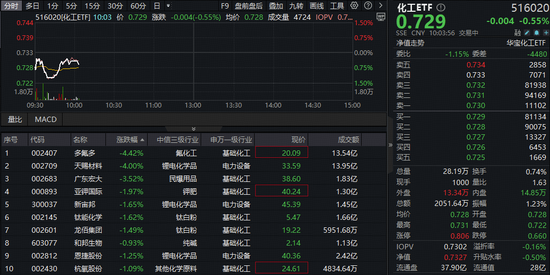
Group 1 - The chemical sector experienced a decline on October 22, with the chemical ETF (516020) dropping over 1% at one point before recovering slightly to a decrease of 0.55% [1] - Key stocks in the sector, including fluorine chemicals, lithium batteries, civil explosives, and potash fertilizers, saw significant declines, with companies like Duofluoride and Tianci Materials both falling over 4% [1][2] - Tianci Materials announced on October 21 that it has completed the technical reserve for sodium-ion battery electrolytes and related core materials, showcasing its strategic extension into sodium-ion battery technology [3] Group 2 - Analysts noted that Tianci Materials' integrated advantages in lithium battery electrolytes have positioned the company favorably for future growth, indicating strong technical adaptability and market insight [3] - As of October 21, the chemical ETF's underlying index had a price-to-book ratio of 2.24, which is at a low point historically, suggesting attractive long-term investment opportunities [3] - Looking ahead, the chemical industry is expected to improve due to the implementation of growth plans, with a focus on sectors such as pesticides, polyester filament, coal chemicals, phosphate, and potash fertilizers [4] Group 3 - Domestic policies are emphasizing supply-side structural optimization, while international factors like rising raw material costs and capacity reductions in Europe and the U.S. are creating uncertainties in chemical supply [4] - The chemical ETF (516020) tracks the CSI segmented chemical industry theme index, covering various sub-sectors and concentrating nearly 50% of its holdings in large-cap leading stocks [5] - Investors can also consider the chemical ETF linked funds (Class A 012537/Class C 012538) for exposure to the chemical sector [5]