
吉利汽车

Search documents
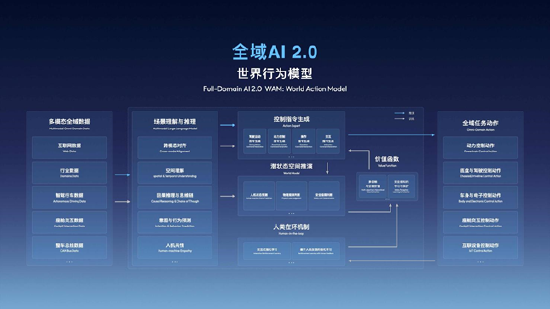
吉利发布全域AI 2.0 千里浩瀚G-ASD今年将推送高速L3和低速L4功能|直击CES
Xin Lang Cai Jing· 2026-01-06 22:07
Group 1 - Geely Auto Group announced the evolution of its AI technology system to version 2.0 at the 2026 CES, enabling cross-domain integration of AI technology in vehicles, providing a continuous "worldview" and "judgment" for automotive intelligence [1] - The new English brand name for Geely's advanced driving assistance system is G-ASD (Geely Afari Smart Driving), representing a high-modulus intelligent driving solution developed in collaboration with Qianli Zhijia [3] - G-ASD utilizes a Smart AI Agent architecture, enhanced by a cloud-based multimodal large model with over 100 billion parameters, significantly improving environmental perception and reasoning capabilities [3] Group 2 - G-ASD is equipped with an extensive dataset, including data from 8.5 million vehicles and 10 billion intelligent driving experiences, along with 25 million clips of model data and the industry's first million vehicle accident safety data [3] - The G-ASD system features leading perception hardware, with models like the Qianli Haohan H7 using Thor and dual Orin chips, and the H9 model achieving 1400 TOPS of computing power with five laser radars for comprehensive 360° coverage [3] - The first version of G-ASD has been integrated into several models from Zeekr and Lynk & Co, with plans to roll out Level 3 and Level 4 functionalities for Robotaxi operations within the year, subject to regulatory approval [4] Group 3 - Geely Auto Group reported sales exceeding 3.02 million units in 2025, with nearly 1.69 million units being new energy vehicles, reflecting a year-on-year growth of 90% [4]


沪指13连阳,再创十年新高,春季行情值得期待
Sou Hu Cai Jing· 2026-01-06 17:37
Market Overview - The A-share market continues its "opening red" trend, with the Shanghai Composite Index reaching a ten-year high. All three major indices closed higher, with the Shanghai Composite Index gaining 1.5%, the Shenzhen Component Index up 1.4%, and the ChiNext Index increasing by 0.75% [1] - The trading volume in the Shanghai and Shenzhen markets reached 2.81 trillion yuan, an increase of 260.2 billion yuan compared to the previous trading day. The market saw over a hundred stocks hitting the daily limit for two consecutive days, with high interest in sectors such as intelligent driving, commercial aerospace, and brain-computer interfaces [1] Intelligent Driving Sector - The intelligent driving concept was active today, with the Intelligent Automobile ETF rising by 4.16%. The industry is expected to see breakthroughs due to technological advancements and the implementation of policies and regulations. The Ministry of Industry and Information Technology has conditionally approved L3 product applications from two car manufacturers, marking a new phase of commercialization for intelligent driving in China [2] - At the CES 2026 conference, NVIDIA's CEO announced new AI inference technology for intelligent driving and a partnership with Mercedes to produce autonomous vehicles. Companies like Qianli Zhijia and Geely also launched new assisted driving brands at CES, indicating significant advancements in the sector [2] Chemical Industry - The chemical industry is expected to see improvements in supply-demand dynamics as supply-side reforms deepen and carbon peak initiatives progress. The Shaanxi Development and Reform Commission has proposed increasing electricity prices for high-energy-consuming products, which could raise costs for industries like chlor-alkali and calcium carbide, potentially leading to the exit of high-cost facilities [3] - The current "14th Five-Year Plan" is crucial for advancing carbon peak goals, with measures being implemented to control energy consumption, including the elimination of preferential electricity prices for high-energy-consuming products and the phasing out of chemical facilities over 20 years old. Investors are advised to pay attention to opportunities in leading chemical ETFs [3] Gold Market - The rising tensions in South America are increasing global uncertainty, which may enhance the safe-haven appeal of gold in the short term. In the medium to long term, loose liquidity and de-dollarization are expected to support gold prices. The long-term investment value of gold is viewed positively, with recommendations for investors to consider gold fund ETFs during market pullbacks to lower costs [3] - Central banks remain significant buyers of gold, and despite substantial increases in holdings over the past three years, the amount held is still relatively low compared to historical geopolitical turning points. Surveys indicate a continued moderate increase in gold purchases by central banks [3]
从“规模优势”迈向“系统优势” 中国科技闪耀CES2026
Zheng Quan Ri Bao· 2026-01-06 16:28
Core Insights - The CES 2026 showcases a significant transformation for Chinese tech companies, highlighting their strategic upgrades in industrial dynamics and globalization [1] Group 1: Industry Representation - The representation of Chinese companies at CES 2026 has evolved from primarily home appliance giants to a diverse array of participants, including both traditional leaders like TCL and emerging tech firms like Xunyang Power and New Stone Technology [2] - Companies like Hisense and Sichuan Changhong are pushing technological boundaries, with Hisense unveiling its new RGB-Mini LED display technology, projected to reach 500,000 units shipped by 2026 [2] Group 2: Systematic Solutions - Chinese enterprises are demonstrating platform-level capabilities, with companies like Great Wall Motors and Geely transitioning from traditional automotive manufacturing to providing comprehensive mobility solutions [3] - The focus has shifted from showcasing individual products to demonstrating systematic capabilities, as seen with Lens Technology and Guangdong Lingyi's full-stack AI hardware and robotics technology [3] Group 3: AI Integration - AI is a central theme at CES 2026, with a notable emphasis on the integration of AI with hardware, particularly in humanoid robots and AI glasses, showcasing advancements in embodied intelligence [4] - The presence of 16 Chinese brands among the 23 AI glasses exhibitors highlights China's innovation in AR/VR hardware and interactive experiences [4] Group 4: Global Collaboration - Chinese tech companies are increasingly collaborating with global industry leaders, as exemplified by Lenovo's partnership with Nvidia, which aims to expand their business scale by five times [6] - The shift from a broad "going global" strategy to a more localized and compliant approach is evident, with companies like Aiper establishing local R&D and distribution channels [6] Group 5: Challenges and Opportunities - Despite the advancements, challenges remain in bridging the gap between technology demonstration and large-scale commercialization, as well as navigating complex global compliance requirements [7] - The overall narrative reflects a significant evolution in the Chinese tech industry, moving from "Made in China" to "Created in China" and now to "Ecology of China" [7]
市场最前沿丨从车企年报透视中国汽车产业突围密码
Xin Hua Wang· 2026-01-06 15:48
Core Insights - The Chinese automotive industry is focusing on innovation, ecosystem collaboration, and market demand to achieve high-quality development, as evidenced by the recent performance of various companies [1][3]. Company Performance - BYD sold over 4.6 million vehicles in 2025, maintaining its position as the annual sales champion in China, showcasing a comprehensive breakthrough in product strength and global strategy [3]. - China FAW Group achieved over 3.3 million vehicle sales in 2025, with a 3.2% year-on-year growth, leading in both joint venture and fuel vehicle sales [3]. - Geely Automobile exceeded 3.02 million vehicle sales, achieving a historical high and surpassing its annual target [3]. - Changan Automobile, as a new state-owned enterprise, reported 2.91 million vehicle sales, marking a nearly nine-year high [3]. - Chery Group's sales surpassed 2.8 million vehicles, emphasizing innovation and user-centric product development [3]. New Entrants and Growth - Leap Motor emerged as the biggest "dark horse" in 2025, delivering nearly 600,000 vehicles, a 103% year-on-year increase, and achieving over 119% of its annual target [4]. - Huawei, leveraging its ICT expertise, collaborated with various automakers to launch popular models, delivering nearly 590,000 vehicles in 2025 [4]. - XPeng Motors delivered nearly 430,000 vehicles, achieving over 100% growth [4]. - NIO returned to a high growth trajectory in the latter half of 2025, delivering over 320,000 vehicles, a record high [6]. Future Outlook - The Chinese automotive industry is entering a new phase characterized by technological iteration, accelerated electrification, and globalization, aiming to lead in both quantity and quality [6]. - BYD plans to maintain significant R&D and financial investments to strengthen electrification and promote intelligent development, aiming to create a new growth curve [6].
德赛西威筹划赴港上市 推进国际化战略布局
Zheng Quan Shi Bao Wang· 2026-01-06 14:33
Core Viewpoint - Desay SV's announcement of planning to issue H-shares and list on the Hong Kong Stock Exchange aims to enhance its international strategy and brand influence while accelerating overseas business expansion [1] Group 1: Company Developments - Desay SV's stock reached a limit-up on January 6, closing at 137.39 yuan per share, with a market capitalization of 82 billion yuan [2] - The company focuses on three main areas: smart cockpits, intelligent driving, and connected services, maintaining a leading position in the industry [2] - In the first half of 2025, the sales revenue from the smart cockpit business is projected to reach 9.459 billion yuan, an increase of 18.76% year-on-year, while the intelligent driving business is expected to generate 4.147 billion yuan, up 55.49% year-on-year [2] Group 2: Client and Market Engagement - Desay SV's fourth-generation smart cockpit has been mass-produced for clients such as Li Auto, Xiaomi, and Geely, with new project orders from GAC Passenger Vehicle and others [2] - The company holds the top market share in the domestic auxiliary driving domain, providing flagship auxiliary driving controllers to major automakers including Xiaomi, Li Auto, Great Wall Motors, and others [2] - Desay SV has deepened strategic cooperation with global core chip manufacturers and OEMs, securing new project allocations from VW and Toyota in the first half of 2025 [2] Group 3: Global Expansion and Supply Chain - The company is building an international supply chain system with global R&D and manufacturing capabilities, having established branches in key countries such as Germany, France, Spain, Japan, and Singapore [3] - Desay SV's production capacity will begin contributing in Indonesia by May 2025, enhancing supply chain resilience in Southeast Asia, while a plant in Monterrey, Mexico, will provide localized services for the Americas [3] - The smart factory in Spain is expected to start production in 2026, offering advanced products in the smart cockpit and auxiliary driving sectors for the European market [3] Group 4: Financial Performance - For the first three quarters of 2025, Desay SV achieved a revenue of 22.337 billion yuan, reflecting a year-on-year growth of 17.72%, and a net profit of 1.788 billion yuan, up 27.08% year-on-year [3]
5分钟充满电!全球首款可量产全固态电池来了
2 1 Shi Ji Jing Ji Bao Dao· 2026-01-06 14:25
Group 1 - The solid-state battery sector continues to rise, with companies like HaiXi Communications and DaoShi Technology seeing gains of over 10% [1] - Donut Lab announced the launch of the world's first mass-producible all-solid-state battery at the CES in Las Vegas, boasting an energy density of 400Wh/kg, enabling longer range and lighter structure [1][2] - The all-solid-state battery can be fully charged in just 5 minutes and supports safe, reliable full discharge without significant capacity degradation over its lifespan, which can reach up to 100,000 cycles [1] Group 2 - The battery is designed without flammable liquid electrolytes, eliminating the risk of thermal runaway and dendrite formation, and has been rigorously tested under extreme conditions [2] - Donut Lab claims that the materials used for the solid-state battery are abundant, low-cost, and geopolitically secure, avoiding reliance on rare or sensitive elements [2] - Verge Motorcycles will be the first to use Donut Lab's solid-state battery, allowing for a 10-minute charge that provides up to 60 kilometers of range per minute of charging, with a long-range version capable of 600 kilometers on a single charge [3] Group 3 - Traditional lithium-ion batteries are nearing their theoretical energy density limit of 300Wh/kg, making it difficult to meet the demands for higher energy density and safety in electric vehicles and other applications [3] - Solid-state batteries are recognized as a disruptive technology that can achieve higher energy density and safety, prompting global companies and research teams to innovate to avoid falling behind [3] - The year 2026 is identified as a critical period for equipment localization in the solid-state battery industry [3]






5分钟充满电!全球首款可量产全固态电池来了
21世纪经济报道· 2026-01-06 14:24
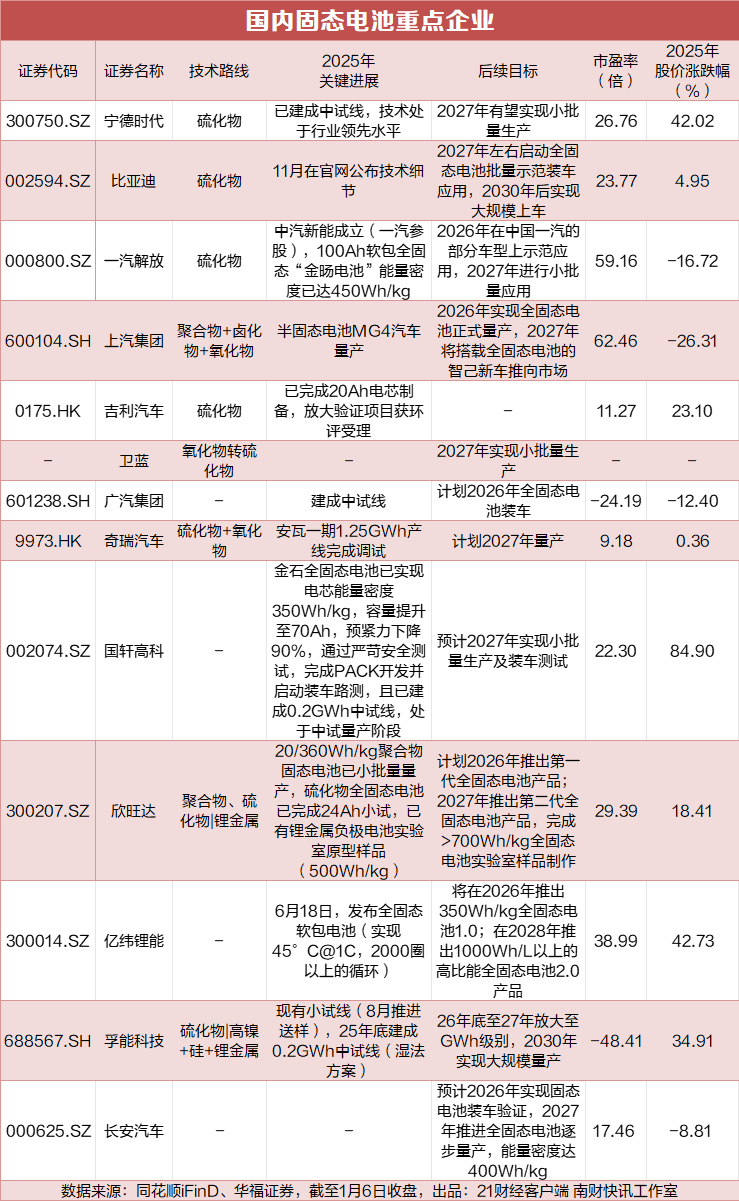
Core Viewpoint - The solid-state battery sector is experiencing significant growth, driven by innovations such as Donut Lab's announcement of the world's first mass-producible solid-state battery, which boasts a high energy density of 400Wh/kg and rapid charging capabilities [1][2]. Group 1: Industry Developments - Donut Lab's solid-state battery can be fully charged in just 5 minutes and supports complete discharge without safety concerns, unlike traditional lithium-ion batteries [1]. - The battery maintains over 99% capacity in extreme temperatures, both at -30°C and above 100°C, demonstrating superior safety and reliability [1]. - The solid-state battery technology is recognized as a disruptive innovation in the industry, with a consensus on the need to reduce liquid electrolyte content and increase solid electrolyte usage [3]. Group 2: Market Impact - Verge Motorcycles will be the first to utilize Donut Lab's solid-state battery, allowing for a 10-minute charge that provides up to 60 kilometers of range per minute of charging, with a long-range version capable of 600 kilometers on a single charge [2]. - Donut Lab is collaborating with WATTEV to create a lightweight modular electric vehicle platform, integrating their battery technology [2]. - Traditional lithium-ion batteries are nearing their theoretical energy density limit of 300Wh/kg, which poses challenges for applications requiring higher energy density and safety [2]. Group 3: Key Players in Solid-State Battery Development - Major companies in the solid-state battery space include CATL, BYD, and others, with various technological approaches and timelines for mass production [4][5]. - CATL aims for small-scale production of solid-state batteries by 2027, while BYD plans to start demonstration applications around the same time [4]. - Other companies like SAIC and Chery are also making strides in solid-state battery technology, with specific targets for production and energy density improvements by 2026 and 2027 [5].
众泰汽车:公司与吉利汽车暂无合作
Mei Ri Jing Ji Xin Wen· 2026-01-06 14:13
(文章来源:每日经济新闻) 众泰汽车(000980.SZ)1月6日在投资者互动平台表示,截至目前,公司与吉利汽车暂无合作。未来如 有合作,公司会按照相关法律法规要求及时履行信息披露义务。 每经AI快讯,有投资者在投资者互动平台提问:传闻吉利汽车的李书福拟对众泰汽车进行专业化整 合,请问目前进展如何? ...

中国车企深入巴西腹地
Cai Jing Wang· 2026-01-06 13:38
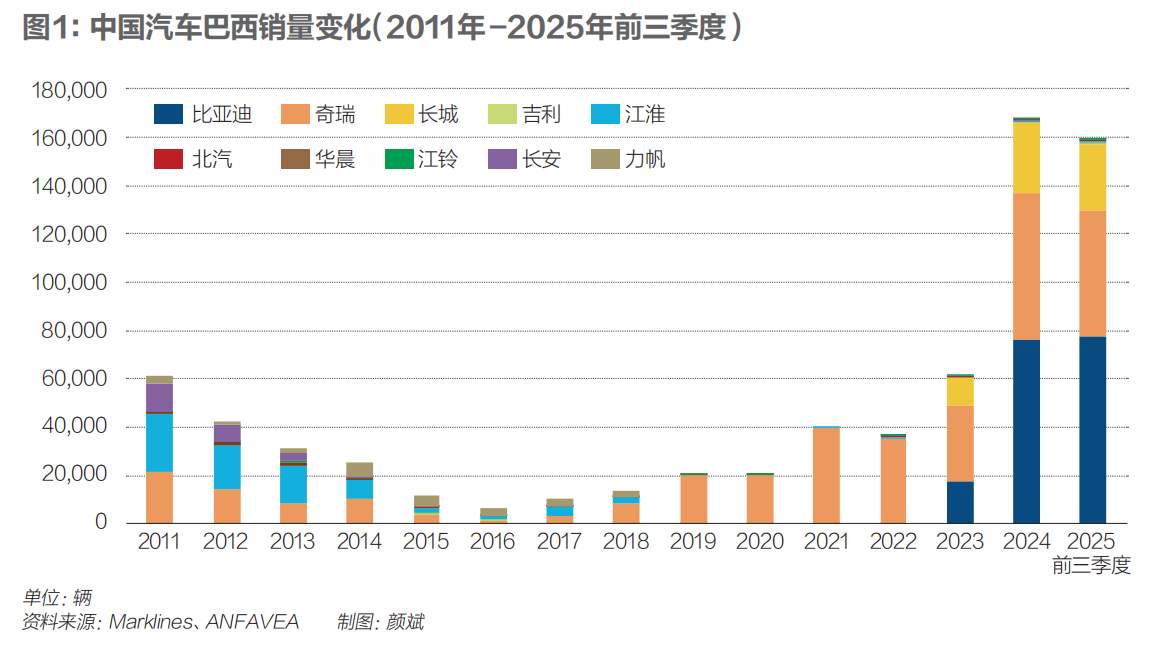
Core Insights - Chinese automotive brands are rapidly establishing a foothold in the Brazilian market, with nearly 40% representation at the São Paulo International Motor Show, showcasing a significant shift in market dynamics [1][3] - The success of Chinese companies in Brazil hinges on their ability to localize supply chains and enhance after-sales services, addressing past shortcomings [1][4] Group 1: Market Presence and Strategy - The São Paulo International Motor Show marked a collective appearance of Chinese brands, with notable participation from companies like BYD, Great Wall, and Chery, indicating a strong market presence [1][2] - Chinese brands are adopting high pricing strategies, with BYD's Tang L model priced at 399,900 reais (approximately 530,000 RMB), reflecting a shift towards the premium segment [1] - The overall market share of Chinese automotive companies in Brazil has surpassed 10%, establishing them as emerging players in the local automotive industry [3] Group 2: Historical Context and Evolution - The journey of Chinese automotive companies in Brazil can be divided into distinct phases: the initial wave from 2009 to 2014, a rebuilding phase from 2015 to 2020, and a resurgence starting in 2021 [7] - The first wave (2009-2014) was characterized by low-cost strategies and heavy marketing, but faced challenges due to a lack of localization and subsequent government policies that increased import taxes on non-localized vehicles [8][11] - The second phase saw companies like Chery pivoting to local partnerships, which helped improve brand perception and sales, with CAOA Chery achieving a 122% sales increase by 2018 [12] Group 3: Technological and Market Adaptation - The current wave (2021 onwards) is marked by significant capital investment and a focus on local production, with companies like Great Wall acquiring existing factories to establish a manufacturing base [13] - Chinese companies are leveraging advanced technologies in electric and hybrid vehicles, with BYD and Great Wall forming a duopoly in the Brazilian new energy vehicle market [14][20] - The adaptation to local market conditions includes developing vehicles that cater to Brazil's unique energy structure, particularly the prevalence of ethanol as a fuel source [27][28] Group 4: Challenges and Opportunities - The Brazilian automotive market presents challenges such as a highly unequal income distribution and specific consumer preferences for smaller vehicles due to parking constraints [23][24] - Chinese brands are addressing these challenges by offering compact, technologically advanced vehicles that appeal to middle-class consumers, moving away from the low-cost strategy of the past [25] - The Brazilian government's "MOVER" plan aims to stimulate local investment in high-efficiency vehicles, providing a framework for Chinese companies to align their strategies with national goals [29][32] Group 5: Future Outlook - The success of Chinese automotive companies in Brazil will depend on their ability to integrate technology transfer, deepen local market engagement, and enhance supply chain capabilities [33] - The potential for Chinese brands to act as a catalyst for innovation in the Brazilian automotive sector is recognized by the government, which seeks to leverage their presence for broader industrial upgrades [19][32]


吉利取得换电站热管理系统专利
Sou Hu Cai Jing· 2026-01-06 12:38
国家知识产权局信息显示,浙江吉利控股集团有限公司、浙江吉智新能源汽车科技有限公司取得一项名 为"换电站热管理系统及具有其的换电站"的专利,授权公告号CN119749319B,申请日期为2024年12 月。 声明:市场有风险,投资需谨慎。本文为AI基于第三方数据生成,仅供参考,不构成个人投资建议。 天眼查资料显示,浙江吉利控股集团有限公司,成立于2003年,位于杭州市,是一家以从事汽车制造业 为主的企业。企业注册资本103000万人民币。通过天眼查大数据分析,浙江吉利控股集团有限公司共对 外投资了38家企业,参与招投标项目523次,财产线索方面有商标信息5000条,专利信息5000条,此外 企业还拥有行政许可275个。 来源:市场资讯 浙江吉智新能源汽车科技有限公司,成立于2018年,位于杭州市,是一家以从事科技推广和应用服务业 为主的企业。企业注册资本10000万人民币。通过天眼查大数据分析,浙江吉智新能源汽车科技有限公 司参与招投标项目10次,专利信息487条,此外企业还拥有行政许可4个。 ...