华为

Search documents
OpenAI新视频震撼发布:这次,真的叫“颠覆”吗?揭秘AI发展的两条岔路
Sou Hu Cai Jing· 2026-01-22 10:47
咱们今天从这两天爆火的AI视频生成聊起,由于相关论文提供的细节内容还不够丰富,咱们暂时还无法对技术做特别深入的评论。 不过可以先说说大致的原理,以及外行普遍的误解。咱们首先要说,这个SORA模型在视频生成方面取得的突破是值得肯定的。它的核心思想在于对视频进 行高度的抽象和压缩,把视频映射到一个抽象的空间。 我这里给大家打一个简单的比方,大家应该都看过皮影戏,你可以把 SORA理解为一个高级点的皮影戏,它有一些抽象的基本的视频元素,相当于木偶,然 后用这些元素拼接成完整视频。 因为每个元素都是来自真实世界的视频,所以拼接出来的整体,至少"打眼一看"还是非常有真实感。然而,SORA和大家想象的真正的"理解物理世界",然 后基于这个理解仿真出一个虚拟的世界,还有不小的距离。多大呢?就是你用手机拍视频和电影制作之间的距离。 然后咱们再客观的讨论一下这个技术的实际影响。可能最重大的影响:股市。 这两天简单翻了一下网上各路外行的评论,尤其是那些不懂技术但是有流量的所谓大V,我觉得他们的想象力真的是非常令人佩服。 因此不用说取代实拍电影,就算是取代动画电影,以目前已知的技术思路,也是绝无可能性。注意不是还有多大差距,是绝对 ...


计算机行业月报:AI应用全面加速,DeepSeek V4有望深刻改变全球AI的竞争格局
Zhongyuan Securities· 2026-01-22 10:24
Investment Rating - The report maintains an "Outperform" rating for the computer industry, indicating a positive outlook compared to the market [1]. Core Insights - The acceleration of AI applications is expected to significantly reshape the global AI competitive landscape, particularly with the anticipated release of DeepSeek's V4 model [7]. - The Chinese AI cloud market is projected to reach 51.8 billion yuan by 2025 and 193 billion yuan by 2030, with Alibaba aiming to capture 80% of the market's incremental growth in 2026 [7]. - The report highlights the ongoing trend of domestic chip manufacturers gaining market share due to restrictions on foreign competitors, particularly Nvidia's H200 [7]. Summary by Sections Industry Data - From January to November 2025, the software industry revenue reached 13.98 trillion yuan, growing by 13.3% year-on-year, marking a continuous recovery over nine months [13]. - The IC design sector showed the highest growth rate at 16.5%, outperforming the overall software industry growth [18]. AI Developments - Major AI models such as OpenAI's GPT-5 and DeepSeek's V3.2 are leading the market, with DeepSeek's models expected to challenge established players significantly [41][46]. - The report notes that the trend of using domestic chips for training large models is expected to gain momentum in 2026, with DeepSeek already optimizing its models for compatibility with domestic chips [66]. Domestic Market Trends - The report emphasizes the increasing number of devices running on Huawei's HarmonyOS, which has surpassed 36 million, indicating a strong push towards domestic technology adoption [7]. - The AI cloud market is becoming increasingly competitive, with Alibaba and Volcano Engine emerging as the two dominant players [7]. Investment Opportunities - The report suggests focusing on companies like Runze Technology, Sugon, and Zhongke Shuguang, which have significant roles in the AI infrastructure and domestic chip development [7]. - It also highlights the potential of companies like Changxin Technology and Chipone Semiconductor, which are actively pursuing IPOs [7].


2025年中国智能手机市场再洗牌:华为重返榜首,苹果、vivo并列第二
Guo Ji Jin Rong Bao· 2026-01-22 10:15
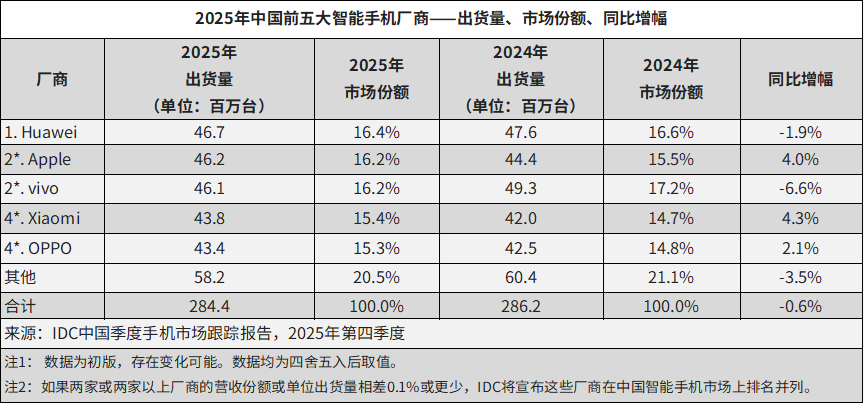
智能手机赛道早已进入"存量搏杀"时代。 近日,国际数据公司(IDC)发布的最新手机市场跟踪报告显示,2025年全年,中国智能手机市场出货量约2.84亿台,同比 下降0.6%。 IDC数据指出,上半年伊始,"国补"叠加春节销售旺季推动市场增长明显,但后继乏力。下半年随着部分市场需求提前释 放,多地"国补"资金提前用尽以及成本持续上升等因素影响,市场继续保持同比下滑趋势。面对存储价格预计仍将大幅上 涨的态势,手机厂商的成本压力将进一步加剧,IDC预计,2026年中国智能手机市场出货量或将出现较明显回落。 然而,排位的更迭难以掩盖整体市场的寒意。2025年,尽管华为凭借4670万台出货量重回第一,但同比仍下滑1.9%;而昔 日冠军vivo则遭遇重创,出货量同比下降6.6%,在头部阵营中表现垫底。 相比之下,小米、苹果及OPPO实现了出货量的小幅增长。IDC指出,从全年来看,苹果以并列第二的市场份额,终结了此 前连续三年的出货量下滑趋势,实现触底回升。其中,iPhone 17 Pro Max仍是最畅销机型,进一步扩大了苹果在800美元以 上高端市场的优势。全面升级的iPhone 17系列显著提升了产品吸引力,获得消费 ...


2025手机销量迷局:华为到底是第一还是第五? | 深网
Xin Lang Cai Jing· 2026-01-22 10:08
Core Viewpoint - The competition in the Chinese smartphone market is extremely fierce, with slight differences in market positions among leading brands, as highlighted by the activation volume rankings for 2025 [2][4]. Market Rankings - The top five brands in terms of activation volume for 2025 are: 1. Vivo (including IQOO) with 46.36 million units and a market share of 16.77%, showing a decrease of 2.58% from 2024 2. Xiaomi (including REDMI) with 45.88 million units and a market share of 16.60%, increasing by 5.41% from 2024 3. Apple with 45.21 million units and a market share of 16.35%, increasing by 9.34% from 2024 4. OPPO (including OnePlus and realme) with 43.99 million units and a market share of 15.91%, increasing by 7.63% from 2024 5. Huawei with 43.40 million units and a market share of 15.70%, decreasing by 0.96% from 2024 [3][15]. Discrepancies in Data - There is a notable discrepancy between the activation volume and shipment data, with Huawei ranking first in shipment volume according to major research firms, while it ranks fifth in activation volume [5][17]. - The difference in rankings has raised questions about the accuracy of the data, particularly why Huawei's shipment figures exceed its activation numbers by over 300,000 units [20]. Sales Channels - The majority of smartphone sales in China occur through offline channels, which account for approximately 70% of total sales, while Xiaomi has historically leaned towards online sales [6][18]. - The sales process involves multiple stages: Sell In (SI), Sell Through (ST), and Sell Out (SO), with most research firms reporting on SI data, while actual user activation (SO) remains confidential [19]. Xiaomi's Strategy - Xiaomi's activation volume surpasses its reported shipment volume by approximately 200,000 units, attributed to its direct online sales model, which shortens the time from shipment to activation [10][21]. - During the 2025 Double Eleven shopping festival, Xiaomi reported total sales exceeding 29 billion yuan, highlighting the effectiveness of its online sales strategy [22]. High-End Market Focus - Xiaomi has been focusing on high-end market penetration since implementing its dual-brand strategy in 2019, investing around 105 billion yuan in R&D over the past five years [11][22]. - The company aims to compete directly with Apple and Huawei in the high-end segment, where it currently holds a market share of only 7.4% compared to Apple's 48% and Huawei's 33.4% [12][22]. Technological Investments - Xiaomi is investing in self-developed SoC chips to enhance its competitive edge in the high-end smartphone market, indicating a long-term commitment to building a strong brand presence [23].
国产AI大模型企业密集上市:资本狂欢下的技术博弈与产业未来
Sou Hu Cai Jing· 2026-01-22 09:54
Group 1 - The year 2024 is recognized as the "Year of Commercialization for China's AI Large Models," with a significant wave of domestic AI companies expected to go public in 2025 [2] - Over ten Chinese tech companies focused on large language models (LLMs) have submitted IPO applications since Q1 2024, raising over 30 billion RMB in the first half of 2025 [2] - Major cities like Beijing, Shanghai, and Shenzhen are becoming hubs for AI large model companies, supported by local government policies [5] Group 2 - DeepSeek, known for its open-source large model, has a valuation exceeding 12 billion USD and plans to invest 4.2 billion RMB in R&D for 2024 [3] - Zhipu AI, backed by Tsinghua University, is pursuing a listing on the Sci-Tech Innovation Board, with its GLM-4 Turbo model outperforming international counterparts in various tasks [3] - Moonshot AI has gained attention for its "Long Context Window" technology, securing 800 million USD in funding and achieving a post-investment valuation of 6.5 billion USD [4] Group 3 - In 2024, total investment in China's AI sector reached 215 billion RMB, with over 60% allocated to large models and related applications, marking a 75% increase from 2023 [6] - The average investment amount in Pre-IPO rounds rose from 520 million RMB in 2023 to 870 million RMB in 2024, indicating a shift towards more mature AI companies [6] - The adoption rate of AI technology among enterprises surged from 22% in 2022 to 47% in 2024, with significant growth expected in sectors like finance, manufacturing, education, and healthcare [7] Group 4 - Domestic large model companies have made significant advancements, with eight out of the top ten positions in the CLUE benchmark held by Chinese models [7] - The Chinese government has introduced supportive policies for AI companies, including measures to facilitate domestic and international financing [7] - The geopolitical landscape, particularly U.S. restrictions on high-end GPU exports, has accelerated the demand for domestic AI solutions [8] Group 5 - Companies are exploring various monetization strategies, including API service fees, enterprise solutions, and open-source models with commercial licenses [14] - The training and inference costs for large models remain a significant challenge, with estimates indicating that training a trillion-parameter model could exceed 120 million RMB [16] - Only 15% of AI large model companies that have submitted IPO applications reported profitability in the last fiscal year, with average losses reaching 1.8 times their revenue [17] Group 6 - Traditional valuation methods are being challenged, leading to the development of new frameworks that emphasize technical barriers and ecosystem value [18] - The stock performance of AI-related companies has shown a polarized trend, with major players like Baidu and Alibaba seeing significant stock price increases [19] - The AI large model sector is expected to undergo a commercial validation phase from 2025 to 2026, with a focus on actual revenue growth and sustainable business models [26]

CPU:服务器中枢大脑,需求的拐点
NORTHEAST SECURITIES· 2026-01-22 09:42
Investment Rating - The report assigns an "Outperform" rating for the industry, indicating that the industry index is expected to exceed market benchmarks in the next six months [6]. Core Insights - The report highlights a significant shift in CPU demand driven by AI applications, with a notable increase in server CPU requirements due to the expansion of generative AI training and inference clusters [2]. - Supply-side constraints are evident, with major players like Intel and AMD planning to raise server CPU prices by 10%-15% by 2026, while also reallocating production capacity from consumer electronics to server CPUs [1]. - The global CPU market is projected to grow from approximately $130.2 billion in 2025 to $141.27 billion in 2026, with a compound annual growth rate (CAGR) of about 8.5% from 2025 to 2030 [3]. Supply Side Summary - Major overseas companies are increasing prices, with Intel shifting production capacity to server CPUs, leading to a significant drop in delivery assurance rates for consumer electronics [1]. - There is a persistent shortage of Intel 7/10 CPUs, exacerbated by a shift in production focus, resulting in a growing supply gap in the PC segment [1]. - Upstream material shortages, particularly in ABF substrates due to T-glass scarcity, are impacting server CPU production, with Intel prioritizing server CPU supply [1]. - The average selling price and gross margin for CPUs are expected to rise as Intel and AMD adjust their product mix towards high-end servers [1]. Demand Side Summary - The demand for AI inference is surging, leading to exponential growth in the need for server nodes [2]. - General-purpose servers are entering a significant upgrade cycle as large-scale data centers require modernization due to power consumption limits of older racks [2]. - The emergence of Agent-based computing is increasing CPU demand, as these systems require more processing power than traditional general-purpose computing [2]. - There is a reversal in the market dynamics, with general-purpose servers now presenting compensatory investment opportunities following a period of AI server dominance [2]. Industry Landscape Summary - The global CPU market is dominated by major players, with Intel and AMD holding 50% and 30% market shares in China, respectively [3]. - The Chinese CPU market is segmented into desktop CPUs (50% share), mobile CPUs (30% share), and server CPUs (20% share), with foreign companies holding a significant market share [3]. Related Companies - Domestic CPU manufacturers include Haiguang Information, Hesheng New Materials, and Loongson Technology [4]. - Upstream CPU suppliers include Huada Jiutian and Huazheng New Materials [4]. - Server manufacturers include Zhongke Shuguang, Inspur Information, and Unisplendour [4].
华为吃高端,Momenta占中端:智驾的“圈地运动”谁能终结?
3 6 Ke· 2026-01-22 09:39
Core Insights - In 2025, the adoption of intelligent driving in China is expected to experience explosive growth, with L2 level vehicles' sales projected to reach a penetration rate of 66.1% by the end of the year, indicating that intelligent driving has become a standard feature in vehicles [1][2][3] Group 1: Market Trends - The intelligent driving industry is facing a significant downturn despite the growth in adoption, leading to a "survival of the fittest" scenario [2][3] - The competition is shifting focus from high-speed NOA (Navigation on Autopilot) to urban NOA, with over 3.129 million vehicles equipped with urban NOA sold from January to November 2025 [12][13] - Mainstream models priced below 300,000 yuan contributed 68.9% of urban NOA sales, indicating a move towards mass-market adoption [14][15] Group 2: Technological Pathways - Two main technological pathways are emerging: the "Vision-Language-Action" (VLA) route, which emphasizes rapid iteration and compatibility with existing hardware, and the "World Model" route, which focuses on deeper cognitive paradigms [5][7][10] - Companies like XPeng and Li Auto are strong proponents of the VLA route, while Huawei represents the World Model approach [6][9] Group 3: Competitive Landscape - The market is characterized by a trend of "self-research dominance" with a high concentration of third-party suppliers, where domestic brands accounted for 81.1% of urban NOA vehicle sales [18][19] - The collapse of companies like Haomo and the shift towards third-party suppliers highlight the challenges faced by automakers in self-research capabilities [20][21] - Leading third-party suppliers, such as Huawei and Momenta, dominate the market, with Momenta holding approximately 61.06% market share [25][26] Group 4: Future Outlook - The competition is expected to intensify, with predictions that only two or three intelligent driving companies may survive by 2026 [32] - The integration of software and hardware is becoming crucial for companies to build competitive advantages, with a focus on deep collaboration between chip design and software development [35][39] - Companies like Horizon Robotics are positioning themselves as challengers to the dominant players by targeting cost-sensitive markets and offering integrated solutions [44][47]

存储芯片之后,CPU接棒“涨价”!澜起科技涨近5%,科创芯片50ETF(588750)盘中价创新高,AI Agent时代,CPU长期增量怎么看?
Sou Hu Cai Jing· 2026-01-22 09:36
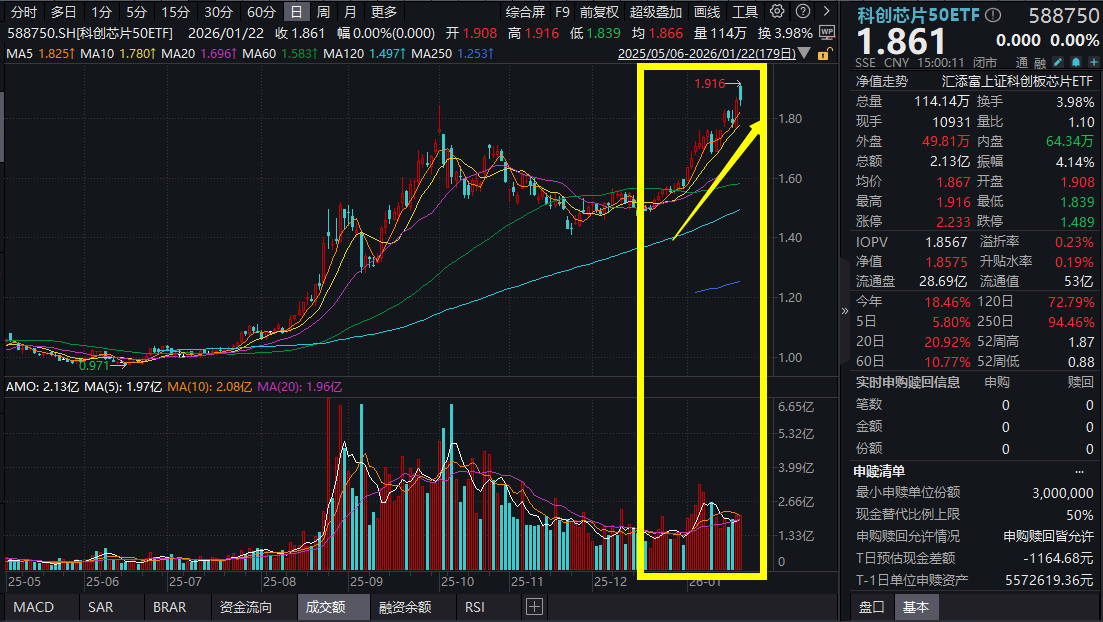
Core Viewpoint - The A-share market experienced fluctuations, particularly in the hard technology sector, with the Sci-Tech Chip 50 ETF (588750) reaching a new high during the trading session [1] Group 1: Market Performance - The Shanghai Stock Exchange Sci-Tech Chip Index (000685) fell by 0.07%, with constituent stocks showing mixed performance; Longxin Zhongke led with an increase of 8.81%, while Aiwai Electronics dropped by 4.23% [3] - The Sci-Tech Chip 50 ETF (588750) maintained a flat position, indicating resilience despite market volatility [1] Group 2: Semiconductor Pricing Trends - Following price increases in storage chips, CPU prices are also expected to rise by 10%-15% due to high demand from global cloud service providers, with Intel and AMD's server CPU capacities for 2026 already sold out [5] - The demand for CPUs is driven by the explosion of AI computing needs, with server CPU market demand significantly increasing due to the expansion of AI server shipments and traditional server upgrades [5] Group 3: Supply-Demand Dynamics - Intel anticipates that CPU shortages will peak in Q1 2026, as demand continues to exceed supply, with no plans to expand production capacity for current nodes [6] - The development of AI Agents is expected to significantly increase CPU demand, potentially making CPUs a bottleneck before GPUs [7] Group 4: Long-term Growth Projections - The number of active AI Agents is projected to rise from approximately 28.6 million in 2025 to 2.216 billion by 2030, leading to a substantial increase in CPU demand [8] - The domestic token consumption related to AI is expected to reach 10.95 trillion annually by 2024, indicating a strong market for CPUs in AI applications [9] Group 5: Investment Opportunities - The semiconductor equipment sector is maintaining high demand, with global semiconductor sales expected to reach $75.2 billion by November 2025, reflecting a year-on-year growth of 29.8% [10] - The Sci-Tech Chip 50 ETF (588750) focuses on high-tech segments of the semiconductor industry, showing strong growth potential and resilience compared to other indices [11][15]





华为折叠屏国内份额超70%,坐等苹果入局
Guan Cha Zhe Wang· 2026-01-22 09:16
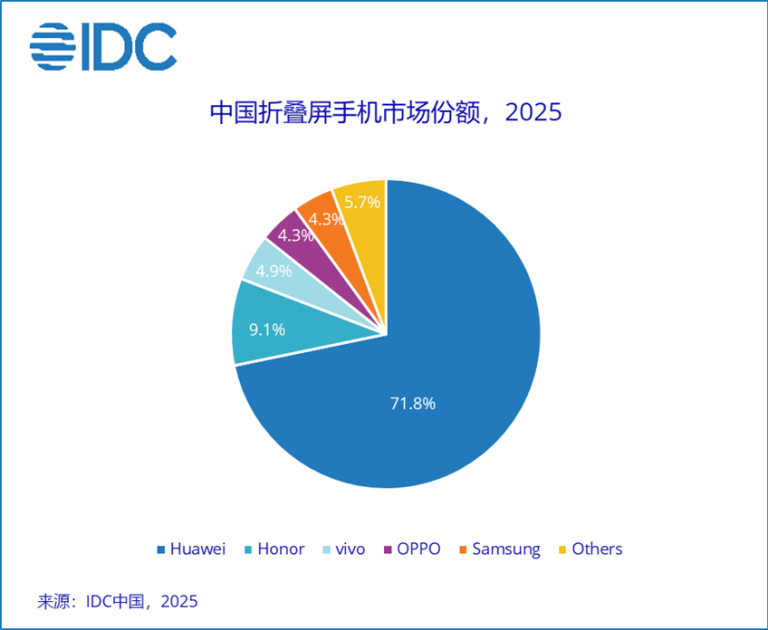
Core Insights - The Chinese foldable smartphone market is projected to see a shipment of approximately 10.01 million units in 2025, reflecting a year-on-year growth of 9.2%, contrasting with a slight decline of 0.6% in the overall smartphone market [1] - Huawei leads the market with a significant share of 71.8%, while other brands like Honor, Vivo, and OPPO have much smaller shares, indicating Huawei's dominant position [1][3] - Despite the emergence of competitive products from other manufacturers, Huawei's comprehensive product lineup and brand strength have solidified its market leadership [4][6] Market Dynamics - The foldable smartphone segment has reached a bottleneck since 2019, with manufacturers struggling to drive sales through hardware improvements alone, leading to a decline in the overall market in Q4 of the previous year [3][4] - Brand strength is increasingly influencing consumer preferences in the high-end market, with Huawei's focus on balanced capabilities and innovative designs contributing to its market share growth of over 20 percentage points in 2025 [4] - The foldable smartphone market still represents only 3.5% of total smartphone shipments in China, prompting some manufacturers to reconsider their strategies in this niche segment [4][6] Technological Innovations - Manufacturers are exploring soft-hard collaboration as a breakthrough direction, with Huawei's MateX7 focusing on AI integration rather than just hardware enhancements [6] - Other brands like OPPO and Vivo are also attempting to bridge compatibility with Apple ecosystems, indicating a trend towards cross-platform functionality [6] Future Outlook - The anticipated entry of Apple's foldable smartphone, expected to be released in the fall of 2026, is generating significant market interest, particularly regarding its potential to enhance hardware and software integration [7][8] - The overall smartphone market in China may face challenges in 2026 due to rising storage costs, which could lead to a noticeable decline in shipments [8]

华为折叠屏国内份额超70%,苹果今年能带来惊喜吗?
Guan Cha Zhe Wang· 2026-01-22 09:12
Core Insights - The Chinese foldable smartphone market is projected to see a shipment of approximately 10.01 million units in 2025, marking a year-on-year growth of 9.2%, contrasting with a slight decline of 0.6% in the overall smartphone market [1] - Huawei leads the market with a significant share of 71.8%, while other brands like Honor, Vivo, and OPPO have much smaller shares, with Xiaomi dropping out of the top five [1][3] - The foldable smartphone segment is experiencing a bottleneck phase, with hardware improvements no longer sufficient to drive significant sales growth, leading to a decline in market performance [3][4] Market Dynamics - Huawei's dominance is attributed to its comprehensive product lineup, including various foldable designs and a focus on balanced capabilities rather than just lightweight models [4] - Other manufacturers have introduced innovative products, such as OPPO's Find N5 and Vivo's lightweight foldable, but these have not significantly challenged Huawei's market position [3][4] - The foldable smartphone market only accounts for 3.5% of total smartphone shipments in China, leading some companies like Xiaomi to reconsider their strategies in this niche [4][6] Technological Innovations - Manufacturers are focusing on soft-hard collaboration to enhance user experience, with Huawei's MateX7 introducing AI capabilities to improve functionality [6] - Competitors like OPPO and Vivo are also exploring compatibility with Apple ecosystems to attract users [6] - The anticipated entry of Apple's foldable phone, expected in 2026, is generating significant market interest, with expectations for superior hardware and software integration [7][9] Future Outlook - The smartphone market is expected to face cost pressures due to rising storage prices, potentially leading to a noticeable decline in shipments in 2026 [9] - The success of Apple's foldable device and its impact on the market remains a key point of interest for industry stakeholders [9]