
南京银行

Search documents
熊猫债市场持续拓展
Jing Ji Ri Bao· 2025-08-10 22:02
Core Insights - Panda bonds are an important channel for offshore institutions to raise funds in RMB, with a steady increase in the number of issuers and types, including international development institutions, foreign governments, offshore financial institutions, and non-financial enterprises [1][4] - The issuance of panda bonds has seen significant growth, with a total issuance scale of 111.2 billion RMB in the interbank market this year, where foreign government institutions, international development institutions, and multinational enterprises accounted for 50% of the issuance, an increase of 27 percentage points compared to the entire year of 2024 [1] Group 1: Recent Developments - The Asian Infrastructure Investment Bank (AIIB) returned to the Chinese bond market, issuing a 2-year panda bond that raised 2 billion RMB with a coupon rate of 1.64%, achieving a record high subscription of 6.4 billion RMB, which is 3.2 times oversubscribed [2] - Morgan Stanley successfully issued a panda bond of 2 billion RMB with a 5-year term and a coupon rate of 1.98%, marking the first panda bond issued by a US-based company [2] - Hungary has become the largest foreign government issuer of panda bonds, successfully issuing 4 billion RMB in 3-year and 1 billion RMB in 5-year bonds, with coupon rates of 2.5% and 2.9% respectively [3] Group 2: Market Expansion - The panda bond market is experiencing internationalization, with participation from various foreign governments and financial institutions, including South Korea, Poland, and Egypt, which have collectively issued 35.46 billion RMB in panda bonds [4] - The continuous opening of cross-border investment and financing, along with the expansion of the RMB cross-border payment system, is expected to attract more sovereign institutions and offshore enterprises into the panda bond market, enhancing economic connectivity between China and the global economy [5]

关注关税是否如期延期
Hua Lian Qi Huo· 2025-08-10 13:15
Report Industry Investment Rating No relevant content provided. Core Viewpoints of the Report - Last week, the broader market opened slightly lower and trended upward, reaching a new high for the year. All four major indices rose, with small-cap stock indices performing strongly. The style indices also all increased, with the cyclical index having the largest gain of nearly 3.5%. Most industries in the Shenwan classification rose, with military, non-ferrous metals, machinery, and comprehensive sectors leading the gains, all with over 5% increases, while only a few sectors like pharmaceutical biology, computer, commercial trade, and tourism posted small losses [4][11][13]. - In July 2025, the manufacturing PMI was 49.3%, down 0.4 percentage points from the previous month, and the non-manufacturing PMI was 50%, down 0.1 percentage points. Supply and demand both declined, with production down 0.6%, new orders down 0.8%, and new export orders down 0.6%. The inventory of finished products decreased again after a one - month increase. Prices of factory - made goods and major raw material purchases increased for two consecutive months after three months of decline [4][23]. - The Politburo set the tone for the real estate market to stop falling and stabilize, and to boost the capital market. The central bank created two new monetary policy tools, cut the reserve requirement ratio, and lowered interest rates, including reducing the interest rates of existing mortgages. The CSRC proposed measures for mergers, acquisitions, and market value management to increase market activity. An implementation plan for promoting the entry of long - term funds into the market was officially released, which is expected to bring an additional 800 billion yuan of long - term funds to the A - share market annually [4]. - In terms of revenue, the revenue growth rates of the ChiNext, ChiNext, and CSI 500 indices increased, while those of the CSI 1000, Shanghai Composite, SSE 50, and CSI 300 indices declined. In terms of net profit attributable to the parent company, except for the Shanghai Composite Index, the net profit growth rates of other indices all increased significantly. Although the performance of the entire A - share market shows signs of stabilization, the 30% increase in tariffs imposed by the US since the second quarter of 2025 may affect the fundamentals of the A - share market, and the A - share performance may bottom out again [4]. - The broader market was oscillating at a high level last Friday, reaching a new high for the year and approaching last year's high. As the August 12 tariff deadline approaches, attention should be paid to whether the tariffs can be extended as scheduled. Overall, the market may need to oscillate and consolidate near the previous high. However, with the stabilization of the net profit attributable to the parent company of the entire A - share market and the four major indices in the first quarter, as well as long - term policy and capital support, the stock index is still optimistic in the long - term. Technically, the broader market has been rising continuously, reaching a new high for the year and is expected to break through the previous high. In the short - term, attention should be paid to whether the Sino - US tariffs will be extended. Operationally, it is advisable to go long on pullbacks in the medium - term, and for options, a bull spread strategy can be considered [7][8] Summary by Related Catalogs Index Industry Trends Review - Last week, the broader market opened slightly lower and trended upward, hitting a new high for the year. All four major indices rose, with small - cap stock indices outperforming [11] - All style indices rose last week, with the cyclical index having the largest gain of nearly 3.5%, followed by growth, financial, stable, and consumer style indices. Most industries in the Shenwan classification rose, with military, non - ferrous metals, machinery, and comprehensive sectors leading the gains, all with over 5% increases. Only a few sectors like pharmaceutical biology, computer, commercial trade, and tourism posted small losses [13] Main Contract and Basis Trends - The four major indices attacked again, with the CSI 1000 breaking through last year's high first. In terms of the basis, the discount of the 08 contract continued to narrow within a reasonable range [16] - In terms of the arbitrage of main contracts, IC/IF and IC/IH oscillated upwards, IH/IF fluctuated, and IM/IF and IM/IH oscillated upwards [20] Policy and Economy - In July 2025, the manufacturing PMI was 49.3%, down 0.4 percentage points from the previous month, and the non - manufacturing PMI was 50%, down 0.1 percentage points. Supply and demand both declined, with production down 0.6%, new orders down 0.8%, and new export orders down 0.6%. The inventory of finished products decreased again after a one - month increase. Prices of factory - made goods and major raw material purchases increased for two consecutive months after three months of decline [23] - Generally, PPI leads the inventory cycle (by 1 month to 1 year, with an average of about half a year). PPI bottomed out and rebounded in June 2023, weakened after two months, and has seen a continuous narrowing of the decline since March 2024. The decline of PPI widened again in July, narrowed again since November until it widened for four consecutive months from March 2025, and remained the same as the previous month in July. In May, the revenue of industrial enterprises continued to decline to 2.7%, and the inventory decreased by 3.5%, indicating a possible entry into the active inventory replenishment stage, corresponding to an economic slowdown [25] - In June 2025, the year - on - year increase in social financing was 419.93 billion yuan, compared with 22.46 billion yuan in the previous period. Government bonds increased by 135.48 billion yuan, and RMB loans increased by 236.37 billion yuan, with an year - on - year increase of 17.1 billion yuan, mainly due to an increase of 17 billion yuan in enterprise loans, including an increase of 49 billion yuan in short - term loans and a rebound in medium - and long - term loans [27] - The growth rate of medium - and long - term credit has been declining for 25 consecutive months to 6.77% as of June 2025, down from the high of 12.94% in May 2023. The growth rate last month was 6.78%, and the decline rate has slowed down significantly [30] - The implementation plan for promoting the entry of long - term funds into the market aims to increase the actual investment ratio, extend the assessment period, and strengthen the synergy of policies. It is expected to bring additional long - term funds to the A - share market annually, and the second - batch pilot of long - term stock investment by insurance funds will be implemented in the first half of 2025, with a scale of no less than 10 billion yuan [32] - The Politburo meeting emphasized boosting the capital market, promoting the entry of long - term funds, supporting mergers and acquisitions and reorganizations of listed companies, and promoting the reform of public funds. It also called for increasing the counter - cyclical adjustment of fiscal and monetary policies, stabilizing the real estate market, and implementing a series of measures such as reducing the reserve requirement ratio and interest rates [35] - The central bank created new monetary policy tools, including a swap facility for securities, funds, and insurance companies, and a re - loan for stock repurchase and increase. It also carried out MLF operations, reverse repurchase operations, and adjusted interest rates. In addition, a series of measures such as reducing the reserve requirement ratio, lowering policy interest rates, and increasing re - loan quotas were implemented [36][38][40] - The total debt - resolution scale is divided into three parts, with the first two parts directly adding 1 trillion yuan of local debt - resolution funds. After the replacement of implicit debts, the local debt - resolution pressure will be greatly reduced [37] Revenue and Net Profit of Each Index - Except for the CSI 500, the year - on - year revenue growth rates of each index in the 2024 annual report declined. In terms of net profit attributable to the parent company, the SSE 50 index continued to grow year - on - year, the CSI 300 index had a small increase, and the CSI 500, ChiNext, and Shenzhen Component Indexes declined to varying degrees [47] - In terms of revenue, the revenue growth rates of the Shenzhen Component, ChiNext, and CSI 500 indices increased, while those of the CSI 1000, Shanghai Composite, SSE 50, and CSI 300 indices declined. In terms of net profit attributable to the parent company, the net profit growth rates of all indices except the Shanghai Composite Index increased significantly [53] - The performance of the entire A - share market shows signs of stabilization, but the 30% increase in tariffs imposed by the US since April may affect the A - share market. In the first quarter of 2025, the performance of IC/IM bottomed out and stabilized, while IH/IF declined year - on - year [57][60] Valuation - The valuation of the Shanghai Composite Index is 15.6876, with an upper - bound value of 15.51, and it is at the 78.41 percentile since 2010. The valuation of the ChiNext is still relatively low [66] Capital Flow - From April 7 to August 8, 2025, the ETF scale increased by 34.4 billion yuan, and last week it decreased by 7.3 billion yuan. From January 1 to June 27, 2025, the scale of newly established equity funds increased by 171.3 billion yuan [5][71] - In terms of margin trading, there was a net inflow of 274.8 billion yuan in 2024. As of August 7, 2025, the net inflow in the first five trading days was 27.9 billion yuan, and the net inflow in 2025 was 200.1 billion yuan [79] - In the first quarter of 2025, the market value of A - shares held by insurance funds increased significantly by 389.3 billion yuan, while the CSI 300 index fell by 1.21%. At the end of 2024, the assets of the national team and insurance funds increased, while the assets of the Hong Kong - Shanghai Stock Connect decreased. Specifically, it was mainly the assets of Central Huijin and insurance funds that increased [75] - As of last weekend, the IPO financing in 2023 was 356.5 billion yuan, 67.3 billion yuan in 2024, and 63.7 billion yuan in 2025 [84] - In the week from August 1 to August 8, 2025, the ETF share increased by 36.368 billion shares (+1.33%), reaching 2780.699 billion shares, and the total scale increased by 65.598 billion yuan (+1.43%), reaching 4658.878 billion yuan [88] - Last week, major shareholders in the secondary market continued to have a net reduction of 5.9 billion yuan [92] - There will be a large amount of restricted - share unlockings in mid - August [93]
信用债周策略20250808:信用债关键词:攻防兼备
Minsheng Securities· 2025-08-10 12:40
Group 1 - The report indicates that credit bond yields across various maturities continue to decline, with short-term yields decreasing more than long-term ones, and lower-rated bonds experiencing greater yield reductions than higher-rated ones [1][9] - As of August 8, the credit spreads for 3Y/AAA, AAA-, and AA+ short-term bonds are 18.81BP, 22.81BP, and 26.81BP respectively, which are close to the year's lowest points [1][9] - The current environment is favorable for credit bonds, with a high carry opportunity and stable funding conditions, suggesting further compression of credit spreads in the last three weeks of August [1][9] Group 2 - The report highlights that industrial investment and major project construction are becoming new drivers for regional economic development, with infrastructure projects in transportation, water conservancy, and energy expected to play significant roles [4][18] - It emphasizes the need for local governments to balance between reducing debt and increasing investment in infrastructure to stimulate employment and economic growth [18][19] - The report notes that there is substantial growth potential in industrial investments, particularly in high-tech sectors, which can provide significant returns [19][20] Group 3 - The report suggests that investors should focus on low-duration, high-rated, and highly liquid credit bonds, especially those with significant recovery potential, as the market adjusts [2][13] - It identifies specific bonds with high recovery potential, including 20 public bonds with implied ratings of AA+ and above, which have shown active trading and recovery space of over 12BP [3][16] - The report advises caution regarding long-term credit bonds, as the sustainability of the current credit spread compression is uncertain [2][13]
债市“科技板”建设持续推进 科技创新债券标准篮子上线交易
Xin Hua Cai Jing· 2025-08-08 13:39
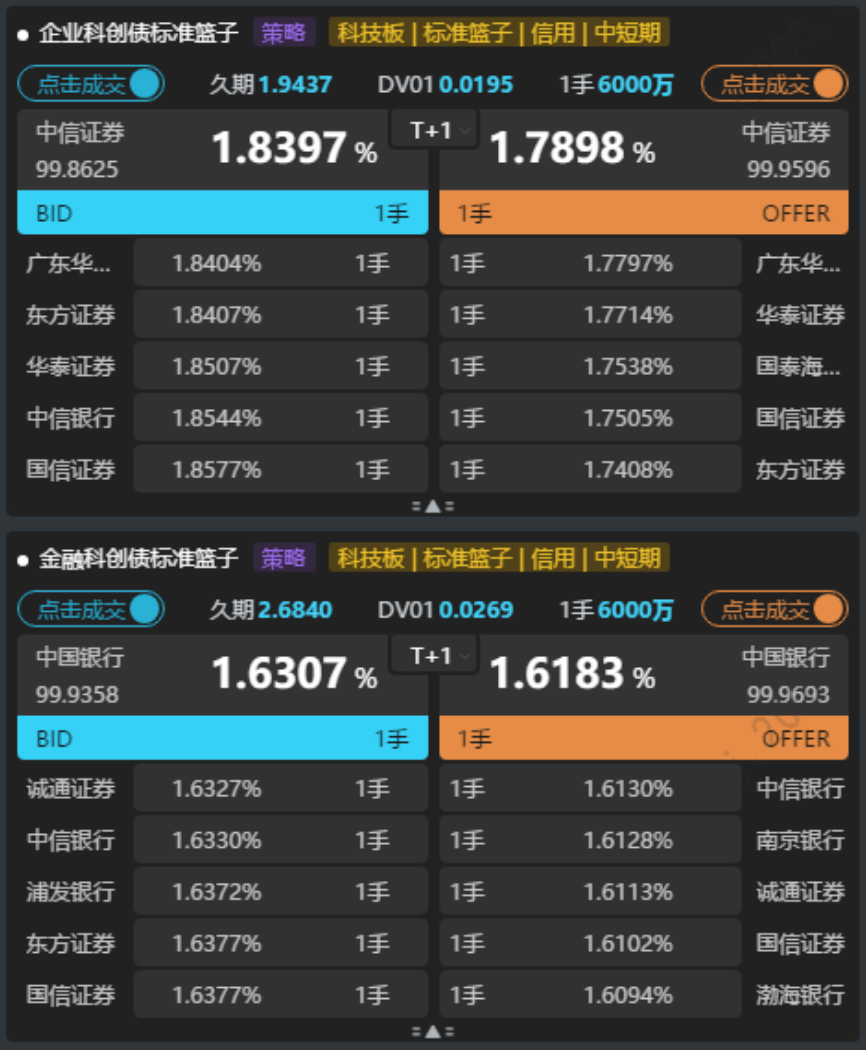
Core Viewpoint - The launch of the "Technology Board" in the bond market aims to enhance liquidity for technology innovation bonds through improved trading infrastructure and the introduction of standardized bond baskets for concentrated investment [1][3]. Group 1: Technology Board Development - The "Technology Board" is being established to support the trading of technology innovation bonds, with a focus on enhancing market liquidity [1]. - The foreign exchange trading center has introduced two standardized bond baskets for technology innovation bonds to meet the investment needs of domestic and foreign investors [1][3]. Group 2: Standardized Bond Baskets - The Financial Technology Innovation Bond Standard Basket (code BBX100100) includes six bonds issued by financial institutions, with a total trading volume of 60 million yuan and a duration of 2.6840 [3]. - The Enterprise Technology Innovation Bond Standard Basket (code BBX100200) consists of six bonds issued by technology enterprises, also with a trading volume of 60 million yuan and a duration of 1.9437 [3]. - Multiple market makers are collaborating to provide quality quotes for both standardized bond baskets, significantly improving the convenience of trading technology innovation bonds [3]. Group 3: Market Makers and Trading Infrastructure - Major market makers involved in the Financial Technology Innovation Bond Standard Basket include China Bank, Shanghai Pudong Development Bank, and others, ensuring competitive pricing [3]. - The Enterprise Technology Innovation Bond Standard Basket features market makers such as CITIC Securities and Huatai Securities, contributing to a robust trading environment [3]. - The foreign exchange trading center plans to continue enhancing trading services for technology innovation bonds and explore the launch of related index products [3].

一周银行速览(8.1—8.8)
Cai Jing Wang· 2025-08-08 13:19
Regulatory Voice - The People's Bank of China emphasizes the implementation of a moderately loose monetary policy in the second half of 2025, focusing on supporting technological innovation, boosting consumption, aiding small and micro enterprises, and stabilizing foreign trade [1] - The Financial Regulatory Bureau reports positive outcomes from the financing coordination mechanism for small and micro enterprises, with banks providing new credit of 23.6 trillion yuan and new loans of 17.8 trillion yuan by the end of June 2025 [1] - A joint draft by the People's Bank, Financial Regulatory Bureau, and Securities Regulatory Commission aims to enhance anti-money laundering regulations through improved customer due diligence and record-keeping practices [1] Industry Focus - Six A-share listed banks, including Shanghai Pudong Development Bank and Hangzhou Bank, report positive growth in both revenue and net profit for the first half of 2025, with five banks showing a double-digit increase in net profit year-on-year [2] Corporate Dynamics - Agricultural Bank of China surpasses Industrial and Commercial Bank of China to become the market value leader in A-shares, reaching a market capitalization of 2.11 trillion yuan, with a price increase of nearly 150% since November 2022 [5] - Nanjing Bank's major shareholder, Nanjing High-Tech, increases its stake to 9%, marking the third significant increase by local state-owned assets in the past two years [6] Financial Personnel - Duan Hongtao has been appointed as the Deputy Secretary of the Party Committee of the Industrial and Commercial Bank of China [7] - The Shanghai Banking Regulatory Bureau has approved Gu Jianzhong's qualifications as the Chairman of Shanghai Bank [8] - Jiangsu Bank announces the approval of Yang Dawei as Vice President and Shi Wenqi as Chief Auditor [8] - Wang Xiaoqing resigns as Vice President of China Merchants Bank to take a position at China Merchants Jin控 [9]


A股“新一哥”诞生!你买了吗?
Zhong Guo Jing Ying Bao· 2025-08-08 12:28
Core Viewpoint - Agricultural Bank of China (ABC) has surpassed Industrial and Commercial Bank of China (ICBC) in A-share market capitalization, reaching 2.14 trillion yuan, marking a significant shift in the banking sector's competitive landscape [5][6]. Group 1: Market Performance - As of August 7, 2023, ABC's A-share closing price was 6.71 yuan per share, with a 1.36% increase, while ICBC's closing price was 7.84 yuan per share, with a 1.03% increase [5]. - ABC's stock price has seen a cumulative increase of over 30% this year, ranking third among bank stocks and first among the six major state-owned banks [6]. - The difference in circulating shares is a key factor affecting market capitalization, with ABC having 3.192 billion circulating shares compared to ICBC's 2.696 billion, a difference of nearly 500 million shares [6]. Group 2: Financial Performance - In the first quarter of 2023, only ABC and Bank of China reported year-on-year revenue growth, while other major banks experienced declines [6]. - ABC's non-performing loan ratio decreased by 0.02 percentage points year-on-year, contrasting with other banks that saw smaller declines or no change [6]. Group 3: Strategic Focus - ABC has significantly increased its county-level loan portfolio, with new loans exceeding 1 trillion yuan, positioning itself advantageously in rural infrastructure and modern agricultural development [7]. - The bank's focus on rural revitalization strategies has created a differentiated market position, which is expected to contribute positively to its future performance [7]. Group 4: Market Sentiment and Investment Trends - Institutional investors are increasingly optimistic about bank stocks, with public funds further increasing their holdings in the banking sector during the second quarter [8][9]. - As of the end of the second quarter of 2025, the proportion of actively managed public funds allocated to bank stocks reached 4.85%, the highest level since the second quarter of 2021 [10]. Group 5: Analyst Insights - Analysts suggest that the banking sector is benefiting from a stable operating environment and favorable macroeconomic policies, which are expected to support continued investment in bank stocks [11]. - The trend of increasing shareholdings by shareholders and executives indicates growing confidence in the banking sector's prospects [12][13].
南京银行杭州分行:聚生态之力 助民企展新枝
Xin Hua Wang· 2025-08-08 08:43
Core Viewpoint - The article highlights the evolving role of financial institutions, particularly Nanjing Bank's Hangzhou branch, in supporting the growth of private enterprises in Zhejiang, transitioning from traditional lenders to partners in development and innovation [1][2]. Group 1: Financial Support for Private Enterprises - Private enterprises are crucial for high-quality development and technological innovation, yet they face significant challenges in financing [2]. - Nanjing Bank's Hangzhou branch provided over 10 million yuan in loans to Diwei II Space Technology Co., Ltd., aiding its growth during its early development phase [2]. - The bank has supported over 2,500 technology enterprises with financing exceeding 65 billion yuan, with a technology loan balance of over 9 billion yuan, addressing the financing difficulties faced by many tech firms [3]. Group 2: Innovative Financial Products - The demand for diverse funding solutions among private enterprises is increasing, necessitating innovative financial products to meet their varied needs [4]. - Nanjing Bank's Hangzhou branch successfully issued the first private enterprise technology bond in response to the new policy, with a total underwriting scale of 2.25 billion yuan for eight bonds [5]. - The bank has tailored its "Provincial Credit Loan" product to meet the urgent short-term financing needs of local manufacturing enterprises, providing over 30 million yuan through 21 loans [5]. Group 3: Building an Ecosystem - Nanjing Bank has been recognized as the "Most Satisfied Bank for Private Enterprises" in Zhejiang, reflecting its commitment to creating a collaborative ecosystem for private businesses [6]. - The bank has facilitated connections between enterprises and potential partners, exemplified by its support for Liang'an Technology, which resulted in an 800,000 yuan order [6]. - The "Xinsixiang" platform developed by the bank integrates various resources, promoting collaboration and breaking down information silos within the industry [7].

因“数”而变
Jin Rong Shi Bao· 2025-08-08 07:55
Core Insights - The banking sector is undergoing significant digital transformation, with a focus on enhancing service efficiency and customer experience through technology integration [1][2][4][5]. Group 1: Digital Transformation and Technology Investment - The latest reports indicate that banks are increasingly adopting a multi-channel service model, integrating AI, remote banking, and physical branches to enhance customer service [1]. - In 2023, the six major banks invested 122.82 billion yuan in financial technology, marking a 5.38% increase from 2022 [2]. - Banks are focusing on improving their digital operational capabilities, which positively impacts their business performance [2][3]. Group 2: Business Model Innovation - Banks are leveraging advanced technologies like big data and AI to innovate their business models, enhancing efficiency and reliability in financial services [4][5]. - For instance, Ping An Bank has improved its operational efficiency and risk management capabilities through digital tools, achieving an automation rate of approximately 49% in operational reviews by mid-2023 [5]. - Industrial banks are also developing intelligent complaint handling systems, significantly improving the efficiency of processing customer complaints [5]. Group 3: Scene Application Development - The expansion of financial scene applications is a clear manifestation of technology-driven service transformation, with banks actively integrating financial services into various ecosystems [7][8]. - Examples include the construction of smart government product systems by ICBC and the development of cross-border financial service apps by Bank of China [7]. - Smaller banks are also focusing on enhancing digital financial applications, with Jiangsu Bank issuing 9.306 million credit cards in the first half of 2024, a 9.36% increase from the end of 2023 [8].
多家银行优化员工团队 科技人才最“吃香”
Jin Rong Shi Bao· 2025-08-08 07:55
Group 1 - Traditional banks are reducing reliance on human resources and optimizing their workforce by increasing the proportion of technology personnel [1][4] - As of mid-2024, several banks have reported staff reductions, with Ping An Bank reducing its workforce by over 5% to 40,830 employees [1][2] - Shanghai Pudong Development Bank has also seen a decrease in staff from 63,582 at the beginning of the year to 61,892 by mid-year, a reduction of 1,690 employees [2] Group 2 - Some banks are still expanding their workforce, with Industrial Bank increasing its staff by 317 to 66,886 employees and Jiangsu Bank adding 28 employees to reach 16,335 [3] - The digital transformation of banks is reflected in their workforce adjustments, with a growing emphasis on technology-driven roles [4][5] - By the end of 2023, major state-owned banks had a total of 94,900 financial technology employees, an increase of over 7,500 from the previous year, indicating a trend towards technology integration in banking [5]

商业银行政府类场景金融创新
Jin Rong Shi Bao· 2025-08-08 07:55
一、银行发力政府类客户场景的背景 (一)促进地方经济与社会治理 现代社会治理模式日益多元化,金融力量的介入不可或缺。国家对地方经济发展的重视以及社会治 理体系的持续完善,促使银行业加速与政府场景的合作。银行在其中扮演着多重角色,它不仅助力政府 构建信用体系,还推动社会资本踊跃参与公共事务,促进社会服务向多元纵深发展。这种合作模式显著 提升了治理效率,增强了社会各界对政府决策的信任与支持。对于银行自身而言,参与政府项目是拓展 业务疆域、强化风险管理能力、提升综合金融服务水平的有效途径,最终达成地方经济、社会治理与银 行发展的多赢格局。 (二)国家智慧政务建设推进 互联网与大数据技术的蓬勃发展为智慧政务建设奠定了坚实基础,也为商业银行打开了 G 端场景 拓展的新大门。智慧政务作为提升政府治理效能的关键举措,能大幅增强决策科学性、社会治理精准性 与公共服务效率,推动政务服务从传统电子政务向智慧政务的进阶。我国政府自 "十三五" 以来出台一 系列智慧政务相关政策,各级政府积极响应开展建设,这为商业银行提供了海量的业务机遇与创新空 间,使其能深度参与政务数字化转型进程。 (三)践行金融人民性 随着经济发展与社会需求的多 ...