华为

Search documents
2025年几家自动驾驶公司的采访总结
自动驾驶之心· 2026-01-22 09:07
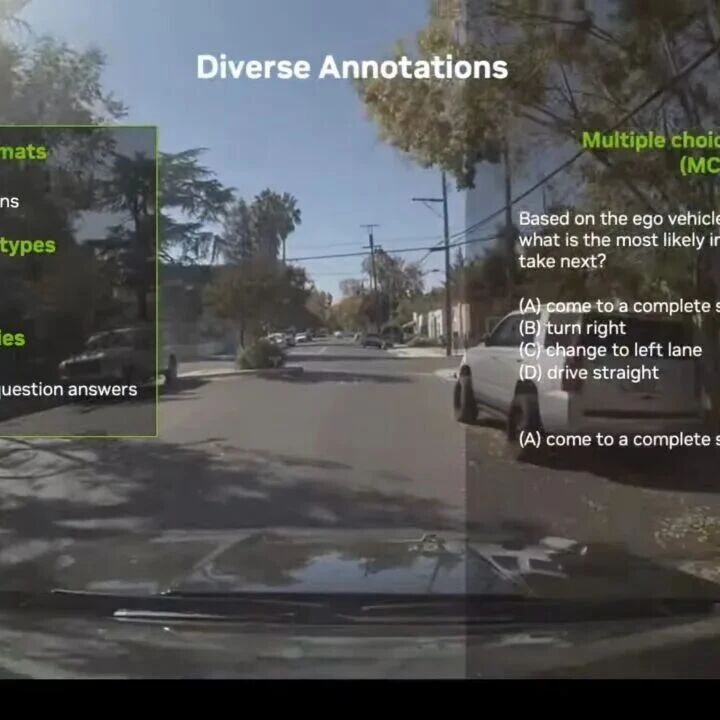
Core Algorithm - The industry has shifted towards end-to-end solutions, moving away from modular approaches, at least in public discourse [1] - The introduction of world models is prevalent, with some companies using them to generate training data, while others incorporate them into end-to-end models to enhance performance [1][8] - There is a divergence in opinions regarding the necessity of language models (VLA) in autonomous driving, with some companies arguing that language is not essential for driving tasks [1][11] Simulation and Infrastructure - The closed-loop systems have evolved from data-driven to simulation testing and training loops [2] - 3DGS is highlighted as a crucial technology for building simulation environments, as emphasized by Tesla at CVPR 2025 [5] - Infrastructure is critical, with companies like Xiaomi and Li Auto noting its benefits for development efficiency [3][14] Organizational Capability - Organizational ability is vital, as large autonomous driving teams face significant management challenges [4] - Team culture and collaboration are emphasized as essential for overcoming complex technical and management issues [5] Technical Choices Comparison - A comparison of various companies' technical choices reveals differing approaches to core technologies and the role of world models and simulation tools [9] - Companies like Li Auto advocate for a training loop that evolves from imitation to self-learning, while NVIDIA emphasizes interpretability and reasoning in AI [9] Key Non-Core Factors - R&D infrastructure and engineering efficiency are crucial for the success of autonomous driving technologies [14] - Simulation and synthetic data are becoming essential for addressing corner cases that real-world data cannot cover [14] - The scale of computing power and chip adaptation is critical, as autonomous driving is not just a software issue but also a hardware challenge [15] User Experience and Safety - User experience and safety are paramount, with companies like Xiaomi stressing the importance of balancing advanced technology with user concerns [17] - The need for a dual-stack safety mechanism is highlighted, ensuring that even aggressive end-to-end models have a fallback to traditional rule-based systems for safety [19]


融适老化设计于全屋智能解决方案,金隅天坛与华为鸿蒙智家达成深度合作
Cai Jing Wang· 2026-01-22 09:02
Core Viewpoint - The opening of the first Huawei HarmonyOS Smart Home Super Experience Center in Beijing marks a significant collaboration between Jinju Tiantan and Huawei, aiming to enhance the integration of smart home solutions and traditional home decoration services [1] Group 1: Collaboration and Strategic Goals - Jinju Tiantan has signed a comprehensive annual framework cooperation agreement with Huawei, indicating a strategic move towards smart home integration and innovation in the home decoration sector [1] - This partnership aligns with national industrial strategies and aims to empower public needs through technology, contributing to high-quality development in the home furnishing industry [1] Group 2: Smart Home Integration - The collaboration will leverage the Huawei HarmonyOS as a core intelligent foundation to promote the deep integration of smart home solutions with home decoration services [1] - Jinju Tiantan plans to establish a comprehensive business system that includes design, construction, intelligence, and operation and maintenance, facilitating a seamless transition from basic decoration to smart living environments [1] Group 3: Focus on Elderly Care - The initiative will incorporate elderly-friendly design into smart home solutions, aiming to create convenient, safe, and emotionally supportive living spaces for the elderly [1] - This approach aligns with the "14th Five-Year Plan" to enhance and expand elderly care services, contributing to a more fulfilling living experience for citizens [1] Group 4: Future Directions - Jinju Tiantan will continue to deepen its collaboration with Huawei HarmonyOS to drive the integration of the home furnishing industry with digital technology [2] - The company aims to fulfill national strategies and meet public aspirations for ideal living conditions, showcasing the strength and responsibility of state-owned enterprises in the modern era [2]

计算机行业月报:AI应用全面加速,DeepSeekV4有望深刻改变全球AI的竞争格局-20260122
Zhongyuan Securities· 2026-01-22 08:53
Investment Rating - The report maintains an "Outperform" rating for the computer industry, indicating a positive outlook compared to the market [1]. Core Insights - The acceleration of AI applications is expected to significantly alter the global AI competitive landscape, particularly with the anticipated release of DeepSeek's V4 model [7]. - The Chinese AI cloud market is projected to reach 51.8 billion yuan by 2025 and 193 billion yuan by 2030, with Alibaba aiming to capture 80% of the market's incremental growth in 2026 [7]. - The report highlights the ongoing trend of domestic chip manufacturers gaining market share due to restrictions on foreign competitors like NVIDIA [7]. Summary by Sections Industry Data - From January to November 2025, the software industry revenue reached 13.98 trillion yuan, growing by 13.3% year-on-year, marking a continuous recovery over nine months [13]. - The IC design sector showed a robust growth of 16.5% during the same period, outperforming the overall software industry growth [18]. AI Developments - Major AI models such as OpenAI's GPT-5 and DeepSeek's V3.2 are leading the market, with DeepSeek's models expected to challenge established players significantly [39][44]. - The report notes that the trend of using domestic chips for training large models is anticipated to grow in 2026, with DeepSeek already optimizing its models for compatibility with local hardware [63]. Domestic Market Trends - The report emphasizes the increasing importance of domestic chip manufacturers, as restrictions on foreign technology create opportunities for local firms [7]. - The number of devices running Huawei's HarmonyOS has surpassed 36 million, indicating strong growth in the domestic software ecosystem [7]. Investment Opportunities - The report suggests focusing on companies like Runze Technology, Sugon, and Huada Jiutian, which are positioned well within the AI and chip sectors [7]. - The ongoing IPOs of companies like Changxin Technology and Chipone Semiconductor are highlighted as potential investment opportunities in the semiconductor space [7].




信安世纪:目前已完成基于鲲鹏CPU的可信执行环境的密码产品的研制
Ge Long Hui· 2026-01-22 08:19
Core Viewpoint - The company has successfully developed a cryptographic product based on Huawei's Kunpeng CPU, achieving commercial cryptographic product certification and addressing data protection challenges through innovative solutions [1] Group 1: Company Developments - The company has engaged in multiple collaborations with Huawei in recent years [1] - A cryptographic product based on the Trusted Execution Environment (TEE) of the Kunpeng CPU has been developed and certified [1] - The solution integrates hardware-level security capabilities, enabling full lifecycle management of keys and core cryptographic operations [1] Group 2: Market Applications - The cryptographic solution has been implemented to serve certain financial clients, demonstrating its practical application in the industry [1]

马斯克预警!留给旧世界的时间只剩2000天,中国握着唯一“王牌”
Sou Hu Cai Jing· 2026-01-22 08:05
Group 1 - Musk predicts that the existing social model has about 2000 days left, with AI expected to fundamentally change everything by 2031 [1] - AGI (Artificial General Intelligence) may be realized by 2026, and by 2030, AI's total intelligence could surpass that of all humans combined [1] - The rapid advancement of AI is likened to a snowball effect, with significant implications for various job sectors, particularly for white-collar workers [3] Group 2 - The transition from 3nm to 2nm chips shows diminishing returns, indicating that the limits of Moore's Law are approaching [3] - High-profile job sectors such as law and accounting are at risk, with a Goldman Sachs report stating that 300 million jobs globally could be at risk of replacement [3] - AI's efficiency in tasks like contract review and coding is leading to a shift in job roles, with many workers becoming mere facilitators [3] Group 3 - Musk emphasizes that electricity supply is a critical bottleneck for AI development, with predictions that global AI data centers will consume more electricity than Japan by 2026 [5] - China is projected to have three times the electricity output of the U.S. by 2026, with a significant capacity for data center demands [5] - China's solar power capacity is substantial, with 1500 GW of production annually, contributing to its competitive edge in AI computing [5] Group 4 - China's computing power is ranked second globally, with a market size projected to reach 835.1 billion yuan by 2025, growing over 30% annually [7] - The country is establishing eight major computing hubs and has the highest number of supercomputers globally, accounting for 45% of the total [7] - Policies are being implemented to regulate AI-generated content and ensure data security, fostering a controlled yet vibrant AI development environment [7] Group 5 - Musk expresses optimism about the technological benefits of AI, emphasizing the need for collaboration to avoid resource wastage [9] - China is expected to lead in computing capabilities, with projections of reaching over 450 EFLOPS by 2030 [9] - The shift towards AI in various sectors, including e-commerce and healthcare, is anticipated to create new opportunities, despite the challenges of transitioning from traditional models [9]

余承东:风阻是经常被忽略的续航“杀手”
Xin Lang Cai Jing· 2026-01-22 07:50
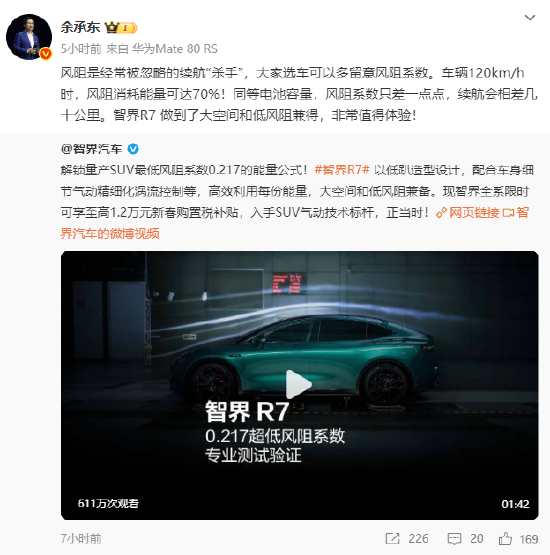
华为终端 BG 董事长余承东今日转发智界R7完成0.217超低风阻系数测试的消息称,风阻是经常被忽略 的续航"杀手",大家选车可以多留意风阻系数。 他指出,车辆120km/h时,风阻消耗能量可达70%!同等电池容量,风阻系数只差一点点,续航会相差 几十公里。 他还表示,智界R7 做到了大空间和低风阻兼得,非常值得体验。 责任编辑:王翔 华为终端 BG 董事长余承东今日转发智界R7完成0.217超低风阻系数测试的消息称,风阻是经常被忽略 的续航"杀手",大家选车可以多留意风阻系数。 他指出,车辆120km/h时,风阻消耗能量可达70%!同等电池容量,风阻系数只差一点点,续航会相差 几十公里。 他还表示,智界R7 做到了大空间和低风阻兼得,非常值得体验。 责任编辑:王翔 ...
华为新年照相馆:用科技定格2026年第一张新年大片
Jing Ji Wang· 2026-01-22 07:44
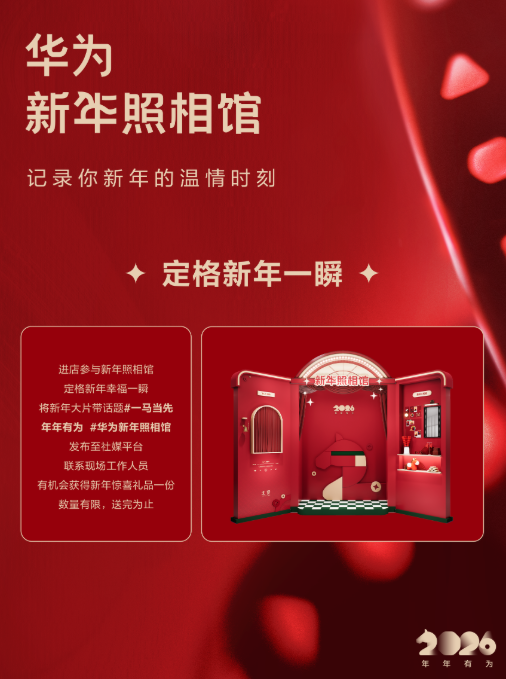
Core Viewpoint - Huawei has officially announced the "New Year Photo Studio" event, set to open in multiple major cities starting January 24, 2026, offering a unique experience that combines technology and emotional warmth for the New Year celebration [1]. Group 1: Event Details - The event allows participants to register easily through the Huawei app, selecting suitable times and locations [3]. - The photo studio features seven themed exhibition areas that showcase how innovative technology enhances traditional New Year celebrations [3]. - Participants can engage with Huawei's full range of products, enjoy music, and receive personalized makeup suggestions through AI technology [3][6]. Group 2: Interactive Features - The "Main Character Debut" area enables family and friends to take New Year photos together, with easy sharing and printing options available [4]. - A dedicated selfie area provides high-definition selfie experiences, with options for creative editing and quick photo generation [4]. - An interactive check-in system rewards participants with exclusive gifts and allows them to create personalized souvenirs like fridge magnets and keychains [4]. Group 3: Technology Integration - The event leverages the advancements of HarmonyOS 6, enhancing photo and editing experiences through AI capabilities [6]. - The sharing feature has been upgraded to support over 60 applications, facilitating seamless content transfer across devices [6]. - The Harmony ecosystem has seen significant growth, with over 350,000 applications and a compatibility rate exceeding 95%, indicating strong ecosystem cohesion [7]. Group 4: Customer Engagement - Huawei will maintain service continuity during the Spring Festival, with over 25,000 retail stores and 1,300 service centers operating normally from February 15 to 23, 2026 [9]. - The company emphasizes long-term customer support, ensuring that services such as installation and customer service are available 24/7 during the holiday period [9].
智驾行业的话语权,究竟掌握在哪些公司手中?
Jing Ji Guan Cha Bao· 2026-01-22 07:36
Core Insights - The smart driving industry is transitioning from a romantic phase focused on L4 technology to a commercial phase where survival is the primary challenge for participants [2][3] - Data is identified as the future fuel of the industry, with vehicle delivery volume equating to market influence and competitive advantage [3][4] Industry Trends - The consensus in the smart driving industry has shifted post-2019, with investors focusing on production orders and revenue sources rather than distant L4 aspirations [3] - The penetration rate of urban NOA (Navigation Assisted Driving) systems is expected to exceed 10% by the end of 2025, marking a critical point for scaling [3][4] Company Strategy - Yuanrong Qixing has achieved a nearly 40% market share in the urban NOA supplier market as of October 2025, with a cumulative delivery of over 200,000 systems [3][4] - The company employs a "car sea strategy," partnering with mainstream brands like Great Wall and Geely to ensure widespread adoption rather than focusing solely on luxury brands [3][4] Data and Technology - Accumulating large-scale data through mass-produced vehicles is essential for the evolution of smart driving algorithms, as more vehicles generate richer scenario data [4][5] - The industry is entering an "AI model-driven phase," where the ability to create a data feedback loop is more critical than the algorithms themselves [6][7] Competitive Landscape - The competition has evolved into a comprehensive battle between third-party suppliers and in-house development by automakers, focusing on technology, production, cost, and data capabilities [8][9] - Leading players like Yuanrong Qixing, Huawei, and Momenta are forming a triad in the market, with vehicle delivery volume being a key differentiator [8][9] Business Model Evolution - The industry is moving from a one-time hardware sales model to a subscription-based software and service model, which requires a substantial user base to be sustainable [10][11] - Yuanrong Qixing's strategy emphasizes the importance of achieving a critical mass of vehicle deliveries to support a subscription model and reduce costs [10][11] Characteristics of Survivors - Successful companies in the smart driving sector are characterized by their ability to create a closed-loop data flow and iterative capabilities [13][14] - A strong alignment between technology choices and business paths is crucial for market validation and operational success [14][15] - Companies must demonstrate healthy cash flow or a clear path to profitability, with vehicle delivery volume being essential for cost distribution and subscription service viability [15][16] - Finding a unique ecological niche within the industry is vital for survival, allowing companies to collaborate effectively with major automakers [16] - The ability to deliver products at scale is critical, as demonstrated by Yuanrong Qixing's successful mass delivery of urban NOA systems [16]

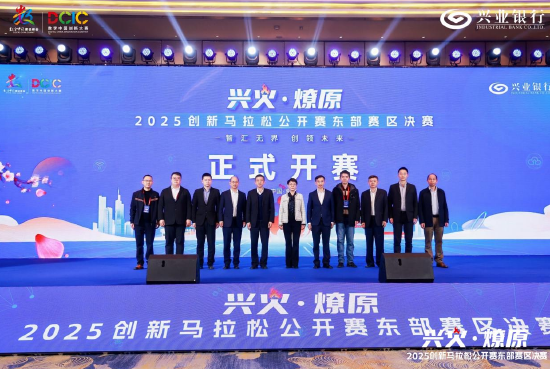
智汇无界 创领未来,2025年“兴火·燎原”创新马拉松公开赛东部赛区决赛在宁圆满落幕
Xin Lang Cai Jing· 2026-01-22 07:10
兴业银行南京分行副行长张健华先生代表赛区组委会致开场辞,银行数字化转型既是服务实体经济高质 量发展的必然路径,更是构建"第二增长曲线"的必然选择。作为数字中国建设峰会的核心赛事,"兴火· 燎原"创新马拉松公开赛始终以凝聚社会各界创新力量为己任,持续搭建优质交流平台,有力地促进了 银政企、产学研深度融合,为创新成果从理念走向落地筑牢桥梁。同时,他寄语全体参赛团队,秉持初 心、全力以赴、赛出专业风采、赛出创新实力。 决赛现场氛围热烈而紧张,决赛各团队以清晰的思路、专业的表达,全面阐述项目的创新亮点、核心优 势、应用场景及市场价值,涵盖新技术应用、智能营销、科技金融、智慧运营、数字风控等多个核心领 域,一个个兼具前瞻性与实用性的创新方案,赢得了现场评委与观众的高度关注。评审团则本着公平、 公正、专业的原则,围绕项目核心痛点、技术可行性、落地潜力等关键维度精准提问、细致点评,既为 参赛项目优化提供了宝贵建议,也为后续成果转化指明了方向。 经过多轮激烈角逐与评审团专业研判,大赛最终评选出一等奖、二等奖、三等奖及优秀奖多个荣誉奖 项。其中《东方财富Choice五篇大文章企业智能识别及全天候监测系统》《需求分析AI平台-软 ...

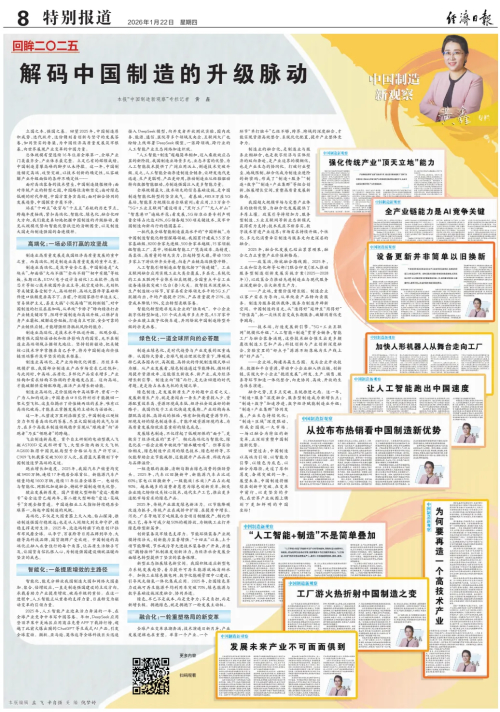
《经济日报》整版报道 解码2025年中国制造的升级脉动
Jing Ji Ri Bao· 2026-01-22 06:41
Core Viewpoint - The article emphasizes the significant advancements in China's manufacturing sector by 2025, highlighting its transition towards high-end, intelligent, green, and integrated manufacturing, which is crucial for the country's economic high-quality development [3][4]. High-end Manufacturing - High-end manufacturing is identified as a critical focus for achieving high-quality development in the manufacturing sector, addressing issues such as reliance on foreign technology and the need for a self-sufficient supply chain [5][6]. - The article notes that by 2025, China's automotive production and sales are expected to exceed 34 million units, maintaining its position as the world's largest automotive market for 17 consecutive years [6][7]. - The successful development of advanced technologies, such as the AS700D electric airship and AG600 amphibious firefighting aircraft, showcases China's progress in high-end manufacturing [6][7]. Intelligent Manufacturing - Intelligent manufacturing is positioned as a primary pathway for enhancing quality and efficiency, with artificial intelligence becoming a driving force for transformation [8][9]. - By 2025, China is expected to have over 1 million industrial devices connected through industrial internet platforms, significantly improving production efficiency and reducing operational costs [10]. - The integration of AI into manufacturing processes is leading to faster R&D cycles and smarter production methods, marking a shift from experience-driven to data-driven manufacturing [9][10]. Green Manufacturing - The article highlights the necessity of green manufacturing as a response to global climate challenges, emphasizing the importance of reducing carbon emissions and enhancing resource efficiency [11][12]. - By 2025, nearly 60% of new energy vehicles are projected to be part of vehicle replacement programs, indicating a strong consumer shift towards green products [12][13]. - The development of green technologies and equipment is expected to support traditional industries in reducing emissions and enhancing sustainability [12][13]. Integrated Manufacturing - Integrated manufacturing is described as a transformative approach that combines manufacturing with services and digital economies, enhancing overall competitiveness [14][15]. - Policies are being implemented to promote the deep integration of advanced manufacturing and modern services, fostering new growth drivers [15][16]. - The article notes that the integration of manufacturing with digital technologies and services is reshaping the value chain, moving from product sales to service-oriented models [15][16].