洋河股份

Search documents
数字化营销为白酒产业注入新活力
Zhong Guo Chan Ye Jing Ji Xin Xi Wang· 2025-07-30 00:49
Core Viewpoint - The rapid development of the internet is driving the transformation of the liquor industry towards digital marketing, marking the entry into the "experience economy" era, where companies must leverage technology and culture to reshape relationships with consumers [1] Group 1: Innovative Marketing Strategies - Shanxi Fenjiu launched the first "3D" marketing advertisement in the liquor industry on JD.com, allowing consumers to view the product in detail and from different angles [2] - Wuliangye introduced a "digital wine certificate" to ensure product authenticity through blockchain technology, with over 68,000 digital certificates created and a repurchase rate of 26.1% [2] - Yanghe launched three cultural liquor products targeting specific consumer groups, demonstrating a shift towards "precision marketing" [3] Group 2: Changing Consumer Demographics - The China Alcoholic Drinks Association reported a decline in consumption among older generations, with younger consumers (born between 1985-1994 and post-1995) becoming the main growth drivers in the liquor market [4] - Companies are adapting their marketing strategies to engage younger consumers, moving from traditional advertising to interactive and participatory marketing approaches [4][5] Group 3: Digital Transformation and Experience - The liquor industry is experiencing a profound transformation driven by digitalization, moving from traditional sales models to innovative consumer experiences [8] - Companies are increasingly utilizing technologies like VR and AR to create immersive product experiences, enhancing consumer engagement and conversion rates [7][8] - The next growth phase for online marketing in the liquor industry is expected to focus on social e-commerce, leveraging platforms like WeChat and Douyin for brand awareness and sales [7] Group 4: Future Directions - The future of liquor marketing is anticipated to evolve towards "intelligent + experiential" strategies, integrating AI for personalized marketing and enhancing consumer experiences through technology [8]
宿迁“场景消费”花样升级
Xin Hua Ri Bao· 2025-07-29 21:46
Group 1 - The core idea is that Suqian City is focusing on new trends in cultural tourism consumption by integrating new business formats and creating new scenarios, particularly through the "pet+" and "coffee+" concepts to enhance service quality and drive high-quality development in cultural tourism [1][2] Group 2 - Suqian is targeting the booming "pet economy" by exploring the construction of pet-friendly scenic areas, starting with the Suqiu District, and equipping attractions with pet-friendly facilities [1] - The city plans to host a series of pet tourism activities such as pet carnivals, fashion shows, and sports events, while also introducing related business formats to create new consumption scenarios [1] - Key scenic areas will be encouraged to add pet play areas, rest stations, and drinking points, promoting a theme of "traveling with pets in Suqian" [1] Group 3 - To attract younger customers, Suqian is unlocking new "coffee and tourism integration" strategies by creating coffee rest areas in scenic spots and developing culturally themed coffee drinks [2] - The city encourages experiential consumption products in cultural tourism areas, such as "underground cellar exploration" and "DIY coffee and wine" [2] - The construction of a water-based coffee bar in Hongze Lake Wetland Scenic Area aims to enhance consumer engagement and increase per capita spending [2]
今世缘股价微涨0.13% 营销争议背后全国化战略提速
Jin Rong Jie· 2025-07-29 16:48
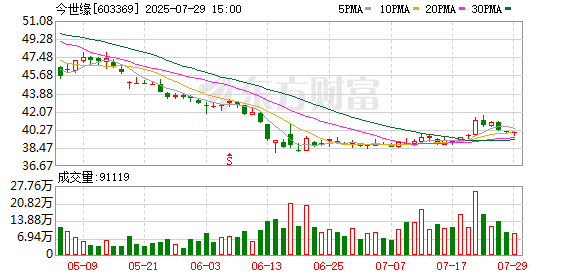
Core Viewpoint - The company, Jinshiyuan, is experiencing a stable stock performance and is actively enhancing its marketing strategies while pursuing national expansion in the competitive liquor industry [1] Group 1: Stock Performance - As of July 29, the stock price of Jinshiyuan closed at 40.04 yuan, up 0.13% from the previous trading day, with a trading volume of 363 million yuan [1] - The intraday price fluctuation ranged from 39.60 yuan to 40.08 yuan, with a volatility of 1.20% [1] Group 2: Business Overview - The company operates in the liquor industry, focusing on the production and sales of baijiu, with brands such as "Guoyuan" and "Jinshiyuan" [1] - Jinshiyuan is a representative liquor enterprise in Jiangsu, primarily targeting the mid-to-high-end baijiu market [1] Group 3: Marketing and Strategy - Recent marketing efforts have drawn industry attention due to a controversial advertisement perceived as a jab at competitor Yanghe's product strategy; the company clarified that the ad was not officially released [1] - Jinshiyuan plans to invest 888 million yuan in advertising for 2024, utilizing sponsorships of sports events and concerts to enhance brand visibility [1] Group 4: Financial and Strategic Goals - On July 29, there was a net outflow of 11.14 million yuan in main funds [1] - The company is advancing its national strategy, with projected revenue growth of 27.37% from outside Jiangsu in 2024, although this still accounts for less than 10% of total revenue [1] - In a recent strategic meeting, the company set a goal to establish the Guoyuan brand as a well-known baijiu brand around Jiangsu within five years [1]

今世缘营销海报引争议 加速冲刺全国化
Zhong Guo Jing Ying Bao· 2025-07-29 14:51
Core Viewpoint - The recent marketing strategies and advertising campaigns by Jiangsu-based liquor companies, particularly Jinshiyuan and Yanghe, have sparked significant industry discussions, highlighting the competitive landscape in the Chinese liquor market [2][4]. Group 1: Marketing Strategies - Jinshiyuan's recent advertisements, which include slogans that indirectly reference Yanghe's new product launch, have been interpreted as a direct challenge to Yanghe's marketing approach [3][4]. - Yanghe's new product, priced at 59 yuan, has gained rapid market traction, with reports of immediate sell-outs and high demand from distributors [3][4]. - Jinshiyuan has been actively increasing its marketing efforts, with a 50.88% year-on-year increase in sales expenses in 2023, reaching 2.097 billion yuan [8]. Group 2: Financial Performance - In 2024, Yanghe's revenue in Jiangsu province is projected to decline by 11.43% to 12.748 billion yuan, while Jinshiyuan is expected to achieve a 16% growth, reaching 10.553 billion yuan [6]. - The revenue gap between Yanghe and Jinshiyuan in Jiangsu is narrowing, currently standing at 2.2 billion yuan, indicating intensifying competition [6]. Group 3: National Expansion Plans - Jinshiyuan has set ambitious national expansion goals, aiming for 2 billion yuan in revenue from outside Jiangsu by 2025, which would account for approximately 13.3% of total revenue [9][10]. - Despite the slow progress in national expansion, Jinshiyuan's revenue from outside Jiangsu was 926 million yuan in 2024, making up only 8.02% of total revenue [10]. - The company plans to leverage its strong brand presence in Jiangsu to penetrate surrounding markets and establish itself as a well-known liquor brand nationally [10].


消费主权时代,白酒产业步入变革重构新阶段
Sou Hu Cai Jing· 2025-07-29 13:05
Core Viewpoint - The Chinese liquor industry is undergoing a significant transformation driven by changing consumer preferences, with product innovation being just the starting point for future competition [1][8]. Group 1: Product Innovation Trends - The industry is witnessing a resurgence in low-alcohol, small-packaged, and light-bottle products, which have become hot topics among major liquor companies [1][2]. - Major companies like Wuliangye and Luzhou Laojiao are launching low-alcohol products, with Luzhou Laojiao announcing the development of a 28-degree version of its flagship product [3][5]. - The rise of the Z generation is influencing the market, leading to increased demand for small-capacity liquor products, with companies like Yanghe and Shui Jing Fang introducing new small-packaged offerings [5][12]. Group 2: Consumer-Centric Changes - The shift towards a consumer-driven market is evident, with companies needing to adapt to the evolving consumer landscape to maintain sales and growth [7][9]. - The traditional business banquet and gift market for liquor is declining, while new consumption scenarios like family gatherings and personal enjoyment are emerging as growth areas [12][13]. - The industry is experiencing a significant drop in sales for business banquets, with a reported decline of 60%-80% in volume for this segment [12]. Group 3: Channel and Market Dynamics - The liquor distribution landscape is undergoing a transformation, moving from a "channel-driven" model to one focused on "user sovereignty," leading to challenges for traditional distribution channels [10][12]. - New sales channels, including direct purchases from supermarkets and e-commerce platforms, are becoming increasingly important as traditional distribution methods struggle [10][12]. - Companies are exploring innovative consumption scenarios and product expressions to better meet diverse consumer needs, as seen with Wuliangye's targeted product for the "golden list" celebration [12][13]. Group 4: Quality Expression and Branding - The industry faces challenges in effectively communicating the quality and value of its products to consumers, necessitating improvements in the quality expression system [13][15]. - The internationalization and youth-oriented strategies of liquor brands are critical, with companies actively seeking to engage younger consumers through low-alcohol products [15].

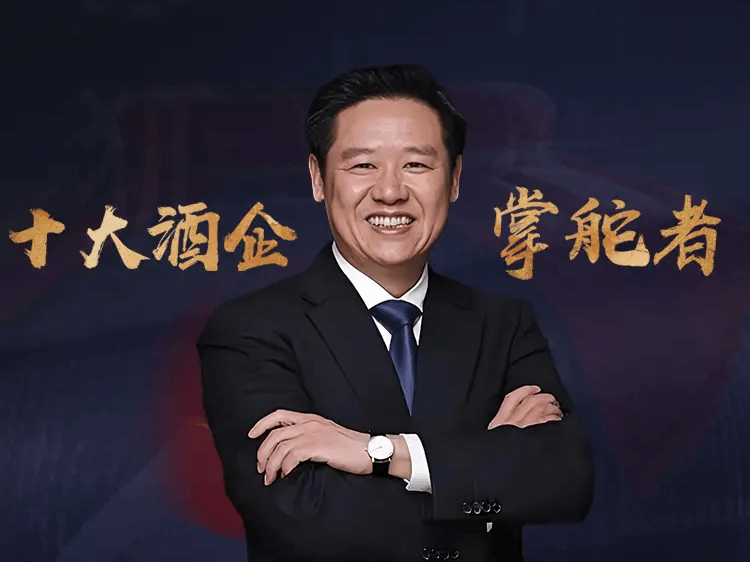
珍酒李渡董事长吴向东:从白酒教父到新晋网红,公司去年营收 71 亿元,大珍能否扛起突围大旗
Sou Hu Cai Jing· 2025-07-29 12:35
Core Viewpoint - The Chinese liquor industry is entering a deep adjustment period in 2024, with intensified market competition and frequent personnel changes, prompting companies to view "reform" as a key driver for exploring new growth points to meet challenges and embrace opportunities [1] Company Overview - Wu Xiangdong, chairman of Zhenjiu Lidu Group, has gained popularity in the liquor industry through his outspoken views on social media, becoming a new "internet celebrity" in the sector [2] - Zhenjiu Lidu has experienced fluctuations in performance amid the industry's adjustment cycle, with revenue reaching 70.67 billion yuan in 2024, a slight increase of 0.52%, while net profit attributable to shareholders fell by 43.12% to 13.24 billion yuan [3][4][11] Strategic Initiatives - To adapt to current consumer trends, Zhenjiu Lidu has reintroduced the strategic new product "Dazhen Zhenjiu" and appointed Yao Anna as its "Cultural Heritage Ambassador," with Wu Xiangdong personally promoting the product [4][14] - The company has focused on reducing the market expansion pace of its core brand Zhenjiu and has cut back on lower-margin products in its e-commerce business [11] Market Positioning - Zhenjiu Lidu's revenue breakdown shows that only Lidu brand experienced growth, with an 18.3% increase to 13.13 billion yuan, while Zhenjiu, Xiangjiao, and Kaikouxiao reported revenues of 44.80 billion yuan, 8.02 billion yuan, and 3.37 billion yuan respectively [11] - The company’s high-end products generated 17.09 billion yuan in revenue, a decline of 10.82%, while the next-highest tier products saw an 8.77% increase to 29.95 billion yuan [11] Competitive Landscape - Zhenjiu has maintained its position as the third-largest sauce-flavored liquor brand in Guizhou for two consecutive years, with revenue of 44.80 billion yuan in 2024, competing closely with Guotai, which set a sales target of 60 billion yuan for 2025 [9][12] - The company is facing pressure from established brands like Moutai and Langjiu, necessitating a transformation to enhance its adaptability in the industry [15] Future Outlook - 2025 marks the 50th anniversary of Zhenjiu, and the company aims to transition towards becoming a world-class liquor enterprise, with ongoing marketing innovations and strategic partnerships to strengthen its market position [15]
白酒不行了?不,是市场太急了
Sou Hu Cai Jing· 2025-07-29 12:15
Core Viewpoint - The Chinese liquor industry is currently undergoing a deep adjustment period, with overall market performance being sluggish and many companies reporting significant declines in revenue and profit [1][3][4]. Industry Overview - The liquor industry is experiencing a noticeable slowdown in growth, with many companies reporting declines in both revenue and net profit, and some even turning from profit to loss [1][3]. - The adjustment in the industry is characterized by a systemic pressure affecting all companies, rather than isolated operational issues [3][4]. Company Performance - Jiu Gui Jiu's net profit for the first half of the year is expected to be between 8 million and 12 million yuan, a decline of 90.08% to 93.39% compared to 121 million yuan in the same period last year, with revenue expected to drop by approximately 43% to around 560 million yuan [1]. - Shui Jing Fang anticipates a net profit of 105 million yuan for the first half of the year, down 56.52% year-on-year, with revenue expected to decrease by 12.84% to 1.498 billion yuan, despite a 14.54% increase in sales volume [1]. - Shunxin Agriculture expects a net profit of 155 million to 195 million yuan, a decline of 53.85% to 63.32% year-on-year, due to decreased sales volume impacting overall revenue and profit levels [3]. - Jinzhongzi forecasts a net loss of 60 million to 90 million yuan for the first half of the year, attributing this to the industry's deep adjustment and ongoing decline in production [3]. Market Dynamics - The industry faces multiple challenges, including shrinking consumption scenarios, soft market demand, and a shift in consumer preferences towards fruit wines and low-alcohol beverages [4]. - High inventory levels and serious price inversion issues are exacerbating industry pressures, with over 58% of distributors reporting increased inventory and more than half facing price inversion problems [4]. - The average inventory turnover days have reached 900 days, an increase of 10% year-on-year, indicating significant supply chain inefficiencies [4]. Future Outlook - Despite the current challenges, leading companies like Kweichow Moutai and Wuliangye are still achieving relatively stable growth, with Moutai reporting a 9% year-on-year revenue increase [7]. - The low-alcohol beverage market is emerging as a new growth point, with companies exploring new product lines and sales channels [7]. - Industry experts predict a full recovery by 2027, with new development opportunities arising in 2028, suggesting that patience and understanding are needed for the industry's transformation [8][9].





珍酒李渡董事长吴向东:从白酒教父到新晋网红,公司去年营收 71 亿元,大珍能否扛起突围大旗?
Sou Hu Cai Jing· 2025-07-29 12:12
Core Viewpoint - The Chinese liquor industry is entering a deep adjustment period in 2024, with intensified market competition and frequent personnel changes, prompting companies to view "reform" as a key driver for exploring new growth points to meet challenges and embrace opportunities [2] Company Overview - Wu Xiangdong, chairman of Zhenjiu Lidu Group, has gained significant attention in the liquor industry through his outspoken views on social media, becoming a new "internet celebrity" in the sector [5] - Zhenjiu Lidu has experienced fluctuations in performance amid the industry's adjustment cycle, with 2024 revenue reaching 70.67 billion yuan, a slight increase of 0.52% year-on-year, while net profit attributable to shareholders fell by 43.12% to 13.24 billion yuan [6][19] Strategic Initiatives - To adapt to current consumer trends, Zhenjiu Lidu has reintroduced the strategic new product "Da Zhen·Zhenjiu" and signed Yao Anna as the "Cultural Heritage Ambassador," with Wu Xiangdong personally promoting the product [8][22] - The company aims to enhance its market position by focusing on the next high-end product segment, with "Da Zhen" priced at 888 yuan, and has allocated a significant portion of its budget towards this initiative [22][24] Market Position and Competition - Zhenjiu Lidu has maintained its position as the third-largest sauce-flavored liquor brand in Guizhou for two consecutive years, with revenue from the Zhenjiu brand at 44.80 billion yuan in 2024 [18][20] - The company faces competition from other brands like Guotai, which has set a sales target of 60 billion yuan for 2025, intensifying the competitive landscape [18] Financial Performance - The company's financial performance shows a decline in net profit primarily due to non-operating financial instrument valuation changes, stock incentive costs, and listing expenses [20] - Revenue breakdown indicates that only the Lidu brand saw growth, with an 18.3% increase to 13.13 billion yuan, while the core brand Zhenjiu experienced a revenue decline [20][21] Future Outlook - 2025 marks the 50th anniversary of Zhenjiu, and the company aims to transition towards becoming a world-class brewing enterprise, indicating a need for transformation and enhanced industry adaptability [25]
估值洼地待填平?吃喝板块继续寻底,白酒、大众品集体下探!机构:板块底部机会值得珍视
Xin Lang Ji Jin· 2025-07-29 12:10
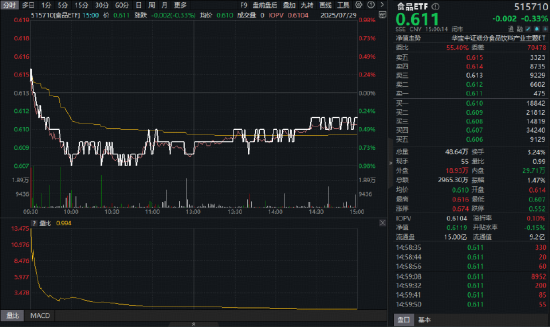
Group 1 - The food and beverage sector continues to experience a pullback, with the Food ETF (515710) showing a slight decline of 0.33% by the end of the trading day [1] - Major consumer goods have seen significant declines, with leading liquor brands also performing poorly; for instance, Yanjinpuzi dropped by 6.22% and Chengde Lulu fell by 3.26% [3] - Historical data suggests that stock prices often bottom out before the fundamentals do, indicating that the pessimistic expectations for the liquor industry may have been over-reflected in current stock prices, making valuations attractive for long-term investors [3][4] Group 2 - The liquor sector is expected to benefit from government policies aimed at reducing competition, which may help stabilize prices and promote high-quality development, enhancing market expectations for future economic growth [4] - Current valuations in the liquor sector are low, and there are opportunities for recovery as sales and financial reports gradually improve [4][5] - Analysts recommend focusing on leading companies with stable demand and strong risk management, as well as those actively exploring new products and channels [5][6] Group 3 - The Food ETF (515710) tracks the sub-index of the food and beverage industry, with approximately 60% of its holdings in leading high-end and mid-range liquor stocks, and nearly 40% in beverage, dairy, seasoning, and beer sectors [6]
今世缘海报遭热议,顾祥悦不允许讲别人坏话
Sou Hu Cai Jing· 2025-07-29 10:43
Core Viewpoint - The competition between Yanghe and Jinshiyuan in the liquor market is intensifying, with Yanghe's new product, the "High-Line Light Bottle Wine," facing criticism from Jinshiyuan, which has led to a focus on their respective market strategies and financial performance [2][4][6]. Group 1: Product Launch and Marketing - Yanghe launched the "High-Line Light Bottle Wine" in June, priced at 59 yuan, emphasizing its quality with 100% three-year aged base liquor [2]. - The product achieved significant sales success, selling out over 10,000 bottles within 48 hours of online pre-sale and experiencing explosive demand in offline channels [4]. Group 2: Competitive Dynamics - Jinshiyuan's recent marketing campaign appears to mock Yanghe's "true vintage" strategy and "brotherhood" marketing approach, indicating a competitive response to Yanghe's positioning [6]. - Jinshiyuan's chairman emphasized a focus on promoting their own products rather than disparaging competitors, reflecting a strategic shift in the industry [6]. Group 3: Financial Performance - Jinshiyuan's revenue is projected to grow from 78.88 billion yuan in 2022 to 115.46 billion yuan in 2024, with net profits increasing from 25.03 billion yuan to 34.12 billion yuan during the same period [6]. - In contrast, Yanghe's revenue is expected to decline from 301.05 billion yuan in 2022 to 288.76 billion yuan in 2024, with net profits dropping from 93.78 billion yuan to 66.73 billion yuan [7]. - In Q1 2025, Jinshiyuan reported a revenue increase of 9.17% to 50.99 billion yuan, while Yanghe's revenue fell by 31.92% to 110.66 billion yuan [7]. Group 4: Strategic Changes - Yanghe has undergone leadership changes, with the departure of former chairman Zhang Liandong and the appointment of Gu Yu, indicating potential shifts in strategic direction [8].