邮储银行

Search documents
邮储银行青岛分行:坚守金融温度 以“心”服务伴民生
Zhong Guo Jin Rong Xin Xi Wang· 2025-12-05 11:11
Group 1 - The core viewpoint of the articles emphasizes the commitment of Postal Savings Bank's Qingdao branch to enhance financial services through digitalization while maintaining a human touch to meet public needs [1][2] - The bank has launched 7,968 "Postal Love Wallets" this year, providing small denomination cash totaling 17.54 million yuan, integrating convenience into citizens' daily lives [1] - The bank has conducted 8 "Cash Mobile Caravan" activities in rural areas, completing the exchange of 151,000 pieces of small change, demonstrating the practical value of financial services reaching underserved communities [1] Group 2 - The bank focuses on elderly care through the "Warm Sun Golden Rays" initiative, establishing 3 nationally certified "Elderly-Friendly Service Five-Star" outlets equipped with necessary facilities for senior citizens [2] - The bank offers basic services such as resting areas, drinking water, and blood pressure measurement for the elderly, along with educational sessions on anti-counterfeiting and financial knowledge [2] - The bank plans to continue extending its services from urban to rural areas and from offline to online, fulfilling its responsibility as a state-owned bank to meet the needs of the public [2]

“十五五”深度研究系列报告(七):如何建立“金融强国”?
ZHESHANG SECURITIES· 2025-12-05 07:26
Group 1: Central Bank Objectives - The "14th Five-Year Plan" emphasizes the need to "improve the modern central banking system," with a notable shift to explicitly include "economic growth" as a primary goal alongside currency stability and financial stability[1] - The dual-pillar framework will provide tools and institutional support for both currency stability and financial stability, marking a significant evolution in the central bank's objectives[3] - The adjustment in primary objectives reflects a structural recalibration, aligning legal requirements with modern central banking discourse, enhancing consistency between law and practice[19] Group 2: Macro-Prudential Management - The macro-prudential framework is expected to evolve along three main lines: objectives, tools, and mechanisms, focusing on systemic stability rather than individual risk management[3] - The macro-prudential toolbox will be systematized, with increased attention to stock, bond, and foreign exchange markets, enhancing the central bank's ability to manage systemic risks[3] - The central bank's focus will shift from temporary crisis management to regular expectation management and emergency arrangements, improving its crisis response capabilities[26] Group 3: Interest Rate Marketization - China's interest rate marketization has progressed through three stages: price liberalization, establishment of a rate transmission system, and refined price control[31] - The future evolution of the interest rate corridor is expected to tilt operational target rates from DR007 towards DR001, enhancing liquidity management and tool innovation[38] - The central bank is likely to explore conditional liquidity tools for non-bank institutions to provide support during extreme market fluctuations, preventing irrational spikes in short-term rates[5] Group 4: Capital Market Development - The "Five Major Articles" will shift focus towards three main lines: from tool coverage to institutional construction, from credit-led to a balanced approach between equity and debt financing, and from central bank-led initiatives to collaborative efforts across multiple policies[8] - The emphasis on direct financing through equity and bond markets aims to enhance the capital market's functionality, aligning it with the needs of the real economy[9] - The development of a direct financing system centered on technology enterprises will focus on deepening equity financing and thickening bond markets[9]
央行“收短放长”再加码,万亿流动性注入稳市场
Huan Qiu Wang· 2025-12-05 06:32
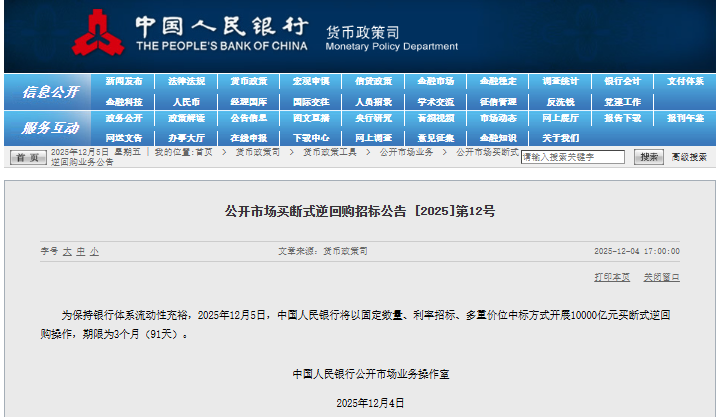
Core Viewpoint - The People's Bank of China (PBOC) conducted a 1 trillion yuan (approximately 140 billion USD) three-month reverse repo operation on December 5 to maintain reasonable liquidity in the banking system at year-end, effectively rolling over the same amount of maturing funds [1]. Group 1: Market Liquidity - The operation reflects a stable demand for liquidity in the banking system at the beginning of the month, with institutions preferring to retain flexibility in managing liabilities until clearer funding needs arise mid-month and month-end [6]. - The market generally anticipates the PBOC's overall support for medium to long-term liquidity in December, with an additional 400 billion yuan (approximately 56 billion USD) six-month reverse repo maturing, and a likelihood of another six-month operation being conducted [6]. - This operation is part of a strategy to address potential liquidity tightening pressures, as the government bond issuance is expected to be high, alongside a significant amount of interbank certificates maturing [6]. Group 2: Monetary Policy Strategy - The operation continues the PBOC's "short-term withdrawal, long-term injection" strategy, having net injected 650 billion yuan (approximately 91 billion USD) of medium to long-term liquidity while withdrawing 556.2 billion yuan (approximately 78 billion USD) of short-term funds through seven-day reverse repos [7]. - This strategy aims to meet the market's demand for stable medium to long-term funds while preventing fund idling and improving fund utilization efficiency, which is crucial for maintaining year-end liquidity and stabilizing market expectations [7]. - Future policy outlook suggests that the PBOC may implement a new round of reserve requirement ratio (RRR) cuts before year-end, potentially leading to a decrease in the scale of net medium-term liquidity injections [7].

房地产底线逻辑研究系列报告一:银行直供房热度背后的真相
Bank of China Securities· 2025-12-05 04:38
Investment Rating - The report rates the real estate industry as "Outperform" [1] Core Insights - The report highlights the increasing attention on bank-supplied housing, primarily due to the ongoing downturn in the real estate market, which has led to declining prices and heightened market concerns [12][28] - It emphasizes that the increase in bank-supplied housing is a response to rising non-performing asset pressures and is part of banks' routine asset disposal operations aimed at liquidity recovery [12][28] - The report suggests that the impact of bank-supplied housing on the overall real estate market is limited, with a small market share and low transaction volumes [28] Summary by Sections 1. What is Bank-Supplied Housing? - Bank-supplied housing refers to properties acquired by banks through the disposal of non-performing loans, which are then sold or rented out directly by the banks [11][12] - The main sources of these properties include loans defaulted by individuals or companies, leading to the banks taking ownership [11][12] 2. Recent Trends in Bank-Supplied Housing - The number of bank-supplied housing listings has increased, with 16,000 units listed in 2024, a 73% year-on-year increase, and 14,000 units in the first ten months of 2025, showing a 4% increase from 2024 [22][27] - However, the total volume remains significantly lower than that of auctioned properties, with bank-supplied housing listings being less than one-eighteenth of auctioned properties [22][28] 3. Distribution and Characteristics of Bank-Supplied Housing - The majority of bank-supplied housing is concentrated in lower-tier cities, with first-tier cities accounting for only 0.6% of listings [30][31] - The properties are predominantly unfinished (59%) or simply decorated (38%), with only 3% being fully furnished [40][48] - A significant portion (86%) of the listings is priced below 1 million yuan, reflecting the current market conditions [47][49] 4. Transaction Dynamics - The transaction rate for bank-supplied housing is low, with only 7% of the 14,000 units listed in the first ten months of 2025 being sold, compared to 20% for auctioned properties [28] - Most transactions occur at or near the starting price, indicating a market heavily influenced by price sensitivity [28] 5. Investment Recommendations - The report suggests focusing on three main lines of investment: 1. Companies with stable fundamentals and high market shares in core cities, such as Binjiang Group and China Merchants Shekou [28] 2. Smaller firms that have shown significant breakthroughs in sales and land acquisition since 2024, like Poly Real Estate Group [28] 3. Commercial real estate companies exploring new consumption scenarios and operational models, such as China Resources and Swire Properties [28]
邮爱公益获得“责任100|2025年第九届CSR中国教育榜”年度典范大奖
Xin Hua Wang· 2025-12-05 02:29
近日,"责任100|2025年第九届CSR中国教育榜"发布。中国邮政储蓄银行获评"最佳责任企业品牌", 其中"邮爱公益"项目凭借在教育公益领域的长期深耕与卓越成效,获得最高荣誉"责任100|年度典范大 奖"。 未来,邮储银行将继续以"邮爱公益"为重要载体,凝聚更多社会力量,以金融之力赋能乡村振兴,在新 时代谱写企业社会责任的新篇章。 (文章来源:新华网) "责任100|CSR中国教育榜"由中国教育联盟于2014年发起,是中国教育领域聚焦联合国可持续发展目 标(SDGs)、企业社会责任(CSR)与环境社会治理(ESG)实践的最具影响力奖项之一。 邮储银行始终积极践行社会责任,履行大行担当,传递温暖力量,以初心使命共创美好生活。邮爱公益 自2017年与中国乡村发展基金会联合发起以来,始终聚焦教育公益,通过"邮爱自强班""邮爱奖学 金""邮爱公益爱心包裹"等一系列品牌项目,持续为乡村学子点亮梦想。截至目前,邮爱自强班已在全 国21个省份47个县域开班,助力数百名学子圆梦清华大学、北京大学等国家重点高校。 ...

银行业为新型城镇化建设添砖加瓦
Jin Rong Shi Bao· 2025-12-05 02:03
Group 1 - The State Council emphasizes the importance of human-centered new urbanization and the need to enhance urbanization quality to unleash the potential of urban-rural integration for economic development [1] - The new urbanization strategy has been a significant development since the 18th National Congress of the Communist Party of China, focusing on optimizing regional economic layout and promoting coordinated regional development [1] - The successful operation of the rail transit line 11 connects Suzhou and Shanghai, highlighting the development of urban areas like Yushan Town in Kunshan, which is becoming a key area for urbanization projects [1] Group 2 - Agricultural Bank of Jiangsu Suzhou Branch leads a syndicate loan of 5.8 billion yuan to support the construction of a new urban center in Yushan Town, integrating high-end business, livable spaces, and cultural education [2] - The bank aims to treat cities, counties, and towns as organic systems, enhancing local characteristics and ensuring precise guidance for high-quality development [2] - The "Opinions" issued by the Central Committee and the State Council outline goals for urban renewal by 2030, focusing on improving living environments and enhancing urban development mechanisms [2] Group 3 - The implementation of urban renewal policies is expected to accelerate nationwide, improving infrastructure, industrial layout, ecological environment, and living quality [3] - In Tongbai County, the underground power line project enhances living conditions and safety, with Postal Savings Bank of Henan Province providing a 0.085 billion yuan loan to support the initiative [3] - Experts suggest that new urbanization should integrate urban and rural planning, with county-level development being crucial for achieving urban-rural integration [3] Group 4 - The Industrial and Commercial Bank of Zhejiang Province supports various projects in Lishui City, focusing on new urbanization, including community development, old city renovation, and public services [4] - The bank promotes initiatives like "Beautiful Countryside Loans" to enhance rural ecological environments and public services, contributing to the construction of beautiful villages [4]
2026邮政金融论坛暨中邮证券策略报告会在京成功举办
Xin Lang Cai Jing· 2025-12-05 01:36
12月3日至4日,"2026邮政金融论坛暨中邮证券策略报告会"在北京成功举办。本次论坛由中邮证券联合中国邮政储蓄银行、中邮保险共同主办,是邮政整 合银行、证券、保险等多方资源、协同发力、共谋发展的一次重要实践。论坛聚焦"十五五"开局之年的宏观经济趋势、金融改革深化、科技创新驱动等核 心议题,来自邮政集团、金融机构、企业界及学术界的众多嘉宾汇聚一堂,通过主题演讲与专题研讨,共谋金融与实体经济深度融合的高质量发展路径。 中国邮政集团副总经理、邮储银行行长刘建军在主会场发表主旨演讲,中国邮政集团总会计师王嘉君作开幕致辞,中邮保险董事长韩广岳、国务院发展研 究中心原副主任刘世锦、清华大学金融科技研究院副院长薛正华、中邮证券首席经济学家黄付生等也发表主旨演讲,中邮证券董事长龚启华主持主会场会 议。 王嘉君在开幕致辞中表示,党的二十届四中全会准确把握我国发展的历史方位,深入分析国际国内形势,擘画了未来5年发展的宏伟蓝图,为深入推进中 国式现代化指明了前进方向。其中,对金融"五篇大文章"、交通强国、低空经济、跨境电商、降低全社会物流成本、扎实推进乡村全面振兴、稳步推进基 本公共服务均等化等领域作出顶层设计和战略部署,为谱写 ...

利率迈入“0字头”时代“新三金”成年轻人理财新配置
Nan Fang Du Shi Bao· 2025-12-04 23:14
Core Viewpoint - The article highlights the decline in deposit interest rates in China, leading to the rise of a new asset allocation strategy called "New Three Golds," which includes money market funds, bond funds, and gold ETFs, particularly among younger generations [2][3][5]. Group 1: Interest Rate Environment - Several state-owned banks have recently removed five-year large-denomination certificates of deposit, with three-year deposit rates generally falling to the range of 1.5% to 1.75% [2][4]. - The current interest rate environment in China is at historical lows, with the six major state-owned banks reducing the interest rates on demand deposits to 0.05% and one-year fixed deposit rates dropping below 1% [3][5]. Group 2: Rise of "New Three Golds" - "New Three Golds" refers to a diversified asset allocation strategy involving money market funds, bond funds, and gold ETFs, aimed at achieving better returns than traditional deposits while controlling overall volatility [3][6]. - As of April 2025, over 9.37 million individuals born in the 1990s and 2000s have adopted the "New Three Golds" strategy on the Ant Wealth platform [2][3]. Group 3: Shift in Investment Behavior - There is a noticeable shift in investment behavior among residents, particularly young individuals, as they seek to preserve and grow their wealth amid declining deposit rates. In October 2025, household deposits decreased by 1.34 trillion yuan, while deposits in non-bank financial institutions increased by 1.85 trillion yuan [5][6]. - Discussions about asset allocation strategies, including "New Three Golds," are increasingly prevalent in online communities frequented by young people, indicating a growing interest in diversified investment approaches [3][6]. Group 4: Expert Insights and Recommendations - Experts suggest that the preference for "New Three Golds" among young investors may indicate a structural long-term change in investment behavior rather than just a temporary response to low interest rates [6][7]. - Financial experts recommend that investors should assess their risk tolerance and investment goals before diversifying their asset allocation, emphasizing the importance of rational decision-making over impulsive investments [6][7].

央行最新数据!信用卡三年减少1亿张,借记卡数量稳步攀升
Xin Lang Cai Jing· 2025-12-04 23:13
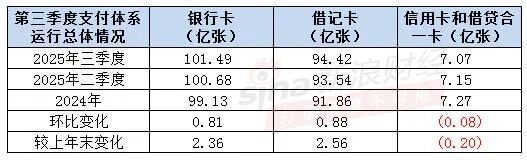
Core Insights - The central theme of the news is the ongoing decline in credit card issuance in China, contrasting with the growth in overall bank card numbers, indicating a shift in consumer behavior and banking strategies [1][3][4]. Group 1: Overall Payment System Performance - As of the end of Q3 2025, a total of 10.149 billion bank cards were issued in China, reflecting a quarter-on-quarter increase of 0.8% and a year-to-date increase of 2.36 billion cards [1][3]. - The number of debit cards reached 9.442 billion, with a quarter-on-quarter growth of 0.94% and a year-to-date increase of 2.56 billion cards [1][3]. - In contrast, the number of credit cards and combined lending cards fell to 707 million, down 8 million from the previous quarter and 20 million from the end of last year, marking a decline of 100 million from the historical peak of 807 million in Q3 2022 [1][3][4]. Group 2: Credit Card Trends - The decline in credit card issuance has been consistent, with a reduction of 8 million cards in Q3 2025 alone, and a total decrease of 10 million cards over the past three years [2][3]. - The average number of credit cards held per person has also decreased since 2023, indicating a broader trend of reduced credit card usage [4][6]. - Regulatory pressures and changing consumer demand are contributing factors to the cautious approach banks are taking towards credit card issuance, as highlighted by Deloitte's report [7][8]. Group 3: Transaction and Usage Statistics - In Q3 2025, the total number of bank card transactions reached 165.278 billion, representing a quarter-on-quarter increase of 12.69%, with transaction amounts totaling 234.92 trillion yuan, up 3.63% from the previous quarter [10][11]. - The number of electronic payment transactions processed by banks was 83.455 billion, with a total value of 94.54 trillion yuan, indicating robust growth in digital payment methods [12][13]. - Notably, the number of ATMs has continued to decline, dropping to 760,900 units by the end of Q3 2025 [1][13].
一则罚单牵出邮储银行两桩刑案!4人获刑,其中一人为支行行长
Xin Lang Cai Jing· 2025-12-04 23:13
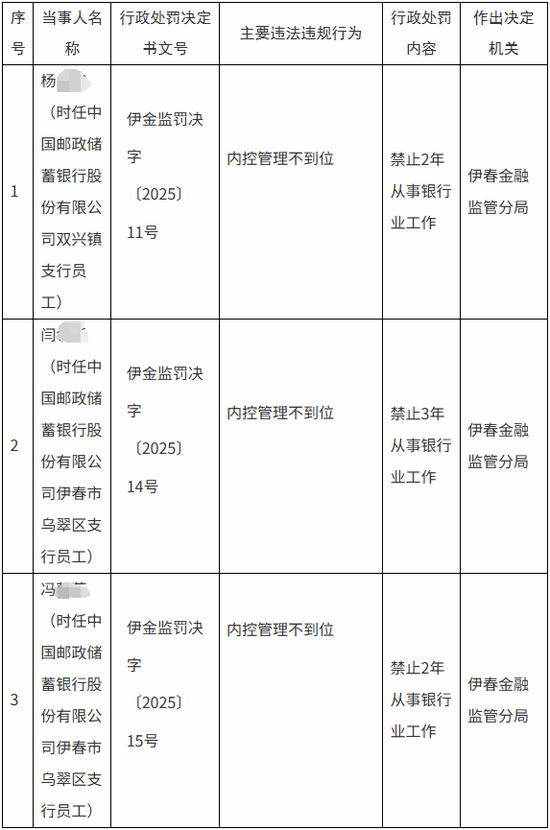
Core Viewpoint - A recent penalty issued by the National Financial Supervision Administration has revealed serious internal management issues at Postal Savings Bank, involving two criminal cases of fund misappropriation and loan fraud by bank employees [1][3]. Group 1: Fund Misappropriation Cases - The first case involves a loan officer who misappropriated over 1 million yuan for personal use and lending to others, ultimately leading to a 900,000 yuan shortfall when the funds could not be replenished [1][5]. - The second case is more complex, involving the same loan officer who not only misappropriated funds but also forged loan documents to defraud the bank, implicating two other employees, including the branch manager [1][9]. Group 2: Internal Control Failures - The penalties issued to three employees were due to "inadequate internal control management," with one employee banned from the banking industry for two years and others for three years [3][10]. - The investigation revealed systemic failures in the bank's management, including lack of checks and balances, ineffective approval processes, and reliance on personal trust rather than institutional controls [6][7]. Group 3: Criminal Activities and Legal Consequences - The main perpetrator, who misappropriated funds, was sentenced to four years in prison and ordered to repay 881,000 yuan [7][12]. - Another employee involved in a more extensive fraud scheme was sentenced to 13 years and six months in prison, with additional fines and restitution of over 1.5 million yuan [12].