
收短放长

Search documents
1月流动性月报:高息存款到期,关注负债压力边际变化-20260108
Huachuang Securities· 2026-01-08 15:31
Report Industry Investment Rating There is no information provided in the content about the report industry investment rating. Core Viewpoints of the Report The report analyzes the liquidity situation in December 2025 and makes a forecast for January 2026. In December, the central bank actively injected liquidity, and the funds across the year were stable. The monetary policy emphasizes cross - cycle balance and flexible and efficient use of reserve requirement ratio cuts and interest rate cuts. In January, the liquidity gap pressure is relatively large, and the potential disturbances on the bank's liability side may increase in the middle and late months, but the funds fluctuation may be relatively mild, and attention should be paid to the marginal changes in the bank's liability pressure after the increase in fiscal factor disturbances [1][3][4]. Summary According to the Directory 1. December 2025 Funds and Liquidity Review: Active Injection, Stable across the Year (1) Funds Review: Narrow - range Fluctuation Continued In December 2025, the overnight fluctuation range narrowed compared with the previous month, and the 7D funds fluctuation range widened. The overnight funds basically ran stably around 1.28%, and the 7D funds were stable around 1.45% from the beginning of the month to the 23rd, then rose continuously until reaching 1.9821% on the 31st. The overnight and 7D funds did not show an inversion. The funds were loose at the beginning of the month, the central bank carried out 100 billion yuan of 3M repurchase on the 5th, and 60 billion yuan of 6M repurchase in the middle of the month, continuing the "short - term contraction and long - term expansion" operation. At the end of the year, affected by seasonal factors, the 7D funds price fluctuated slightly. The funds across the year were relatively stable [11][12]. (2) Liquidity Review: The Central Bank Actively Injected in December, Continuing the "Short - term Contraction and Long - term Expansion" - **Liquidity Aggregate**: In December, the base money may have increased by 1.7 trillion yuan, with government deposits supplementing about 1 trillion yuan, the central bank's net injection totaling 752.8 billion yuan, and foreign exchange funds continuing to withdraw slightly by 7 billion yuan. After deducting the consumption of excess reserves, the excess reserves at the end of the month may have increased by about 1 trillion yuan, and the excess reserve ratio may be around 1.5%, at a seasonal level. The narrow - sense excess reserve level after deducting reverse repurchases may be around 0.8%, close to the seasonal level [36]. - **Open - market Operations**: In December, the central bank's open - market reverse repurchases slightly increased, with a net injection of 28.19 billion yuan. The MLF was injected with 40 billion yuan and 30 billion yuan matured, with a balance of 6.25 trillion yuan. The net injection of the outright reverse repurchase was 20 billion yuan, with a balance of 6.5 trillion yuan. The central bank also net - bought 5 billion yuan of national debt, carried out 26 billion yuan of treasury time deposits, and 15.94 billion yuan of PSL and other structural tools [46][51][54]. 2. December 2025 Monetary Policy Tracking: Focus on Cross - cycle Balance, Flexibly and Efficiently Use Reserve Requirement Ratio Cuts and Interest Rate Cuts In December 2025, important meetings emphasized "flexibly and efficiently using reserve requirement ratio cuts and interest rate cuts." The overall loosening may be relatively prudent, but the idea of liquidity protection continues. The central bank emphasizes cross - cycle balance to avoid large - scale policy expansion and contraction. The central economic work conference takes promoting stable economic growth and reasonable price recovery as important considerations. The fourth - quarter monetary policy meeting first proposed to "give play to the integrated effect of incremental and existing policies." In a neutral scenario next year, the policy interest rate is likely to be cut once, with a range of 10bp [3][57][63]. 3. January 2026 Gap Prediction: Disturbances May Increase in the Middle and Late Months (1) Rigid Gap: Reserve Requirement Slightly Consumes Excess Reserves, and MLF Maturities Decrease Marginally In January, the increase in general deposits may consume about 32.96 billion yuan of excess reserves. The MLF matures at 20 billion yuan, and the outright reverse repurchase matures at 1.7 trillion yuan (1.1 trillion yuan for 3M and 600 billion yuan for 6M), of which 1.1 trillion yuan of the 3M outright reverse repurchase was renewed on the 7th [69]. (2) Exogenous Shocks: Cash Withdrawal and Non - financial Institution Deposits Consume Liquidity at the End of the Year In January, cash withdrawal and non - financial institution deposits slightly consume excess reserves. Cash withdrawal may consume about 67.87 billion yuan of excess reserves, and non - financial institution deposits may consume about 16.36 billion yuan [71]. (3) Fiscal Factors: A Big Month for Taxation, Coupled with Government Bond Issuance, May Partially Consume Reserves In January, government bond issuance pressure increases. Considering factors such as payment and refund, taxation, and fiscal expenditure, government deposits may consume about 1.2 trillion yuan of liquidity [4][75][76]. (4) Comprehensive Judgment: Stable at the Beginning of the Month, Disturbances May Increase in the Middle and Late Months In January, the liquidity gap pressure is relatively large, but the bank's liquidity level at the beginning of the month may be relatively abundant. Affected by factors such as the maturity of high - interest deposits and the renewal of large - scale certificates of deposit, the potential disturbances on the bank's liability side may increase in the middle and late months. However, considering the current relatively low excess reserve level, the central bank has no intention of large - scale withdrawal, and the Spring Festival is later, so the funds fluctuation may be relatively mild. Attention should be paid to the marginal changes in the bank's liability pressure after the increase in fiscal factor disturbances [4][80].
——流动性和机构行为周度观察:当前收短放长不等同于负债成本提升-20251209
Changjiang Securities· 2025-12-08 23:30
Report Industry Investment Rating - Not provided in the given content Core Viewpoints - The current "shortening receipt and lengthening issuance" by the central bank does not necessarily mean an increase in liability costs. The central bank's "shortening receipt and lengthening issuance" in terms of quantity is more significant, and the large - scale long - end issuance is more effective in alleviating the liability pressure of financial institutions, especially banks [7]. Summary by Directory 1. Funds - In December 2025, the central bank conducted a 3 - month buy - out reverse repurchase operation of 100 billion yuan at the same volume. From December 1st - 5th, the central bank's 7 - day reverse repurchase had a net withdrawal of 84.8 billion yuan, and from December 8th - 12th, 66.38 billion yuan of 7 - day reverse repurchases will mature. In November, the central bank's net purchase of treasury bonds was 5 billion yuan [6]. - From December 1st - 5th, the average values of DR001 and R001 were 1.30% and 1.36% respectively, down 1.2 basis points and 2.3 basis points compared with November 24th - 28th. The average values of DR007 and R007 were 1.44% and 1.49% respectively, down 1.9 basis points and 3.9 basis points compared with November 24th - 28th [6]. - From December 1st - 7th, the net government bond payment was about 18.66 billion yuan, about 14.23 billion yuan less than November 24th - 30th. From December 8th - 14th, the net government bond payment is expected to be - 79.52 billion yuan [7]. 2. Negotiable Certificates of Deposit (NCDs) - As of December 5th, 2025, the maturity yields of 1 - month and 3 - month NCDs were 1.5793% and 1.6150% respectively, up 13.4 basis points and 4.0 basis points compared with November 28th. The 1 - year NCD maturity yield was 1.6550%, up 1.5 basis points compared with November 28th [8]. - From December 1st - 7th, the net financing of NCDs was about 4.71 billion yuan. From December 8th - 14th, the expected maturity repayment amount of NCDs is 106.24 billion yuan, with a significant increase in the pressure of maturity renewal [8]. 3. Institutional Behavior - From December 1st - 5th, the average leverage ratio of the inter - bank bond market was 107.56%, up from 107.32% in November 24th - 28th [9]. - On December 5th, 2025, the median duration of medium - long - term interest - rate style pure bond funds (MA5) was 4.47 years, a weekly increase of 0.79 years, at the 84.1% quantile since early 2022. The median duration of short - term interest - rate style pure bond funds (MA5) was 1.80 years, a weekly increase of 0.24 years, at the 51.2% quantile since early 2022 [9].
【债市观察】央行流动性操作“收短放长” 超长债跌创年内新低
Xin Hua Cai Jing· 2025-12-08 03:34
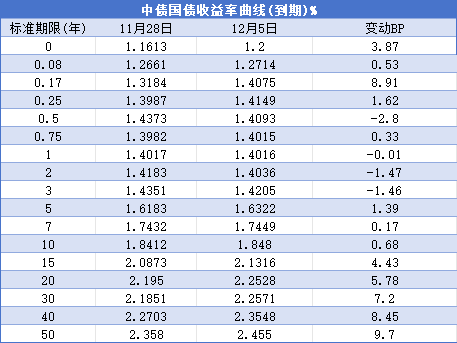
Core Viewpoint - The bond market is experiencing significant fluctuations, particularly in the long-end yields, influenced by macroeconomic narratives and policy expectations, while the equity market remains relatively stable [1][19]. Market Overview - The liquidity in the market was relatively loose at the beginning of December 2025, with the central bank conducting a net bond purchase of 500 billion yuan in November, indicating a "short-term collection and long-term release" strategy [1][14]. - The yield curve has steepened, with the 30-year government bond yield rising over 7 basis points, reflecting a correction in pricing logic for ultra-long bonds [1][4]. Yield Changes - As of December 5, 2025, the yields for various maturities showed mixed movements compared to November 28, 2025, with the 30-year yield increasing by 7.2 basis points to 2.2571% [2][3]. - The 10-year government bond yield also saw fluctuations, closing at 1.8285% after a series of adjustments throughout the week [4][6]. Issuance and Market Activity - In the primary market, a total of 78 bonds were issued, amounting to 430.717 billion yuan, including 4 government bonds worth 223 billion yuan [8][9]. - The issuance of a 30-year government bond at a bidding rate of 2.30% was noted to be higher than the secondary market level, indicating a potential divergence in market expectations [9]. International Context - The U.S. bond market saw a rise in yields, with the 10-year Treasury yield increasing by over 12 basis points to 4.14%, influenced by expectations of interest rate changes from the Federal Reserve [10][12]. - Japan's central bank signaled a potential interest rate hike, leading to a rise in Japanese government bond yields, which may affect capital flows and investor sentiment in the global bond market [12][19]. Institutional Insights - Analysts from CITIC Securities expect the central bank to maintain liquidity support through a combination of short and long-term operations, especially as year-end cash withdrawal demands increase [18]. - Industry experts from Industrial Securities highlighted a fundamental shift in macro narratives affecting ultra-long bonds, suggesting a decrease in the certainty of capital gains from such investments [19].

央行“收短放长”再加码,万亿流动性注入稳市场
Huan Qiu Wang· 2025-12-05 06:32
Core Viewpoint - The People's Bank of China (PBOC) conducted a 1 trillion yuan (approximately 140 billion USD) three-month reverse repo operation on December 5 to maintain reasonable liquidity in the banking system at year-end, effectively rolling over the same amount of maturing funds [1]. Group 1: Market Liquidity - The operation reflects a stable demand for liquidity in the banking system at the beginning of the month, with institutions preferring to retain flexibility in managing liabilities until clearer funding needs arise mid-month and month-end [6]. - The market generally anticipates the PBOC's overall support for medium to long-term liquidity in December, with an additional 400 billion yuan (approximately 56 billion USD) six-month reverse repo maturing, and a likelihood of another six-month operation being conducted [6]. - This operation is part of a strategy to address potential liquidity tightening pressures, as the government bond issuance is expected to be high, alongside a significant amount of interbank certificates maturing [6]. Group 2: Monetary Policy Strategy - The operation continues the PBOC's "short-term withdrawal, long-term injection" strategy, having net injected 650 billion yuan (approximately 91 billion USD) of medium to long-term liquidity while withdrawing 556.2 billion yuan (approximately 78 billion USD) of short-term funds through seven-day reverse repos [7]. - This strategy aims to meet the market's demand for stable medium to long-term funds while preventing fund idling and improving fund utilization efficiency, which is crucial for maintaining year-end liquidity and stabilizing market expectations [7]. - Future policy outlook suggests that the PBOC may implement a new round of reserve requirement ratio (RRR) cuts before year-end, potentially leading to a decrease in the scale of net medium-term liquidity injections [7].
央行,10000亿大动作!就在周五→
Zheng Quan Shi Bao· 2025-12-04 16:11
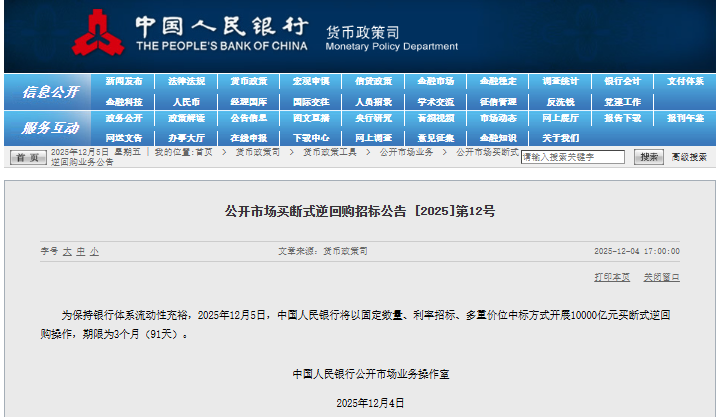
Core Viewpoint - The People's Bank of China (PBOC) is set to conduct a 1 trillion yuan buyout reverse repurchase operation, aimed at maintaining liquidity in the banking system as the year-end approaches [1][2]. Group 1: Reverse Repo Operations - The PBOC will carry out a 1 trillion yuan buyout reverse repo operation with a term of 3 months (91 days) on December 5, which will be an equivalent rollover of the same amount maturing this month [1]. - The operation will utilize a fixed quantity, interest rate bidding, and multiple price bidding methods, reflecting the true demand for funds from institutions [2]. - The December operation is expected to support the funding environment across year-end, preventing liquidity gaps due to maturing funds [2]. Group 2: Market Analysis and Expectations - Analysts suggest that the current liquidity environment in December is stable, similar to previous months, with fewer disturbances [2]. - There is a potential tightening pressure on liquidity in December due to a large amount of interbank certificates maturing and the Ministry of Finance issuing local government debt limits [2]. - The PBOC's strategy of "short-term collection and long-term release" has been evident, with a net injection of 650 billion yuan in medium to long-term liquidity in November, while simultaneously withdrawing 556.2 billion yuan through 7-day reverse repos [3].
央行,10000亿大动作!就在周五→
证券时报· 2025-12-04 15:54
Core Viewpoint - The People's Bank of China (PBOC) is set to conduct a 1 trillion yuan buyout reverse repurchase operation to support liquidity in the banking system, reflecting a strategy to manage liquidity effectively during the year-end period [1][3]. Group 1: Reverse Repo Operations - On December 5, the PBOC will carry out a 1 trillion yuan buyout reverse repo operation with a term of 3 months (91 days), maintaining the same scale as previous operations [1]. - The buyout reverse repo operations in September and November were also conducted as equal-scale renewals, indicating banks' preference to manage liquidity actively at clearer points in the month [2]. - A total of 1.4 trillion yuan in buyout reverse repos will mature in December, with expectations for continued increased operations across different terms [2]. Group 2: Liquidity Management - The current liquidity environment in December is stable, similar to previous months, with fewer disturbances, allowing banks to retain flexibility in managing liabilities [3]. - The PBOC's strategy of "short-term collection and long-term release" aims to stabilize market expectations and support year-end liquidity, with a net injection of 650 billion yuan in medium to long-term liquidity in November [4]. - The PBOC's approach includes a net withdrawal of 556.2 billion yuan in 7-day reverse repos, reflecting a balance between short-term and long-term liquidity management [4].
央行大动作!明日,10000亿元
券商中国· 2025-12-04 15:04
Core Viewpoint - The People's Bank of China (PBOC) is conducting a 1 trillion yuan reverse repurchase operation with a term of 3 months, reflecting a strategy to support liquidity in the banking system and manage year-end funding needs [1][6]. Group 1: Reverse Repo Operations - On December 5, the PBOC will conduct a 1 trillion yuan buyout reverse repo operation with a 3-month term, which is a continuation of similar operations in September and November [1][2]. - The December operation is expected to maintain liquidity levels as there is a total of 1.4 trillion yuan in reverse repos maturing this month, with expectations for additional operations [2][6]. - The fixed quantity, interest rate bidding, and multiple price winning mechanism of the reverse repo operation allows institutions to reflect their funding needs more accurately [6][7]. Group 2: Liquidity Management - The PBOC has been actively managing medium to long-term liquidity through various operations, including reverse repos and medium-term lending facilities (MLF) [5][7]. - The central bank's strategy of "short-term withdrawal and long-term injection" aims to stabilize market expectations and prevent excessive short-term liquidity accumulation [7]. - In November, the PBOC net injected 650 billion yuan of medium to long-term liquidity while withdrawing 556.2 billion yuan through 7-day reverse repos, indicating a balanced approach to liquidity management [7]. Group 3: Market Expectations - Analysts suggest that the current liquidity environment in December is stable, with fewer disturbances, similar to previous months [6]. - The PBOC's actions are seen as a proactive measure to avoid liquidity gaps due to maturing funds, especially as the month progresses [6][7]. - The ongoing operations are expected to guide the banking system towards a stable and ample liquidity state, addressing potential tightening pressures [6].
【笔记20251204— 债农每日一盼:央妈今天爱吗?】
债券笔记· 2025-12-04 11:44
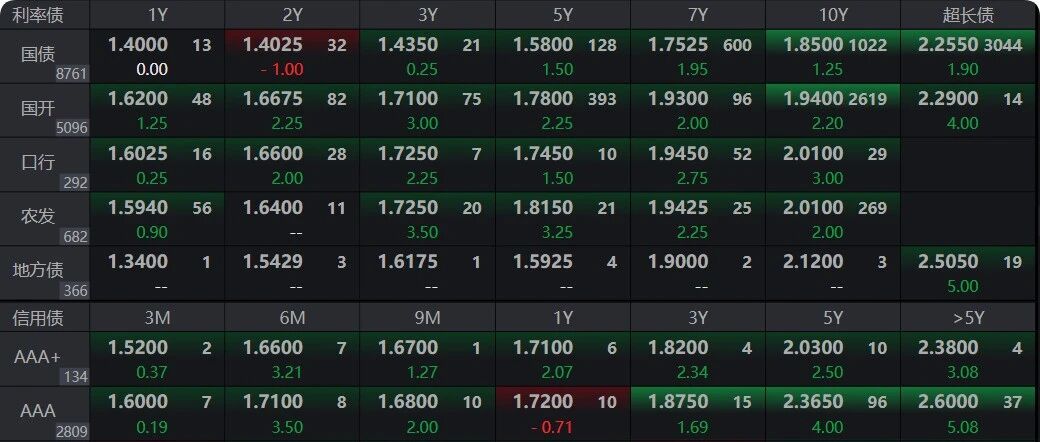
Core Viewpoint - The article discusses the current state of the financial market, focusing on the central bank's actions and their impact on liquidity and interest rates, particularly in the bond market. Group 1: Central Bank Actions - The central bank conducted a 1,808 billion yuan reverse repurchase operation, with 3,564 billion yuan maturing today, resulting in a net withdrawal of 1,756 billion yuan [1] - An announcement was made for a 10,000 billion yuan buyout reverse repurchase operation scheduled for December 5, 2025 [1][3] - The overall funding environment is described as balanced and slightly loose, with stable funding rates [1] Group 2: Interest Rate Movements - The 10-year government bond yield opened higher at 1.845% and fluctuated, reaching a peak of 1.861% before settling at 1.8500% [3] - The weighted average rates for various repo codes indicate a slight increase, with R001 at 1.36% and R007 at 1.49% [2] - The market reacted to the Financial Times' commentary on "short-term tightening and long-term easing," leading to fluctuations in bond prices and yields [3] Group 3: Market Sentiment - The article reflects a sense of uncertainty among investors, with questions about the central bank's support for the market, likening it to a daily inquiry from stock and bond investors [3] - The sentiment is further illustrated by the humorous commentary on market expectations, highlighting the disconnect between investor hopes and market realities [3]
央行“收短放长”保持流动性充裕
Jin Rong Shi Bao· 2025-12-04 00:57
Core Viewpoint - The People's Bank of China (PBOC) has implemented a net liquidity injection of 6,500 billion yuan in November through various monetary policy tools, indicating a continued net liquidity provision in the medium to long term [1][2]. Group 1: Liquidity Injection Details - In November, the PBOC's net injection included 1,000 billion yuan from Medium-term Lending Facility (MLF), 254 billion yuan from pledged supplementary lending, and 1,150 billion yuan from other structural monetary policy tools [1]. - The PBOC's operations also included a net withdrawal of 5,562 billion yuan from 7-day reverse repos, while other term reverse repos saw a net injection of 5,000 billion yuan, and net purchases of government bonds amounted to 500 billion yuan [1]. - The overall strategy reflects a "short-term withdrawal and long-term injection" approach, aimed at maintaining liquidity efficiency and preventing excessive short-term funds in the market [3]. Group 2: Market Conditions and Economic Implications - The market liquidity in November was relatively loose, with the average DR007 at 1.47%, remaining stable compared to the previous month, while the average yield on 1-year AAA-rated interbank certificates of deposit decreased by 3 basis points to 1.63% [2]. - The PBOC's actions are seen as necessary to stabilize market sentiment amid a slowing stock market and to encourage banks to increase credit issuance [2][3]. - Analysts suggest that the PBOC's current liquidity management strategy is crucial for supporting economic growth, especially as the fourth quarter is a critical period for implementing growth-stabilizing policies [2][3].
央行连续两个月开展国债买卖操作,12月资金面均衡可期
Shang Hai Zheng Quan Bao· 2025-12-04 00:13
Core Viewpoint - The People's Bank of China (PBOC) has been actively managing liquidity through various policy tools to ensure a stable financial environment as the year-end approaches, with expectations that the overall liquidity will remain balanced in December [1][5]. Group 1: Central Bank Operations - In November, the PBOC conducted a net withdrawal of 556.2 billion yuan through 7-day reverse repos, while maintaining a net injection of medium to long-term liquidity through other tools, including a net injection of 500 billion yuan via reverse repos and 100 billion yuan through Medium-term Lending Facility (MLF) [2][6]. - The PBOC's continuous operations in the bond market, with a net injection of 50 billion yuan in November, indicate a supportive monetary policy stance aimed at stabilizing economic growth [2][6]. Group 2: Market Liquidity Conditions - November saw slight fluctuations in liquidity, with the average R001 rising by 4 basis points to 1.43% and R007 remaining stable around 1.50%. The DR001 and DR007 also experienced minor increases [3][7]. - Analysts expect that while liquidity may experience increased volatility as year-end approaches, the PBOC's supportive measures will help maintain a balanced and ample liquidity environment [3][8]. Group 3: Future Outlook - The expectation for December is that liquidity will remain balanced, despite potential year-end fluctuations, as the PBOC is likely to continue its supportive stance [4][8]. - Historical trends suggest that December liquidity fluctuations are primarily driven by year-end disturbances, but the overall increase in liquidity rates is expected to be manageable [3][7].