奇瑞汽车

Search documents
成飞集成(002190.SZ):集成瑞鹄主要承接奇瑞汽车的汽车车身零部件订单
Ge Long Hui· 2025-08-27 07:42
Core Viewpoint - Chengfei Integration (002190.SZ) is primarily responsible for undertaking automotive body parts orders from Chery Automobile [1] Company Summary - Chengfei Integration is engaged in the automotive industry, specifically focusing on the production of body parts for vehicles [1]

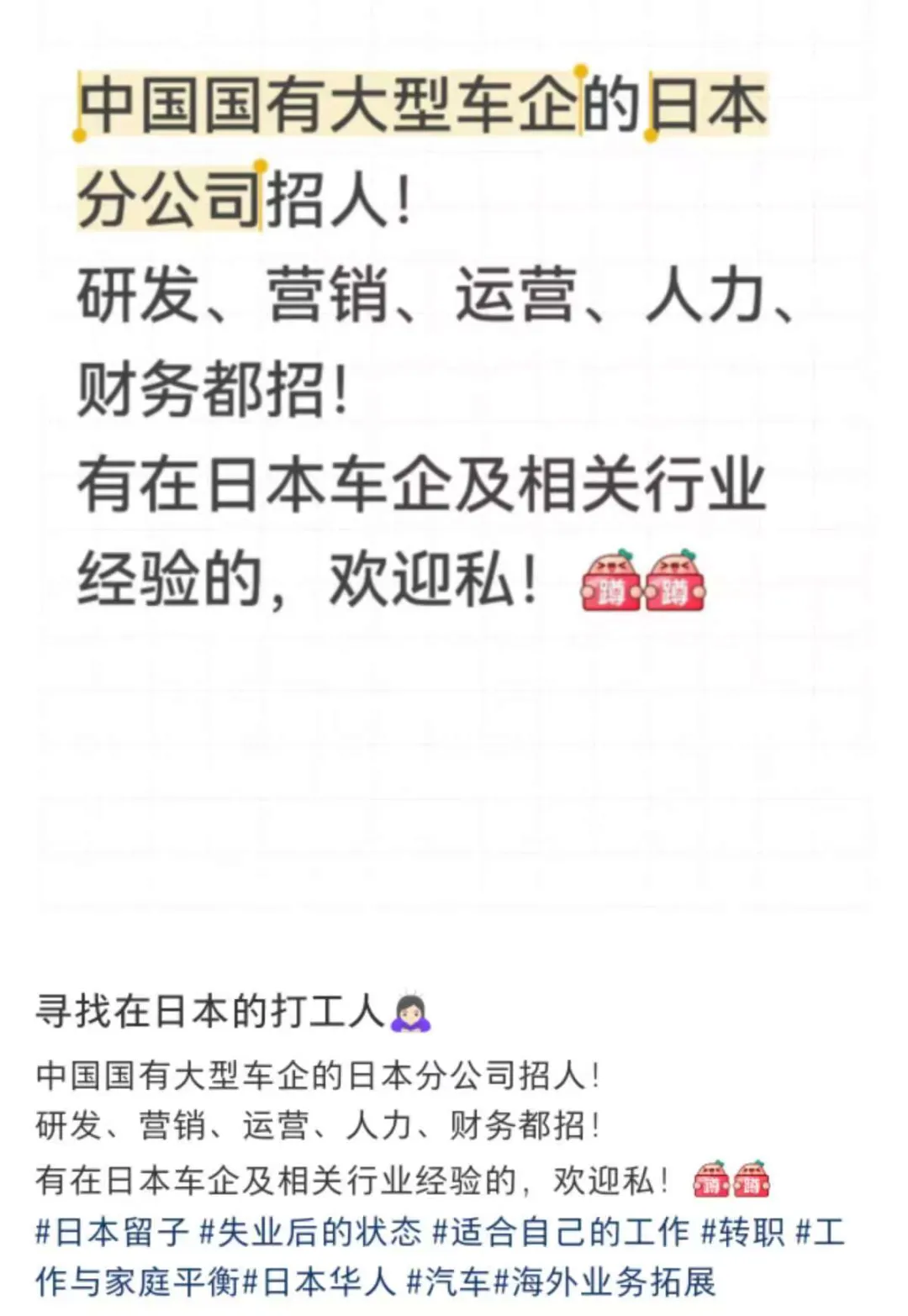
招人!招人!奇瑞出海布局提速
Zhong Guo Jing Ji Wang· 2025-08-27 03:23
Group 1 - A large state-owned automotive company from China is actively recruiting in Japan, indicating a significant expansion of its operations in the region [1][4] - The company, identified as Chery Automobile, is hiring for a wide range of positions including R&D, marketing, operations, human resources, and finance, with some roles at the managerial level [4][6] - The recruitment drive is part of a broader strategy to enhance brand presence and market share in Japan, with specific roles focusing on market strategy, brand building, and sales support [5][6] Group 2 - Chery Jaguar Land Rover has announced a global talent recruitment campaign for its FREELANDER brand, which includes 31 positions across four departments [6][10] - The FREELANDER brand, previously under the Land Rover umbrella, is being revived for new electric vehicles, with production set to take place at Chery Jaguar Land Rover's factory in Changshu [10] - Chery Group has established itself as a leader in automotive exports, achieving a record of 1.1446 million vehicles exported in 2024, marking a 21.4% year-on-year increase [10][11]

国际产业新闻早知道:美国拟对印度商品征收50%关税,韩国重视AI投资
Chan Ye Xin Xi Wang· 2025-08-26 05:35
Group 1: Trade Negotiations - Chinese Vice Minister of Commerce, Li Chenggang, will visit Washington this week for trade negotiations with the U.S. [1] - Li Chenggang is expected to meet with U.S. Trade Representative Katherine Tai and senior officials from the U.S. Treasury [2] - The U.S. and China have previously extended the tariff truce period by 90 days to continue discussions on trade deficits, market access, and rare earth issues [3] Group 2: U.S.-India Tariffs - The U.S. plans to impose a 50% tariff on Indian goods starting from August 27 [4] - This tariff will apply to all imported Indian goods for consumption or storage [5] - The overall tariff rate on Indian goods will increase to 50% due to an additional 25% tariff signed by President Trump [6][7] - India has expressed that the U.S. tariff increase is "unfair, unjust, and unreasonable," and will take necessary actions to protect its national interests [8] Group 3: South Korea's Diplomatic Efforts - A South Korean delegation led by former National Assembly Speaker Park Byeong-seok visited China to strengthen communication [10] - The delegation aims to discuss economic cooperation with Chinese officials, including Commerce Minister Wang Wentao [10] - The visit coincides with the 33rd anniversary of diplomatic relations between China and South Korea, reflecting South Korea's emphasis on balancing its relations with both the U.S. and China [12][13] Group 4: South Korea's Investment in the U.S. - South Korean companies plan to invest approximately $150 billion in the U.S. [14][15] - This investment commitment was announced during a meeting between business leaders from both countries [15] - Notable attendees included Samsung Electronics Chairman Lee Jae-Yong and NVIDIA CEO Jensen Huang [16] Group 5: AI Investment in South Korea - South Korean President Lee Jae-myung announced plans to prioritize investment in artificial intelligence (AI) [20] - The government aims to increase research spending by nearly 20% by 2026, reaching a record 35.3 trillion won (approximately $252.3 billion) [21] - The government will launch policies for 30 major AI and innovation projects starting in the second half of 2025 [22] Group 6: Semiconductor Industry Developments - The U.S. Department of Commerce canceled a $7.4 billion semiconductor manufacturing research funding program initiated during the Biden administration [45] - This program aimed to strengthen the U.S. semiconductor supply chain and close the technology gap with Asian manufacturers [45] - The cancellation may be influenced by recent budget disputes in Congress and shifts in industrial policy priorities [45] Group 7: 3D DRAM Technology Breakthrough - Researchers from imec and Ghent University announced a breakthrough in 3D DRAM technology, successfully growing 120 layers of Si/SiGe on 300mm wafers [48][49] - This advancement addresses challenges in traditional DRAM processes and is expected to enhance storage density for AI and high-performance computing applications [48][49] - The successful development of 3D DRAM could significantly impact the semiconductor industry and meet the growing demand for high-performance storage [49] Group 8: RISC-V Industry Alliance in Jiangsu - The Jiangsu Province RISC-V Industry Alliance was established to link innovation resources in the RISC-V field [50][51] - The alliance aims to enhance collaboration among industry leaders, universities, research institutions, and industry associations [51] - Jiangsu has a robust semiconductor industry with over 380 companies and a scale exceeding 120 billion yuan [50] Group 9: ChipScale's GaN Semiconductor Production - ChipScale has begun mass production of 650V gallium nitride (GaN) power semiconductors in South Korea [53][54] - This technology offers higher power efficiency and faster switching speeds compared to traditional silicon materials [53] - The company aims to expand its market presence in various applications, including AI and data centers [54]


松原安全(300893):气囊方向盘启动新增长引擎,国内外产能投放进展顺利
China Post Securities· 2025-08-25 09:23
Investment Rating - The report maintains a "Buy" rating for the company, indicating an expected relative price increase of over 20% compared to the benchmark index within the next six months [10][16]. Core Insights - The company reported a revenue of 1.148 billion yuan for the first half of 2025, representing a year-on-year growth of 42.9%, with a net profit attributable to shareholders of 161 million yuan, up 30.9% year-on-year [4][5]. - The growth in revenue is primarily driven by the recovery in sales from core customers in the automotive sector, including Chery, Geely, and SAIC-GM-Wuling, which saw sales increases of 15%, 30%, and 18% respectively [5]. - The company has established a second growth engine with its airbag and steering wheel businesses, which have shown significant revenue increases of 72.3% and 283.3% respectively [5]. Financial Performance - The gross profit margin for the first half of 2025 was 28.6%, a slight decrease of 1.6 percentage points year-on-year, attributed to a higher proportion of lower-margin airbag and steering wheel products [6]. - The company has a comprehensive safety belt supply chain and is focusing on cost reduction and efficiency improvements, which are expected to enhance overall profitability [6]. Capacity Expansion - The company is making steady progress in expanding its domestic and overseas production capacity, with new facilities in Anhui and Zhejiang, and an overseas plant in Malaysia expected to reach mass production by the third quarter of 2025 [7][9]. - The automotive passive safety system market is significant, and the company aims to leverage its new capacity to increase its market share in this sector [9]. Earnings Forecast - The projected net profit attributable to shareholders for 2025-2027 is 407 million, 543 million, and 721 million yuan respectively, with corresponding price-to-earnings ratios of 25.7, 19.3, and 14.5 [10][12].
智驾免费背后车企的经济账
Zhong Guo Qi Che Bao Wang· 2025-08-25 02:30
Core Viewpoint - The automotive industry is experiencing a shift towards "intelligent driving equality," leading to discussions on whether advanced driving assistance systems should be charged or offered for free [2][6]. Group 1: Industry Trends - The transition from 2G to 5G has made mobile data services a basic consumer good, influencing the automotive sector to consider similar models for intelligent driving features [2]. - Companies like BYD are advocating for "intelligent driving equality," aiming to make advanced driving technologies accessible to a broader consumer base [3][4]. - The introduction of various intelligent driving solutions, such as BYD's "Tian Shen Zhi Yan" and XPeng's AI driving features, reflects a trend towards standardizing these technologies across all vehicle models [3][4]. Group 2: Business Models - The industry is divided into two main camps regarding the commercialization of intelligent driving: those advocating for free access and those supporting a paid model [6][7]. - Tesla and Huawei represent the "charging camp," focusing on monetizing software services through one-time purchases or subscriptions, which has proven to be a lucrative model [6][7]. - A middle-ground approach is emerging, where companies embed hardware and offer software on a subscription basis, balancing hardware sales with potential software revenue [7][8]. Group 3: Cost Considerations - The cost of hardware for advanced driving systems is significant, with estimates ranging from 15,000 to 30,000 yuan per vehicle, impacting the profitability of companies adopting free models [9][10]. - R&D costs for advanced driving technologies are substantial, with leading companies investing billions annually, necessitating a sustainable business model to recoup these investments [9][10]. - The pressure to offer free intelligent driving features is leading to cost-cutting measures within the supply chain, affecting suppliers' margins [10][11]. Group 4: Future Outlook - The sustainability of the "intelligent driving free" model is under scrutiny, as companies must find a balance between cost absorption and future revenue generation [11][12]. - Some companies are beginning to see success through cost reduction strategies and scaling, indicating a potential path to profitability [12]. - The industry is expected to evolve towards a model where user experience and real value become the primary competitive factors, rather than just pricing strategies [13].



传奇瑞应届生员工发邮件反对周六培训开会,本人已离职;曝问界M8出现「预制车」,8月生产出9月的车;OPPO回应被苹果起诉员工窃密
雷峰网· 2025-08-25 00:40
Group 1 - Apple has filed a lawsuit against former employee Chen Shi for allegedly stealing 63 confidential files related to Apple Watch development and providing them to OPPO [4][5] - OPPO's legal department responded, stating they found no evidence linking the allegations to the employee's actions during their employment [5] - The lawsuit includes internal chat records indicating Chen Shi's intent to collect and share Apple's information with OPPO [4] Group 2 - A recent incident involving a Chery Automobile employee, who opposed mandatory Saturday training, has led to significant internal discussion and resulted in the cancellation of the meeting [7] - The employee, who has since left the company, expressed dissatisfaction with the company's practices and received support from many colleagues [7] Group 3 - The Aion M8 electric vehicle was reported to have a manufacturing date of September 2025, raising questions about production practices [9] - This incident follows a previous error regarding battery types in the Aion M8's certification documents [9] Group 4 - The Chinese cleaning robot industry is experiencing a surge in demand, with export orders reportedly extending to the end of the year [24] - Domestic sales of cleaning robots have also increased significantly, with a 40% year-on-year growth in revenue from January to July [24] - Global shipments of smart cleaning robots are projected to reach 20.6 million units in 2024, reflecting an 11.2% increase [24] Group 5 - Alibaba has restructured its business groups from six to four, consolidating various operations under new categories [15][17] - This restructuring follows a previous announcement in March regarding organizational changes aimed at improving efficiency [17] Group 6 - Four-dimensional Map Technology is reportedly in the final stages of acquiring Intelligent Robot, aiming to enhance its smart driving solutions [18] - The company has been increasing its investment in smart driving technology and expanding its team [18] Group 7 - Meta has been sued for allegedly using pirated adult films to train its AI models, with potential damages amounting to $359 million [31] - The lawsuit claims that Meta knowingly infringed on copyrights to enhance its AI capabilities [31] Group 8 - The U.S. government has acquired a 10% stake in Intel, a move aimed at supporting the semiconductor industry amid competition with TSMC [29] - This investment is expected to help Intel recover from financial difficulties and maintain its position in advanced semiconductor manufacturing [29] Group 9 - Apple is reportedly exploring partnerships with Google, OpenAI, and Anthropic to develop a new AI engine for Siri [34] - This initiative follows delays in the planned upgrade of Siri, which is now expected to launch next year [34]

新泉股份2025082320250822
2025-08-24 14:47
Summary of New Spring Co., Ltd. Conference Call Company Overview - New Spring Co., Ltd. has undergone four development stages since its establishment: - 2011-2015: Stable revenue between 500 million to 1 billion CNY - 2016-2017: Revenue growth from 1 billion to approximately 3 billion CNY, benefiting from strong performance of Geely and SAIC's self-owned models - 2018-2020: Revenue stagnation in the range of 3 billion to 3.5 billion CNY - 2021-2024: Revenue growth driven by increased penetration of new energy vehicles and rising market share of self-owned brands, expected to exceed 13 billion CNY [1][2][5] Market Share and Profitability - Market share of passenger car dashboards increased from approximately 2%-3% (2012-2016) to about 5.7% (2017-2018) due to the ramp-up of Geely and SAIC [4] - Overall gross margin decreased from nearly 30% in 2013 to about 20% in 2024, influenced by product structure changes, fluctuations in commercial vehicle profitability, and rising raw material prices [4] - Passenger car business gross margin remained relatively stable despite overall margin decline [4] Capital Expenditure and Expenses - Full-process gross margin saw a significant decline from 2018 to 2019 due to accelerated capital expenditure, stagnant revenue growth, and rising raw material prices [5] - Sales expenses are expected to decrease in 2024 due to warranty impacts, while management expenses will rise due to overseas expansion and early mass production of Tesla projects [6] Customer Structure and Future Expectations - Customer structure has changed significantly over time: - Early stage: Chery and Geely were major customers (22% each) - Mid-stage: Geely became the largest customer (29%), followed by SAIC (25%) - Recent stage: Key customers include Chery, Tesla, Geely, and Li Auto [9] - Future growth is anticipated through global expansion and partnerships with overseas OEMs such as Volkswagen, Volvo, and Audi [7] Product Development and Competitive Advantage - New Spring is expanding its product line to include exterior parts and passenger car seats, aiming to become a leading player in the automotive interior sector [13] - The company has a competitive advantage in cost control and response efficiency compared to competitors, with a strong market position due to increasing industry concentration and limited new entrants [14] Financial Projections - Expected net profits for 2025, 2026, and 2027 are projected to be 1.337 billion, 1.725 billion, and 2.102 billion CNY respectively [2][13]

为求生存,燃油车悄然降价简配
经济观察报· 2025-08-23 10:47
Core Viewpoint - The automotive market is undergoing a complex transformation, with traditional fuel vehicles adapting through price cuts and simplifications while electric vehicles face their own challenges in market positioning and strategy [1][2][3]. Group 1: Fuel Vehicle Strategies - Traditional fuel vehicle companies are adopting a "price for volume" strategy, reducing prices while simplifying configurations, such as using lower-quality materials and reducing advanced features [2][6]. - The Nissan Sylphy has introduced a new base model priced at 75,800 yuan, significantly lower than previous models, achieved through substantial configuration reductions [6][7]. - High-end fuel vehicles are also engaging in price cuts and simplifications to capture market share, as seen with the Volkswagen Touareg's new model priced at 508,800 yuan, down from its previous entry-level model [7][8]. Group 2: Market Dynamics - The retail sales of fuel vehicles showed a slight growth of 0.35% year-on-year in July 2025, indicating that fuel vehicles are still maintaining a presence in the market despite the rise of electric vehicles [3][16]. - The penetration rate of new energy vehicles reached 54% in the domestic passenger car market by July 2025, highlighting the increasing competition between fuel and electric vehicles [16][19]. - The market is shifting towards hybrid models, with companies like Toyota phasing out pure fuel versions in favor of hybrid options, reflecting a broader trend of energy diversification [16][19]. Group 3: Technological Adaptation - Fuel vehicles are increasingly integrating smart technologies to enhance competitiveness, with models like the Audi A5L featuring advanced driving systems developed in collaboration with tech companies [11][12]. - The cost of integrating smart features into fuel vehicles is expected to increase by 15% to 20%, posing challenges for mid-range models [14]. - Major automotive companies are leveraging economies of scale to manage costs while enhancing the smart features of their fuel vehicles, as seen in Volkswagen's strategy for the Chinese market [14]. Group 4: Future Outlook - The global automotive landscape is evolving, with predictions indicating that the market share of traditional fuel vehicles will decline from approximately 59% in 2023 to around 31% by 2030 [19]. - The future automotive market is expected to consist of a diverse energy system, with no single powertrain dominating, but rather a coexistence of electric, hybrid, and fuel vehicles based on specific market needs [19].
骆驼股份(601311):25H1业绩优秀 低压锂电持续放量
Xin Lang Cai Jing· 2025-08-23 10:25
Core Viewpoint - The growth logic of Camel Group's low-voltage lithium battery business is clear, and the scale effect during business growth is expected to significantly enhance the company's performance, maintaining a "buy" rating [1][2]. Financial Performance - The company raised its net profit forecast for 2025/26/27 to 1.04 billion, 1.3 billion, and 1.47 billion yuan, representing year-on-year growth of 69%, 25%, and 14% respectively [2]. - For the first half of 2025, the company achieved revenue of 8 billion yuan, a year-on-year increase of 6.2%, and a net profit of 530 million yuan, a year-on-year increase of 69.5% [2]. - The gross margin was 15.4%, down 0.4 percentage points year-on-year, while the net margin was 6.7%, up 2.4 percentage points year-on-year [2]. - In Q2 2025, revenue was 3.86 billion yuan, a year-on-year decrease of 5.2% and a quarter-on-quarter decrease of 6.7% [2]. Low-Voltage Lithium Battery Business Growth - The low-voltage lithium battery business generated revenue of 350 million yuan in the first half of 2025, a year-on-year increase of 196% [3]. - The company achieved mass production supply for 15 designated projects in the automotive low-voltage lithium battery sector, with clients including Seres, NIO, and Volkswagen [3]. - Cumulative sales of automotive low-voltage lithium batteries reached 229,000 KWH, a year-on-year increase of 274%, maintaining rapid growth [3]. Overseas Business Development - The company's overseas market sales grew by approximately 21% in the first half of 2025, attributed to breakthroughs in partnerships with five major manufacturers and the development of new channels in nine countries [4]. - The sales of AGM lead-acid start-stop batteries increased by approximately 46%, indicating growth potential in the aftermarket as more vehicles with start-stop functions enter the market [4].

为求生存,燃油车悄然降价简配
Jing Ji Guan Cha Wang· 2025-08-23 07:28
Core Viewpoint - The automotive market is experiencing a complex transformation where traditional fuel vehicles are adapting to the rise of electric vehicles (EVs) through price reductions and configuration simplifications while also enhancing their technological features to remain competitive [2][11]. Group 1: Market Performance - In July 2025, the retail sales of passenger vehicles in China reached 1.826 million units, a year-on-year increase of 6.3%, with new energy vehicles (NEVs) accounting for 987,000 units, up 12% [2]. - The retail sales of fuel passenger vehicles were 839,000 units, showing a slight growth of 0.35% [2]. Group 2: Pricing Strategies - Traditional fuel vehicle manufacturers are adopting a "price-for-volume" strategy, often accompanied by configuration reductions to attract price-sensitive consumers [3]. - The launch of the 2026 model of the Nissan Sylphy introduced a new base model priced at 75,800 yuan, which is 10,000 yuan lower than the previous model, achieved through significant configuration cuts [3][4]. Group 3: Configuration Reductions - The "省心版" model of the Nissan Sylphy has seen reductions in lighting, safety technology, and comfort features, such as the removal of the 8-inch central control screen [3][4]. - The Volkswagen Touareg "锐越版" model has also reduced comfort features while maintaining its powertrain specifications, indicating a trend of simplification across various vehicle segments [4]. Group 4: Intelligent Features - Fuel vehicles are increasingly integrating smart technologies to enhance competitiveness, with models like the Audi A5L featuring advanced driving assistance systems developed in collaboration with Huawei [7][8]. - Companies like Volkswagen are planning to enhance the smart capabilities of their fuel vehicles, leveraging economies of scale to optimize costs [10][9]. Group 5: Market Dynamics - The competition between fuel and electric vehicles is evolving, with fuel vehicles transitioning towards hybrid models and exploring new energy sources, such as biofuels and hydrogen [11][12]. - The market share of traditional fuel vehicles is projected to decline from approximately 59% in 2023 to 31% by 2030, while the global market share is expected to drop from about 47% in 2025 to between 30% and 35% by 2030 [14].