长安汽车

Search documents
中国智驾驶入“脱手”时代!
Xin Lang Cai Jing· 2025-12-18 14:24
导读 行业普遍认为,L3级是从"辅助驾驶"到"完全自动驾驶"的重要过渡,后续的L4级自动驾驶将实现更大突破——在固定区域内,车辆可完全脱离人类干预, 真正实现无人驾驶。 12月15日,工业和信息化部正式公布了我国首批L3级有条件自动驾驶车型准入许可名单并附条件许可了长安旗下深蓝汽车SL03(L3版)、极狐阿尔法S6(L3 版)这两款车型产品。这是我国L3级自动驾驶从测试阶段迈入商业化应用的关键一步,对高阶智驾进入按法规要求交付、运营并接受监管的新阶段具有重 要意义。 12月15日,工业和信息化部正式公布了我国首批L3级有条件自动驾驶车型准入许可名单并附条件许可了长安旗下深蓝汽车SL03(L3版)、极狐阿尔法S6(L3 版)这两款车型产品。获批车型将分别在重庆指定拥堵路段和北京指定高速路段开展上路试点,最高运行速度分别被限制在50km/h和80km/h。这一举措不 仅是我国L3级自动驾驶从测试阶段迈入商业化应用的关键一步,还意味着高阶智驾不再仅停留于技术展示,而是进入了按法规要求交付、运营并接受监 管的新阶段。 深蓝汽车SL03(L3版)和极狐阿尔法S6(L3版)能够获批搭载L3级自动驾驶功能的智能网联汽车产品 ...




吉利,加码固态电池
DT新材料· 2025-12-18 14:13
| 中国未来产业崛起引领全球新材料创新发展 | | --- | | 2026.06.10 -> 06.12 上海新国际博览中心(N1-N5)馆 | | 2026未来产业新材料博览会 | (FINE),围绕机器人、汽车、无人机、数据中心、航空航天、AI、新能源等未 | | | --- | --- | --- | | 来产业共性需求特设6大展区, | N3 先进电池与能源材料展区 聚焦 | 固态 | | 电池 | 、钠电池、钙钛矿、液流电池、电容器 等 | | | , | 欢迎咨询:18957804107 | | 【DT新材料】 获悉,近日, 吉利 在固态电池赛道动作频频,除对 2026-2027年度固态电池电芯研发物料进行采购 招标外,12月9日,据"吉利招标"信息, 浙江 绿色智行科创有限公司 (下称"绿色智行")发布招标公告",对2026-2027年度固态电池电芯研发物料进行招标。 该项目总投资7100万元,主要用于固态电池阶段性实验成果的放大性测试,以验证电池稳定性、阻抗性以及使用寿命,摸索最佳数据,为规模化生产提供依据。 公告同时显示,该项目电池主要分为两类: 60Ah电池和<1Ah电池。60Ah电池每 ...

一周一刻钟,大事快评(W136):整车投资策略更新,福达股份更新
Shenwan Hongyuan Securities· 2025-12-18 14:11
Investment Strategy Update - The investment strategy for the automotive sector has been updated for 2026 due to two key changes: the unfulfilled subsidies in Q4 2025 and adjustments in the "two new subsidies" policy, along with the State Administration for Market Regulation's draft guidelines aimed at preventing chaotic price wars, which may increase survival pressure on low-margin automakers [2][3] - The revised strategy focuses on the mid-to-high-end market and overseas expansion, categorized into three tiers: the first tier includes companies less affected by industry fluctuations, such as BAIC and JAC; the second tier includes other mid-to-high-end brands like XPeng and NIO; the third tier includes mainstream brands like BYD and Geely that have overseas or mid-to-high-end transformation potential [3][4] High-End Intelligent Driving - High-level intelligent driving has entered the engineering phase, with L2+ and L3 features expected to become standard configurations in the industry; high-end vehicles will offer superior experiences through advanced configurations, while mid-range vehicles will adopt basic usable features [4] - The year 2024 is anticipated to mark the beginning of "intelligent driving equality," with related features expected to be widely adopted in vehicles priced above 130,000 to 150,000 yuan [4] Fuda Co., Ltd. Update - Fuda Co., Ltd. has made significant progress in its robotics business, recently signing a strategic cooperation agreement with Changban Technology and Yiyou Robotics to create a comprehensive ecosystem for humanoid robot joint solutions [5] - The company is positioning its robotics components business as a strategic new business, focusing on mass production of planetary gear products and collaborating with Changban Technology to enhance capabilities in linear and rotational actuators [5] - Fuda's partnerships and strategic focus are expected to accelerate its layout in humanoid robots and intelligent equipment, with more developments anticipated in the future [5] Investment Recommendations - The report recommends focusing on domestic strong alpha manufacturers such as NIO, Xiaomi, XPeng, and Li Auto, as well as companies benefiting from the trend of intelligentization like Jianghuai Automobile and Seres [2][5] - It also suggests paying attention to state-owned enterprise reforms and recommending companies like SAIC Motor, Dongfeng Motor, and Changan Automobile, along with component manufacturers with strong growth and overseas expansion capabilities such as Xingyu, Fuyao Glass, and Fuda [2][5] Valuation Overview - A valuation table for key automotive companies is provided, showing metrics such as market capitalization, price-to-book (PB) ratios, and projected net profit growth rates for 2024 to 2026, highlighting significant variations among companies [7]

金融工程日报:指缩量微涨,商业航天表现强势、医药商业反复活跃-20251218
Guoxin Securities· 2025-12-18 13:51
- The report discusses the market performance of various indices, highlighting that the SSE 50 Index performed well with a 0.23% increase, while the CSI 300 Index fell by 0.59%[6] - The report also notes that the SSE Composite Index performed well among sector indices, with a 0.16% increase, while the SZSE Composite Index fell by 0.70%[6] - The report provides details on the performance of industry indices, noting that the coal, banking, and petrochemical industries performed well with returns of 2.03%, 2.00%, and 1.31% respectively[7] - The report highlights the performance of various thematic concepts, with SPD, parachute, and PVC flooring concepts performing well with returns of 6.76%, 3.81%, and 3.51% respectively[10] - The report provides data on market sentiment, noting that 71 stocks hit the daily limit up and 8 stocks hit the daily limit down at the close of trading on December 18, 2025[14] - The report includes information on market capital flows, noting that the margin trading balance was 2.5 trillion yuan as of December 17, 2025, with a financing balance of 2.4859 trillion yuan and a securities lending balance of 170 billion yuan[20] - The report discusses the premium and discount rates of ETFs, noting that the cash flow ETF Yongying had the highest premium of 0.90%, while the materials ETF had the highest discount of 0.84% on December 17, 2025[24] - The report provides data on block trading, noting that the average daily transaction amount of block trades over the past six months was 2.1 billion yuan, with a discount rate of 6.64%, and the transaction amount on December 17, 2025, was 2.2 billion yuan with a discount rate of 7.59%[27] - The report includes information on the annualized discount rates of stock index futures, noting that the annualized discount rate of the SSE 50 stock index futures main contract was 29.32% on December 18, 2025, which was at the 1% percentile over the past year[29] - The report provides data on institutional attention and the Dragon and Tiger List, noting that Changan Automobile was the most researched stock by institutions in the past week, with 214 institutions conducting research[31] - The report includes data on the net inflow and outflow of institutional seats on the Dragon and Tiger List, noting that the top ten stocks with the highest net inflow of institutional seats on December 18, 2025, were Xue Ren Group, Tongyu Communications, Zhejiang Shibao, Bona Film Group, Deyi Wenhua, Aerospace Huanyu, Meinian Health, Sanyangma, Haixia Innovation, and Huaren Health[37] - SSE 50 Index, performance: +0.23%[6] - CSI 300 Index, performance: -0.59%[6] - SSE Composite Index, performance: +0.16%[6] - SZSE Composite Index, performance: -0.70%[6] - Coal industry, performance: +2.03%[7] - Banking industry, performance: +2.00%[7] - Petrochemical industry, performance: +1.31%[7] - SPD concept, performance: +6.76%[10] - Parachute concept, performance: +3.81%[10] - PVC flooring concept, performance: +3.51%[10] - Number of stocks hitting daily limit up: 71[14] - Number of stocks hitting daily limit down: 8[14] - Margin trading balance: 2.5 trillion yuan[20] - Financing balance: 2.4859 trillion yuan[20] - Securities lending balance: 170 billion yuan[20] - Cash flow ETF Yongying, premium: 0.90%[24] - Materials ETF, discount: 0.84%[24] - Average daily transaction amount of block trades: 2.1 billion yuan[27] - Discount rate of block trades: 6.64%[27] - Transaction amount on December 17, 2025: 2.2 billion yuan[27] - Discount rate on December 17, 2025: 7.59%[27] - Annualized discount rate of SSE 50 stock index futures main contract: 29.32%[29] - Changan Automobile, number of institutions conducting research: 214[31] - Top ten stocks with highest net inflow of institutional seats: Xue Ren Group, Tongyu Communications, Zhejiang Shibao, Bona Film Group, Deyi Wenhua, Aerospace Huanyu, Meinian Health, Sanyangma, Haixia Innovation, Huaren Health[37]
雷军、何小鹏、张一鸣和贾跃亭都来跨界操盘AI机器人,王兴兴和宇树科技们还守得住护城河吗?
3 6 Ke· 2025-12-18 12:15
Core Insights - The article discusses the rapid evolution of the robotics industry, highlighting the entry of major players from various sectors, including automotive and technology, into the robotics field, indicating a competitive landscape akin to the previous waves of innovation in the internet and automotive industries [1][4][9]. Industry Trends - The robotics sector is experiencing a "hundred-group war," with companies like Xiaomi, BYD, and others investing heavily in robotics, with Xiaomi alone investing approximately 15 billion yuan in related technologies [4][11]. - Major automotive manufacturers are transitioning into robotics, with companies like GAC Group and BYD planning to launch humanoid robots and establish production lines for core components [9][14]. Company Strategies - Xiaomi's strategy involves leveraging its existing capabilities in automotive technology to enhance humanoid robot development, while also investing in talent and research to build a comprehensive ecosystem [6][17]. - Other tech giants, such as ByteDance and Huawei, are also making significant strides in robotics, with ByteDance expanding its robotics team and Huawei launching its own robot based on the HarmonyOS [7][11]. Competitive Landscape - The article notes that the competition is intensifying, with companies like Yushutech leading in the consumer robotics sector, holding over 60% market share in quadruped robots and achieving significant revenue growth [13][14]. - The market is shifting from a technology-driven focus to an ecosystem-based competition, where companies must not only excel in technology but also in building a robust ecosystem to sustain their competitive edge [16][17]. Market Projections - By 2025, the Chinese robotics market is expected to exceed 150 billion yuan, with local manufacturers surpassing foreign brands for the first time, indicating a significant shift in market dynamics [15]. - The global industrial robot sales are projected to reach 542,000 units, with China maintaining its position as the largest market, accounting for 54% of global installations [15]. Future Outlook - The article suggests that the humanoid robot market will see increased competition among major players, with predictions that the number of humanoid robots will eventually surpass the human population, leading to widespread adoption across various industries [12][18]. - Companies that can effectively integrate technology with market needs and build a sustainable ecosystem will likely emerge as leaders in this evolving landscape [17].


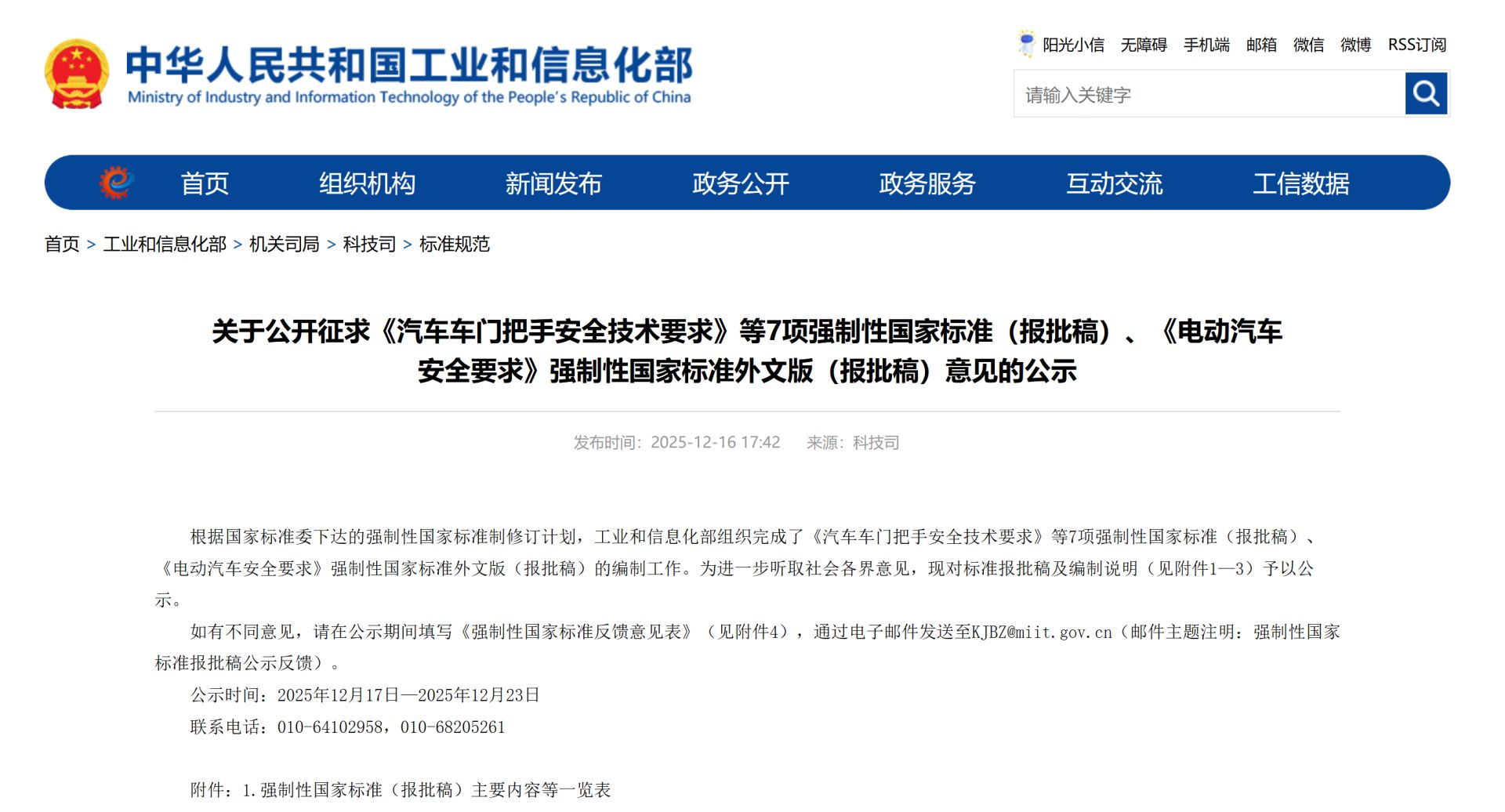
全隐藏式门把手“退场”倒计时!国标新规2027年落地 车企人员:车辆改动成本不小
Mei Ri Jing Ji Xin Wen· 2025-12-18 10:52
Core Viewpoint - The article discusses the safety concerns surrounding hidden door handles in electric vehicles, particularly Tesla, following a tragic accident where passengers were trapped due to the inability to open the doors during a fire. This has led to regulatory changes mandating mechanical door handles for safety reasons [1][6][9]. Group 1: Safety Concerns - A lawsuit has been filed against Tesla after a fatal accident where passengers could not escape due to hidden door handles [1]. - Consumers are increasingly worried about the safety risks associated with hidden door handles, prompting regulatory action [2]. - The new regulations require that every car door must have a mechanical release handle, even if the vehicle has electronic locking mechanisms [5][7]. Group 2: Regulatory Changes - The Ministry of Industry and Information Technology has completed the drafting of mandatory national standards for automotive door handles, including safety technical requirements [2][9]. - The new standards specify that door handles must be mechanically operable in emergencies, ensuring that passengers can escape without relying on electronic systems [7][8]. - The regulations also define the required hand operation space for door handles to ensure accessibility [8]. Group 3: Industry Impact - The implementation of these new standards is expected to lead to significant changes in the automotive industry, potentially phasing out models with hidden door handles [9][10]. - Companies like Great Wall Motors have expressed concerns about the practicality and safety of hidden door handles, citing minimal aerodynamic benefits and increased weight [7]. - The transition to comply with new regulations may involve substantial redesign costs and time for manufacturers, with estimates for mold costs ranging from 4 million to 6 million yuan [10].
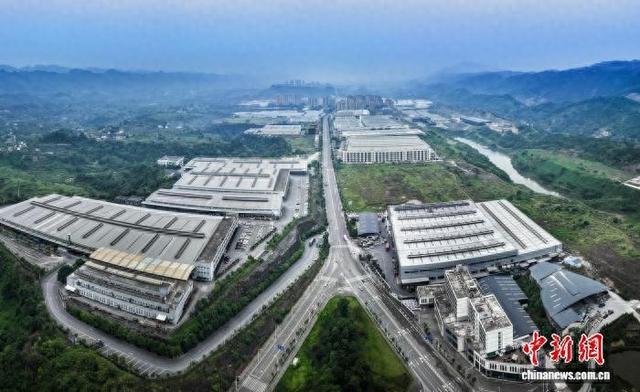
“腾笼换鸟”赋能产业升级 重庆合川闲置资产“焕”新生
Zhong Guo Xin Wen Wang· 2025-12-18 09:16
Core Viewpoint - The article discusses how Hechuan District in Chongqing is revitalizing idle assets and resources, particularly focusing on the automotive industry, to drive economic growth and development through strategic planning and targeted investments [1][3]. Group 1: Asset Utilization Strategy - Hechuan District has adopted a strategy of "revitalizing existing assets to generate new growth," focusing on idle factories and land left by companies like BAIC Ruixiang and Bisu Auto [1][3]. - The district has identified approximately 1,557.55 acres of industrial land and 837,000 square meters of vacant factory space, prioritizing these for high-growth projects [3][6]. Group 2: Project Development and Investment - Since August 2024, Hechuan has signed 64 projects with a total investment of 15.393 billion yuan, including 37 automotive parts projects worth 11.275 billion yuan [3][6]. - The district aims to attract high-quality enterprises by creating a "chain master-chain subordinate" model, focusing on companies with high technical content and growth potential [3][6]. Group 3: Industry Focus and Future Goals - Hechuan is concentrating on developing the intelligent connected new energy vehicle parts industry, with plans to create a billion-level industrial cluster centered on chassis systems, lightweight structural components, and intelligent cockpit parts [6][8]. - By the end of 2026, Hechuan aims to introduce over 20 quality projects, increasing the local supply rate to over 60% and contributing significantly to the high-quality development of the automotive industry in the Chengdu-Chongqing economic circle [8].

打响关键一枪,汽车行业乱象被叫停!
Jin Tou Wang· 2025-12-18 08:57
Core Viewpoint - The automotive industry is undergoing significant regulatory changes aimed at curbing price wars and ensuring fair competition, with the State Administration for Market Regulation (SAMR) taking decisive actions against misleading pricing practices and excessive discounts [1][3]. Group 1: Regulatory Actions - The SAMR has officially halted price wars in the automotive sector, allowing price reductions only for inventory vehicles and prohibiting below-cost sales [1][3]. - Car manufacturers are now required to display clear pricing without misleading discounts, and they must inform consumers about delivery timelines for vehicles [1][3]. - The recent crackdown on pricing tactics is a response to practices that disrupt market order, with major companies like BYD and Xpeng already indicating changes in their sales strategies [3]. Group 2: Market Conditions - The automotive industry, now a key economic pillar, contributes 10% to the national GDP, with the penetration rate of new energy vehicles nearing 60% [5]. - The market has shifted from growth to competition for existing sales, with leading companies like BYD experiencing a decline in sales for three consecutive months, indicating a growth crisis [5]. - The average transaction price for passenger vehicles in China has dropped from 196,400 yuan to 171,600 yuan in the first half of the year, with discount rates increasing from 14.53% to 27.77% [5]. Group 3: Future Implications - In the short term, the new regulations are expected to pressure automotive sales in the coming year, particularly with the introduction of vehicle purchase taxes and restrictions on price cuts [7]. - Long-term, while the penetration of new energy vehicles exceeds 50%, the market remains competitive, and price wars may continue as a natural market-clearing mechanism [7]. - The automotive industry faces a significant challenge, with only 3 out of 71 brands currently profitable, and it is anticipated that 80% of brands may face closure if current trends continue [7].

航天概念涨幅居前,19位基金经理发生任职变动
Sou Hu Cai Jing· 2025-12-18 08:44
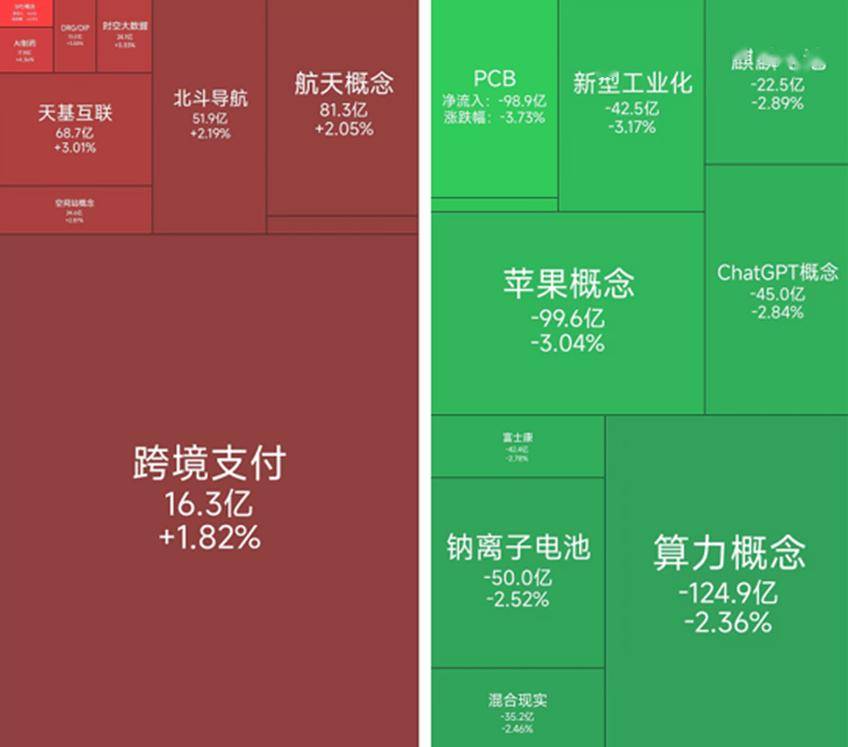
Market Performance - On December 18, A-shares showed mixed performance with the Shanghai Composite Index up by 0.16% closing at 3876.37 points, while the Shenzhen Component Index fell by 1.29% to 13053.97 points, and the ChiNext Index decreased by 2.17% to 3107.06 points [1] Fund Manager Changes - On December 18, a total of 19 fund managers experienced changes in their positions, with 10 funds announcing departures of fund managers, involving 5 individuals. The primary reason for these changes was job transitions [3] - In the past 30 days (November 18 to December 18), 651 fund products saw changes in their fund managers, indicating a significant turnover in the industry [3] New Fund Managers - On December 18, 32 fund products announced new fund manager appointments, involving 14 new managers. Notably, Liu Wenliang from Southern Fund manages assets totaling 170.55 billion yuan, with his highest-performing fund, Southern Changyuan Convertible Bond A, achieving a return of 85.99% over 5 years and 288 days [4] Fund Research Activity - In the past month (November 18 to December 18), Bosera Fund conducted the most company research, engaging with 46 listed companies. Other active funds included Huaxia Fund and Penghua Fund, which researched 39 and 38 companies respectively. The most researched industry was specialized equipment with 211 instances, followed by consumer electronics with 193 [6] - The most focused stock by public funds in the last month was Zhongke Shuguang, a company in the specialized computing equipment sector, with 117 fund management companies participating in its research [7] Recent Fund Research Highlights - In the week from December 11 to December 18, Chang'an Automobile was the most researched company, receiving attention from 68 fund institutions. Other notable companies included Guanglian Aviation and Yipin Hong, with 43 and 40 fund institutions respectively [7]
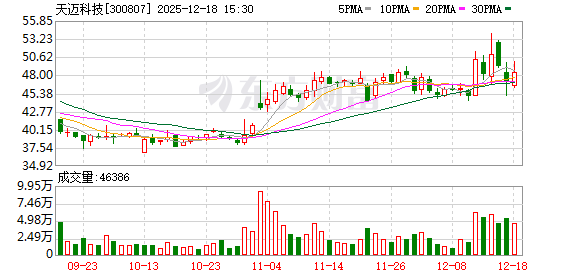
天迈科技:未与长安汽车,北汽新能源,浙江世宝等车企开展合作
Mei Ri Jing Ji Xin Wen· 2025-12-18 07:49
Group 1 - The company, Tianmai Technology, primarily focuses on the public transportation sector and has not established partnerships with the mentioned electric vehicle manufacturers such as Changan Automobile, BAIC New Energy, and Zhejiang Sebao [2]