
伊利股份

Search documents
吃喝板块全线回调,食品ETF(515710)震荡走弱!中国酒类市场景气指数首期成果发布,如何解读?
Xin Lang Ji Jin· 2025-09-16 06:36
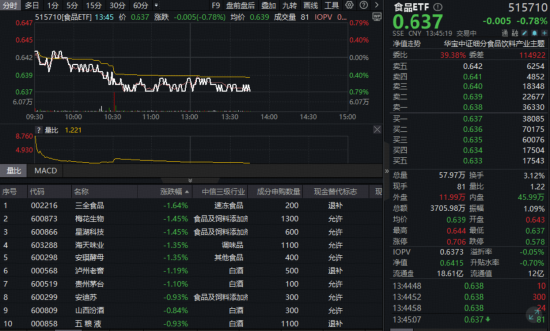
Group 1 - The food and beverage sector performed poorly on September 16, with the Food ETF (515710) experiencing a decline of 0.78% as of the report time [1][2] - Major consumer goods stocks, including several liquor companies, saw significant declines, with stocks like Sanquan Foods, Haitian Flavoring, Luzhou Laojiao, and Kweichow Moutai dropping over 1% [1][2] - The China Liquor Market Prosperity Index for the first half of 2025 was reported at 47.14, indicating a weak recessionary state in the market, suggesting that consumer demand is still recovering [3] Group 2 - The current valuation of the food and beverage sector is at a low point, with the Food ETF (515710) P/E ratio at 21.24, which is in the 10.37% percentile of the last decade, indicating a favorable long-term investment opportunity [3] - The second quarter of 2025 saw a significant impact on the liquor sector due to policy changes, leading to a noticeable decline in demand, but there are signs of recovery as consumer behavior begins to normalize [4] - The Food ETF (515710) tracks the CSI Sub-Industry Food and Beverage Index, with approximately 60% of its holdings in leading high-end and mid-range liquor stocks, and nearly 40% in beverage, dairy, seasoning, and beer sectors [5]






常温纯牛奶禁用复原乳今日生效:不合标奶三类处置,部分企业恐被迫退出市场
Zhong Guo Neng Yuan Wang· 2025-09-16 05:20
Core Viewpoint - The implementation of the revised national food safety standard for sterilized milk mandates that pure milk production must solely use raw milk, rendering products containing reconstituted milk as non-compliant [1][2]. Group 1: Industry Response - During the 6-month transition period, dairy companies are employing various strategies to eliminate non-compliant products, with retail channels being the primary focus for clearance [2]. - Major brands like Bright Dairy and Yili have proactively removed products containing reconstituted milk from shelves, utilizing promotions to clear remaining stock by the end of August [2]. - Smaller dairy companies are converting non-compliant products into fortified milk, while some are resorting to destruction of unsold products, ensuring compliance with regulations [2]. Group 2: Company Strategies - Leading companies such as Mengniu, Yili, and Bright Dairy have adapted their supply chains to meet the new standards, with Mengniu reporting a 100% raw milk procurement rate and plans to cease the use of reconstituted milk by the end of 2024 [3]. - Smaller enterprises are restructuring their supply chains, with some signing contracts for significant raw milk supplies, resulting in cost reductions compared to reconstituted milk [3]. - The industry is collectively updating product labels to remove references to reconstituted milk, focusing on terms like "pure milk" [3]. Group 3: Regulatory Actions - Regulatory authorities are initiating special inspections to verify compliance with the new standards, focusing on raw material procurement records and production processes [4]. - Non-compliant companies face penalties up to ten times the value of the goods involved, emphasizing the importance of adherence to the new regulations [4]. - The new regulations allow for the continued use of reconstituted milk in products like yogurt and cheese, provided that ingredient lists are properly labeled, thus balancing industry standards with resource management [4].



中国质量界“奥斯卡”,伊利这次又双叒上榜!
Zhong Jin Zai Xian· 2025-09-16 04:31
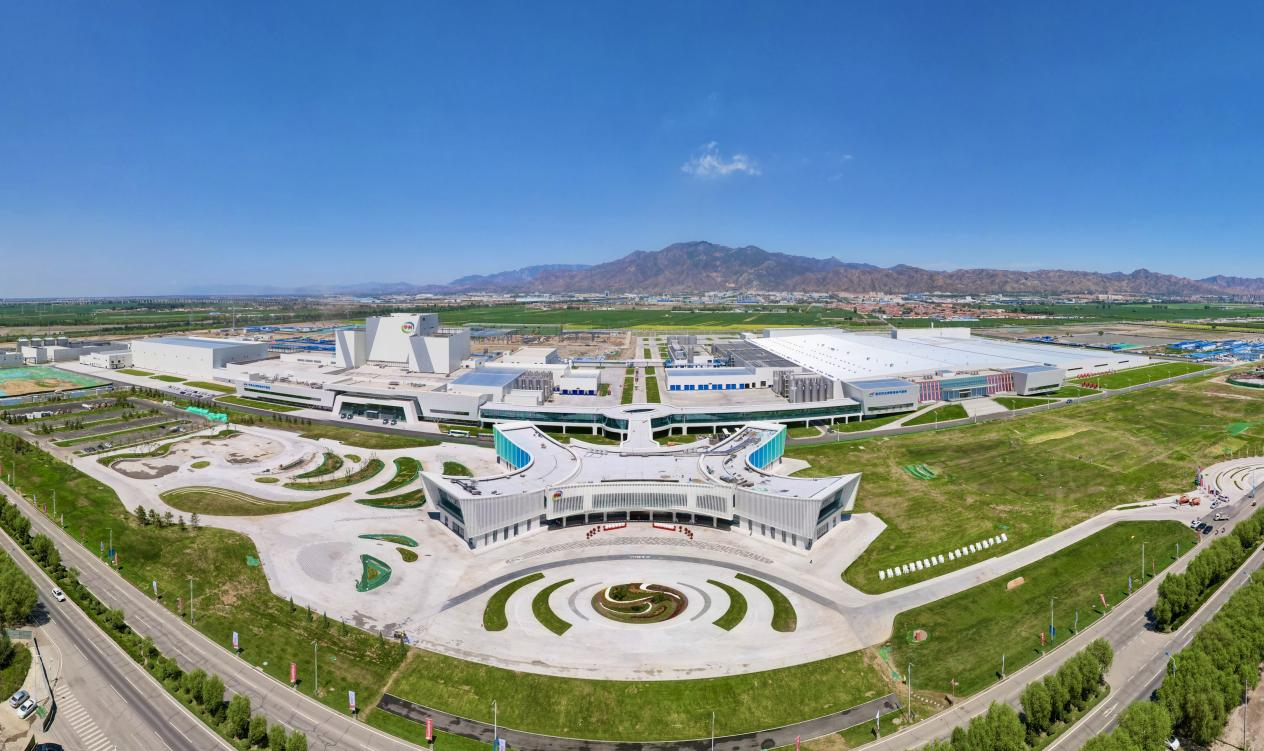
Core Insights - The fifth China Quality Award results were announced on September 16, with Yili Group receiving a nomination for its outstanding quality innovation practices, highlighting its contribution to "Chinese quality manufacturing" [1][2] - A total of 541 organizations and 73 individuals were reviewed for the award, focusing on quality innovation, efficiency improvement, and quality management system promotion [1] - Yili Group's achievement alongside major state-owned enterprises demonstrates its strong capabilities in quality management and technological innovation [1][2] Group 1: Quality Recognition - The China Quality Award has been a competitive arena for top enterprises since its establishment, with Yili standing out among leaders in high-end manufacturing and energy sectors, validating its forward-looking "quality strategy" [2] - Yili has received the China Quality Award nomination for three consecutive sessions, showcasing its sustained leadership in quality management [2] Group 2: Achievements and Standards - Under the "Quality Strong Nation" strategy, Yili has garnered multiple prestigious awards, becoming the first dairy company to achieve national, continental, and global quality management awards [4] - In 2022, Yili became the first food enterprise globally to obtain the "Gold Standard Certification," which evaluates both production process rigor and product quality against global advanced standards [4] - Yili's raw milk quality significantly exceeds EU standards in key indicators such as total bacterial count and somatic cell count, reflecting the industry's rapid modernization in China [4] Group 3: Cultural and Management Practices - The evaluation of the China Quality Award emphasizes not only product quality but also corporate quality culture, with Yili's cultural foundation and talent pool contributing to its success [6] - Guided by the philosophy of respecting and developing people, Yili prioritizes talent development and cultural transmission, embedding quality principles throughout the organization [6] - Yili has implemented rigorous standards, including the innovative food safety "three-line" standard and the QbD (Quality by Design) control system, ensuring that quality is integrated into every aspect of its operations [6]
中国零售销售-2025 年 8 月增长进一步乏力-ChinaHong Kong Consumer-China Retail Sales – August 2025 Growth Faltered Further
2025-09-16 02:03
Summary of Key Points from the Conference Call Industry Overview - **Industry**: China Retail Sales - **Date**: August 2025 - **Growth Rate**: Retail sales growth decelerated to +3.4% YoY in August, down from +3.7% in July and below the consensus estimate of +3.8%, indicating prolonged lukewarm demand [1][4][6] Core Insights - **Demand Recovery**: No meaningful recovery in demand is expected for September due to deflation and the fading effects of subsidies [1][4] - **Category Performance**: - **Electronics and Appliances**: Growth slowed to 14% YoY, down from nearly 30-50% growth from March to July, attributed to a normalized comparison base due to trade-in subsidies starting in August 2024 [2][4] - **Alcohol & Tobacco**: Growth turned negative in August, likely due to seasonality and weak demand trends [2][4] - **Gold & Jewelry**: Experienced the highest growth acceleration in August at 16.8% YoY [2][5] - **Cosmetics, Soft Drinks, Apparel, and Restaurant & Dining**: These categories saw some growth acceleration compared to July [2][4] Retail Sales Trends - **Overall Retail Sales**: - August 2025: 3.4% YoY growth - July 2025: 3.7% YoY growth - CAGR vs. 2019: Stabilized at 2.7% [5][6] - **Retail Sales Excluding Autos**: - August 2025: 3.7% YoY growth - July 2025: 4.3% YoY growth [5] Stock Implications - **Consumer Sentiment**: Remains lackluster due to deflation, concerns over wage growth, and a softening property market [4][6] - **Investment Focus for 2H25**: - Recovery pace and pricing trends are critical for re-rating [4] - Preferred stocks include: - High growth: Pop Mart (9992.HK), Giant Biogene (2367.HK) - Turnaround plays: Yili (600887.SS) - Resilient earnings: YUMC (YUMC.N), Anta (2020.HK) [4][6] Additional Insights - **Consumer Policies**: Consumption-supportive policies could provide some support to demand sentiment [4] - **Category Divergence**: There is a notable divergence in trends across different retail categories, indicating varied consumer behavior and preferences [3][4] Conclusion The retail landscape in China is currently facing challenges with decelerating growth rates and mixed performance across categories. The outlook for September remains cautious, with expectations of continued weak demand influenced by macroeconomic factors. Investors are advised to focus on specific high-growth and resilient companies as potential opportunities amidst the broader market challenges.
火热的中国冰淇淋市场:梦龙准备靠收购扩张丨消费参考
2 1 Shi Ji Jing Ji Bao Dao· 2025-09-16 00:08
Ice Cream Industry Performance - The ice cream industry has experienced significant growth, with Mengniu's ice cream business revenue increasing by 15.04% year-on-year to 3.879 billion yuan in the first half of the year [1] - Yili's cold drink revenue saw a remarkable growth of 37.96%, reaching 4.124 billion yuan during the same period [1] Dream Ice Cream Company Strategy - Dream Ice Cream, spun off from Unilever, reported double-digit sales growth in China for the first half of the year, holding approximately 11% market share, ranking second in the market [2] - The CEO emphasized a high-end product strategy in China, focusing on regional operations and increasing investment in e-commerce channels to compete with strong local players like Yili and Mengniu [2][3] Market Significance and Expansion Plans - The Chinese market is strategically important for Dream Ice Cream, as success in this competitive landscape could lead to success in other markets globally [3] - Dream Ice Cream plans to act as a "disruptor" in the high-end market, promoting its premium product lines and leveraging digital differentiation [3] - The company is also looking to acquire local businesses and expand its footprint by identifying successful innovative products for global scaling [3] Financial Projections - Dream Ice Cream projected a revenue of 7.9 billion euros (approximately 66.6 billion yuan) for 2024, with an adjusted EBITDA of 1.3 billion euros (approximately 11 billion yuan) and a global retail market share of about 21% [3]
白酒底部价值,大众品把握龙头
2025-09-15 14:57
Summary of Key Points from Conference Call Records Industry Overview Baijiu Industry - The baijiu sector has reached a bottom in fundamentals, with valuations at low levels and market expectations recovering. Demand-side pressures are dissipating, and seasonal catalysts are expected to boost interest in brands like Luzhou Laojiao and Zhenjiu Shede for short-term opportunities, while Moutai, Fenjiu, and Gujing Gongjiu are recommended for long-term investment [1][2][4] Beverage and Snack Industry - The beverage sector is favorable for leading companies such as Nongfu Spring and Dongpeng Beverage, while the snack sector shows good alignment between valuation and growth potential. Key products to watch for Q4 catalysts include Weijia and Yanjinpuzi, with Yili identified as a bottom-value recovery company [1][5] Whisky Industry - In 2024, whisky imports are expected to decline by approximately 40%, with high-aged whisky's share also decreasing. Instant consumption channels now account for over 30% of sales, with dining and home consumption being the primary scenarios [3][13] Beer Industry - Both Yanjing Beer and Zhujiang Beer have seen their valuations drop to attractive levels, with Yanjing at 23-24 times earnings and Zhujiang at 21 times, both reflecting 2025 valuation levels. These companies are noted for their growth potential driven by flagship products [19] Company-Specific Insights Zhenjiu Lid - Zhenjiu Lid has launched an equity payment plan to bind the interests of alliance merchants, with the first quarter's alliance contributing approximately 320 million yuan in revenue. The acupuncture business is projected to account for 5% of the company's total revenue in 2024 [6][8][7] Baijun Co., Ltd. - Baijun's major shareholder transferred 6% of shares to Homa's Liu Jianbo, which is expected to empower Baijun in business expansion and overseas market development. The shareholding structure remains stable, providing opportunities for deeper collaboration [12] Restaurant Chain Industry - The restaurant chain sector has shown signs of recovery since Q2 2025, with stable performance from leading companies like Lihua Bao and Baba Foods. The frozen food leader Anjins has also shown significant improvement in revenue [10][11] Zhujiang Beer - Zhujiang Beer is focusing on expanding its market share through its flagship product, Pure Draft 97, while also launching new products to maintain competitiveness. The company is developing its "15th Five-Year Plan" for future growth [15][17][18] H&H International Holdings - H&H International expects high single-digit revenue growth for the year, with EBITDA margins around 15%. The health supplement business is performing well, while the milk powder segment anticipates low double-digit growth [20] Jianhe Health - Jianhe Health's fundamentals are improving, driven by new consumer customer acquisition in China and profitability improvements in its overseas subsidiaries. The company is expected to see good performance in Q3 due to new orders [21][22] Additional Insights - The baijiu sector is currently viewed as a mid-to-long-term value investment opportunity, with market expectations warming up as demand-side pressures ease [2] - The innovative model of the Wan Shang Alliance is expected to have a significant impact on the company's financials, with a focus on long-term development and binding interests with distributors [9]


安徽省安庆市市场监督管理局食品安全“你点我检”专项抽检信息通告(2025年第44期)
Zhong Guo Zhi Liang Xin Wen Wang· 2025-09-15 06:42
Core Points - The Anqing Market Supervision Administration conducted a special food safety inspection, collecting 91 samples from 12 categories of food products based on consumer preferences [2] - Out of the 91 samples tested, 89 were found to be compliant with food safety standards, while 2 samples were deemed non-compliant [2] - The local market supervision authorities have initiated investigations and actions regarding the non-compliant food products [2] Summary of Inspection Results - **Total Samples Collected**: 91 - **Compliant Samples**: 89 - **Non-Compliant Samples**: 2 - **Categories Inspected**: Included edible agricultural products, edible oils, aquatic products, frozen foods, tea and related products, pastries, grain processing products, convenience foods, dairy products, nuts, egg products, and alcoholic beverages [2] Non-Compliant Products - **Product 1**: Banana from Anqing Daguang District Xiaolu Vegetable Shop, detected with pesticide residue (0.082 mg/kg, standard ≤0.02 mg/kg) [2] - **Product 2**: Yellow chili from Qianshan City Nie's Aquatic Products, detected with antibiotic residue (156 µg/kg, standard ≤100 µg/kg) [2] Compliant Products - Various compliant products included: - Qimen Kung Fu Black Tea from Anhui Province Xin Xu Tang Tea Co., Ltd. - Huangshan Green Tea from Anhui Province Tian Xu Tea Co., Ltd. - Various types of peanuts and eggs from different manufacturers [2][3]
白酒行业基本面逐步筑底,消费ETF嘉实(512600)盘中涨近1%
Sou Hu Cai Jing· 2025-09-15 05:51
Core Insights - The consumption ETF, Jia Shi (512600), has shown significant performance with a 0.67% increase, and notable individual stocks like Hai Da Group and Hua Xi Bio have risen by 3.14% and 2.37% respectively [1] - The ETF has experienced a net inflow of 25.22 million yuan over the past five trading days, indicating strong investor interest [1] - The current price-to-earnings ratio (PE-TTM) of the index tracked by the ETF is 20.2, which is historically low, suggesting potential undervaluation [2] Performance Metrics - As of September 12, 2025, the consumption ETF has achieved an 8.61% increase in net value over the past six months [1] - The ETF's highest single-month return since inception was 24.50%, with an average monthly return of 6.05% [1] - The ETF's performance over the last three months has outperformed its benchmark with an annualized return of 7.08%, ranking it first among comparable funds [1] Market Trends - The food and beverage sector is undergoing adjustments due to policy impacts, with a noticeable decline in revenue year-on-year in Q2 2025, which may help clear historical burdens [4] - The upcoming Mid-Autumn Festival and National Day are expected to boost market demand, with recent sales showing improvement compared to June and July [5] - Leading liquor companies are adapting to industry cycles and changing consumer trends, which may lead to a gradual recovery in the sector [5] Sector Composition - The index tracked by the consumption ETF includes major consumer sectors such as liquor, pork, dairy, and food processing, with liquor accounting for over 39% of the index weight [2] - Key stocks within the index include Yili (10.02% weight), Kweichow Moutai (9.85% weight), and Wuliangye (9.85% weight), among others [4]

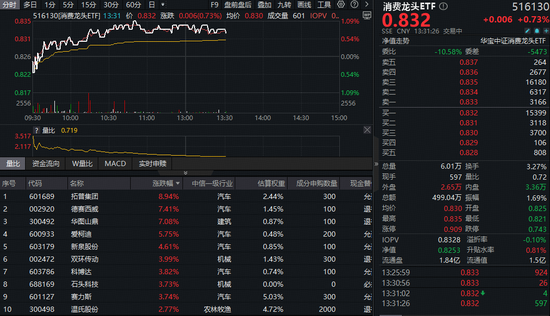
政策组合拳激活大消费,消费龙头ETF(516130)盘中涨超1%!基金经理火线解读
Xin Lang Ji Jin· 2025-09-15 05:47
Group 1 - The consumer sector showed strong performance on September 15, with the Consumer Leader ETF (516130) experiencing a rise of 0.73% during trading [1][3] - Key stocks in various sub-sectors such as automotive, construction, machinery, and agriculture saw significant gains, with Top Group rising over 8% and several others like Desai Xiwai and Huatu Shanding increasing over 7% [1][3] - The market is shifting focus from technology stocks, particularly those related to AI, to consumer sectors that have seen relatively lower valuations [1][3] Group 2 - The Consumer Leader ETF tracks the Consumer Leader Index, which selects the most representative and high-quality companies in the consumer sector, including major stocks like Kweichow Moutai and Gree Electric [5] - The index's price-to-earnings ratio was reported at 18.5 times, indicating a low valuation compared to historical data, suggesting a favorable long-term investment opportunity [3] - Upcoming consumption policies, particularly in regions like Zhejiang, are expected to stimulate domestic consumption during the Mid-Autumn Festival and National Day, potentially boosting the overall consumer sector [4]
2025年1-7月酒、饮料和精制茶制造业企业有5878个,同比下降0.84%
Chan Ye Xin Xi Wang· 2025-09-15 03:01
Group 1 - The core viewpoint of the article highlights the current state and future prospects of the beverage industry in China, particularly focusing on the number of manufacturing enterprises and market dynamics from 2025 to 2031 [1] - As of January to July 2025, the number of enterprises in the liquor, beverage, and refined tea manufacturing sector is reported to be 5,878, which represents a decrease of 50 enterprises compared to the same period last year, reflecting a year-on-year decline of 0.84% [1] - The proportion of these enterprises within the total industrial enterprises stands at 1.13%, indicating a relatively stable but slightly contracting sector [1] Group 2 - The data presented is sourced from the National Bureau of Statistics and compiled by Zhiyan Consulting, a leading industry consulting firm in China, known for its in-depth industry research and market insights [1] - The report emphasizes the importance of understanding market trends and dynamics for investment decisions, providing a comprehensive analysis of the beverage industry's operational landscape and future outlook [1]
