中国铝业

Search documents
有色金属行业资金流出榜:北方稀土等20股净流出资金超亿元
Zheng Quan Shi Bao Wang· 2025-11-03 13:02
Market Overview - The Shanghai Composite Index rose by 0.55% on November 3, with 22 industries experiencing gains, led by Media and Coal, which increased by 3.12% and 2.52% respectively. The Nonferrous Metals and Home Appliances sectors saw the largest declines, down by 1.21% and 0.66% respectively [2]. Fund Flow Analysis - The main funds in the two markets experienced a net outflow of 23.944 billion yuan, with 9 industries seeing net inflows. The Media sector led with a net inflow of 2.031 billion yuan, followed by the Banking sector with a net inflow of 1.831 billion yuan and a daily increase of 1.33% [2]. - The Nonferrous Metals sector had the highest net outflow, totaling 7.054 billion yuan, followed by the Electronics sector with a net outflow of 4.571 billion yuan. Other sectors with significant outflows included Non-Bank Financials, Computers, and Communications [2]. Nonferrous Metals Sector Performance - The Nonferrous Metals sector declined by 1.21%, with a total of 137 stocks in the sector. Out of these, 49 stocks rose while 87 stocks fell. The sector saw a net inflow of funds into 32 stocks, with 14 stocks receiving over 10 million yuan in net inflows. China Aluminum led with a net inflow of 143 million yuan, followed by Nanshan Aluminum and Yun Aluminum with inflows of 143 million yuan and 105 million yuan respectively [3]. - The sector's outflow was dominated by 20 stocks with net outflows exceeding 100 million yuan, with Northern Rare Earth, Luoyang Molybdenum, and Zijin Mining experiencing the largest outflows of 1.182 billion yuan, 542 million yuan, and 481 million yuan respectively [3][5]. Nonferrous Metals Sector Fund Inflow and Outflow Rankings - **Top Inflow Stocks**: - China Aluminum: +1.80%, 3.06% turnover, 143.29 million yuan inflow - Nanshan Aluminum: +2.17%, 3.70% turnover, 142.80 million yuan inflow - Yun Aluminum: +5.65%, 2.46% turnover, 105.49 million yuan inflow [4]. - **Top Outflow Stocks**: - Northern Rare Earth: -3.76%, 3.84% turnover, -1.18195 billion yuan outflow - Luoyang Molybdenum: -3.93%, 1.57% turnover, -542.24 million yuan outflow - Zijin Mining: -1.64%, 1.15% turnover, -481.02 million yuan outflow [5].






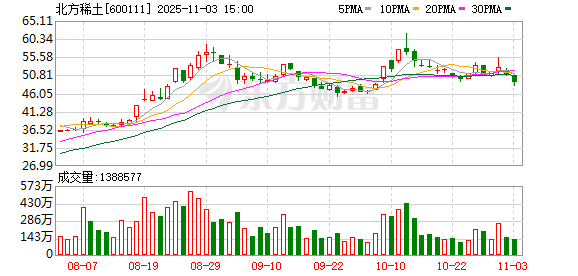
11月3日投资时钟(399391)指数涨0.23%,成份股星辉娱乐(300043)领涨
Sou Hu Cai Jing· 2025-11-03 11:10
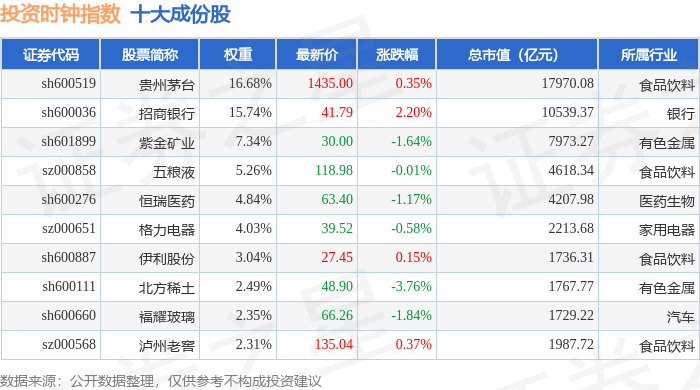
Core Points - The Investment Clock Index (399391) closed at 3364.41 points, up 0.23%, with a trading volume of 95.671 billion yuan and a turnover rate of 0.98% [1] - Among the index constituents, 66 stocks rose, with Xinghui Entertainment leading at a 9.29% increase, while 33 stocks fell, with Lingnan Holdings leading the decline at 5.24% [1] Index Constituents Summary - Major constituents include: - Kweichow Moutai (16.68% weight) at 1435.00 yuan, up 0.35%, with a market cap of 1797.008 billion yuan [1] - China Merchants Bank (15.74% weight) at 41.79 yuan, up 2.20%, with a market cap of 1053.937 billion yuan [1] - Zijin Mining (7.34% weight) at 30.00 yuan, down 1.64%, with a market cap of 797.327 billion yuan [1] - Wuliangye (5.26% weight) at 118.98 yuan, down 0.01%, with a market cap of 461.834 billion yuan [1] - Hengrui Medicine (4.84% weight) at 63.40 yuan, down 1.17%, with a market cap of 420.798 billion yuan [1] Capital Flow Summary - The index constituents experienced a net outflow of 2.407 billion yuan from institutional investors and 0.251 billion yuan from retail investors, while retail investors saw a net inflow of 2.658 billion yuan [3] - Notable capital flows include: - China Merchants Bank with a net inflow of 433.16 million yuan from institutional investors [3] - China Petroleum with a net inflow of 326 million yuan from institutional investors [3] - China Shipbuilding with a net inflow of 284 million yuan from institutional investors [3]






11月3日国企改革(399974)指数涨0.25%,成份股金风科技(002202)领涨
Sou Hu Cai Jing· 2025-11-03 10:23
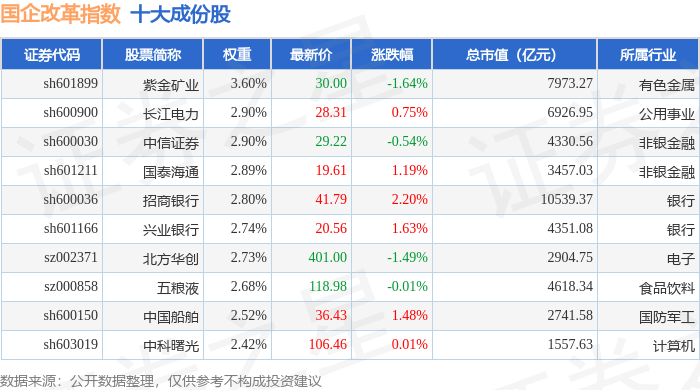
Core Points - The State-Owned Enterprise Reform Index (399974) closed at 1902.39 points, up 0.25%, with a trading volume of 146.44 billion yuan and a turnover rate of 0.74% [1] - Among the index constituents, 56 stocks rose, with Goldwind Technology leading at a 6.94% increase, while 39 stocks fell, with China Rare Earth leading the decline at 5.24% [1] Index Constituents Summary - The top ten constituents of the State-Owned Enterprise Reform Index include: - Yingmei Ge, with a weight of 3.60%, latest price at 30.00, down 1.64%, total market value of 797.33 billion yuan [1] - Changjiang Electric Power, with a weight of 2.90%, latest price at 28.31, up 0.75%, total market value of 692.70 billion yuan [1] - CITIC Securities, with a weight of 2.90%, latest price at 29.22, down 0.54%, total market value of 433.06 billion yuan [1] - Yuanta Haitong, with a weight of 2.89%, latest price at 19.61, up 1.19%, total market value of 345.70 billion yuan [1] - China Merchants Bank, with a weight of 2.80%, latest price at 41.79, up 2.20%, total market value of 1053.94 billion yuan [1] - Industrial Bank, with a weight of 2.74%, latest price at 20.56, up 1.63%, total market value of 435.11 billion yuan [1] - North Huachuang, with a weight of 2.73%, latest price at 401.00, down 1.49%, total market value of 290.48 billion yuan [1] - Wuliangye, with a weight of 2.68%, latest price at 118.98, down 0.01%, total market value of 461.83 billion yuan [1] - China Shipbuilding, with a weight of 2.52%, latest price at 36.43, up 1.48%, total market value of 274.16 billion yuan [1] - Zhongke Shuguang, with a weight of 2.42%, latest price at 106.46, up 0.01%, total market value of 155.76 billion yuan [1] Capital Flow Summary - The net outflow of main funds from the index constituents totaled 4.443 billion yuan, while speculative funds saw a net inflow of 1.03 billion yuan, and retail investors had a net inflow of 3.413 billion yuan [3] - Notable capital flows include: - China Merchants Bank with a net inflow of 433 million yuan, accounting for 11.29% of the total [3] - Allwind Technology with a net inflow of 430 million yuan, accounting for 11.88% of the total [3] - China Petroleum with a net inflow of 326 million yuan, accounting for 14.97% of the total [3] - China Shipbuilding with a net inflow of 284 million yuan, accounting for 10.31% of the total [3]

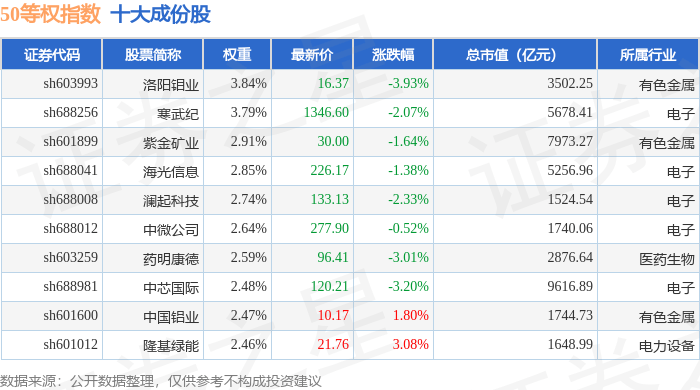
11月3日50等权(000050)指数涨0.02%,成份股中国石油(601857)领涨
Sou Hu Cai Jing· 2025-11-03 09:59
资金流向方面,50等权(000050)指数成份股当日主力资金净流出合计29.79亿元,游资资金净流入合计 11.81亿元,散户资金净流入合计17.98亿元。成份股资金流向详情见下表: | 代码 | 名称 | 主力净流入(元) | 主力净占比 游资净流入 (元) | | 游资净占比 散户净流入(元) | | 散户净占比 | | --- | --- | --- | --- | --- | --- | --- | --- | | 600036 招商银行 | | # 4.33 Z | 11.29% | -2.98亿 | -7.76% | -1.35 Z | -3.52% | | 601857 | 中国石油 | 3.26 Z | 14.97% | 360.76万 | 0.17% | -3.30 Z | -15.14% | | 601012 隆基绿能 | | 2.97 | 4.75% | 4303.19万 | 4 0.69% | -3.40 Z | -5.44% | | 600150 | 中国船舶 | 2.84亿 | 10.31% | -1.30亿 | -4.71% | -1.54亿 | -5.60% | | 60108 ...
国运来了!我国将入手50亿吨世界级铁矿,澳美破防:铁矿牌废了
Sou Hu Cai Jing· 2025-11-03 06:11
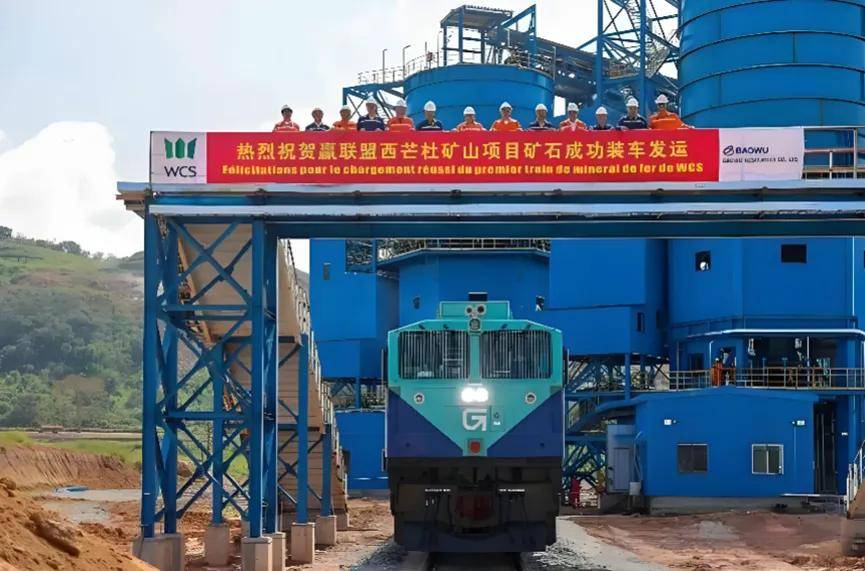
Core Viewpoint - The development of the Simandou iron ore project in Guinea, a collaboration between China Aluminum Corporation and Rio Tinto, is set to significantly impact the global iron ore market and enhance Guinea's economic position, while also challenging the dominance of Australian and Brazilian suppliers [1][5][6]. Group 1: Project Overview - The Simandou iron ore project has a total reserve of 5 billion tons, making it one of the largest undeveloped high-quality iron ore resources globally [1]. - The project includes a 600-kilometer railway and deep-water port, with an estimated investment of $13.3 billion to $21 billion, half of which is funded by Chinese investments [2][5]. - The first shipment of iron ore, totaling 150,000 tons, is expected to begin in October, with sea transport starting in November [2]. Group 2: Economic Impact - The International Monetary Fund predicts that the Simandou project will boost Guinea's GDP by 26% by 2030, positioning it as a key player in the global iron ore market [5]. - China is expected to receive approximately 27 million tons from the projected annual output of 60 million tons from the Simandou project [5]. Group 3: Market Dynamics - The commencement of the Simandou project may lead to downward pressure on iron ore prices, particularly affecting Australian and Brazilian suppliers [6][8]. - The project is anticipated to reduce Australia's share of iron ore exports to China from 60% in 2024 to 45% in 2025, diminishing its bargaining power in the iron ore sector [8]. - The shift towards the Simandou project and the use of RMB for transactions may disrupt the existing pricing dominance held by Australian suppliers [10].
煤炭、传媒和石油石化领涨,收益与规模表现稳定的自由现金流ETF基金(159233)备受关注
Sou Hu Cai Jing· 2025-11-03 06:08
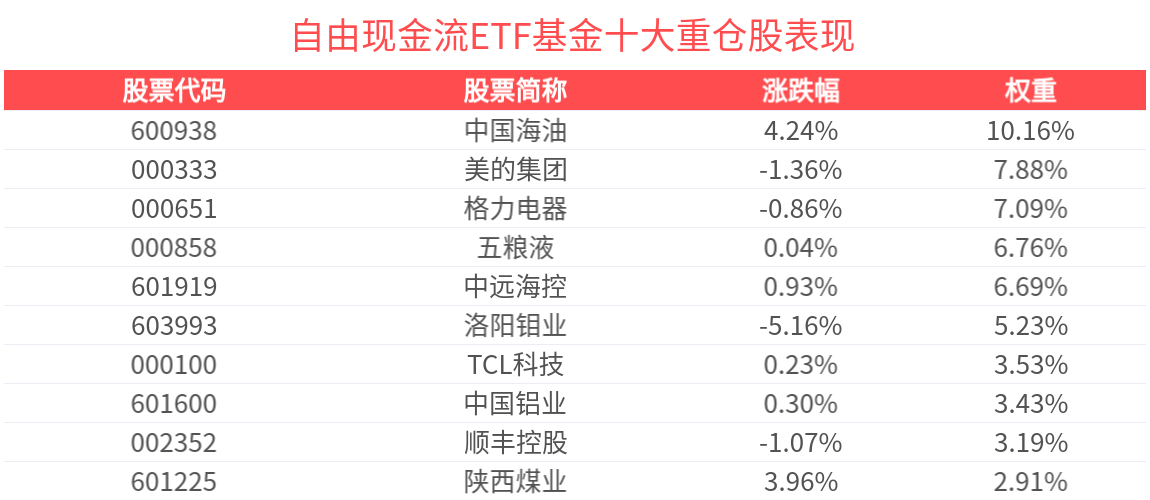
Core Insights - The China Securities Index Free Cash Flow Index (932365) has shown a positive performance, with a 0.33% increase as of November 3, 2025, and notable gains in constituent stocks such as Haixia Co., Ltd. (9.33%) and Tubaobao (5.07%) [1][2] Performance Summary - The Free Cash Flow ETF Fund (159233) has increased by 0.25%, with a latest price of 1.18 yuan. Over the past week, the fund has accumulated a 1.29% increase, ranking 3rd out of 13 comparable funds [1] - The fund's trading volume was 582.14 million yuan, with a turnover rate of 1.54%. The average daily trading volume over the past year was 2,056.06 million yuan [1] - The fund's latest scale reached 378 million yuan, marking a three-month high, with a total of 322 million shares outstanding [1] Fund Inflows - The Free Cash Flow ETF Fund has seen continuous net inflows over the past three days, with a maximum single-day net inflow of 9.49 million yuan, totaling 24.78 million yuan in net inflows, averaging 8.26 million yuan daily [1] Return Metrics - Since its inception, the Free Cash Flow ETF Fund has achieved a maximum monthly return of 7.80%, with the longest streak of monthly gains being five months and a total gain of 17.66%. The fund has a 100% monthly profit percentage and a 91.01% probability of monthly profitability [2] - The maximum drawdown since inception is 3.76%, with a recovery time of 35 days [2] Index Composition - As of October 31, 2025, the top ten weighted stocks in the China Securities Index Free Cash Flow Index account for 56.53% of the index, including China National Offshore Oil Corporation (10.16%) and Midea Group (7.88%) [3][5]
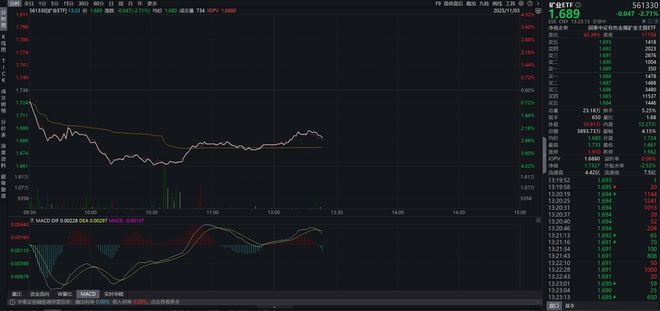
有色板块盘中调整,关注 “家里有矿,年内涨超有色”的矿业ETF(561330)布局机会
Mei Ri Jing Ji Xin Wen· 2025-11-03 05:52
Core Viewpoint - The non-ferrous metal mining sector is experiencing a correction, but the mining ETF (561330) has shown a year-to-date increase of over 80%, indicating potential for re-entry after the pullback [1]. Group 1: Copper Market Insights - The copper market is facing supply disruptions, with Antofagasta, a major Chilean copper producer, announcing that its 25-year copper production may only meet the lower guidance limit due to inflation-related capital expenditure cuts [3]. - Several projects, including Kamoa-Kakula and Grasberg, have lowered their medium-term production guidance by nearly 500,000 tons, leading to a significant reduction in copper supply growth compared to last year [3]. - The mid-term copper supply is expected to remain tight, providing upward support for copper prices [3]. Group 2: Gold Market Dynamics - After a rapid increase over the past two months, gold prices are experiencing heightened volatility, but the long-term upward trend remains intact [3]. - Factors such as excessive money supply, fiscal deficit monetization, and global geopolitical instability are driving demand for gold as a safe-haven asset [3]. - The combination of a potential Federal Reserve interest rate cut cycle, increased macroeconomic uncertainty abroad, and a global trend towards de-dollarization is expected to support gold prices in the medium to long term [3]. Group 3: Non-Ferrous Metals Sector Outlook - According to Dongfang Securities, the non-ferrous metals sector is entering a new cycle driven by supply-demand balance, resource strategic importance, and the transformation of old and new industries [4]. - Industrial metals like copper are gaining attention due to improved supply-demand dynamics, while strategic resources such as lithium and rare earths are seeing sustained demand growth amid the energy transition [4]. - Overall, the non-ferrous metals industry is benefiting from structural supply-demand contradictions and the overlapping demands of new and old industries, exhibiting independent operational characteristics [4]. Group 4: Mining ETF (561330) Performance - The mining ETF (561330) has outperformed the CSI Non-Ferrous Index by nearly 10% year-to-date as of October 31, 2025, due to its concentrated holdings in leading companies [5]. - The ETF tracks the CSI Non-Ferrous Metals Mining Theme Index, which consists of 37 components, with the top ten stocks accounting for 7.26% of the index, indicating a more precise capture of market trends compared to the broader index [5]. - The higher concentration of gold, copper, and rare earths in the mining ETF, which makes up 54.9% of the index, enhances its responsiveness to favorable catalysts in these sectors [8].
“国家队”资金 最新持仓曝光
Zhong Guo Zheng Quan Bao· 2025-11-03 04:54
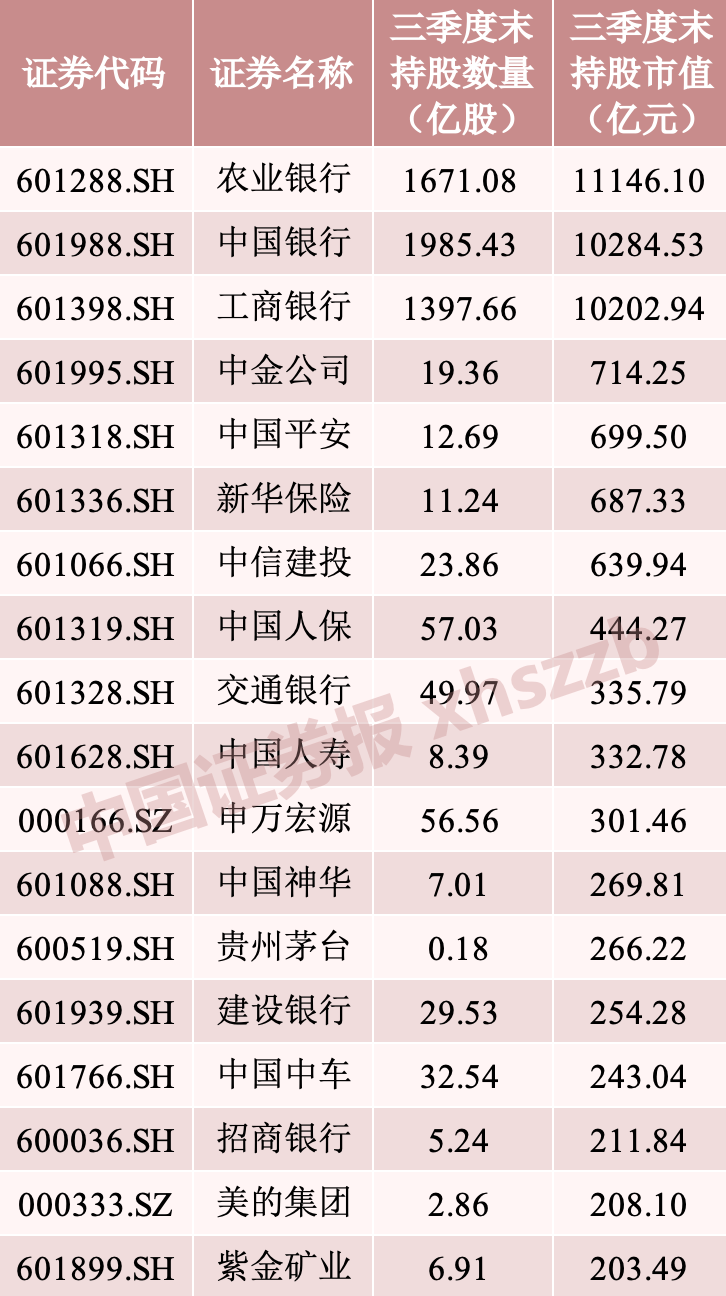
Core Insights - "National Team" funds held over 800 A-shares as of the end of Q3, with significant investments in Agricultural Bank of China, Bank of China, and Industrial and Commercial Bank of China, each exceeding 1 trillion yuan in market value [1][3] - The "National Team" increased holdings in sectors such as insurance, resources, consumer goods, electronics, and telecommunications, with some stocks doubling in price during Q3 [1][8] - The funds exited from the top ten shareholders in sectors like securities, banking, electricity, real estate, and pharmaceuticals [1][8] Holdings Overview - As of the end of Q3, "National Team" funds were among the top ten shareholders in over 800 A-share companies, with 33 companies having a market value exceeding 10 billion yuan [3] - The top three holdings by market value were Agricultural Bank of China (1.11 trillion yuan), Bank of China (1.03 trillion yuan), and Industrial and Commercial Bank of China (1.02 trillion yuan) [3][5] - Other significant holdings included China International Capital Corporation, China Ping An, and New China Life Insurance, each with market values above 60 billion yuan [3][5] Sector Adjustments - In Q3, "National Team" funds entered the top ten shareholders of nearly 180 new listed companies, with notable investments in Mindray Medical, Giant Network, and Unisoc, each exceeding 1 billion yuan in market value [6] - The funds increased their positions in financial stocks such as New China Life Insurance and China Pacific Insurance, as well as resource stocks like Baosteel and China Aluminum [8] - Growth-oriented stocks that saw increased holdings included electronic companies like Pengding Holdings and Sanan Optoelectronics, with some stocks like Deep South Circuit and EVE Energy experiencing price increases around 100% [9]






李乐成《党建》刊发署名文章:加快推进人工智能赋能新型工业化
Bei Jing Ri Bao Ke Hu Duan· 2025-11-03 03:54
Core Insights - Artificial intelligence (AI) is recognized as a crucial driver of the new technological revolution and industrial transformation, with a strong emphasis on self-reliance and application-oriented development [1][2][3] Group 1: Importance of AI in Industrialization - AI is identified as a strategic technology leading the current technological revolution and industrial transformation, with significant implications for global technological competition and industrial optimization [2] - The integration of AI with the real economy, particularly manufacturing, is deemed essential for success [2] Group 2: Key Tasks for AI Empowerment - Continuous strengthening of foundational research and focusing on core technologies such as high-end chips and basic software is emphasized [3] - The establishment of a collaborative innovation system involving enterprises, academia, and research institutions is crucial for upgrading traditional industries and developing new strategic industries [3] Group 3: Pathways for AI Empowerment - Deep integration of AI technology and industrial innovation is necessary, with a focus on market-driven technological development [4] - A robust governance mechanism for AI is essential to ensure safety and security while promoting industrial strength [4] Group 4: Progress in AI Industry - China's AI industry is projected to exceed 900 billion yuan by 2024, with over 5,000 AI companies and more than 400 national-level specialized "little giant" enterprises [5][6] - Significant advancements in computing power and data resources have been made, with over 35,000 high-quality datasets established [6] Group 5: Optimizing the AI Ecosystem - The establishment of a comprehensive standardization system for AI is underway, with nearly 200 standards expected to be developed by 2025 [7] - A national AI industry investment fund of 60 billion yuan has been launched to support the sector [7] Group 6: Fostering AI Advantageous Enterprises - Support for leading enterprises in AI innovation and the development of small and medium-sized enterprises is crucial for creating a robust ecosystem [11][12] - The focus is on enhancing the development environment for AI, including standardization and funding support [12] Group 7: Strengthening Safety and Governance - The importance of balancing development and safety in AI is highlighted, with a focus on enhancing technical safeguards and ethical governance [12][13] - The establishment of a monitoring system for AI safety risks is essential for ensuring responsible development [12]
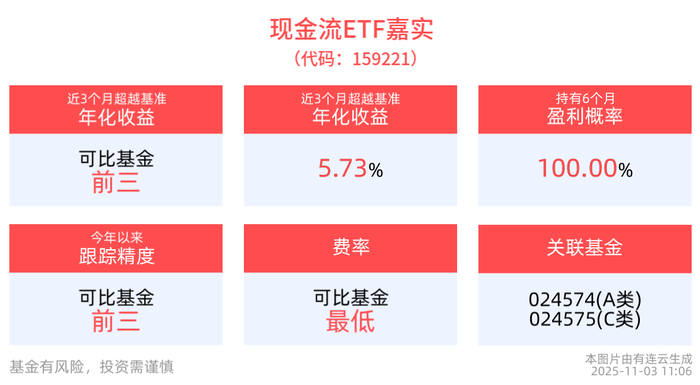
A股三季报核心指标环比改善,现金流ETF嘉实(159221)红盘蓄势,成分股亚翔集成、海陆重工10cm涨停
Xin Lang Cai Jing· 2025-11-03 03:29
Core Insights - The National Index of Free Cash Flow has increased by 0.15% as of November 3, 2025, with notable stock performances from companies like Yaxing Integration and Hailu Heavy Industry reaching the daily limit up [1] - The Cash Flow ETF from Harvest has seen a net value increase of 20.15% over the past six months, indicating strong performance and investor interest [3] Group 1: Cash Flow ETF Performance - As of October 31, 2025, the Cash Flow ETF from Harvest has achieved a maximum monthly return of 6.91% since its inception, with an average monthly return of 3.13% [3] - The top ten weighted stocks in the National Index of Free Cash Flow account for 54.79% of the index, with China National Offshore Oil Corporation (CNOOC) being the largest at 9.80% [3][5] Group 2: Market Environment and Trends - Global monetary and fiscal easing expectations have positively influenced risk assets, creating a favorable macro environment for A-shares [5] - A-share third-quarter reports show improvements in key metrics such as profit, revenue, and ROE compared to the first half of the year, suggesting a potential transition to a fundamental bull market [5]