海尔

Search documents
驶入阿拉木图:满街的中国品牌,与一场正在发生的认知变革
2 1 Shi Ji Jing Ji Bao Dao· 2026-01-14 12:15
Core Insights - Chinese brands have established a strong presence in Kazakhstan, becoming a significant part of the local market with a wide range of products from automobiles to electronics [1][2][3] - The trade relationship between China and Central Asia has seen substantial growth, with trade volume expected to reach $60.7 billion from 2017 to 2024, marking a 150% increase [1] - Kazakhstan is emerging as a key hub for Chinese companies looking to expand overseas, with over 9,000 Chinese enterprises operating in the region [1][3] Trade and Investment - By 2024, China's direct investment and loans to Central Asia are projected to exceed $24 billion, with bilateral trade between China and Kazakhstan reaching a historic high of $43.8 billion [3][4] - The market share of Chinese automotive manufacturers in Kazakhstan has surged from approximately 2% in 2020 to 38% in 2024, indicating a rapid acceptance of Chinese vehicles [3][4] Market Dynamics - The local market in Kazakhstan is characterized by a young population, with 95% owning smartphones, making it an attractive target for internet and technology companies [1][2] - The presence of Chinese brands is evident in various sectors, including home appliances, automobiles, and mobile phones, with local production of Chinese vehicles already underway [4][5] Consumer Behavior - There is a notable shift in consumer perception of Chinese products, moving from low-cost options to recognizing their reliability and technological advancements [5][6] - The acceptance of new technologies and experiences by the young population in Kazakhstan provides fertile ground for the introduction of innovative products [5][6] E-commerce and Marketing Strategies - The e-commerce market in Central Asia is projected to reach $14.7 billion by 2024, with Kazakhstan's market alone estimated at $6 billion [6][7] - Companies are advised to adopt a dual approach in marketing: utilizing mainstream e-commerce platforms for quick consumer access while also developing direct-to-consumer (D2C) channels to build brand identity [7][8] Localization Challenges - Entering the Central Asian market requires a nuanced understanding of local languages and consumer habits, as each country has distinct preferences and regulatory environments [8][9] - Companies often underestimate the complexity of the market, leading to potential pitfalls if they do not conduct thorough market research and engage local partners [9]
CES2026:双轮驱动出海,思必驰让中国AI创新成果惠及世界
Jiang Nan Shi Bao· 2026-01-07 12:33
Core Viewpoint - The 2026 International Consumer Electronics Show (CES) serves as a significant platform for showcasing Chinese AI technology to the world, with the company Siboer demonstrating its advancements in voice interaction technology across various sectors [1]. Group 1: AI Technology and Localization - Siboer has upgraded its AI technology from simple "functional output" to a "localized empowerment engine," supporting over 40 languages and optimizing for regional language characteristics and cultural habits [2]. - The AI voice interaction system has shown exceptional adaptability in different markets, such as handling mixed languages in Southeast Asia and accommodating regional accents in North America [2]. - The company's voice system has received positive feedback for its natural synthesis and understanding of diverse languages, indicating a strong technical foundation for serving global markets [2]. Group 2: Applications in Smart Office and IoT - Siboer provides integrated voice interaction solutions for smart robots, consumer electronics, and home appliances, helping brands like Haier and Hisense develop customized multilingual interaction systems [3]. - The company showcased its AI office products, which feature intelligent sound pickup, noise reduction, and real-time transcription capabilities, attracting significant attention at CES [2][3]. Group 3: Global Market Strategy - The global integration rate of AI voice functions in smart devices is increasing, and Siboer's strategy targets both consumer and enterprise markets, achieving technical scalability and market penetration [4]. - Siboer addresses localization challenges for domestic companies going abroad, offering tailored AI voice solutions that enhance user experience in various applications [5]. - The company has successfully entered over 20 international markets, including Europe and the Middle East, by leveraging its smart office hardware and breaking the long-standing dominance of international brands in the professional audio-visual sector [5]. Group 4: Future Outlook - Siboer aims to continue its technological innovation and connect global industrial resources, contributing to a global AI cooperation framework and enhancing the presence of Chinese AI innovations worldwide [6].
从小切口透视大行业 ——2025年汽车供应链变革“风暴眼”
Zhong Guo Qi Che Bao Wang· 2026-01-06 02:18
Core Insights - The automotive industry's core competitiveness is shifting from traditional mechanical performance to smart technology, safety, and integration with energy networks [3] - Eight key component areas have emerged as focal points for change in the automotive supply chain by 2025 [3] Group 1: AI and Smart Technology - AI large models, including VLA and VLM, are reshaping the perception, decision-making, and interaction systems in smart vehicles [4] - Companies like Li Auto and XPeng are actively developing and deploying VLA-based autonomous driving systems, with plans for mass production by 2026 [4] - The competition in AI models is intensifying, with a focus on the underlying support systems like computing power and data [4] Group 2: Vehicle-to-Grid (V2G) Interaction - V2G is becoming a hot topic as electric vehicles can act as distributed energy storage units within new energy systems [5] - Government policies are driving the adoption of V2G, with pilot projects and plans to expand the scope of V2G applications by 2027 [5][6] - Companies like GAC Group are implementing V2G functionalities in their models and developing charging infrastructure to support this transition [6] Group 3: Battery Safety Standards - The new national standard for electric vehicle batteries, effective July 2026, emphasizes safety by requiring batteries to be "non-flammable and non-explosive" [7] - The updated standards will compel battery manufacturers to innovate in materials, design, and production processes to meet stricter safety requirements [7] - Leading battery companies like BYD are already adapting to these new standards, which will enhance safety and consumer trust in electric vehicles [7] Group 4: Door Handle Innovations - Electric hidden door handles are becoming a focal point due to safety concerns arising from their failure in collision scenarios [8][9] - New regulations are being proposed to ensure that all door handles, including electronic ones, have a mechanical release function for emergency situations [9] Group 5: Solid-State Batteries - Solid-state batteries are gaining traction due to their advantages in energy density and safety, with several companies planning to launch new products or production lines [10] - The development of solid-state batteries is seen as a key competitive factor for companies in the next generation of electric vehicles [10][11] Group 6: Human-Car-Home Ecosystem - The "Human-Car-Home" ecosystem is emerging, integrating automotive, home, and personal devices into a cohesive smart system [12] - Companies like Haier and Midea are collaborating with automotive brands to create interconnected systems that enhance user experience [12][13] Group 7: Humanoid Robots - The automotive industry is increasingly intersecting with humanoid robotics, with companies exploring the integration of robotic technology into manufacturing processes [14][15] - The demand for precision and adaptability in manufacturing is driving the development of humanoid robots tailored for automotive applications [14] Group 8: Zero-Gravity Seats - Zero-gravity seats are becoming a key feature in mid to high-end vehicles, enhancing passenger comfort and experience [16] - The lack of standardized regulations for these seats poses challenges, particularly regarding safety during vehicle operation and collisions [16]


铜价狂飙36%,格力回应空调涨价问题
Xin Lang Cai Jing· 2026-01-05 12:57
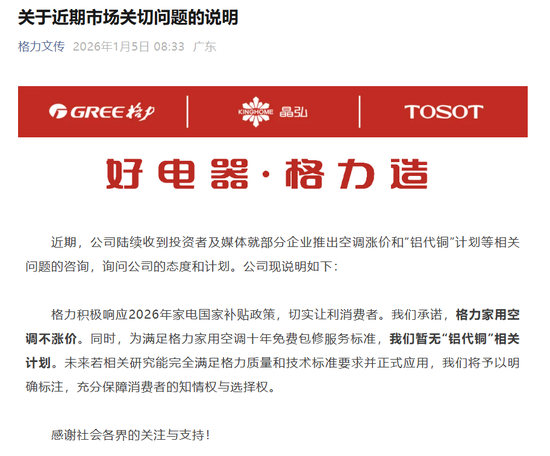
炒股就看金麒麟分析师研报,权威,专业,及时,全面,助您挖掘潜力主题机会! 记者丨翁榕涛 编辑丨骆一帆 近期,格力电器(000651.SZ)陆续收到投资者及媒体就部分企业推出空调涨价和"铝代铜"计划等相关 问题的咨询,询问公司的态度和计划。 1月5日,格力电器官方微信号发布通知表示,格力家用空调不涨价。同时,为满足格力家用空调十年免 费包修服务标准,暂无"铝代铜"相关计划。未来若相关研究能完全满足格力质量和技术标准要求并正式 应用,格力将予以明确标注,充分保障消费者的知情权与选择权。 2025年12月23日,格力电器也曾于投资者互动平台表示,铜是空调的核心原材料,占空调成本的20%左 右,尽管同等情况下,铝材成本约为铜材的1/12(价格约为1/4,密度约为1/3),但其在熔点、热传导 系数、电阻率、耐腐蚀等参数以及长期可靠性等方面,与铜存在较大差距,在其性能、质量和可靠性不 能完全保证的情况下,公司暂时没有"铝代铜"计划。公司重视"铝代铜"技术研究,并将持续关注行业动 态。 Wind数据显示,铜价在近日首次突破10万元关口,2026年1月5日,现货铜价报100620元/吨,这一价格 较2025年初的73830元 ...

铜价狂飙36%,格力回应空调涨价问题
21世纪经济报道· 2026-01-05 12:52
Core Viewpoint - Gree Electric Appliances has decided not to raise prices for its home air conditioners despite rising copper prices, emphasizing its commitment to consumer rights and maintaining the benefits of national subsidies [1][5]. Group 1: Price Strategy and Market Position - Gree Electric announced that it will not increase the price of its home air conditioners, aiming to ensure that the benefits of national subsidies reach consumers fully [1][5]. - The company highlighted that copper constitutes about 20% of the cost of air conditioners, and the recent surge in copper prices has led to a cost increase of approximately 7.26% per unit [4]. - Gree's market director stated that transferring cost pressures to consumers undermines the effectiveness of national subsidy policies [5]. Group 2: Aluminum vs. Copper Debate - Gree Electric has no current plans to adopt "aluminum instead of copper" technology, citing significant performance and reliability differences between the two materials [4][6]. - The company has been actively researching aluminum technology but insists that it will only switch to aluminum when it meets the same technical standards as copper [6]. - Other companies in the industry, such as Midea and Haier, have signed a self-regulatory agreement to accelerate the adoption of aluminum, while Gree has opted out of this initiative [6][7]. Group 3: Industry Trends and Future Outlook - The air conditioning industry is seeing a push towards aluminum use, with expectations that aluminum replacement rates could reach 60% for heat exchangers and 90% for connecting pipes by 2030 [7]. - Analysts predict that the air conditioning sector, due to its high copper intensity and cost sensitivity, will be a leading area for aluminum adoption, potentially increasing annual aluminum demand by 200,000 to 500,000 tons [7].

铜价一年涨超36%!格力坚持空调不涨价,不用“铝代铜”
2 1 Shi Ji Jing Ji Bao Dao· 2026-01-05 12:00
2025年12月23日,格力电器也曾于投资者互动平台表示,铜是空调的核心原材料,占空调成本的20%左 右,尽管同等情况下,铝材成本约为铜材的1/12(价格约为1/4,密度约为1/3),但其在熔点、热传导 系数、电阻率、耐腐蚀等参数以及长期可靠性等方面,与铜存在较大差距,在其性能、质量和可靠性不 能完全保证的情况下,公司暂时没有"铝代铜"计划。公司重视"铝代铜"技术研究,并将持续关注行业动 态。 近期,格力电器(000651)(000651.SZ)陆续收到投资者及媒体就部分企业推出空调涨价和"铝代 铜"计划等相关问题的咨询,询问公司的态度和计划。 1月5日,格力电器官方微信号发布通知表示,格力家用空调不涨价。同时,为满足格力家用空调十年免 费包修服务标准,暂无"铝代铜"相关计划。未来若相关研究能完全满足格力质量和技术标准要求并正式 应用,格力将予以明确标注,充分保障消费者的知情权与选择权。 数据显示,铜价在近日首次突破10万元关口,2026年1月5日,现货铜价报100620元/吨,这一价格较 2025年初的73830元/吨上涨36.28%,较2015年的周期低点涨幅接近2倍。 若以铜原材料占据空调成本的20%计 ...
汽车行业周报:2026年汽车以旧换新国补延续,比亚迪超越特斯拉成为纯电汽车全球销冠-20260104
KAIYUAN SECURITIES· 2026-01-04 13:43
Investment Rating - The industry investment rating is "Positive" (maintained) [1] Core Views - The automotive sector is expected to experience a bottom recovery due to the implementation of the vehicle trade-in policy in 2026, with BYD surpassing Tesla to become the global sales champion for pure electric vehicles [5][16] - The domestic automotive market saw significant sales growth in 2025, with BYD leading with 4.6 million units sold, a 8% increase year-on-year [5][16] - The report highlights the competitive landscape, with new energy vehicle sales driving market growth, particularly for companies like BYD and NIO [5][16] Industry News - In 2025, BYD sold 4,602,436 vehicles, maintaining its position as the top seller, while new entrants like Leap Motor and Xiaomi also showed strong sales growth [5][13] - Tesla's 2025 delivery data revealed nearly 1.64 million vehicles delivered, with a 8.6% decrease compared to the previous year [14][16] - NIO has expanded its battery swap network, aiming to build 1,000 new battery swap stations by 2026 [15] - The lithium battery industry is experiencing price increases, with demand for energy storage batteries remaining high [18] - The 2026 vehicle trade-in policy will adjust subsidies based on vehicle price, with a maximum subsidy of 20,000 yuan [19] Market Performance - The automotive sector outperformed the market with a 1.49% increase, ranking fifth among A-share industries [6][28] - The passenger vehicle index saw a decline of 1.20%, while the automotive parts index increased by 3.63% [6][28] - The report indicates a decrease in PE ratios for passenger and commercial vehicle sectors, while the automotive parts sector saw a 12% increase in PE ratios [10][12] Investment Recommendations - For passenger vehicles, the report recommends companies like JAC Motors and Seres, with beneficiaries including Geely [7] - In the automotive parts sector, companies such as Desay SV and Zhejiang Xiantong are recommended, with beneficiaries including Weichai Power and Huayu Automotive [7]

增长8.3%!元旦假期,青岛10家商贸企业3天销售额破2亿元
Qi Lu Wan Bao· 2026-01-04 06:35
齐鲁晚报·齐鲁壹点记者 尚青龙 元旦假期,青岛市商务局紧抓成功争创国际化消费环境建设和消费新业态新模式新场景试点城市契机, 围绕2026"购在中国·乐购青岛"迎新消费季活动部署,联动各部门、各区市,开展线上线下 (300959)、商旅文融合促消费主题活动50场以上,为市民和游客打造跨年消费盛宴,营造浓郁迎新消 费氛围。监测显示,假期全市10大重点商贸监测企业(集团)实现销售额2亿元,较去年同期增长 8.3%。 区市消费市场活力迸发 市南区持续激发消费潜力,万象城推出"万象启新"新年促销活动,举办法国顽童乐团青岛首演,为岛城 顾客带来丰富多元的文化艺术体验,带动节日期间客流增长超20%,销售额增长近10%。 市北区紧抓节庆消费窗口,联动凯德MALL、丽达茂、未来城万科广场等8家重点商贸载体,策划开展 13场促消费活动,有效释放消费潜力。大鲍岛文化休闲街区聚焦展现百年老街新貌,通过非遗糖球制 作、胶州秧歌表演等特色场景,激活老城消费新活力。预计假期实现销售额超5000万元,带动客流量80 万人次。 李沧区聚焦"年轻时尚、多元融合、场景创新"消费趋势,精心策划推出"元旦潮玩消费季"系列促消费主 题活动,整合辖区商圈 ...
喜茶掉队、DeepSeek被它打败,2025年好品牌之争谁赢了
3 6 Ke· 2026-01-04 02:24
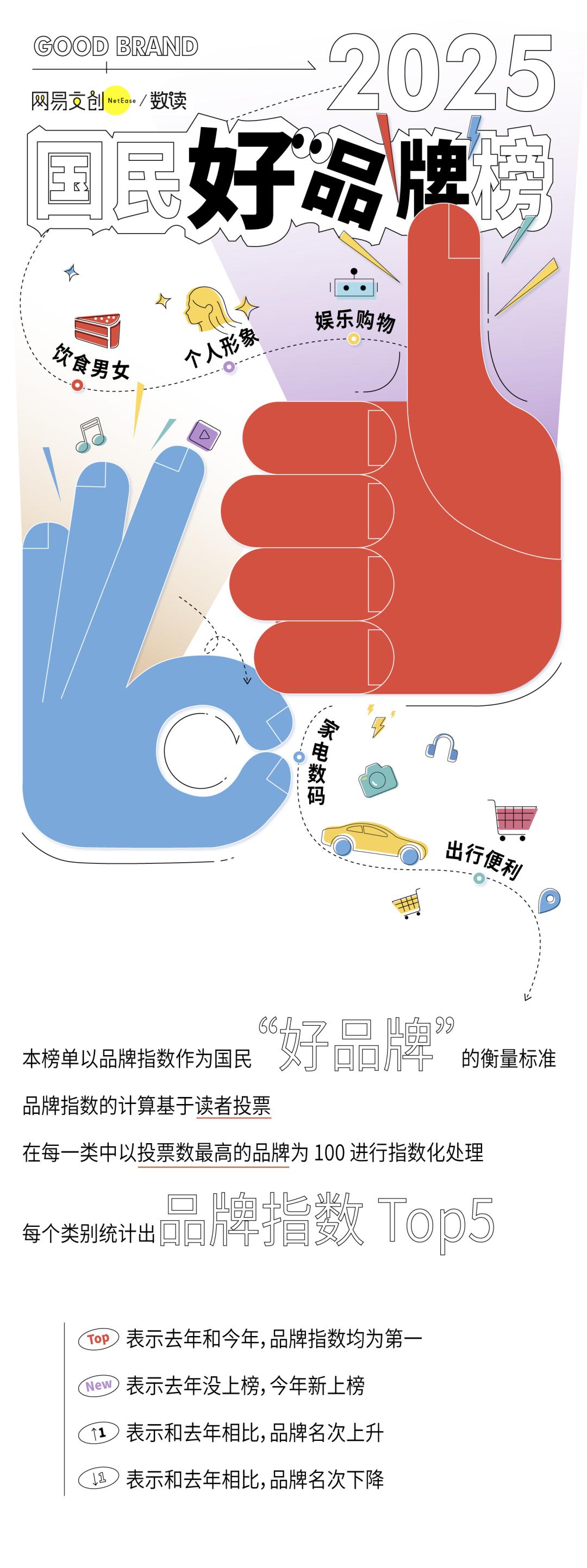
Group 1 - The brand index is used as a measurement standard for the public, calculated based on reader votes, with the highest voted brand in each category set to 100 for index processing [2] - The top five brands in various categories have been identified, with changes in rankings noted, including new entries and shifts in positions compared to the previous year [4][9] - The overall consumer sentiment indicates a cautious approach to spending, with a significant portion of respondents prioritizing product quality and reliability over brand loyalty [123][124] Group 2 - Heytea has fallen behind, with Guming Tea replacing it in the top five, and Guming Tea's store count reaching 11,179 with a net profit of 1.625 billion yuan, surpassing its total profit from the previous year [9] - Haidilao remains the top brand in the hot pot category, while KFC and McDonald's have swapped positions, with KFC slightly ahead [12] - The beverage market sees a return of Nongfu Spring to the top ranks, while Wahaha faces management turmoil, impacting its brand perception [15][17] Group 3 - In the beauty and personal care sector, Estee Lauder and L'Oreal dominate, with significant changes in rankings and the absence of local brands in the top positions [41] - Anta and Li Ning lead the sportswear category, with Li Ning rising to first place from fourth last year, while Adidas has returned to the rankings [45] - Douyin has surpassed Bilibili in the short video sector, with Douyin's daily active users reaching 600 million, while Bilibili has improved its profitability [55] Group 4 - The e-commerce landscape is evolving, with traditional platforms like JD, Meituan, and Taobao entering the instant retail competition, leading to significant financial investments in subsidies [73] - The AI app market is witnessing explosive growth, with ByteDance's products leading in active user numbers, indicating a shift towards AI-driven applications [80] - The adult product market is quietly rising, with brands like Durex and Okamoto leading the category [82] Group 5 - The home appliance market is characterized by intense competition, with Midea focusing on diversified business strategies, while Haier emphasizes high-end and localized operations [92] - Huawei continues to focus on the high-end market, with significant developments in its HarmonyOS ecosystem, while Apple faces challenges with its latest iPhone series [94][95] - The hotel industry is shifting towards new chain hotels, with traditional five-star hotels losing appeal as consumers seek more modern accommodations [116]

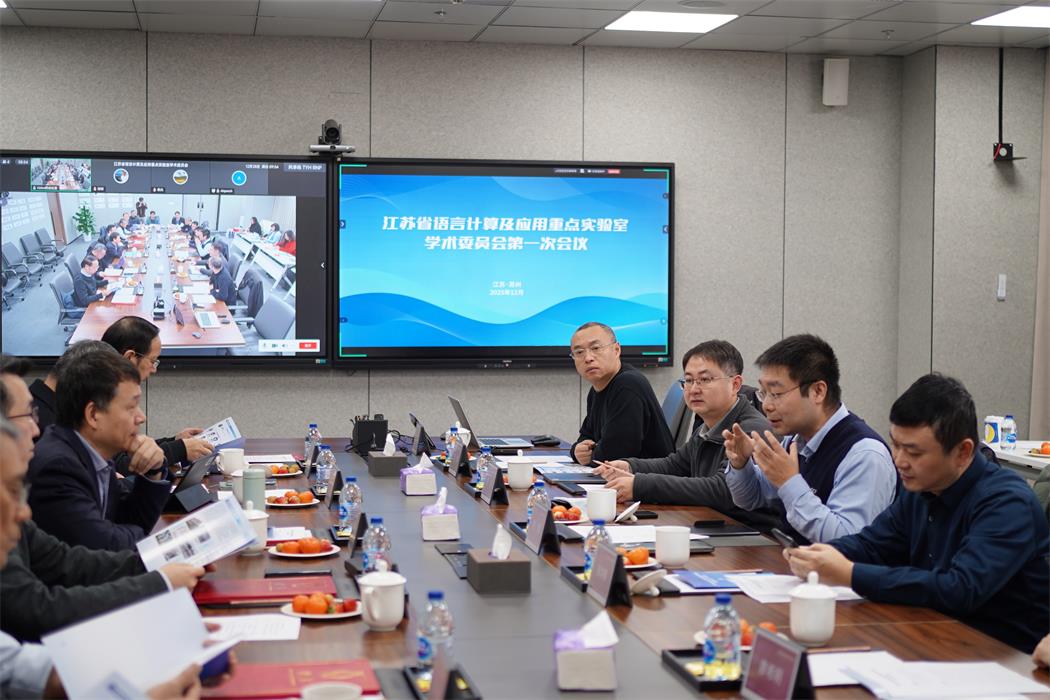
江苏省语言计算及应用重点实验室召开学术委员会第一次会议
Jiang Nan Shi Bao· 2025-12-31 07:28
Core Insights - The Jiangsu Provincial Language Computing and Application Key Laboratory has successfully held its first academic committee meeting, focusing on the transition from generative to executable AI technologies [1][3] - The laboratory aims to become a leading center for original innovation in language computing within three years, contributing to high-quality development in China's AI sector [3][12] Group 1: Laboratory Overview - The laboratory is the first AI key laboratory in Jiangsu led by a company, highlighting the province's emphasis on AI industry development and enterprise-driven technological innovation [7] - It is established in collaboration with Shanghai Jiao Tong University and Suzhou University, leveraging top-tier research resources to focus on core language computing technologies [7] - The laboratory emphasizes a "reliability-first" approach in cross-modal general intelligence, targeting key technologies such as trustworthy speech and multi-modal perception [7] Group 2: Academic Committee Insights - The academic committee, chaired by Zhang Bo, includes experts from various prestigious institutions, providing constructive feedback on the laboratory's mid-to-long-term development plans [5][9] - Experts recommend strengthening foundational research and core technology breakthroughs, particularly in multi-modal perception, agent communication, and reliability enhancement [3][9] Group 3: Industry Applications - The laboratory's AI technologies have been successfully implemented in smart travel, smart office, and smart IoT sectors, demonstrating effective integration of research and application [9][10] - In the smart travel sector, the laboratory's solutions have been adopted by major automotive brands, enhancing in-car language processing and user experience [9][10] - The smart IoT solutions have been deployed in key areas such as smart robotics and consumer electronics, collaborating with leading companies to drive industry transformation [10] Group 4: Future Directions - The laboratory plans to deepen collaboration with local universities and enterprises to accelerate the application of technological achievements in various key scenarios [3][12] - The focus will be on core technology breakthroughs and fostering high-end talent in general AI to enhance Jiangsu's competitiveness in the AI industry [7][12]