三花智控

Search documents
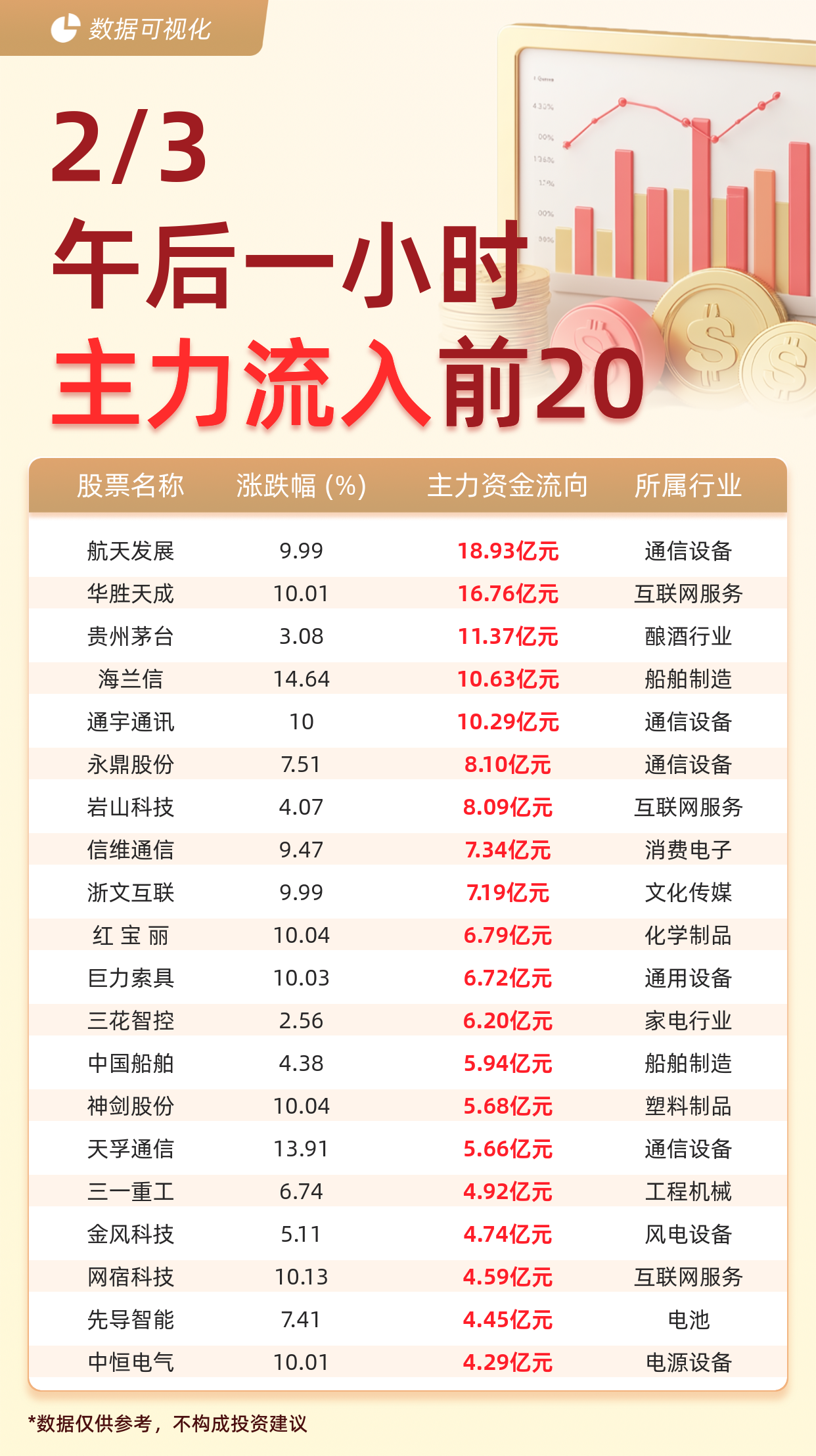
主力资金流入前20:航天发展流入18.93亿元、华胜天成流入16.76亿元
Jin Rong Jie· 2026-02-03 06:12
Core Viewpoint - The data indicates significant capital inflows into various stocks, highlighting potential investment opportunities in specific sectors such as communication equipment, internet services, and consumer electronics [1][2][3]. Group 1: Stock Performance and Capital Inflows - Aerospace Development saw a capital inflow of 1.893 billion, with a price increase of 9.99% [2] - Huasheng Tiancheng experienced a capital inflow of 1.676 billion, with a price increase of 10.01% [2] - Kweichow Moutai had a capital inflow of 1.137 billion, with a price increase of 3.08% [2] - Hailanxin recorded a capital inflow of 1.063 billion, with a price increase of 14.64% [2] - Tongyu Communication had a capital inflow of 1.029 billion, with a price increase of 10% [2] - Yongding Co. saw a capital inflow of 810 million, with a price increase of 7.51% [2] - Yanshan Technology had a capital inflow of 809 million, with a price increase of 4.07% [2] - Xinyi Communication recorded a capital inflow of 734 million, with a price increase of 9.47% [2] - Zhejiang Wenhu Interconnect had a capital inflow of 719 million, with a price increase of 9.99% [2] - Hongbaoli saw a capital inflow of 679 million, with a price increase of 10.04% [2] - Julisi saw a capital inflow of 672 million, with a price increase of 10.03% [3] - Sanhua Intelligent Control had a capital inflow of 620 million, with a price increase of 2.56% [3] - China Shipbuilding recorded a capital inflow of 594 million, with a price increase of 4.38% [3] - Shenjian Co. saw a capital inflow of 568 million, with a price increase of 10.04% [3] - Tianfu Communication had a capital inflow of 566 million, with a price increase of 13.91% [3] - Sany Heavy Industry recorded a capital inflow of 492 million, with a price increase of 6.74% [3] - Goldwind Technology saw a capital inflow of 474 million, with a price increase of 5.11% [3] - Wangsu Science & Technology had a capital inflow of 459 million, with a price increase of 10.13% [3] - Xian Dao Intelligent recorded a capital inflow of 445 million, with a price increase of 7.41% [3] - Zhongheng Electric saw a capital inflow of 429 million, with a price increase of 10.01% [3]





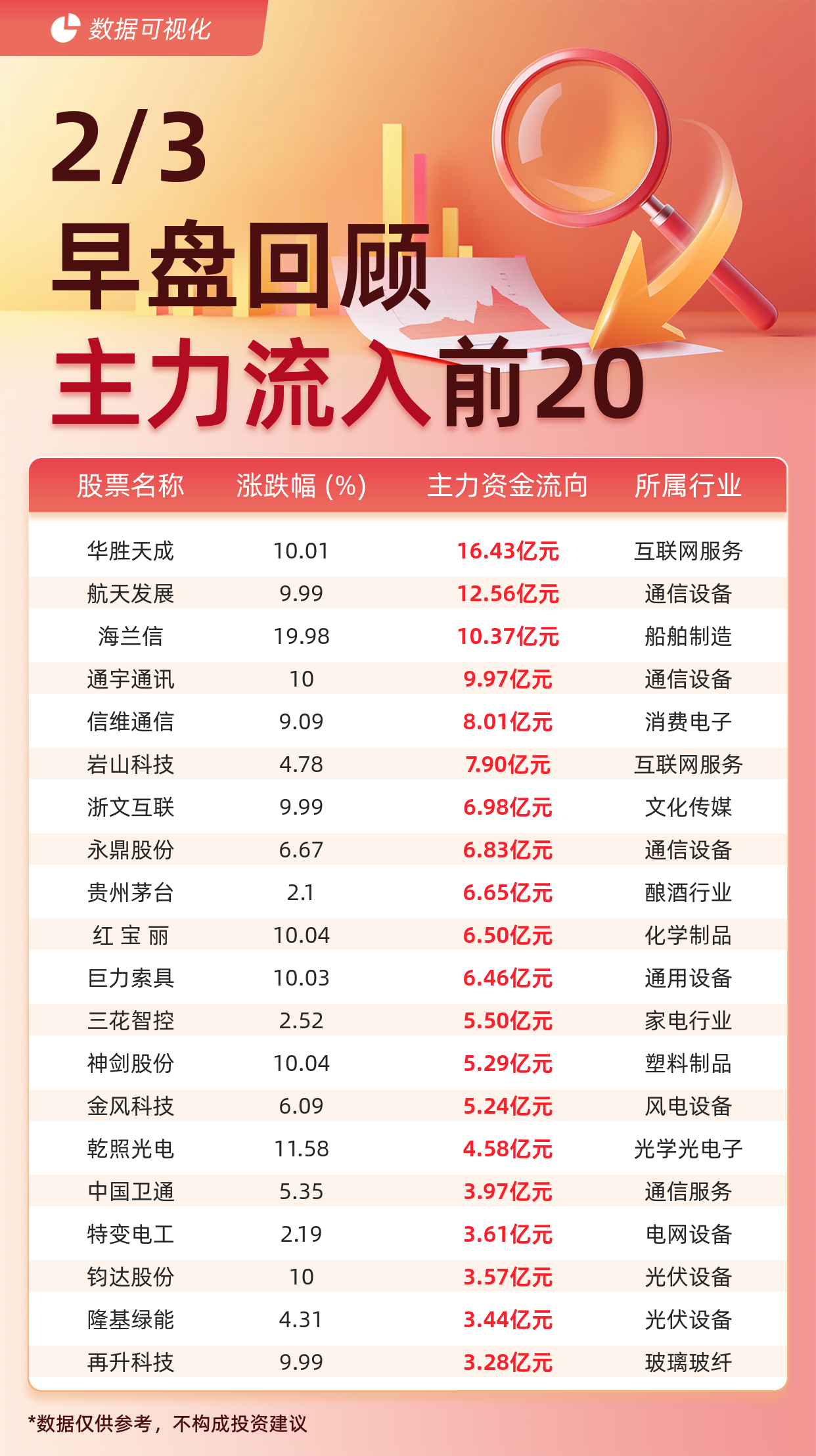
主力资金流入前20:华胜天成流入16.43亿元、航天发展流入12.56亿元
Jin Rong Jie· 2026-02-03 04:08
Group 1 - The top 20 stocks with significant capital inflow as of February 3 include Huasheng Tiancheng (1.643 billion), Aerospace Development (1.256 billion), and Hailanxin (1.037 billion) [1] - Huasheng Tiancheng saw a price increase of 10.01%, while Hailanxin experienced a notable rise of 19.98% [2][3] - Other notable stocks with substantial capital inflow include Tongyu Communication (0.997 billion), Xinwei Communication (0.801 billion), and Yonding Co. (0.683 billion) [1][2] Group 2 - The sectors represented among the top inflow stocks include Internet Services, Communication Equipment, and Consumer Electronics [2] - Guizhou Moutai, a major player in the liquor industry, attracted 0.665 billion with a price increase of 2.1% [2] - Companies like Junda Co. and Longi Green Energy, both in the photovoltaic equipment sector, also saw significant capital inflow of 0.357 billion and 0.344 billion respectively [3]


阿童木机器人冲击港股,聚焦工业机器人产品,净利润连续两年亏损
Ge Long Hui· 2026-02-03 03:21
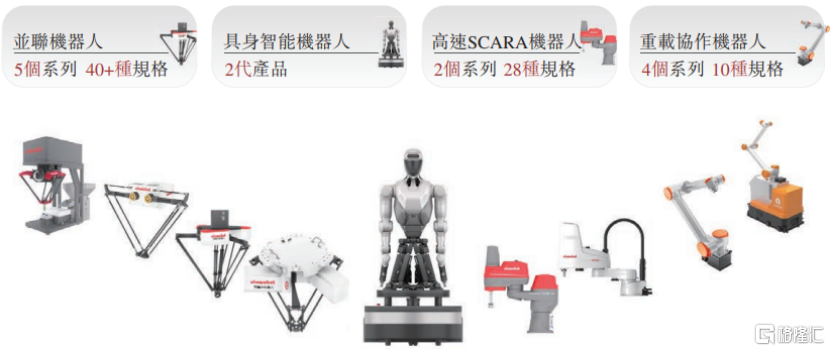
Core Insights - The article highlights the increasing importance of industrial robots in manufacturing, driven by the rise of smart manufacturing and structural increases in labor costs, positioning robots as key tools for efficiency and cost reduction [1] Company Overview - Tianjin Atongmu Robot Co., Ltd. (referred to as "Atongmu Robot") has submitted an IPO application to the Hong Kong Stock Exchange, aiming to list under Chapter 18C, with Huatai International as the sole sponsor [1] - The company focuses on the research, production, sales, and service of high-speed and high-reliability industrial robots, with products spanning parallel robots, high-speed SCARA robots, heavy-duty collaborative robots, and embodied intelligent robots [1][4] Financial Performance - Approximately 50% of Atongmu Robot's revenue comes from parallel robots, but the company has reported net losses for two consecutive years [3] - Revenue for the years 2023, 2024, and the first nine months of 2025 is approximately RMB 93.49 million, RMB 135.26 million, and RMB 156.96 million, respectively, with corresponding gross margins of 17%, 22.8%, and 28.9% [8] - The company has incurred net losses of approximately RMB -39.25 million, RMB -47.07 million, and a profit of RMB 0.938 million for the same periods [8] Product and Market Dynamics - Atongmu Robot's product matrix includes parallel robots, high-speed SCARA robots, and heavy-duty collaborative robots, with a significant portion of revenue derived from robot bodies [6][8] - The average selling prices of the company's products have declined during the reporting period, which may impact revenue [8][9] - The global and Chinese industrial robot market is projected to grow, with expected shipment values of approximately RMB 101.3 billion and RMB 46.6 billion in 2024, respectively [15][16] Competitive Landscape - The industrial robot market is characterized by intense competition, with Atongmu Robot needing to compete against multinational corporations and established domestic manufacturers [10][18] - In 2024, Atongmu Robot is expected to rank second among global parallel robot manufacturers with a market share of 4.8% and first in China with a market share of 12.3% [18] Future Outlook - The company plans to use the funds raised from the IPO for ongoing research and development, expanding its multifunctional headquarters, enhancing production capacity, and developing overseas markets [22] - The future growth of the industrial robot market is anticipated due to ongoing automation upgrades across various industries, with a compound annual growth rate of approximately 12.3% for the global market from 2024 to 2029 [16]

三花智控涨2.01%,成交额38.35亿元,主力资金净流入1.82亿元
Xin Lang Zheng Quan· 2026-02-03 02:57
Core Viewpoint - Sanhua Intelligent Controls has experienced fluctuations in stock price and trading volume, with a recent increase of 2.01% in share price, reaching 51.76 CNY per share, while the company has seen a year-to-date decline of 6.21% [1] Company Overview - Sanhua Intelligent Controls, established on September 10, 1994, and listed on June 7, 2005, is based in Shaoxing, Zhejiang Province, China. The company primarily engages in the manufacturing of refrigeration and air conditioning electrical components and automotive parts [2] - The company's revenue composition is 63.88% from refrigeration and air conditioning electrical components and 36.12% from automotive parts [2] - The company operates in two segments: HVAC and electrical equipment, and automotive thermal management, with key products including four-way valves, electronic expansion valves, and electronic water pumps [2] Financial Performance - As of September 30, 2025, Sanhua Intelligent Controls reported a revenue of 24.03 billion CNY, reflecting a year-on-year growth of 16.86%, and a net profit attributable to shareholders of 3.24 billion CNY, up 40.85% year-on-year [3] - The company has distributed a total of 8.83 billion CNY in dividends since its A-share listing, with 3.64 billion CNY distributed over the past three years [4] Shareholder Information - As of September 30, 2025, the number of shareholders increased to 445,500, with an average of 8,271 circulating shares per person, a decrease of 41.88% from the previous period [3] - Major shareholders include Hong Kong Central Clearing Limited and various ETFs, with some experiencing a reduction in shareholding [4]
未知机构:东吴电新周策略容量电价政策出台储能锂电优质龙头利好行业-20260203
未知机构· 2026-02-03 02:35
Summary of Conference Call Records Industry: Energy Storage and Lithium Battery Key Points 1. **Energy Storage Policy**: The national capacity compensation electricity price policy has been introduced, with provinces expected to follow up with detailed regulations and lists. There is a strong demand for large-scale energy storage, with an expected growth of over 60% in 2026. The U.S. Inflation Reduction Act has led to unexpected installations in 2025, and data center energy storage is anticipated to explode starting Q4 2025, with 2026 expected to exceed forecasts. Emerging markets in Europe and the Middle East are also projected to see significant growth in energy storage demand, contributing to a global installation growth of over 60% in 2026 and a compound annual growth rate of 30-50% over the next three years. The focus remains on large-scale energy storage integration and leading energy storage battery companies [1][1][1] 2. **Lithium Battery Market**: The China Passenger Car Association anticipates a recovery in electric vehicle sales in late January, with retail sales expected to reach 800,000 units, a year-on-year increase of 8%, which is better than pessimistic forecasts. Domestic sales in 2026 are expected to grow by 5-10%, with battery capacity increasing by 10%. The national energy storage capacity price policy is expected to be followed by multiple provinces, and the recent decline in lithium carbonate prices may lead to the suspension or restart of some projects. Production is expected to decrease by over 10% in February due to the Spring Festival, but recovery is anticipated post-holiday. Battery prices have been adjusted to 0.38 yuan/wh, with price increases for small and medium customers already implemented, and larger customers expected to see gradual price adjustments after March. The battery sector is strongly recommended, with top picks including CATL and EVE Energy, along with other quality material leaders [2][2][2] 3. **Industrial Control and Wind Power**: The industrial control sector is experiencing a weak recovery in demand, with positive trends in lithium battery demand, wind power, and machine tools. The domestic offshore wind power capacity is projected to exceed 8GW in 2025, with a three-year action plan to enhance domestic offshore wind potential. The European offshore wind sector is entering a sustained boom cycle, and the domestic onshore wind power capacity is expected to exceed 100GW, a 25% year-on-year increase. Wind turbine prices are expected to rise by 3-5%, with profit margins gradually recovering. Recommendations include companies involved in offshore cables, foundations, and complete machines [3][3][3] 4. **Solar Power and Grid Investment**: Demand in the solar power sector is currently weak, with rising silver prices pushing battery prices up significantly. The component sector is facing pressure, and demand is expected to decline for the first time in 2026. However, space solar power presents significant growth potential, with gallium arsenide, P-type HJT, and space perovskite expected to benefit first. The grid investment is projected to grow in 2025, with opportunities in overseas transformer markets. Key recommendations include leading companies in various segments of the energy sector [3][3][3] 5. **Company Recommendations**: - CATL: Global leader in power and energy storage batteries, with confirmed growth and low valuation - Sungrow: Global leader in inverters, with strong overseas energy storage integration capabilities - Sifang Electric: Domestic leader in power equipment with strong overseas orders and profitability - EVE Energy: Strong growth in power and energy storage lithium batteries, with a stable consumer battery segment - Other notable companies include Ganfeng Lithium, BYD, and LONGi Green Energy, which are expected to perform well in their respective sectors [3][3][3] Additional Insights - The energy storage market is expected to see a significant increase in demand driven by new policies and technological advancements - The lithium battery sector is poised for growth, with a focus on production recovery and price adjustments - The industrial control and renewable energy sectors are experiencing a gradual recovery, with specific companies positioned to benefit from these trends - The solar power market faces challenges but also opportunities in emerging technologies like space solar power [1][2][3][4][5]




研判2026!中国汽车智能水阀行业市场政策汇总、产业链图谱、市场规模、竞争格局及发展趋势分析:下游市场需求旺盛[图]
Chan Ye Xin Xi Wang· 2026-02-03 01:35
Core Viewpoint - The automotive smart water valve market in China is experiencing rapid growth driven by the booming new energy vehicle (NEV) industry, with a projected market size of 4.96 billion yuan by 2025, representing a 44.6% year-on-year increase and accounting for 62.1% of the global market [1][11]. Overview - The automotive thermal management system is crucial for regulating and optimizing vehicle temperatures to enhance efficiency, safety, and comfort, encompassing various components such as heat exchangers, valves, pumps, and compressors [2]. - Automotive smart water valves, also known as electronic water valves, are key components in thermal management systems, enabling precise control of coolant flow to regulate temperature in electric vehicle systems [3]. Market Policies - The Chinese government has implemented several policies to support the development of the automotive parts industry, including the automotive smart water valve sector, creating a favorable policy environment for growth [5]. Industry Chain - The upstream of the automotive smart water valve industry includes metal parts, electronic components, and raw materials, while the midstream involves R&D, design, and production, and the downstream primarily targets the automotive market [6]. Development Status - The demand for high-end products like proportional valves and multi-way valves is rapidly increasing, driven by the higher precision and stability requirements of NEVs compared to traditional fuel vehicles [10][11]. Competitive Landscape - The global automotive thermal management system market is highly concentrated, with leading companies leveraging their expertise in core components and system integration. Chinese companies like Sanhua Intelligent Control and Top Group are gaining market share in the NEV sector [12]. - The competitive structure of the smart water valve market mirrors that of the overall thermal management system market, characterized by foreign dominance in high-end segments and the rise of domestic players in mid-range products [12]. Key Players Analysis - Sanhua Intelligent Control focuses on thermal management solutions and has established partnerships with major automotive manufacturers, achieving significant revenue from its automotive parts business [12]. - Tianbo Intelligent Technology specializes in automotive thermal management components and has seen substantial growth in smart water valve production and sales [14]. Development Trends - Future trends indicate a shift towards integrated and intelligent designs for smart water valves, incorporating multiple functions and advanced materials to enhance performance and efficiency [15]. - Regulatory pressures will drive product upgrades and green transformations, emphasizing energy efficiency and sustainability across the supply chain [15]. - Local companies are increasingly replacing imported products, enhancing supply chain localization and fostering collaboration between automakers and valve manufacturers [16].

特斯拉业务重心转向,但中国供应商仍是中坚力量
Guan Cha Zhe Wang· 2026-02-02 11:53
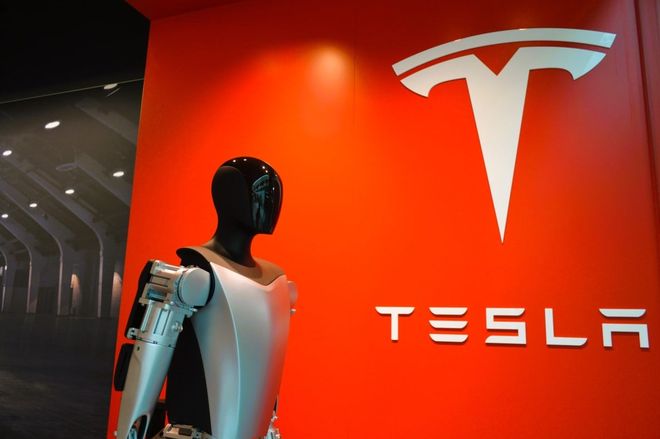
Core Viewpoint - Tesla is shifting its business focus from electric vehicles to humanoid robots, with plans to produce the "Optimus" robot in the U.S. while still relying on China's extensive robot supply chain for components [1][4]. Group 1: Tesla's Plans and Production - Elon Musk announced plans to gradually reduce the production of Model S and Model X electric vehicles to convert the Fremont factory for "Optimus" production, aiming for mass production by the end of 2026 [5]. - The long-term goal is to produce 1 million humanoid robots annually at the Fremont factory, with a third-generation "Optimus" expected to launch in a few months [5]. - Musk expressed caution regarding the current performance of "Optimus," stating it is still in the early stages of development [5]. Group 2: Supply Chain and Component Suppliers - Tesla has been engaging with hundreds of Chinese component suppliers for over three years, collaborating on research and hardware design, with some suppliers already delivering prototype parts [3]. - Key potential suppliers include Zhejiang Sanhua Intelligent Control, which provides thermal management components, and Ningbo Top Group, which is developing actuators and other robot parts [3]. - Bain & Company estimates that Chinese suppliers will play a significant role in the global humanoid robot supply chain, accounting for at least 55% of the material costs for core components [4]. Group 3: Cost and Market Dynamics - Morgan Stanley predicts that component suppliers are likely to benefit first from the growth of the humanoid robot industry, with an expected 16% decrease in the total material costs for humanoid robots in China this year [6]. - Tesla aims to keep the manufacturing cost of each "Optimus" robot around $20,000 (approximately 138,900 RMB) [6]. - Analysts highlight that the cost and efficiency of the Chinese supply chain are key advantages, allowing for localized production and rapid response to design changes [5].

智能制造行业周报:SpaceX申请百万颗卫星,卫星互联网产业化提速-20260202
Shanghai Aijian Securities· 2026-02-02 11:09
证券研究报告 行业研究 / 行业点评 2026 年 02 月 02 日 行业及产业 机械设备 一年内行业指数与沪深 300 指数对比走势: 《芯碁微装(688630.SH)首次覆盖:PCB 与 先进封装共振,直写光刻龙头乘势起》 2025-12-12 王凯 S0820524120002 021-32229888-25522 wangkai526@ajzq.com 资料来源:聚源数据,爱建证券研究所 相关研究 《智能制造行业周报:SpaceX 推进星链升级与 IPO 进程》2026-01-26 《以第一性原理推演中国商业航天降本革命— —商业航天行业深度系列(一)》2026-01-21 《智能制造行业周报:看好 2026 年中国商业 航天产业拐点确立》2026-01-20 《神开股份(002278.SZ)首次覆盖报告:深 海装备国产化破局,AI 驱动数字油服商业模式 升级》2025-12-20 ——智能制造行业周报(2026/01/26-2026/01/30) SpaceX 申请百万颗卫星,卫星互联网产业 化提速 强于大市 投资要点: 本周行情:本周(2026/01/26-2026/01/30)沪深 300 指 ...
智能制造行业周报:SpaceX申请百万颗卫星,卫星互联网产业化提速
Shanghai Aijian Securities· 2026-02-02 10:24
Investment Rating - The mechanical equipment sector is rated as "stronger than the market" based on its relative performance compared to the CSI 300 index [2][25]. Core Insights - The mechanical equipment sector experienced a decline of 3.49% this week, while the CSI 300 index increased by 0.08%. The best-performing sub-sector was other automation equipment, which rose by 2.93% [2][3][4]. - The report highlights the potential growth in the satellite internet industry, particularly with SpaceX's application to launch up to 1 million satellites, which could enhance AI applications and create a stable business model in China [2]. - In the semiconductor equipment sector, ASML's recent performance exceeded expectations, indicating strong demand and a positive outlook for global wafer fabrication capacity [2]. - The humanoid robot segment is expected to benefit from advancements in hardware architecture and AI capabilities, with companies like Tesla planning to ramp up production of humanoid robots [2]. - The report also discusses the advancements in nuclear fusion technology, with the FLAME device achieving significant experimental progress, potentially offering a more economical path for commercialization [2]. Summary by Sections Mechanical Equipment Sector - The sector's PE-TTM valuation decreased by 3.35%, with notable declines in refrigeration and air conditioning equipment (-7.41%) and printing and packaging machinery (-7.09%) [2][8]. - The report recommends focusing on companies such as North Huachuang (002371) and Shengmei Shanghai (688082) in the semiconductor equipment space [2]. Commercial Aerospace - Companies to watch include Western Materials (002149), Yingliu Co., Ltd. (603308), and Srey New Materials (688102) as the low-orbit satellite network evolves into a "space information infrastructure platform" [2]. Semiconductor Equipment - ASML's Q4 2025 results showed a net sales of €9.7 billion and a gross margin of 52.2%, with a strong order backlog indicating sustained demand [2]. Humanoid Robots - The report emphasizes the advancements in humanoid robots, particularly with Tesla's Optimus robot, which is set to begin mass production by the end of 2026 [2]. Nuclear Fusion - The report highlights the progress in fusion technology, particularly the FRC approach, which could significantly reduce construction costs compared to traditional methods [2].
家电零部件板块2月2日跌0.51%,三星新材领跌,主力资金净流出3.36亿元
Zheng Xing Xing Ye Ri Bao· 2026-02-02 09:15
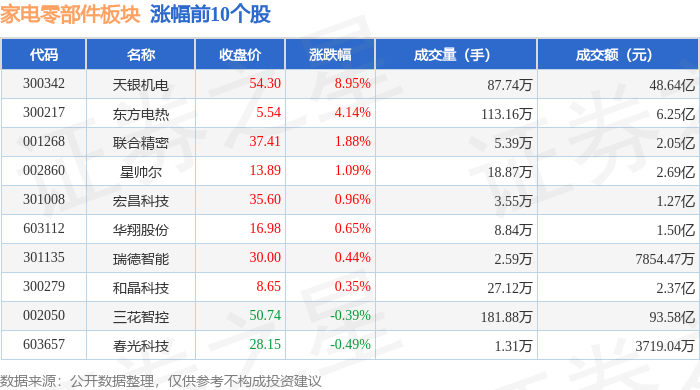
Market Overview - The home appliance parts sector experienced a decline of 0.51% on February 2, with Samsung New Materials leading the drop [1] - The Shanghai Composite Index closed at 4015.75, down 2.48%, while the Shenzhen Component Index closed at 13824.35, down 2.69% [1] Stock Performance - Notable gainers in the home appliance parts sector included: - Tianyin Electromechanical (300342) with a closing price of 54.30, up 8.95% and a trading volume of 877,400 shares, totaling 4.864 billion yuan [1] - Dongfang Electric Heating (300217) closed at 5.54, up 4.14% with a trading volume of 1,131,600 shares [1] - Conversely, Samsung New Materials (603578) saw a significant decline of 9.97%, closing at 15.17 with a trading volume of 109,100 shares [2] - Other notable decliners included: - Hesheng New Materials (002290) down 5.99% to 57.00 [2] - Shunwei Co., Ltd. (002676) down 4.11% to 7.93 [2] Capital Flow - The home appliance parts sector experienced a net outflow of 336 million yuan from institutional investors, while retail investors saw a net inflow of 46.243 million yuan [2] - The capital flow for specific stocks showed: - Hojing Technology (300279) had a net inflow of 21.6936 million yuan from institutional investors [3] - Dongfang Electric Heating (300217) saw a net inflow of 16.6791 million yuan from institutional investors [3] - Samsung New Materials (603578) had a significant net outflow of 9.97% [2]