
中国中铁

Search documents
西部证券晨会纪要-20260129
Western Securities· 2026-01-29 01:37
Group 1: Fund Analysis - The public FOF fund scale increased in Q4 2025, with a new issuance scale of 458.54 billion yuan, primarily in bond-type funds [6][7] - The proportion of positive returns for FOF was 49%, with the top performer being CITIC Securities' selected fund [6][8] - Fund managers are optimistic about the market outlook, focusing on structural opportunities with technology and cyclical sectors as the main themes [6][11] Group 2: Electric Vehicle Market - The European electric vehicle market is entering a new phase, with a projected penetration rate of 29% in 2025 and 35% in 2026 due to supply-side drivers and supportive policies [14][15] - The introduction of affordable electric models by European automakers is expected to stimulate consumer demand significantly [15] - Chinese lithium battery companies are positioned to capitalize on the growth of the European market, enhancing their competitive landscape [14][16] Group 3: Construction and Decoration Industry - The construction state-owned enterprises are expected to benefit from strategic and professional restructuring policies initiated by the state [18][19] - The market share of major construction state-owned enterprises remains relatively low, with significant competition and operational pressure evident [19][20] - Recommendations include companies like China Communications Construction, China Railway, and China Chemical, which are likely to enhance their competitiveness through restructuring [21] Group 4: Beauty and Personal Care - The beauty industry in China is transitioning from incremental expansion to competitive positioning, with domestic brands gaining market share [23][24] - The company aims to achieve 30 billion yuan in sales by 2030, driven by research and development, brand expansion, and global operations [25] - The application of AI in production and marketing is expected to enhance operational efficiency and support long-term growth [25] Group 5: Basic Chemicals - The price of hafnium has surged by 21.64% since the beginning of 2026, driven by high demand in sectors like semiconductors and aerospace [27][28] - The company is advancing its zirconium-hafnium separation project, which is expected to significantly contribute to future earnings [29] - Hafnium's unique properties make it essential in high-tech applications, indicating strong future demand [28] Group 6: Electronics - The company is set to benefit from the high demand for PCB and packaging substrates, with projected net profits for 2025 expected to increase by 68% to 78% [31][32] - The expansion of production capacity is ongoing, with new facilities in Thailand and South China expected to enhance growth potential [33] - The company is recognized as a leading provider of electronic circuit technology, with a positive outlook for future performance [33]





中国中铁(601390):铜钼矿产待重估,承建海南商业航天发射场
GUOTAI HAITONG SECURITIES· 2026-01-29 01:14
Investment Rating - The investment rating for the company is maintained as "Buy" with a target price of 9.07 CNY, based on a PE ratio of 9.3 times for 2026 [3][9]. Core Insights - The company holds leading reserves of copper, cobalt, and molybdenum in China, with significant production capacity in these metals. The new order growth is projected at 1% for 2025, with overseas orders expected to increase by 17% [2][4]. - The LME copper spot price remains high, recorded at 12,980 USD/ton, a year-on-year increase of 43.4%. The company’s production for the first half of 2025 includes 148,789 tons of cathode copper, 2,830 tons of cobalt, and 7,103 tons of molybdenum [4]. - The company’s subsidiary, China Railway Resources, is expected to achieve a net profit of 2.58 billion CNY in the first half of 2025, a year-on-year increase of 27.4% [4]. Financial Summary - Total revenue for 2023 is reported at 1,263.5 billion CNY, with a projected decline to 1,099.3 billion CNY in 2025, reflecting a decrease of 5.3% [7]. - The net profit attributable to the parent company is expected to decrease from 33.5 billion CNY in 2023 to 24.3 billion CNY in 2025, a decline of 13.0% [7]. - Earnings per share (EPS) are forecasted to be 0.98 CNY for 2025, with a slight increase to 1.00 CNY in 2027 [3][7]. Order Growth and Structure - The company signed new contracts totaling 27,509 billion CNY in 2025, representing a year-on-year increase of 1.3%. The overseas business saw a significant increase of 16.5% [5][20]. - The breakdown of new contracts includes 18,505 billion CNY from engineering construction, 4,725 billion CNY from emerging businesses, and 2,041 billion CNY from asset management [5][20]. Strategic Initiatives - The company is actively promoting an "AI+" initiative and has launched its first enterprise-level model, "Pioneer Model," aimed at various sectors including surveying, design, and construction [6]. - The company is involved in significant projects such as the construction of the Hainan commercial space launch site and has secured contracts for the China-Kyrgyzstan-Uzbekistan railway [6].
五新隧装(920174):布局高景气增量赛道,并购协同成长
Caixin Securities· 2026-01-29 00:30
Investment Rating - The investment rating for the company is "Buy" [2] Core Viewpoints - The company focuses on the tunnel construction and mining equipment sector, emphasizing research, design, production, sales, and service across various markets including railways, highways, and hydropower [5][12] - The company has achieved self-research and industrialization of full-process equipment for the drilling and blasting method, which is widely used in the market [12][17] - The company is actively expanding into new growth areas such as hydropower and mining, which are expected to become key growth drivers [6][7] Summary by Relevant Sections 1. Business Overview - The company has a clear focus on tunnel intelligent equipment, with a robust governance structure supporting healthy cash flow [5][11] - It has developed a comprehensive product matrix that includes various types of equipment tailored for tunnel and mining construction [12][17] 2. Market Opportunities - The tunnel construction industry is rooted in traditional infrastructure, with ongoing demand driven by high-speed rail and urbanization [5][6] - The company is expanding its market presence in hydropower and mining, which are expected to provide significant growth opportunities [6][7] 3. Financial Performance - The company's revenue reached a historical high of 9.54 billion yuan in 2023, reflecting a year-on-year increase of 76.34% [33] - In 2024, revenue is projected to decline to 7.99 billion yuan due to funding pressures in the highway sector, leading to reduced equipment procurement [5][33] - The company maintains a strong cash flow, with cash reserves increasing from 0.52 billion yuan in 2020 to 2.68 billion yuan in the first three quarters of 2025, a year-on-year increase of 25.54% [5][33] 4. Strategic Developments - The company is undergoing significant asset restructuring, which has been approved by regulatory authorities, aimed at enhancing performance and creating synergies [7][8] - The acquisition of related companies is expected to significantly boost earnings and establish a second growth curve in high-end port logistics equipment manufacturing [7][8] 5. Customer Base - The company primarily serves large state-owned enterprises and top domestic construction and mining groups, with a growing focus on international markets due to the Belt and Road Initiative [22][25] - Major clients include China Railway, China Communications Construction, and China State Construction, contributing significantly to the company's revenue [22][25]
建筑建材行业专题报告:建筑央企有望受益于国资央企战略性、专业化重组
Western Securities· 2026-01-28 13:58
行业专题报告 | 建筑装饰 建筑央企有望受益于国资央企战略性/专业化重组 证券研究报告 2026 年 01 月 28 日 核心结论 行业评级 超配 政策层面:导向明确,加强国资央企战略性、专业化重组。2024 年 12 月, 国务院国资委召开中央企业负责人会议便已经提出"加大力度推进战略性重 组和专业化整合"。2025 年下半年国资委表述开始频繁,比如 2025 年 9 月, 国务院国资委副主任李镇在国新办举行的新闻发布会上表示,下一步"大力 推动国资央企战略性专业化重组整合";2025 年 12 月,国务院国资委主任 张玉卓在《充分激发各类经营主体活力》一文中强调,要"加强战略性、专 业化重组,加大力度合并'同类项',避免重复建设和无序竞争";2025 年 12 月国务院国资委召开中央企业负责人会议,以及 2026 年 1 月国新办举行 新闻发布会介绍 2025 年国资央企高质量发展情况,均表明 2026 年国资央 企要"大力推进战略性、专业化重组整合和高质量并购"。 行业层面:需求承压,专业化重组或助力建筑央企提升综合竞争力。大建筑 央企市占率相对较低:2024 年八大建筑央企合计市占率达到 21.4%, ...


新舵手吴秉琪注入“华润基因”,《华侨城十戒》正式发布
Sou Hu Cai Jing· 2026-01-28 10:12
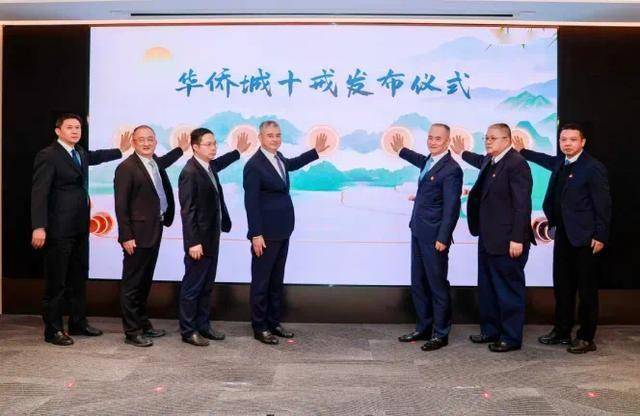
《星岛》记者 钟凯 广州报道 1月27日,"创想华侨城"官微披露,华侨城集团已于1月23日正式发布《华侨城十戒》并举办发布仪式。 这是拥有深厚华润履历的新任董事长吴秉琪空降华侨城后,推出的重磅治理举措,被外界视为集团深化 改革、重塑管理文化的标志性动作。 6.违规从事营利活动; 7.编造、传播谣言或诬告陷害; 8.违规投资并购; 华侨城十戒发布仪式现场。来源:"创想华侨城"官微 据《星岛》了解,华侨城近期对标优秀企业做法,面向全体员工开展"侨城十戒"征求意见工作,最终按 得票率由高到低,从12条管理人员禁止行为候选条款中选出得票率最高的10条。而最终形成的正式版 本,其内容与票选结果完全一致,具体为: 1.利用职权谋取私利; 2.不如实报告重要事项或重特大事故; 3.私自持有、处置公司资产; 4.泄露公司核心机密; 5.做假账; 9.对组织阳奉阴违; 10.违规开展虚假贸易。 这一治理动作与华侨城集团的核心人事调整密切相关。2025年11月下旬,国务院国资委宣布,吴秉琪正 式出任华侨城集团党委书记、董事长,同步伴随多位高管职务调整。履新仅一个月后,吴秉琪便密集拜 会华润集团党委书记、董事长王祥明,中建集团党组 ...


智通AH统计|1月28日
智通财经网· 2026-01-28 09:24
Core Viewpoint - The report highlights the AH premium rates of various stocks, indicating significant disparities between H-shares and A-shares, with some stocks showing extremely high premiums while others exhibit negative premiums [1][2]. Group 1: Top AH Premium Rates - Northeast Electric (00042) leads with an AH premium rate of 847.37%, followed by Zhejiang Shibao (01057) at 349.31% and Beijing Jingcheng Machinery Electric (00187) at 279.42% [1][2]. - The lowest AH premium rates are recorded for Contemporary Amperex Technology (03750) at -14.34%, China Merchants Bank (03968) at -4.99%, and Heng Rui Medicine (01276) at -1.15% [1][2]. Group 2: Top AH Deviation Values - Junshi Biosciences (01877) has the highest deviation value at 22.43%, followed closely by Beijing Jingcheng Machinery Electric (00187) at 22.18% and CanSino Biologics (06185) at 21.90% [1][3]. - The lowest deviation values are observed in Changfei Optical Fiber (06869) at -50.58%, Zhejiang Shibao (01057) at -45.38%, and Nanhua Futures (02691) at -27.12% [1][4]. Group 3: Detailed AH Premium and Deviation Rankings - The top ten AH stocks by premium rate include companies like Hongye Futures (03678) with a premium of 271.30% and Sinopec Oilfield Service (01033) at 248.51% [2]. - The bottom ten AH stocks by premium rate include WuXi AppTec (02359) with a slight premium of 0.42% and Midea Group (00300) at 6.75% [2]. - The top ten stocks by deviation also feature companies like Goldwind (02208) at 19.35% and Andeli Juice (02218) at 19.04% [3].

基础建设板块1月28日跌0.17%,冠中生态领跌,主力资金净流出16.98亿元



Zheng Xing Xing Ye Ri Bao· 2026-01-28 09:04
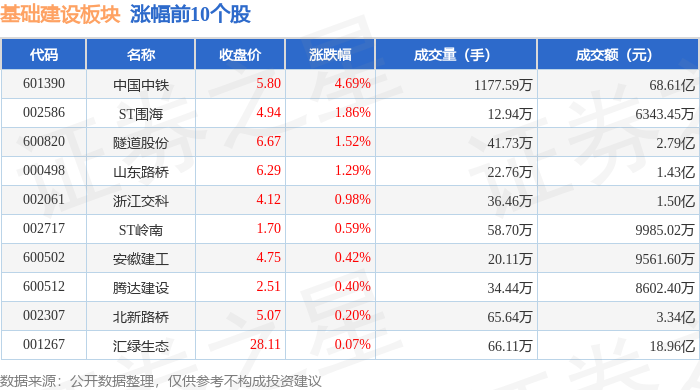
Core Viewpoint - The infrastructure sector experienced a slight decline of 0.17% on January 28, with Guanzhong Ecological leading the losses, while the Shanghai Composite Index rose by 0.27% and the Shenzhen Component Index increased by 0.09% [1]. Group 1: Market Performance - The Shanghai Composite Index closed at 4151.24, up 0.27% [1]. - The Shenzhen Component Index closed at 14342.9, up 0.09% [1]. - The infrastructure sector saw a net outflow of 1.698 billion yuan from major funds, while retail investors contributed a net inflow of 778 million yuan [2][3]. Group 2: Individual Stock Performance - China Railway (601390) closed at 5.80, with a gain of 4.69% and a trading volume of 11.7759 million shares, amounting to 6.861 billion yuan [1]. - Guanzhong Ecological (300948) closed at 22.60, down 9.89% with a trading volume of 135,400 shares, totaling 318 million yuan [2]. - The top gainers in the infrastructure sector included China Railway and ST Jianhai, while Guanzhong Ecological and Yuan Sheng Technology were among the largest decliners [1][2]. Group 3: Fund Flow Analysis - Major funds showed a net inflow into China Railway of 1.10 billion yuan, while North New Road Bridge (002307) had a net inflow of 41.7265 million yuan [3]. - Retail investors had significant outflows from North New Road Bridge, totaling 60.8525 million yuan, indicating a divergence in investor sentiment [3]. - The overall fund flow indicates a mixed sentiment in the infrastructure sector, with major funds pulling back while retail investors remained active [2][3].
黄金逼近5300美元,有色金属概念集体爆发,超20股涨停
2 1 Shi Ji Jing Ji Bao Dao· 2026-01-28 07:52
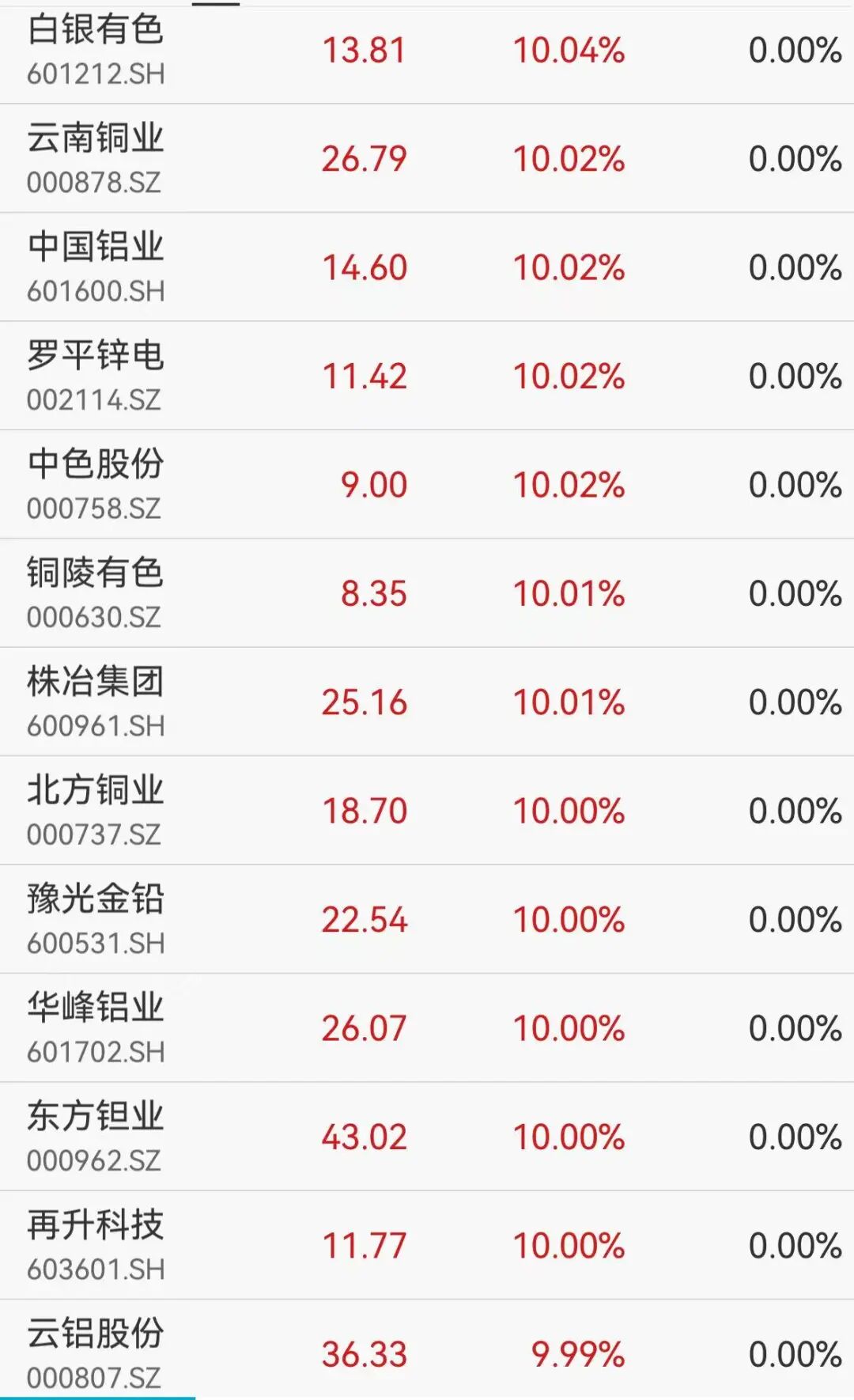
1月28日,沪指、深成指冲高回落,创业板指高开低走,盘中一度跌超1%。截至收盘,沪指涨0.27%,深成指涨0.09%,创业板指跌0.57%。沪深两市成交 额2.99万亿,较上一个交易日放量708亿。盘面上,全市场超3600只个股下跌。 资源股全天领涨,贵金属、油气、电解铝方向轮番爆发。黄金、有色金属板块午后持续拉升,云铝股份(000807)、华峰铝业(601702)、中金黄金 (600489)、北方铜业(000737)、赤峰黄金(600988)等20余股涨停。 | 白银有色 | 13.81 | 10.04% | 0.00% | | --- | --- | --- | --- | | 601212.SH | | | | | 云南铜业 | 26.79 | 10.02% | 0.00% | | 000878.SZ | | | | | 中国铝业 | 14.60 | 10.02% | 0.00% | | 601600.SH | | | | | 罗平锌电 | 11.42 | 10.02% | 0.00% | | 002114.SZ | | | | | 中色股份 | 9.00 | 10.02% | 0.00% | | 00 ...
黄金逼近5300美元,有色金属概念集体爆发,超20股涨停
21世纪经济报道· 2026-01-28 07:37
记者|金珊 见习记者林芊蔚 编辑|黎雨桐 1月28日,沪指、深成指冲高回落,创业板指高开低走,盘中一度跌超1%。截至收盘,沪指涨 0.27%,深成指涨0.09%,创业板指跌0.57%。沪深两市成交额2.99万亿,较上一个交易日放量 708亿。盘面上,全市场超3600只个股下跌。 | 行情 | 资金净流入 | 涨跌分布 | | --- | --- | --- | | 上证指数 | 深证成指 | 科创综指 | | 4151.24 | 14342.89 | 1880.57 | | +11.33 +0.27% +12.99 +0.09% -8.90 -0.47% | | | | 万得全A | 创业板指 | 北证50 | | 6863.27 | 3323.56 | 1562.45 | | +7.43 +0.11% -19.04 -0.57% -2.49 -0.16% | | | | 沪深300 | 中证500 | 中证A500 | | 4717.99 | 8601.16 | 5951.10 | | +12.30 +0.26% +52.23 +0.61% +20.68 +0.35% | | | | 中证1000 | 深证 ...


港股央企红利50ETF(520990)盘中大涨3.4%,成交额超2亿元居同标的第一,机构:红利资产股息吸引力或将进一步提升
2 1 Shi Ji Jing Ji Bao Dao· 2026-01-28 07:03
Group 1 - The Hang Seng Index and Hang Seng Tech Index both rose over 2% on January 28, with the CSI Hong Kong Stock Connect Central State-Owned Enterprises Dividend Index increasing by 3.44% [1] - Among the index constituents, Yangtze Optical Fibre and Cable rose over 15%, China Aluminum increased over 12%, and China Railway and China Metallurgical Group both rose over 5% [1] - The Hong Kong Central State-Owned Enterprises Dividend 50 ETF (520990) rose by 3.4%, with a trading volume of 213 million yuan, making it the top performer in its category [1] Group 2 - The Hong Kong Central State-Owned Enterprises Dividend 50 ETF (520990) closely tracks the CSI Hong Kong Stock Connect Central State-Owned Enterprises Dividend Index, which selects companies with stable dividend levels and high dividend yields from the State-owned Assets Supervision and Administration Commission's list [1] - Guosen Securities indicated that policy support is injecting long-term valuation reshaping momentum into dividend assets, with listed companies increasing their dividend payouts [1] - As the dividend system continues to improve, the attractiveness of dividend assets in terms of yield is expected to further increase [1]