
今世缘

Search documents
2025白酒行业专题报告:茅五亮牌,剑向何方?
Sou Hu Cai Jing· 2025-12-31 12:03
Core Viewpoint - The high-end liquor market, represented by Moutai and Wuliangye, is experiencing a significant price decline, leading to concerns about market confidence and a potential restructuring of the industry [1][2][11]. Group 1: Market Dynamics - The overall white liquor sector has seen a decline of approximately 7% since December, with Moutai's price dropping to around 1500 yuan and Wuliangye's to about 780 yuan, reflecting intensified supply-demand conflicts [1][11]. - Moutai and Wuliangye have initiated measures to stabilize prices, including Moutai's decision to halt the release of unfulfilled quotas and reduce the supply of high-value products [1][2][22]. - Wuliangye has adjusted its payment policy for the first time since 2014, offering a discount of 119 yuan per bottle to ease financial pressure on distributors [2][31]. Group 2: Strategic Adjustments - Moutai's recent actions include holding meetings with distributors to communicate its commitment to controlling supply and stabilizing prices, which has led to a rebound in Moutai's price to around 1600 yuan [1][22][29]. - Wuliangye has implemented various incentives, including market expansion rewards and bottle scanning subsidies, to enhance channel vitality and stabilize its pricing system [2][31]. - The report indicates a shift in the industry from "volume-driven by price" to "price-driven by volume," emphasizing the importance of sales performance [2][3]. Group 3: Future Outlook - The adjustments made by leading companies are expected to gradually alleviate overall inventory pressure in the industry, although other brands still face significant pricing and inventory challenges [2][3]. - The industry is undergoing a structural transition from rapid growth to rational management, with a focus on maintaining channel health and price stability for future high-quality development [3][14]. - The performance of sales and collections before and after the Spring Festival will be critical in determining the industry's trajectory [2][36].



A股2025市值增长九强省盘点:江苏TOP5企业贡献21%市值增量 洋河股份为市值缩水最严重企业
Xin Lang Cai Jing· 2025-12-31 09:43
Group 1 - In 2025, the market value increment of A-share listed companies in Jiangsu Province reached 24,249 billion yuan, representing a growth of 37.01% compared to the beginning of the year [1] - Leading companies contributed significantly to the market value increment, with WuXi AppTec, Tianfu Communication, Dongshan Precision, Hengrui Medicine, and Hengli Hydraulic contributing 1,115 billion, 1,072 billion, 1,052 billion, 1,026 billion, and 766 billion yuan respectively, accounting for a total of 20.75% of Jiangsu's total market value increment [1] - The companies with the most significant market value reduction in Jiangsu Province included Yanghe Brewery, Guodian NARI, Ninghu Expressway, Jinshiyuan, and Changdian Technology, with each experiencing a decline of no more than 350 billion yuan [1] Group 2 - The formation of a MACD golden cross signal indicates a positive trend for certain stocks [2]

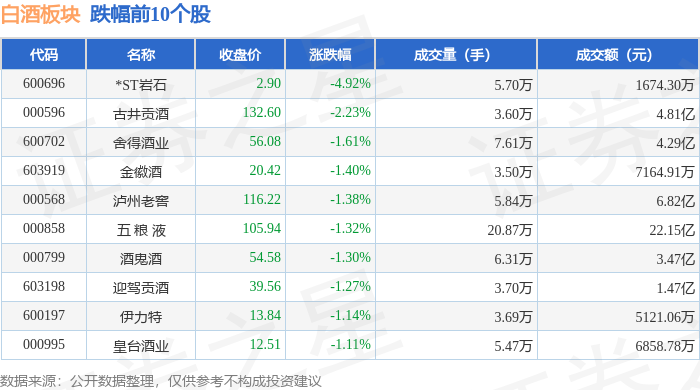
白酒板块12月31日跌1.01%,*ST岩石领跌,主力资金净流出15.73亿元
Zheng Xing Xing Ye Ri Bao· 2025-12-31 08:59
Core Viewpoint - The liquor sector experienced a decline of 1.01% on December 31, with *ST Yanshi leading the drop, while the overall market showed mixed results with the Shanghai Composite Index up by 0.09% and the Shenzhen Component Index down by 0.58% [1] Liquor Sector Performance - The closing prices and percentage changes for key liquor stocks are as follows: - *ST Yanshi: 2.90, -4.92% - Gujing Gongjiu: 132.60, -2.23% - Shede Manye: 56.08, -1.61% - Quanwei Jiu: 20.42, -1.40% - Luzhou Laojiao: 116.22, -1.38% - Wuliangye: 105.94, -1.32% - Zhisi Cha: 54.58, -1.30% - Yingjia Gongjiu: 39.56, -1.27% - Yilite: 13.84, -1.14% - Huangtai Jiuye: 12.51, -1.11% [1] Capital Flow Analysis - The liquor sector saw a net outflow of 1.573 billion yuan from main funds, while retail investors contributed a net inflow of 712 million yuan [1] - The detailed capital flow for selected stocks indicates: - Gujing Gongjiu: Main net inflow of 5.437 million yuan, retail net inflow of 2.302 million yuan - *ST Yanshi: Main net outflow of 4.866 million yuan, retail net inflow of 4.265 million yuan - Other stocks like Jinzhongzi Jiu and Kuozi Jiao experienced significant net outflows from main and retail funds [2]


西南酒价年度图谱:价格失守、库存高企,白酒明年靠啥翻盘?
Nan Fang Du Shi Bao· 2025-12-31 07:34
Core Viewpoint - The Chinese liquor market in 2025 is facing dual pressures of "price stability" and "inventory reduction," leading to a challenging environment for the industry. The market is experiencing a shift from "volume and price increase" to "price stability for survival" as major brands see a decline in prices and face high inventory levels [1][2]. Group 1: Market Trends - The key terms for 2025 are "price stability" and "inventory reduction," with companies focusing on maintaining a stable pricing system to boost market confidence and product value [2]. - Major liquor brands like Moutai and Wuliangye have seen significant price drops, with Moutai falling from over 2500 yuan to below 2000 yuan per bottle, and Wuliangye dropping from nearly 1000 yuan to below 900 yuan [2]. - Inventory levels among 20 A-share listed liquor companies reached 168.39 billion yuan, an increase of 19.29 billion yuan year-on-year, indicating a continuing upward trend in inventory [2]. Group 2: Inventory Challenges - The meaning of inventory has shifted for liquor distributors from being a source of profit to a burden, as high inventory levels lead to increased storage and management costs [3]. - Companies are moving away from traditional inventory pressure tactics and are actively assisting distributors in reducing inventory, but this poses a balancing act as aggressive inventory reduction can depress market prices [3]. Group 3: Price Control Strategies - The "control quantity and protect price" strategy has become crucial, with companies like Wuliangye reducing contract volumes by 0% to 50% for certain channels to maintain price stability [4]. - Various companies have implemented strict measures against price chaos and counterfeit products, including fines and termination of partnerships with non-compliant distributors [5][6]. Group 4: Future Outlook for 2026 - In December 2025, major liquor companies held meetings to outline strategies for 2026, emphasizing the importance of channel profits and a shift towards a sustainable profit model rather than short-term gains [7][8]. - Companies are focusing on consumer-centric strategies, with an emphasis on young consumers and innovative marketing approaches to adapt to changing consumption patterns [9][10]. - The industry is expected to see improvements in supply and demand dynamics in 2026, with analysts suggesting a gradual recovery in sales and pricing [10][11].
白酒行业2025年终观察:深水区破局前行,重构中锚定新增长曲线
Xin Hua Wang· 2025-12-31 06:56
Core Insights - The Chinese liquor industry is at a crossroads of "adjustment and innovation" in 2025, facing dual pressures from consumption trends and market competition, leading to a significant reshaping of the industry landscape [1] - The industry is transitioning from "scale expansion" to "value cultivation," with new growth opportunities emerging amidst the pain of transformation [1] Industry Performance - In the first three quarters of 2025, the overall performance of the liquor industry showed a phase of decline, with a 5.90% decrease in revenue to 317.79 billion yuan and a 6.93% drop in net profit to 122.57 billion yuan [2] - The third quarter alone saw a revenue decline of 18.47% and a net profit drop of 22.22% [2] - The production of liquor from January to October 2025 was 2.902 million kiloliters, down 11.5% year-on-year, indicating a systemic adjustment in the industry [2] Market Segmentation - The top six liquor companies accounted for 88% of the total revenue and 95% of the net profit among 20 listed companies, highlighting an increasing concentration in the industry [3] - Regional liquor companies are experiencing significant differentiation, with some maintaining stability through geographic advantages, while many mid-sized and small companies face unprecedented challenges [3][4] - Companies like Jinhuijiu and Jiansiyuan have shown resilience with smaller revenue declines compared to the industry average, while others like Jiuguijiu and Jinzizijiu faced revenue drops exceeding 20% [3] Inventory and Channel Dynamics - The average inventory turnover days reached 900 days in the first half of 2025, reflecting severe inventory pressure across the industry [5] - The total inventory of 20 listed liquor companies reached 170.69 billion yuan, up 11.32% year-on-year, indicating that destocking remains a priority for most companies [5] - Traditional liquor distributors are struggling with profitability due to high inventory and declining prices, leading to a significant drop in their earnings [5][6] Product Innovation and Consumer Trends - The rise of light bottle liquor and low-alcohol products is reshaping the industry, with light bottle liquor expected to surpass a market size of 200 billion yuan in 2025 [11] - Companies are shifting focus from traditional high-end products to more affordable, quality-driven options that appeal to younger consumers [11][12] - The emergence of low-alcohol products is also notable, with several major companies launching innovative offerings that cater to a more casual drinking experience [12] Regulatory Environment and Support Measures - Regulatory efforts to clean up industry practices have intensified, with local governments implementing supportive policies to boost market confidence and promote recovery [19][20] - Initiatives such as consumer vouchers and financial support for sales growth are being introduced to stimulate the market [20] Future Outlook - The industry is expected to see a structural upturn in 2026, with high-end products likely to recover first due to their stable social and gifting attributes [21][22] - Companies are encouraged to innovate new channels and adapt to changing consumer preferences, focusing on quality and brand storytelling to maintain market share [21][22] - The liquor industry is anticipated to continue its transition towards high-quality development, with a focus on digital transformation and consumer engagement [23]
酒企排队赞助!刘德华、刀郎……谁是白酒“带货王”?
Nan Fang Du Shi Bao· 2025-12-31 00:19
Core Viewpoint - The white liquor industry is increasingly leveraging concert sponsorships as a marketing strategy to boost sales and brand value amidst high inventory and declining profits, raising questions about the effectiveness of such investments in driving actual sales [2][7]. Group 1: Marketing Strategies - Major liquor companies like Wuliangye and Luzhou Laojiao are sponsoring concerts to enhance brand visibility and engage consumers, with over 20 concerts planned for 2025 [2][3]. - The "buy alcohol, get concert tickets" model is a key tactic, allowing companies to directly link product purchases to concert attendance, thereby driving sales [5][6]. Group 2: Industry Challenges - The white liquor industry faces significant challenges, with inventory levels reaching 168.39 billion yuan, a year-on-year increase of 19.29 billion yuan, indicating ongoing inventory pressure [3]. - A survey revealed that 58.1% of distributors reported increased inventory, and over 40% faced cash flow pressures, highlighting the financial strain on the distribution network [3][4]. Group 3: Effectiveness of Concert Sponsorships - While some companies report increased sales from concert sponsorships, others struggle to see a return on investment, with risks of inventory not being effectively sold but merely transferred [7][8]. - The cost of sponsoring concerts can be substantial, with expenses for a single event easily exceeding 5 million yuan, posing a risk for smaller companies [7]. Group 4: Future Outlook - As the industry shifts from growth to competition for existing market share, companies must focus on long-term brand value rather than short-term sales boosts to achieve sustainable growth [8].
新发展环境下禁酒政策调整对白酒行业影响分析
Lian He Zi Xin· 2025-12-30 11:16
Investment Rating - The report indicates a cautious outlook for the liquor industry, with expectations of continued pressure until mid-2026, followed by a potential recovery in the latter half of 2026 [32][33]. Core Insights - The new alcohol prohibition policy introduced in May 2025 has significantly impacted the liquor industry, particularly affecting sales and profits of listed companies, which experienced a year-on-year decline for the first time since 2015 [4][5][6]. - The shift in consumer behavior from government-related consumption to business and personal consumption has made the industry less sensitive to policy changes, although the recent prohibition has still caused notable disruptions [12][15]. - The liquor market is undergoing a structural transformation, with a focus on rational consumption and a shift towards mid-range and low-end products, as high-end consumption becomes less dominant [16][17]. Summary by Sections Policy Adjustment and Industry Operation - The new prohibition policy has led to a significant reduction in liquor consumption, particularly in the second and third quarters of 2025, resulting in a decline in sales and profits for the industry [5][6][7]. - The impact of the new policy is compounded by the cyclical nature of the industry, with the current downturn being attributed to both policy effects and the industry's operational cycle [9][11]. Market Structure Changes - The main consumption scenarios have shifted from government-led to diverse drivers, with personal and business consumption now accounting for approximately 95% of total demand [13][15]. - The price structure of the liquor market has also changed, with a notable increase in demand for mid-range and low-end products, reflecting a more pragmatic consumer approach [16][17]. External Factors - The slowing macroeconomic growth and declining labor population are expected to suppress the overall growth of the liquor industry [19][21]. - The changing demographics and consumption preferences among younger generations indicate a shift towards lower-alcohol products and a focus on health and quality of life [21][22]. Response Strategies of Mainstream Enterprises - Liquor companies are transitioning from passive responses to proactive strategies, including product structure optimization and digital channel enhancements to mitigate risks [26][29]. - The focus on cultural value reconstruction and international expansion is seen as a long-term strategy to overcome domestic market challenges [30][31]. Industry Development Trends - The liquor industry is expected to face significant pressure in the short term, with a potential turning point anticipated in the latter half of 2026 as policy impacts diminish and inventory levels normalize [32][33]. - Long-term projections suggest a gradual contraction in market size, with increased industry concentration likely benefiting leading enterprises [34].
2025茅五泸掀价格保卫战,经销商收缩求生
3 6 Ke· 2025-12-30 10:30
Core Viewpoint - The Chinese liquor industry is undergoing a significant adjustment, with high-end liquor prices declining and companies shifting their strategies to stabilize prices and adapt to changing consumer behaviors [4][10][11]. Group 1: Market Dynamics - The demand for high-end liquor has decreased, with a shift from traditional gifting consumption to more personal consumption, leading to a reduction in sales of premium products [5][6]. - The price of 53-degree 500ml Flying Moutai has fluctuated significantly, dropping to around 1495 yuan per bottle, prompting the company to implement quantity control measures to stabilize market expectations [3][8]. - The overall liquor market is experiencing a price decline, with major brands like Wuliangye and Fenjiu also seeing price reductions compared to the previous year [9][10]. Group 2: Financial Performance - In the first three quarters of the year, the liquor sector's 19 listed companies reported a total revenue of 317.74 billion yuan, a year-on-year decrease of 5.85%, and a net profit of 122.68 billion yuan, down 6.90% [14]. - The average return on equity (ROE) for the sector fell to 19.77%, a decrease of 2.84 percentage points from the previous year, indicating pressure on profitability [14]. - The stock performance of the liquor sector has been weak, with a cumulative decline of 13.76% for the liquor index in 2025, resulting in a market capitalization reduction of approximately 404 billion yuan [14][15]. Group 3: Strategic Adjustments - Companies are focusing on reducing burdens on distributors and shifting marketing strategies to be more consumer-centric, moving away from traditional distribution methods [17][18]. - Major liquor companies are streamlining their distribution channels, with a net reduction of 1,701 distributors among 20 listed companies in the first half of 2025 [18]. - The concept of a "shared destiny" between manufacturers and distributors is being emphasized, with calls for shared pricing power and responsibilities to ensure sustainable partnerships [18].

国泰海通晨报-20251230
国泰海通· 2025-12-30 05:14
Group 1: Food and Beverage Industry - The report highlights that the liquor industry is accelerating its bottoming process, moving towards supply-demand balance, with leading brands like Moutai and Wuliangye expected to stimulate sales through price adjustments in 2026 [3] - The domestic dairy product sector is anticipated to see accelerated domestic substitution due to temporary anti-subsidy measures on EU dairy products, which may increase domestic milk consumption and reverse the industry cycle [3] - Key recommendations include focusing on companies with price elasticity such as Moutai, Wuliangye, and Luzhou Laojiao, as well as high-growth beverage companies like Dongpeng Beverage and Nongfu Spring [2][3] Group 2: Banking Sector - The report on Ningbo Bank indicates a strong growth trajectory in loans, with a year-on-year increase of 17.9% in the first three quarters of 2025, primarily driven by corporate clients [10] - The bank's net profit growth forecasts for 2025-2027 are set at 8.6%, 10.9%, and 12.4%, respectively, with a target price of 38.89 yuan per share [9] - The bank's asset quality is improving, with a decrease in non-performing loan generation rate from 1.23% in Q1 2024 to 0.92% in Q3 2025, indicating a positive trend in credit risk management [11] Group 3: Energy Sector - PX and PTA prices have been on the rise since October 2025, with PX futures increasing from 6296 yuan/ton to 7324 yuan/ton, a rise of 16.33% [13] - The polyester production in China showed strong performance, with a year-on-year increase of 7.7% in the first eleven months of 2025, indicating robust downstream demand [14] - The report anticipates a tight supply-demand balance for PX in the first half of 2026, with new capacity expected to come online in the second half of the year [14] Group 4: Brain-Computer Interface Industry - 2025 is projected to be a pivotal year for the development of brain-computer interfaces in China, with numerous policies being introduced to support the industry [6] - Clinical trials for invasive and semi-invasive brain-computer interfaces are expected to surge, with several companies like Borui Kang aiming for regulatory approval in 2026 [8] - The commercialization of non-invasive brain-computer interfaces is already underway in areas such as brain monitoring and rehabilitation, indicating early market entry [8]
今世缘:省内市场占有率大幅增长,省外超千万地级板块达40个
Cai Jing Wang· 2025-12-30 04:10
Core Insights - The company has achieved significant growth during the "14th Five-Year Plan" period, with revenue surpassing 10 billion yuan in 2023, marking a historic milestone [1] - The market expansion has deepened, with a substantial increase in market share within the province and over 40 cities outside the province exceeding 10 million yuan in sales [1] - The brand product matrix has been optimized, enhancing the high-end image of the Guo Yuan V series and revitalizing classic brands [1] Group 1 - The company has implemented a marketing transformation, optimizing its organizational structure and enhancing organizational capabilities while promoting a "factory and merchants as one family" philosophy [1] - The company has achieved significant production capacity milestones, with raw material and original liquor capacities exceeding 80,000 tons and ceramic storage capacity reaching 300,000 tons [1] - A strategic talent program called "3333 Project" has been initiated to build a core talent team [1] Group 2 - The chairman emphasized the importance of reform and innovation, aiming to enhance quality and upgrade across supply, production, sales, and consumption dimensions [2] - The company aims to become the most growth-oriented innovative enterprise in China's liquor industry during the "15th Five-Year Plan" period, focusing on reform and innovation as the main theme [2] - The company plans to tackle four major challenges: market penetration, brand enhancement, structural upgrades, and collaborative ecosystem building [2]

