长电科技

Search documents
先进封装龙头积极抢滩布局,产业进入“扩产+提价”新阶段
Zhong Guo Neng Yuan Wang· 2026-01-19 02:10
Group 1 - The core viewpoint of the report highlights the significant price increases in semiconductor packaging services driven by strong demand for AI chips and rising raw material costs, with price hikes expected to range from 5% to 30% across various companies [1][4] - TSMC has raised its capital expenditure guidance for 2026 to between $52 billion and $56 billion, a substantial increase of up to 36.9% from 2025, with 10-20% of this investment allocated to advanced packaging and testing [2] - Major companies are actively expanding capacity to meet the growing demand for advanced packaging, with significant investments announced by firms such as Changdian Technology and Tongfu Microelectronics for new facilities and production lines [3] Group 2 - The semiconductor packaging industry is experiencing structural demand growth, particularly for AI and storage chips, leading to a tightening of standard storage chip packaging capacity as resources shift towards advanced packaging [4] - The increase in prices for raw materials such as gold, silver, and copper is contributing to higher packaging costs, prompting packaging companies to raise prices to maintain profitability [4] - Investment recommendations focus on domestic companies actively engaging in high-end advanced packaging, such as Changdian Technology and Tongfu Microelectronics, as well as potential beneficiaries in the sector [5]


两融余额较上一日增加127.86亿元 电子行业获融资净买入额居首
Sou Hu Cai Jing· 2026-01-19 01:41
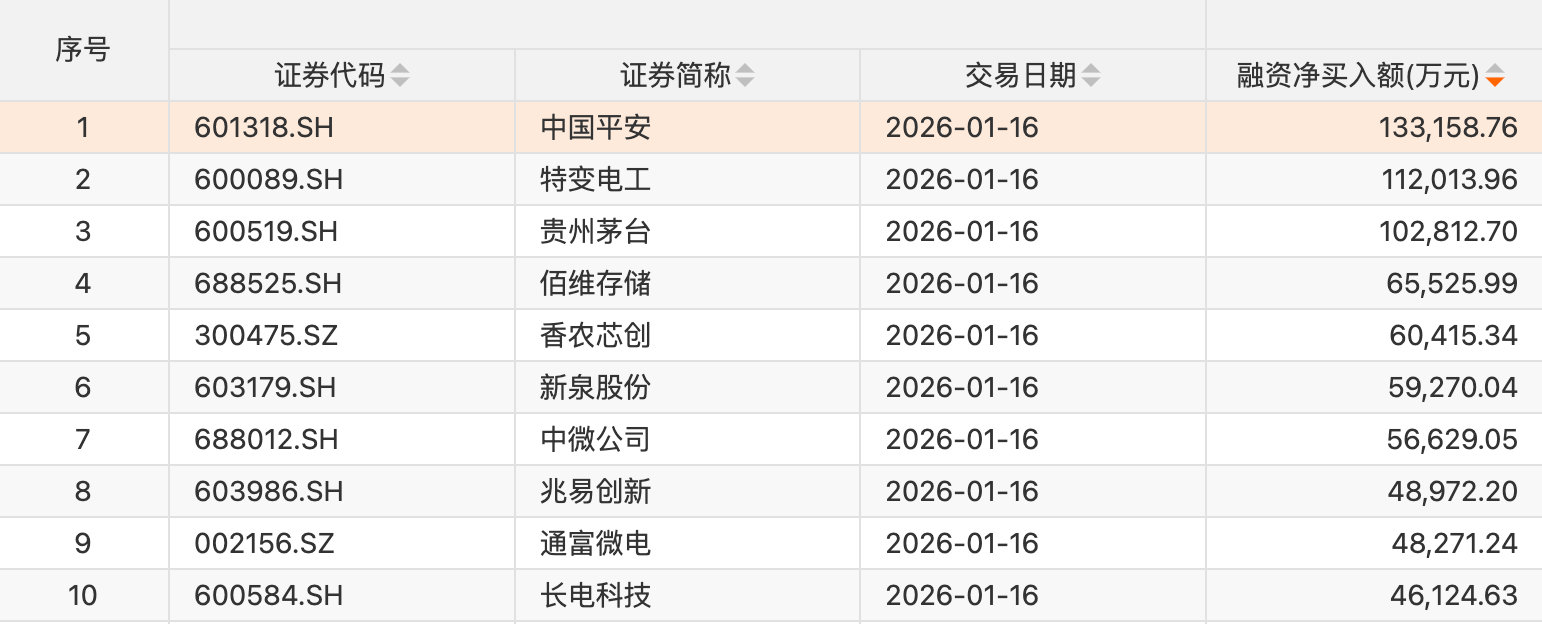
Group 1 - As of January 16, the margin trading balance in A-shares reached 27,315.37 billion yuan, an increase of 127.86 billion yuan from the previous trading day, accounting for 1.65% of the A-share circulating market value [1] - The trading volume for margin transactions on the same day was 3,364.9 billion yuan, which is an increase of 184.47 billion yuan from the previous trading day, representing 10.99% of the total A-share trading volume [1] - Among the 31 primary industries, 20 experienced net financing inflows, with the electronics sector leading at a net inflow of 10.279 billion yuan [1] Group 2 - The top individual stocks with net financing inflows exceeding 1 billion yuan included China Ping An, which had a net inflow of 1.332 billion yuan, followed by TBEA, Kweichow Moutai, and others [1] - The report from Huawei indicates that by 2035, the total computing power in society is expected to grow by up to 100,000 times, suggesting a significant upward trend in the semiconductor cycle driven by artificial intelligence [2] - The research from Huajin Securities recommends focusing on the entire semiconductor industry chain, from design and manufacturing to packaging testing and upstream equipment materials [2]






券商晨会精华 | 关注跨年行情变化
智通财经网· 2026-01-19 00:38
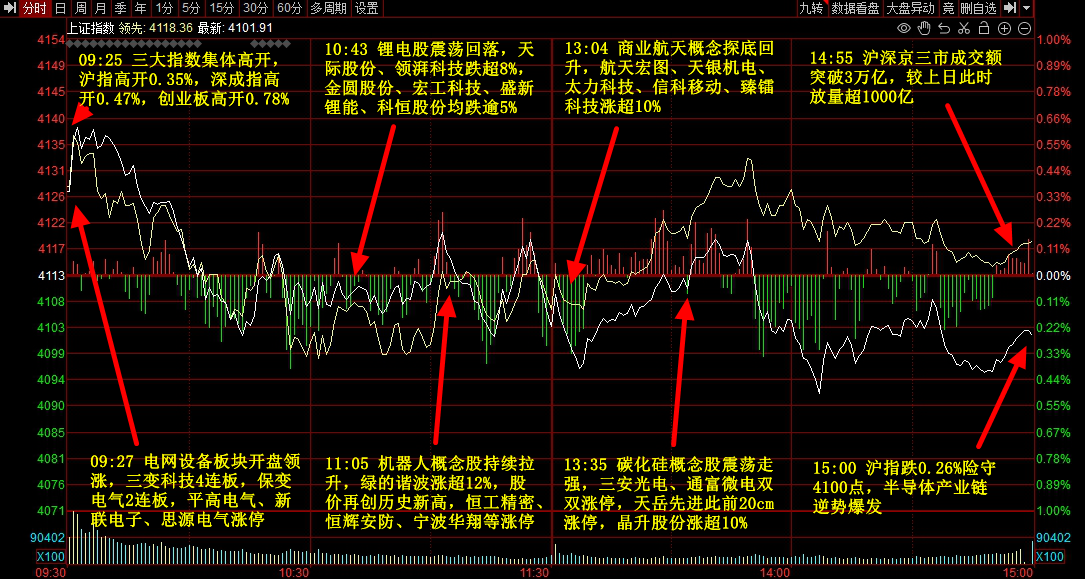
开年以来跨年行情愈演愈烈,资金踊跃进场,商业航天、AI应用等板块持续暴涨引发局部交易过热, 本周主动降温后热点出现调整,部分投资者担忧这会不会逆转跨年行情的格局。整体来看,本次主动降 温不影响跨年行情的整体格局,但是此前局部过热的情况可能会得到缓解,资金交易的方向或将出现一 些变化。从行业配置来看,AI算力、有色金属、创新药和汽车有较为明显的景气催化,前期市场热点 商业航天和AI应用可能阶段性调整,可以关注其他主题线索如特高压、脑机接口、可控核聚变等。 国盛证券:市场短期调整或已基本到位 上周五市场高开低走,三大指数集体收跌。沪深两市成交额3.03万亿,较上一个交易日放量1208亿。全 市场超2900只个股下跌。从板块来看,半导体产业链集体走强,长电科技涨停创5年多新高,存储芯片 概念午后持续拉升,佰维存储、江波龙均创历史新高。人形机器人概念走高,电网设备概念表现活跃。 下跌方面,油气、AI应用等板块跌幅居前。截至收盘,沪指跌0.26%,深成指跌0.18%,创业板指跌 0.2%。 在今日券商晨会上,中信建投认为,关注主动降温下跨年行情的变化;国盛证券认为,市场短期调整或 已基本到位;银河证券认为,内外扰动交织 ...
沪指震荡险守4100点,存储芯片逆势走强带动情绪
Sou Hu Cai Jing· 2026-01-19 00:28
Market Overview - The market maintained a trend of fluctuation and consolidation, with major indices showing a decline in sentiment and market heat [1] - The semiconductor industry chain continued to rise, particularly in storage chip concepts, while previously popular AI applications and commercial aerospace experienced a pullback [1] - The A-share market saw a collective drop in the three major indices, with the Shanghai Composite Index closing at 4101.91 points, down 0.26% [1][3] - The trading volume in the Shanghai and Shenzhen markets reached 3.03 trillion yuan, an increase of 120.8 billion yuan from the previous trading day [1] Policy Developments - The State Council, led by Premier Li Qiang, discussed measures to boost consumption and cultivate new growth points in service consumption [3] - The China Securities Regulatory Commission (CSRC) announced an increase in the margin requirement for financing from 80% to 100%, effective January 19, 2026, to shift the market focus from leverage-driven to performance-driven [2][3] - The CSRC emphasized the need to prevent excessive speculation and market manipulation, aiming to maintain a stable market environment [2][3] Sector Performance - The semiconductor sector saw significant gains, with companies like Changdian Technology hitting a five-year high, and storage chip firms like Baiwei Storage and Jiangbolong reaching historical highs [1] - Conversely, sectors such as oil and gas, AI applications, and financial technology faced notable declines, with several AI-related stocks hitting their daily limit down [1] - The market is expected to experience a "structural optimization" with a focus on performance certainty and reasonable valuations, as high-valuation speculative stocks may face outflows [2] Investment Insights - The current market environment suggests a cautious approach, with recommendations to focus on technology growth assets supported by fundamentals, particularly in semiconductors and advanced manufacturing [3] - The recent surge in trading volume for broad-based ETFs indicates active capital movement, with significant outflows from major ETFs like the CSI 300 ETF, which saw a net outflow of 103.75 billion yuan [3]
品牌工程指数 上周涨0.6%
Zhong Guo Zheng Quan Bao· 2026-01-18 21:37
Core Viewpoint - The market experienced fluctuations last week, but the overall trend remains positive with a low probability of systemic risks in 2026, driven by favorable macro policies and industry factors [1][4]. Market Performance - The China National Brand Index rose by 0.60% to 2059.78 points last week, while the Shanghai Composite Index fell by 0.45% and the Shenzhen Component Index increased by 1.14% [2]. - Notable performers included Changdian Technology, which surged by 17.51%, and Huazhong Microelectronics, which rose by 17.36% [2]. Year-to-Date Performance - Year-to-date, Anji Technology has increased by 38.85%, leading the gains, followed by Zhongwei Company at 38.29% and Changdian Technology at over 30% [3]. - Other significant gainers include Huazhong Microelectronics and Keda Xunfei, which rose by 29.02% and 26.67%, respectively [3]. Investment Strategy - Market sentiment has shown considerable volatility, but the impact on liquidity is minimal, primarily affecting short-term emotions [4]. - As annual performance forecasts begin to be disclosed, sectors with strong earnings support are expected to attract more attention from investors [4]. - The investment strategy emphasizes structural selection as key, with expectations of more industries entering a performance realization phase due to domestic policy support [4].



品牌工程指数上周涨0.6%
Zhong Guo Zheng Quan Bao· 2026-01-18 20:45
Group 1 - The core index of the National Brand Engineering Index rose by 0.60% last week, closing at 2059.78 points, with strong performances from stocks like Changdian Technology, China Resources Microelectronics, and Glodon [1][2] - The market experienced fluctuations, with the Shanghai Composite Index down by 0.45%, while the Shenzhen Component Index and the ChiNext Index rose by 1.14% and 1.00% respectively [1] - Year-to-date, stocks such as Anji Technology and Zhongwei Company have shown significant gains, with Anji Technology up by 38.85% and Zhongwei Company up by 38.29% [2] Group 2 - Market sentiment has been volatile, with regulatory policies leading to a decrease in speculative trading, but the actual impact on market liquidity is minimal [2] - Starstone Investment indicates that there are still many opportunities in the market, particularly as domestic policies drive supply-demand balance and price recovery, leading to more industries entering the performance realization phase [3] - Looking ahead to 2026, the overall market is expected to trend upwards due to positive macroeconomic policies and industry factors, although increased volatility and operational challenges are anticipated [3]
晚报 | 1月19日主题前瞻
Xuan Gu Bao· 2026-01-18 14:21
Semiconductor - ASML, the global leader in photolithography machines, saw its stock rise by 2.03% on January 16, reaching a historic high with a market capitalization of $526.3 billion (approximately 3.69 trillion RMB), making it the third European stock to surpass $500 billion in market value [1] - Morgan Stanley's semiconductor team indicated that in the most optimistic scenario, ASML's stock could increase by 70% as chip manufacturers ramp up spending to meet surging AI demand [1] - CITIC Securities believes that domestic equipment manufacturers will experience sustained demand driven by the dual forces of the AI wave and domestic substitution, leading to a golden development period of 5 to 10 years [1] Nuclear Fusion - The 2026 Nuclear Fusion Energy Technology and Industry Conference was held in Hefei on January 16, where 10 major procurement projects and 4 fusion joint laboratory projects were signed [2] - The procurement plan for the 2026 Fusion Industry Federation includes over 120 projects with a total budget of nearly 10 billion RMB, focusing on tasks such as EAST upgrades and CRAFT [2] Charging Infrastructure - The National Energy Administration announced that by 2025, China's total electricity consumption will exceed 10 trillion kilowatt-hours, reaching 10.4 trillion kilowatt-hours, a year-on-year increase of 5% [3] - This figure is more than double the annual electricity consumption of the United States and exceeds the combined annual consumption of the EU, Russia, India, and Japan [3] - The growth in electricity consumption is significantly driven by the tertiary industry and urban residents, contributing 50% to the increase [3] Robotics - The 2026 Spring Festival Gala successfully completed its first rehearsal on January 17, integrating "technology + art" and showcasing intelligent robots, which enhances public recognition of the "Made in China" brand [4] - The presence of robots at the gala is expected to boost industry exposure and public awareness, validating the capabilities of domestic robot technology and accelerating industry upgrades [4] Commercial Aerospace - China’s Securities Regulatory Commission announced that the commercial aerospace company, Zhongke Yuhang, has completed its counseling work and is entering the acceptance phase for its IPO [5] - Zhongke Yuhang, incubated by the Institute of Mechanics of the Chinese Academy of Sciences, focuses on the development of medium and large rockets and has made significant progress with its Lijian series rockets [5] - The IPO progress of commercial aerospace companies is expected to alleviate funding pressures and accelerate the iteration of core technologies [5] Liquid Metal - Recent advancements in liquid metal flexible electronics manufacturing have been reported by the team from the Institute of Physics, providing innovative solutions for high-performance and green applications [6] - The team developed a no-damage etching technology that achieves circuit pattern preparation with a resolution of 5μm, compatible with various substrates [6] - These innovations address key challenges in flexible electronics manufacturing, showcasing potential applications in wearable health monitoring and aerospace intelligent systems [6]
台积电4Q25业绩点评:预计26年销售额增长30%,未来三年的资本支出或显著增加
Xinda Securities· 2026-01-18 12:26
Investment Rating - The industry investment rating is "Positive" [2] Core Insights - TSMC's revenue for Q4 2025 reached NT$1.046 trillion (US$33.73 billion), representing a year-on-year increase of 20.5% and a quarter-on-quarter increase of 5.7% [2][4] - The gross margin for Q4 2025 was 62.3%, up 3.3 percentage points year-on-year and 2.8 percentage points quarter-on-quarter [2][4] - TSMC expects a nearly 30% growth in sales for 2026, driven by strong customer demand, particularly in AI [2][3] - Capital expenditures (CapEx) for Q4 2025 were US$11.51 billion, with a full-year CapEx of US$40.9 billion for 2025, and a planned CapEx of US$52-56 billion for 2026 [2][3] - AI business revenue is projected to account for over 10% of total revenue, with a revised CAGR growth target of 55%-59% for AI revenue from 2024 to 2028 [2][3] - Advanced process technology remains dominant, with 77% of revenue coming from 7nm and below processes in Q4 2025 [2][3] - TSMC's global capacity planning includes multiple factories in Arizona, Japan, and Germany, with significant advancements in 2nm wafer production [3] Summary by Sections Financial Performance - Q4 2025 net income attributable to shareholders was NT$505.74 billion, a 35.0% increase year-on-year [4] - For the full year 2025, TSMC's revenue was US$122.42 billion, a 35.9% increase from 2024 [12] Capital Expenditure and Growth Plans - TSMC plans to significantly increase capital expenditures over the next three years to meet rising demand for AI chips [3] - The company aims to enhance production capacity to address the supply-demand gap in the AI sector [3] Market Demand and Product Segmentation - The revenue from high-performance computing (HPC) applications accounted for 55% of Q4 2025 revenue, with mobile applications contributing 32% [2][3] - TSMC's advanced process technology continues to lead the market, with a notable increase in the share of 3nm technology [2][3]

行业点评报告:先进封装龙头积极抢滩布局,产业进入“扩产+提价”新阶段
KAIYUAN SECURITIES· 2026-01-18 07:43
Investment Rating - The industry investment rating is "Overweight" [1] Core Insights - The semiconductor industry is expected to experience significant growth driven by advancements in AI and high-end packaging technologies. TSMC has raised its capital expenditure guidance for 2026 to between $52 billion and $56 billion, a substantial increase of up to 36.9% from 2025, with a focus on advanced packaging and testing [3][4] - Major companies are actively expanding capacity to meet the rising demand for advanced packaging, with investments in new facilities and technologies across various sectors, including automotive and AI [4] - Price increases in packaging services are anticipated due to strong structural demand and rising raw material costs, with some companies already implementing price hikes of up to 30% [5] Summary by Sections Capital Expenditure and Growth - TSMC's capital expenditure for 2026 is projected to be between $52 billion and $56 billion, with advanced packaging investments expected to contribute over 10% of revenue by 2026 [3] - The revenue contribution from advanced packaging is expected to grow from approximately 8% in 2025 to slightly above 10% in 2026, indicating a higher growth rate than the overall company growth [3] Capacity Expansion - Major players like Changdian Technology and Jinglong Technology are investing heavily in new facilities to enhance their testing capabilities for high-end semiconductors, with investments reaching billions [4] - Companies such as Tongfu Microelectronics and Nexperia are also planning significant investments to boost their packaging capacities, indicating a trend of expansion in response to market demand [4] Price Trends in Packaging - The packaging industry is experiencing price increases driven by high demand for AI and memory chips, with companies like ASE and others in Taiwan raising prices by 5-20% and up to 30% respectively [5] - The increase in raw material costs, including metals like gold and copper, is contributing to the overall rise in packaging costs, which may lead to improved profitability for packaging companies [5] Investment Recommendations - Investors are advised to focus on domestic companies actively engaged in high-end advanced packaging, such as Changdian Technology and Tongfu Microelectronics, as well as those benefiting from the sector's growth like Yongxi Electronics and Huada Technology [6]

先进封装,全速扩产
半导体行业观察· 2026-01-18 03:32
Core Viewpoint - The article discusses the significant investment and strategic shifts in the semiconductor packaging industry, particularly focusing on advanced packaging technologies driven by the AI wave and the structural changes in the storage industry [1][2]. Group 1: Investment and Market Trends - SK Hynix announced a 19 trillion KRW (approximately 12.9 billion USD) investment to build an advanced chip packaging factory in Cheongju, South Korea, reflecting the structural changes in the storage industry due to AI [1]. - The global advanced chip packaging market is projected to grow from 50.38 billion USD in 2025 to 79.85 billion USD by 2032, with a compound annual growth rate (CAGR) of 6.8% [2]. - By early 2026, leading packaging and testing companies are expected to ramp up advanced packaging capacity, indicating a competitive landscape focused on advanced packaging capabilities [2]. Group 2: TSMC's Dominance - TSMC is recognized as the leader in advanced packaging, holding over 60% market share in semiconductor manufacturing and establishing significant competitive barriers in advanced packaging technologies [2][3]. - TSMC has developed three branches of CoWoS technology: CoWoS-S for medium-sized chips, CoWoS-R for greater design flexibility, and CoWoS-L for large AI chips [3]. - TSMC's SoIC technology, based on CoWoS and wafer-on-wafer stacking, offers higher interconnect density and improved performance compared to traditional 2.5D packaging [3]. Group 3: Capacity Expansion and Technological Advancements - TSMC's CoWoS capacity is projected to increase 6-8 times from 2023 to 2026, with a CAGR exceeding 60% [5]. - TSMC's new advanced packaging facilities, including the flagship AP6 plant in Zhunan, are designed for full automation and are expected to handle significant orders from major clients like NVIDIA and AMD [5][6]. - TSMC is also expanding its advanced packaging capabilities in the U.S. with plans for two new facilities in Arizona, focusing on SoIC and CoPoS technologies [6]. Group 4: Competitors' Strategies - ASE, as the largest packaging and testing foundry, is benefiting from the advanced packaging trend, with over 60% of its ATM business expected to come from advanced packaging by 2025 [9]. - ASE is developing its own 2.5D packaging platform, FOCoS, and is expanding its production capacity across multiple sites, including a new K28 plant aimed at meeting the demand for AI and GPU chips [10][11]. - Amkor is enhancing its market position through partnerships, such as its collaboration with Intel on EMIB technology, and expanding its facilities in the U.S. to meet advanced packaging demands [15][16]. Group 5: Mainland China's Participation - Mainland Chinese companies are actively investing in advanced packaging technologies and capacity, with firms like Yongxi Electronics and Changjiang Electronics focusing on high-density packaging and automotive electronics [20][22]. - Yongxi Electronics is establishing a new production base in Malaysia to enhance its overseas strategy, while Changjiang Electronics is expanding its automotive electronics packaging capabilities [21][22]. - Tongfu Microelectronics is also increasing its advanced packaging capacity, particularly in automotive and high-performance computing sectors, to meet growing market demands [23][24]. Group 6: Future Outlook - The article concludes that while TSMC's dominance in advanced packaging is unlikely to be challenged in the short term, other specialized packaging firms are seeking to differentiate themselves through flexible capacity and innovative technologies [25][27]. - The collective expansion of packaging firms represents a significant industry bet on the demand for AI-driven computing power, with the potential for winners to emerge as the market stabilizes and technology paths clarify [27].