今世缘

Search documents
A股白酒股快速拉升,水井坊涨停
Ge Long Hui A P P· 2025-12-25 05:43
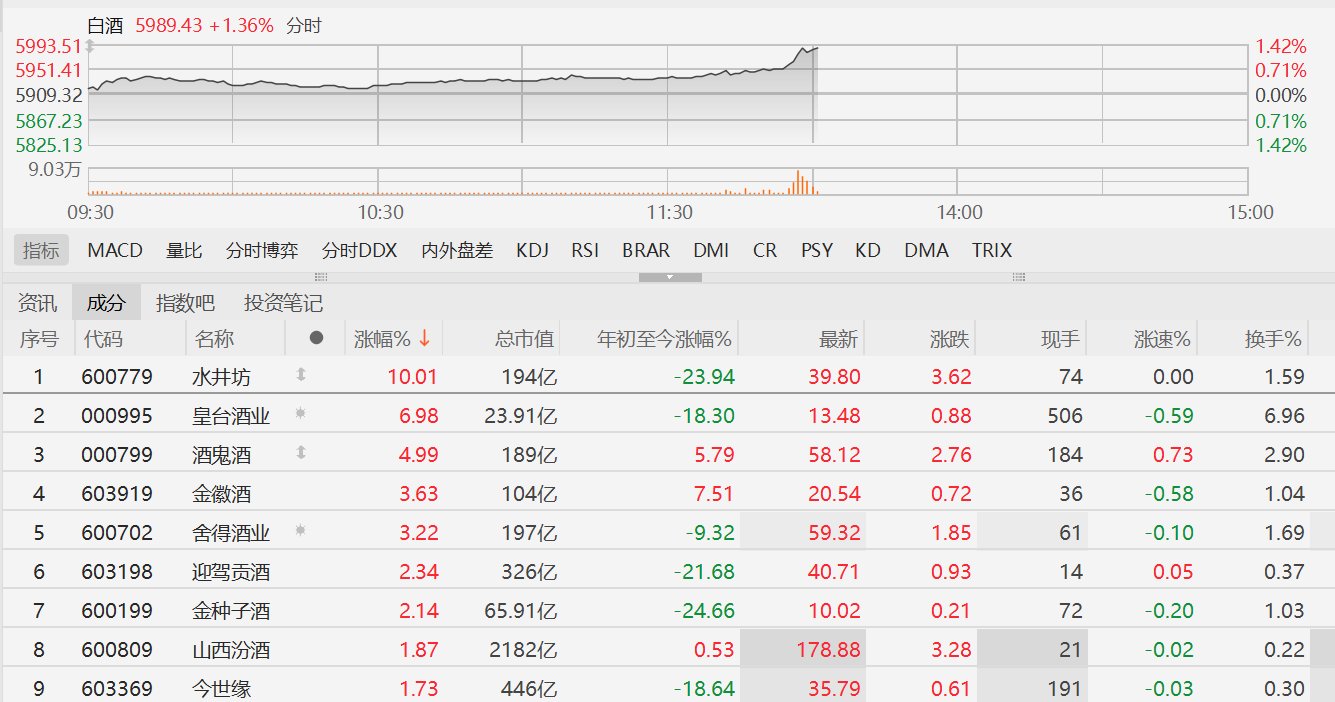
Group 1 - The A-share market saw a rapid increase in liquor stocks, with Shui Jing Fang hitting the daily limit, Huangtai Liquor rising over 6%, and Jiu Gui Jiu increasing nearly 5% [1] - Other notable performers included Jin Hui Jiu and She De Jiu Ye, both rising over 3% [1] Group 2 - The liquor index showed a gain of 1.36%, reaching 5989.43 points [2] - Shui Jing Fang had a significant increase of 10.01%, with a total market value of 194 billion [2] - Huangtai Liquor rose by 6.98%, with a market value of 23.91 billion [2] - Jiu Gui Jiu increased by 4.99%, with a market value of 189 million [2] - Jin Hui Jiu and She De Jiu Ye saw increases of 3.63% and 3.22%, respectively, with market values of 104 billion and 197 billion [2]


消费:年末复盘及2026Q1展望
2025-12-24 12:57
消费:年末复盘及 2026Q1 展望 20151223 摘要 白酒板块预计 2026 年 Q1 收入和利润双位数下滑,但降幅或收窄,头 部企业汾酒、五粮液可能调整,酒企对全年持保守态度,重在稳定市场 和份额,预计 Q1 仍处于下修状态。 大中型零食和饮料企业受益于品类和渠道红利,对未来展望积极,叠加 春节效应,预期增长高于行业平均水平;啤酒企业淡季保守,奶制品企 业结构性收缩,液态奶下滑明显。 品牌服饰受气温和需求影响,终端流水走弱,运动品牌加盟渠道 12 月 流水下降,但海澜之家、森马等大众品牌保持增长。春节较晚利于去库 存,但对 Q4 财报有负面影响,多数龙头品牌对 26 年度计划谨慎。 出口制造受耐克财报影响,大中华区销售额下降,运动品牌订单调减。 中期看好全球化布局、垂直一体化及新产能新客户开拓标的,如申洲国 际、华利实业等。 黄金珠宝受金价高涨压制终端销售,推动商业模式向品牌化转型,如潮 宏基、周大福等逆势增长。春节较晚使订货会滞后,Q1 订货量同比有 利,Q4 压力大。高金价背景下,板块调整延续,关注传动机,适度关 注周大福与老铺。 Q&A 2025 年第四季度食品饮料行业的表现如何?对 2026 ...
扩大内需战略解读与推荐
2025-12-22 01:45
Summary of Key Points from Conference Call Records Industry Overview - The focus is on the **expansion of domestic demand** as a long-term structural reform strategy to address challenges such as declining demographic dividends and globalization pressures. The shift is from supply-driven to demand-driven, emphasizing the need to supplement both upstream R&D and downstream consumption [1][2][3]. Core Insights and Arguments - **Increase in Resident Income**: A critical factor for expanding domestic demand. Policies like trade-in subsidies may have a short-term effect but can lead to over-reliance on such measures. The emphasis should be on increasing wage and asset income through fiscal reforms to achieve broad-based benefits [1][6]. - **Consumer Trends**: By 2026, service consumption, high-end consumption, and emerging self-reward consumption are expected to perform well. Policies may favor sectors like tourism and dining, while a declining real estate market could enhance purchasing power for younger consumers [1][9]. - **Investment Focus**: Effective investments are anticipated in water conservancy, energy, municipal infrastructure, and core technology sectors such as AI, biomedicine, and quantum communication. The green transition is expected to unlock consumption potential in areas like eco-tourism and energy-efficient appliances [1][11]. Industry-Specific Insights Home Appliance Sector - The home appliance industry is projected to experience a downturn in the second half of 2025 due to trade-in policies, but a recovery is expected in early 2026 as subsidies are renewed, leading to a replenishment cycle [1][12][13]. - **Sales Data**: By November 2025, air conditioner sales grew by approximately 2%, while refrigerator sales declined by about 1%. The overall industry saw a decline in the latter half of the year, particularly in Q4, where air conditioner sales dropped over 20% [12][13]. Fiscal Policy and Consumer Behavior - The fiscal reform is expected to shift focus from incremental taxation to more comprehensive measures, such as property and capital gains taxes, which will gradually influence overall household income and consumption [7][8]. - The effectiveness of subsidies is questioned, as they may lead to a crowding-out effect on autonomous consumption. For instance, a 300 billion yuan subsidy led to a 2.7 trillion yuan increase in retail sales, but the non-subsidy portion contributed negatively [6]. Investment Recommendations - **Home Appliances**: Companies like Midea, Haier, TCL, and Hisense are recommended for their strong domestic and international performance. The expectation is that these companies will benefit from the renewed subsidy policies in 2026 [15]. - **New Consumption Trends**: Focus on emerging brands in personal care and health products, as well as established brands with significant market barriers, such as Mao Geping and Shanghai Jahwa [18]. - **Health and Wellness Sector**: Companies like Xianle Health and Ximai Foods are highlighted for their growth potential in the health and wellness market, driven by the aging population and increasing health awareness [19][21]. Additional Insights - **Transportation Sector**: The aviation industry is expected to benefit directly from increased demand, while the shipping industry will see indirect benefits from heightened domestic trade activities [28]. - **Agricultural Sector**: Recommendations include focusing on the pet industry and functional ingredients, with companies like Zhongchong and Bailong Chuangyuan showing strong growth potential [31]. Conclusion - The overall sentiment is optimistic regarding the expansion of domestic demand, with significant investment opportunities across various sectors, particularly in health, home appliances, and new consumption trends. The emphasis on increasing resident income and effective fiscal reforms will be crucial in driving this growth [26][27].
“失意”2025:白酒行业“深水区”探底,亟待价值重塑
Zhong Guo Ji Jin Bao· 2025-12-21 13:20
Core Insights - The Chinese liquor industry is undergoing significant adjustments, facing challenges from macroeconomic policies and reduced consumer demand, leading to a decline in prices and market confidence [3][4][7] - Major liquor companies are shifting from passive responses to proactive strategies, focusing on price stabilization and product innovation to navigate the current downturn [3][6][14] Price Dynamics - The wholesale price index for liquor dropped by 9.9% year-on-year in the first half of 2025, with premium liquor prices falling by 14.96% [4] - High-end liquor, such as Moutai, has seen its wholesale price fall below the retail guidance price, with a 35% decrease since the beginning of the year [5] - Major companies like Wuliangye and Moutai are implementing strict price controls and discount strategies to support their distribution channels and stabilize the market [6][8] Performance Metrics - In the first three quarters of 2025, the total revenue of 20 listed liquor companies in A-shares was 320.23 billion yuan, a decline of 5.83% year-on-year, with net profits down by 6.76% [7] - The third quarter saw a more severe decline, with total revenue dropping by 18.42% and net profits by 22.03% [7] Market Concentration - The market is experiencing a "Matthew Effect," with the top six liquor companies capturing 84% of the market share, indicating increasing concentration [7][8] - Smaller liquor companies are facing severe challenges, with several experiencing financial distress and "exploding" due to unsustainable business models [8] Management Changes - The liquor industry has seen numerous executive changes in 2025, with key figures resigning amid poor performance, reflecting the pressure for companies to adapt to new market conditions [9][10][12] - Notable departures include the chairman of Yanghe and the general manager of Jinzhongzi, both of whom failed to improve their companies' competitive positions [10][11] Transformation and Innovation - Brands focusing on "low-alcohol and health" products, such as Jin Liquor, have reported growth, highlighting a shift in consumer preferences towards healthier options [13][14] - Traditional liquor companies are accelerating their transformation efforts, introducing lower-alcohol products and engaging in innovative marketing strategies to attract younger consumers [14][15]

“这是一场文化与缘分的双向奔赴”,“今世有缘,相伴扬子”书画雅集以缘聚力以文化人
Yang Zi Wan Bao Wang· 2025-12-21 00:07
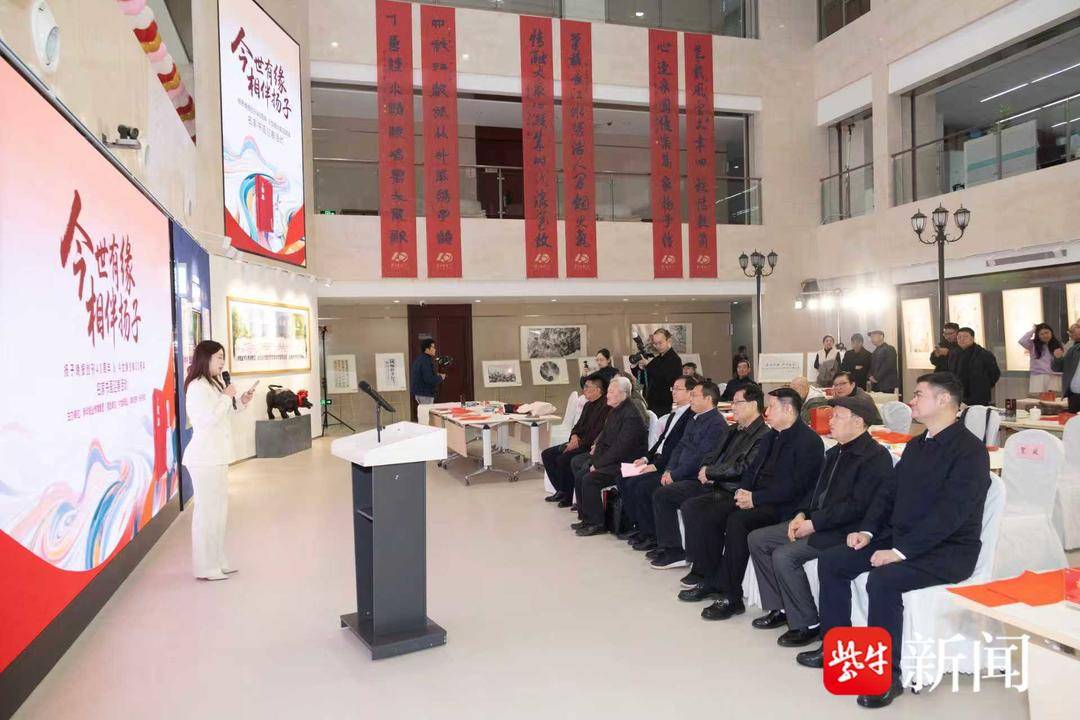
Core Viewpoint - The event celebrating the 40th anniversary of Yangzi Evening News and the 30th anniversary of Jinshiyuan highlights the strong cultural connection between Jinshiyuan and Yangzi Evening News, emphasizing the importance of cultural integration in brand development and consumer engagement [3][4][7]. Company Performance - Jinshiyuan's revenue has grown from 5 billion yuan at the end of the 13th Five-Year Plan to over 10 billion yuan in 2023, ranking it seventh among publicly listed Chinese liquor companies [3]. - The company has contributed nearly 13 billion yuan in taxes to the state over the past four years [3]. Cultural Integration - Jinshiyuan has established a cultural system centered around the concept of "fate," which serves as a bridge between liquor culture and calligraphy and painting art [4]. - The integration of liquor and art is seen as a way to enhance brand communication, allowing consumers to experience the cultural and emotional values behind the brand [4]. Quality Control - Jinshiyuan emphasizes a "zero defect, more perfect" quality pursuit, which is not just a slogan but a belief that permeates the entire production chain [6]. - The company implements strict quality control measures from raw materials to production, utilizing smart technology for consistent quality and involving all employees in quality assurance [6]. Market Strategy - Jinshiyuan is expanding its reach to younger markets and diversifying its product offerings while integrating cultural elements into its business model [7]. - The company aims to transform from merely selling liquor to offering a lifestyle, positioning culture as the soul of consumption [7].

白酒板块12月19日跌0.66%,*ST岩石领跌,主力资金净流出5.64亿元
Zheng Xing Xing Ye Ri Bao· 2025-12-19 09:03
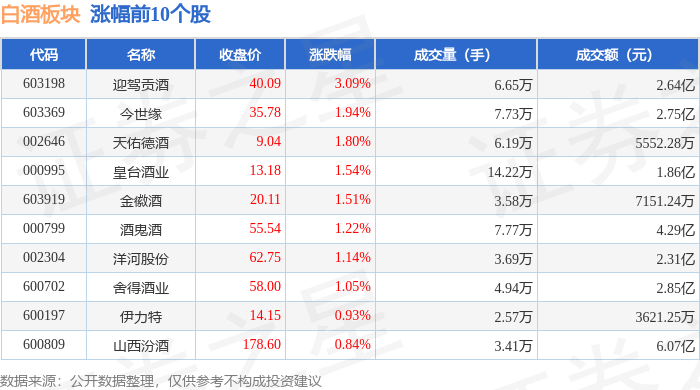
Group 1 - The liquor sector experienced a decline of 0.66% on December 19, with *ST Rock leading the drop [1] - The Shanghai Composite Index closed at 3890.45, up 0.36%, while the Shenzhen Component Index closed at 13140.22, up 0.66% [1] - Key stocks in the liquor sector showed varied performance, with Yingjia Gongjiu rising by 3.09% to a closing price of 40.09, and *ST Rock falling by 4.91% to 3.29 [2] Group 2 - The liquor sector saw a net outflow of 564 million yuan from institutional investors, while retail investors contributed a net inflow of 264 million yuan [2] - Major stocks like Wuliangye and Moutai had minimal price changes, with Wuliangye at 110.53 (up 0.09%) and Moutai at 1410.00 (up 0.21%) [2] - The liquidity dynamics showed that retail investors were more active, with significant inflows into stocks like Yingjia Gongjiu and Yanghe Co., despite overall institutional outflows [3]


食品饮料2026年度策略报告:食品饮料2026:大年起点,持旧迎新-20251219
Orient Securities· 2025-12-19 02:46
食品饮料行业 策略报告 看好(维持) 食品饮料2026:大年起点,持旧迎新 ——食品饮料2026年度策略报告 日期:2025年12月19日 姓 名 李耀 邮 箱 liyao@orientsec.com.cn 电 话 021-63325888 执业证书编号 S0860525100001 东方证券股份有限公司 食品饮料2026:大年起点,持"旧"迎"新" • 食品饮料2026:大年起点易涨难跌,核心矛盾在于业绩。我们认为,食品饮料2021-2024年主要在于通过业绩释放来去化估值泡沫,站 在2025年末,板块估值回到历史区间底部,但消费力低迷等因素导致板块处于业绩下修区间,板块核心矛盾回归分子端,也即是业绩。 • 分子端:从结构红利到总量修复,持"旧"迎"新"。我们认为,伴随经济结构转型及居民资产负债表修复,2026年有望成为需求侧的拐 点,在一定时间内,消费的"需求侧L型"与消费的"结构性"特征或将共存,新消费业绩景气延续,旧消费业绩出清;伴随时间展开,消 费有望呈现总量修复与结构性繁荣共存局面,传统消费与新消费均有望实现业绩上修,其中传统消费有望释放业绩弹性。 • 持"旧":需求探底、经营改善,传统消费将迎来 ...
11月CPI继续回升,食品饮料板块转正
Sou Hu Cai Jing· 2025-12-19 02:38
行业目前仍处于深度调整期,龙头公司纷纷采取措施稳价格、稳渠道,有利于加速行业筑底出清。中短 期来看,2025Q4—2026Q1受2026年春节较晚,酒企报表端、渠道端继续出清等影响,预计2026Q2龙头 公司将在低基数下迎来触底回升。经过前期调整,目前白酒板块估值处于近10年来10%左右分位数水 平;龙头公司注重股东回报,加大分红,板块中长期投资价值逐步显现。建议关注贵州茅台、五粮液、 泸州老窖、山西汾酒、今世缘、古井贡酒等。 大众品方面,10月CPI同比转正,11月CPI食品项转正;社零受益国庆中秋双节影响,餐饮、文旅等服 务消费表现较为亮眼。乳制品、调味品、啤酒等传统板块龙头表现平稳,行业需求端虽有压力,但成本 端仍保持低位;零食、软饮料等新消费板块依然保持较快增速,景气持续。未来,随着扩内需政策的逐 步落地,若CPI延续10月、11月趋势逐步上行,物价走出通缩,传统消费龙头有望迎来触底回升。建议 关注海天味业、伊利股份、青岛啤酒、东鹏饮料、安琪酵母、妙可蓝多等。 (以上内容仅供参考,不作为投资决策依据。投资有风险,入市需谨慎。) 晨报讯(南京晨报/爱南京记者 许崇静)近期,中央经济工作会议明确将"坚持内 ...



五粮液表态不会为短期增速而恶性竞争:确保经销商合理经营回报,直面电商百亿补贴
Cai Jing Wang· 2025-12-18 14:05
Core Viewpoint - The recent conference by Wuliangye has provided reassurance to the liquor industry amidst fluctuating pricing and sales strategies, emphasizing a commitment to long-term stability over short-term gains [1][7]. Group 1: Company Strategy and Reforms - Wuliangye has implemented unprecedented reforms linking executive compensation to market performance, establishing mechanisms for performance-based adjustments and dismissals for underperformance [1][8]. - The company is focusing on maintaining reasonable returns for distributors and avoiding destructive competition for short-term growth [1][7]. - Wuliangye is enhancing its marketing mechanisms and has shifted from a divisional to a company structure, with direct oversight from senior management [8][10]. Group 2: Industry Challenges and Responses - The liquor industry is currently facing four major issues: overcapacity, high inventory, price inversion, and lack of consumption scenarios [3][4]. - The industry is showing signs of recovery, with improved capacity optimization and a reduction in high inventory levels as premium brands adjust their market strategies [3][4]. - The Ministry of Industry and Information Technology has recognized the liquor industry as a historical classic industry, aiming to enhance its influence and promote high-quality development [4]. Group 3: Market Dynamics and Future Outlook - Wuliangye aims to balance volume and price, with specific targets for its products in the premium segment, including the eighth generation of Wuliangye and Wuliangye 1618 [9][10]. - The company is actively engaging with e-commerce platforms and has initiated a significant subsidy program to stabilize its supply chain and enhance market presence [10][11]. - The overall strategy emphasizes rational growth, with a focus on maintaining market order and preventing price disruptions [7][12].

新任董事长顾宇,能拯救掉队的洋河吗?
Sou Hu Cai Jing· 2025-12-18 01:13
Core Viewpoint - Yanghe Co., Ltd. has been facing significant challenges in the white liquor market, with declining sales and profits, despite continuing to invest heavily in advertising partnerships, such as being the exclusive timekeeping partner for the 2026 Spring Festival Gala for the seventh consecutive year [2][4]. Group 1: Financial Performance - In Q3 2024, Yanghe reported revenue of 3.295 billion yuan, a year-on-year decline of 29.01%, and a net loss of 373 million yuan, marking a significant downturn compared to leading competitors like Kweichow Moutai and Wuliangye [5][6]. - The company's sales volume in 2024 was 139,076.05 tons, down 16.3% from 2023, while production decreased by 8.4% to 145,494.73 tons [8]. - In the first half of 2025, Yanghe's sales volume fell to 78,192.32 tons, a decrease of 32.35%, and production dropped to 48,891.12 tons, down 51.63% [10]. Group 2: Market Position and Competition - Yanghe has dropped out of the top three in the white liquor industry, currently ranking fifth, facing increasing competition from regional brands like Jinshiyuan and Gujinggongjiu [5][6]. - In Jiangsu Province, Yanghe's revenue fell by 11.43% to 12.748 billion yuan, while Jinshiyuan experienced a 16% growth to 10.551 billion yuan, narrowing the revenue gap significantly [12][14]. - The number of Yanghe's distributors decreased by 257 to 8,609, indicating weakened market presence and a potential impact on future sales [15]. Group 3: Strategic Challenges - Yanghe's high-end brand, Dream Blue, struggles to establish itself in the market compared to established products from competitors like Moutai and Wuliangye, limiting its appeal as a collectible item [19]. - The company has faced challenges in brand positioning and channel management, leading to a decline in distributor enthusiasm and market share [16][18]. - The new leadership under Gu Yu lacks experience in corporate management and the liquor industry, raising concerns about the effectiveness of future strategies [17]. Group 4: Future Outlook - Yanghe may need to focus on maintaining its mid-range product line while exploring new consumer segments, particularly younger demographics, to adapt to changing market dynamics [21]. - The company has seen a slight increase in average price per ton, indicating potential for maintaining profit margins despite declining sales volume [21].