凯莱英

Search documents
创新药企业绩普遍增长 上游CXO行业调整基本完成(附概念股)
Zhi Tong Cai Jing· 2025-11-24 05:49
Core Insights - The CXO sector in A-shares has shown resilience, with 20 out of 29 listed companies reporting year-on-year revenue growth in the first three quarters [1] - The growth in the CXO sector is driven by internationalization and increased demand for innovative drugs, benefiting companies in the upstream of the innovative drug industry chain [1] - The innovative drug sector is experiencing a dual boost from policy support and surging demand, which is stimulating new drug research and development [1] Summary by Categories Industry Trends - Three major trends are emerging in the innovative drug field: 1. Deepening internationalization with an expected 103 license-out transactions and upfront payments reaching $8.45 billion by 2025, leading to valuation premiums for companies going abroad [2] 2. Unprecedented policy support, including improved efficiency in medical insurance negotiations and the establishment of a directory for innovative drugs under commercial insurance for the first time [2] 3. Continuous technological breakthroughs in areas such as ADC, IO dual antibodies, GLP-1 weight loss drugs, and small nucleic acid drugs [2] Market Outlook - The CXO industry adjustment is largely complete, with stable overseas demand and a rebound in domestic investment and financing [2] - There is significant recovery in the upstream industry chain, with ample room for increasing domestic production rates, driven by smart, digital production and international expansion [2] Key Companies - Leading companies in the CXO sector include: - Kelaiying (002821) (06821) - Kanglong Chemical (300759) (03759) - Zhaoyan New Drug (603127) (06127) - WuXi Biologics (02269) - WuXi AppTec (603259) (02359) [3]
拆解小核酸价值链条
2025-11-24 01:46
Summary of Key Points from the Conference Call Industry Overview - The conference call focuses on the small nucleic acid drug industry, specifically the production and cost structure of active pharmaceutical ingredients (APIs) and formulations [1][2][3]. Cost Structure and Value Distribution - The cost structure of small nucleic acid drugs shows that the API accounts for 13%-14% of the terminal sales cost, while the formulation part constitutes 20% [1][2]. - The primary costs arise from the commercial GMP (Good Manufacturing Practice) system rather than just raw materials [2]. - The production of small nucleic acid drugs involves key intermediates and raw materials, including carriers (e.g., L96, CCTP), monomers (e.g., phosphoramidite), and solvent reagents [1][4]. Key Components and Their Cost Impact - Monomer costs represent 30%-40% of total production costs, while solvent reagents account for approximately 30% [1][5]. - The delivery system, such as GalNAc, contributes about 6% to the total production cost [6]. - The market price for L96 ranges from 400,000 to 500,000 yuan per kilogram, with leading manufacturers like Zhaowei charging up to 700,000 yuan per kilogram [7]. Production Requirements and Challenges - Producing 1 gram of siRNA API requires 30-40 grams of monomer and about 100 liters of acetonitrile, while producing 1 gram of ASO requires about 20 grams of monomer [8][10]. - Different modifications affect the synthesis yield, necessitating a re-evaluation of processes [11]. - Key raw materials such as core monomers, carriers, coupling reagents, and critical solvents cannot be easily changed without thorough justification and regulatory approval [12]. Production Technology and Market Dynamics - The mainstream production technology for small nucleic acid APIs is solid-phase synthesis, which is well-established [13]. - Domestic CDMO (Contract Development and Manufacturing Organization) companies include Hequn Pharmaceutical and Kailaiying, while global leaders include Alice Belgium, Agent Biotech, and Sermon XT [15][16]. - The tension in China-U.S. relations presents structural opportunities for China's CDMO industry, which could become the second-largest supplier globally due to its cost advantages and scale of production [18]. Clinical Stage Cost Variations - There are significant cost differences between early-stage and late-stage clinical trials, with late-stage trials incurring higher costs due to stricter impurity control and product consistency requirements [14]. Conclusion - The small nucleic acid drug industry is characterized by a complex cost structure influenced by various factors, including the type of product, production technology, and regulatory requirements. The industry is poised for growth, particularly in the context of evolving global supply chains and increasing demand for high-quality CDMO services.
多款口服环肽药物具重磅潜力,产业链有望充分受益
2025-11-24 01:46
Summary of Key Points from Conference Call Records Industry Overview - The pharmaceutical industry is generally optimistic, with signs of a rebound in the innovative drug sector. Large-cap companies have seen declines of over 30%, while small-cap companies have dropped more than 50%, indicating a potential opportunity for stock alpha in the coming year [1][2][4]. Key Companies to Watch - **Innovative Drug Sector**: Focus on companies like Innovent Biologics and China National Pharmaceutical Group, as well as smaller firms like Genscript Biotech and Luyin Pharmaceutical [1][4]. - **Medical Devices**: Companies such as Mindray and Spring Medical are highlighted for their recovery and growth potential in high-value consumables and medical equipment [5][6]. - **Traditional Chinese Medicine**: Increased institutional interest, with companies like Yiling Pharmaceutical and China Resources Sanjiu expected to benefit from a recovery in the sector [1][7][9]. - **CRO and API Sectors**: Kanglong Chemical and ProPharma are noted for their growth potential, particularly in clinical research and API business recovery [1][10][11]. Market Trends and Opportunities - **High-Value Consumables**: The pressure from centralized procurement is easing, leading to a reassessment of value driven by innovation [5][6]. - **Blood Products**: The sector is in an adjustment phase but shows signs of reversal, with supply tightening expected in 2026 [3][12][15][16]. - **Oral Peptide Drugs**: New oral formulations like Merck's MK0,616 and Johnson & Johnson's GNG2,113 show promise in treating chronic diseases, with potential to change administration methods and improve patient compliance [3][17][20][27]. Financial Performance and Projections - **Kanglong Chemical**: Expected adjusted net profit of 2.12 billion yuan by 2026, with a price-to-earnings ratio of 25 times [11]. - **ProPharma**: Anticipated to see a compound annual growth rate exceeding 20% by 2027, with a current P/E ratio of about 14 times [11]. - **Tianyu Co.**: Projected profit of 300 million yuan for the year, with a growth rate of over 30% expected [14]. Challenges and Considerations - **Regulatory and Market Dynamics**: The medical device sector faces pressures from policy changes and international competition, necessitating innovation and adaptation [5][6]. - **Blood Product Supply**: The industry is experiencing a supply-demand imbalance, with potential for improvement as new products are introduced [12][15][16]. - **Oral Peptide Development**: Challenges in molecular modification and large-scale production remain significant hurdles for the commercialization of new oral peptide drugs [27]. Conclusion - The pharmaceutical and medical device industries are poised for growth, with several companies showing strong potential for recovery and innovation. Investors are encouraged to focus on key players within these sectors, particularly those involved in innovative drug development and high-value medical devices, as they navigate the evolving market landscape [1][4][5][11][14].
港股概念追踪|创新药企业绩普遍增长 上游CXO行业调整基本完成(附概念股)
智通财经网· 2025-11-24 00:24
Core Viewpoint - The CXO sector in the A-share market is experiencing significant growth, with 20 out of 29 listed companies reporting year-on-year revenue increases in the first three quarters, driven by internationalization and policy support for innovative drug companies [1][2]. Group 1: Industry Trends - Three major trends are emerging in the innovative drug sector: 1. Deepening internationalization 2.0, with an expected 103 license-out transactions and a record upfront payment of $8.45 billion by 2025, leading to valuation premiums for companies going abroad [2]. 2. Unprecedented policy support, including improved efficiency in medical insurance negotiations and the establishment of a commercial insurance directory for innovative drugs [2]. 3. Continuous technological breakthroughs, with advancements in ADC, IO dual antibodies, GLP-1 weight loss drugs, and small nucleic acid drugs [2]. Group 2: Market Outlook - The CXO industry adjustment is largely complete, with stable overseas demand and a rebound in domestic investment and financing, particularly for CDMO companies with strong international capabilities and leading clinical CROs [2]. - The recovery of the upstream industry chain is significant, with ample room for increasing domestic production rates, driven by smart and digital production alongside international expansion [2]. - The capital market's recovery in financing activities and the expansion of innovative drug transactions abroad, combined with a potential recovery in domestic innovative drug R&D demand, are expected to boost CXO companies' performance in the second half of the year [1]. Group 3: Key Companies - Leading companies in the CXO sector include: - Kelaiying (06821) - Kanglong Chemical (03759) - Zhaoyan New Drug (06127) - WuXi Biologics (02269) - WuXi AppTec (02359) [3].

华创医药周观点:多款口服环肽药物具重磅潜力,产业链有望充分受益 2025/11/22
华创医药组公众平台· 2025-11-22 14:58
Core Viewpoint - Multiple oral cyclic peptide drugs have significant potential, and the industry chain is expected to benefit fully from this development [11][18]. Market Review - The CITIC pharmaceutical index decreased by 6.76%, underperforming the CSI 300 index by 2.99 percentage points, ranking 25th among 30 primary industries [7]. - The top ten stocks by increase this week include Hainan Haiyao, *ST Changyao, and *ST Suwu, while the top ten stocks by decrease include Jindike and Haichen Pharmaceutical [7][8]. Overall Viewpoint and Investment Themes - **Innovative Drugs**: The domestic innovative drug industry is transitioning from quantity logic to quality logic, emphasizing products that can ultimately generate profits. By 2025, more attention should be paid to differentiated domestic products and international pipelines [9]. - **Medical Devices**: The bidding volume for imaging equipment has significantly rebounded this year, and home medical device markets are benefiting from subsidy policies. The orthopedic sector is expected to see good growth post-collection [9]. - **Innovation Chain (CXO + Life Science Services)**: Overseas investment and financing are expected to continue recovering, while domestic financing is likely to stabilize. The innovation chain wave is anticipated to begin a bottom reversal [9]. - **Pharmaceutical Industry**: The specialty raw material drug sector is expected to see cost improvements, leading to a new growth cycle. Attention should be paid to new volumes from patent expirations and the gradual realization of formulation expansions [10]. Focus on Oral Cyclic Peptide Drugs - **Oral PCSK9 Inhibitors**: These drugs are expected to reshape the lipid-lowering treatment landscape. Current injectable PCSK9 inhibitors have poor patient adherence, and oral formulations could capture market share due to their convenience [11][19]. - **Clinical Data**: Recent clinical data for several oral cyclic peptide candidates in autoimmune and metabolic diseases have shown positive results, indicating a promising future for these therapies [13][19]. Focus on Oral IL-23 Antagonists - **JNJ-2113**: This oral peptide antagonist has shown positive Phase III data and has been submitted for FDA approval. It demonstrates significant efficacy in treating psoriasis, with high response rates compared to existing therapies [28][34]. - **Market Potential**: The annual peak sales for JNJ-2113 across all indications (psoriasis, psoriatic arthritis, ulcerative colitis, Crohn's disease) are expected to exceed $5 billion [41]. Industry Chain Benefits - Companies involved in the research and production of cyclic peptides are expected to benefit significantly. Notable domestic CXO companies include WuXi AppTec, Kanglong Chemical, and Kelaiying, with projected growth in net profits and market capitalization [42].

医疗服务板块11月21日跌2.71%,百花医药领跌,主力资金净流出13.25亿元
Zheng Xing Xing Ye Ri Bao· 2025-11-21 09:33
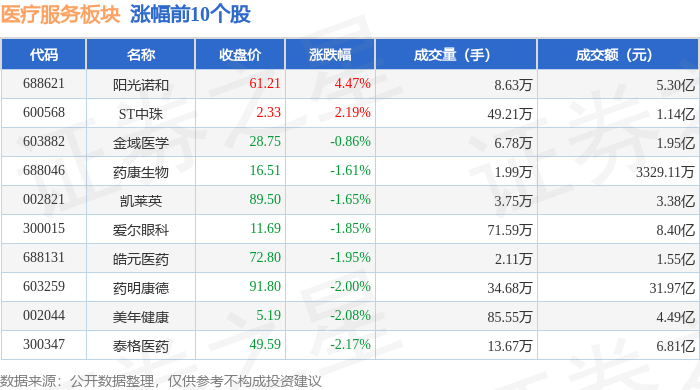
Market Overview - The medical services sector experienced a decline of 2.71% on November 21, with Baihua Pharmaceutical leading the drop [1] - The Shanghai Composite Index closed at 3834.89, down 2.45%, while the Shenzhen Component Index closed at 12538.07, down 3.41% [1] Stock Performance - Notable gainers included Yangguang Nuohua, which rose by 4.47% to a closing price of 61.21, with a trading volume of 86,300 shares and a transaction value of 530 million [1] - Baihua Pharmaceutical saw a significant decline of 9.67%, closing at 9.06, with a trading volume of 292,400 shares and a transaction value of 275 million [2] - Other notable decliners included Chengda Pharmaceutical (-9.58%), Berry Genomics (-8.67%), and Guangzheng Eye Hospital (-7.26%) [2] Capital Flow - The medical services sector experienced a net outflow of 1.325 billion in institutional funds, while retail investors saw a net inflow of 1.332 billion [2] - The table of capital flow indicates that major stocks like Yangguang Nuohua had a net inflow of 10.986 million from institutional investors, while retail investors had a net inflow of 1.374 million [3]


太辰光目标价涨幅63.7% 中金公司获2家推荐|券商评级观察
2 1 Shi Ji Jing Ji Bao Dao· 2025-11-21 00:32
Group 1: Target Price Increases - On November 20, the target price increases for listed companies were led by Taicheng Technology, Zhongjin Company, and China Railway Construction, with target price increases of 63.73%, 61.08%, and 53.57% respectively, belonging to the communication equipment, securities, and infrastructure sectors [1][2]. - The target prices for Taicheng Technology, Zhongjin Company, and China Railway Construction are set at 149.21 yuan, 56.20 yuan, and 12.04 yuan respectively [2]. Group 2: Broker Recommendations - A total of 37 listed companies received broker recommendations on November 20, with Zhongjin Company receiving 2 recommendations [3]. - Zhongjin Company had a closing price of 34.89 yuan and was recommended by 2 brokerage firms in the securities industry [3]. Group 3: First Coverage - On November 20, two companies received initial coverage from brokers, with Hengyin Technology rated "Buy" by Dongwu Securities and Hanhai Group rated "Buy" by Huafu Securities [4][5]. - Hengyin Technology operates in the computer equipment sector, while Hanhai Group is in the home goods sector [5].

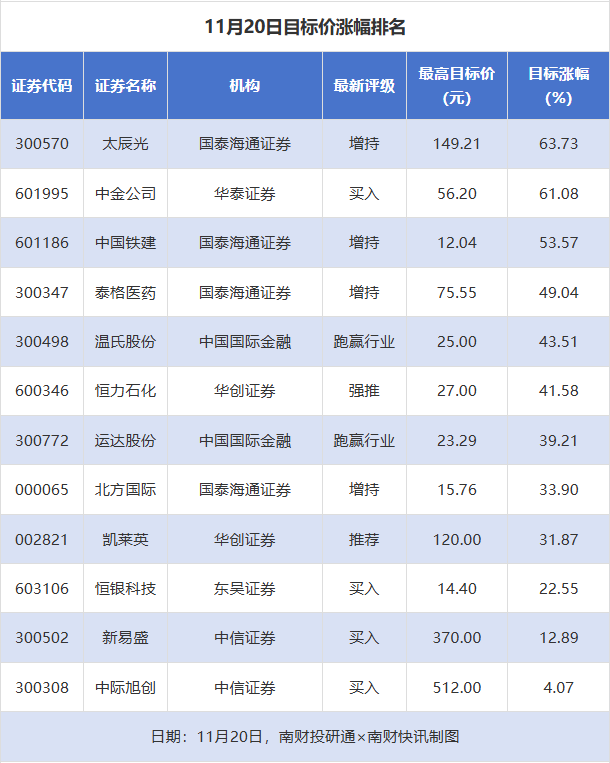
太辰光目标价涨幅63.7%;中金公司获2家推荐
2 1 Shi Ji Jing Ji Bao Dao· 2025-11-21 00:26
Group 1 - The core viewpoint of the article highlights the target price increases for several listed companies as of November 20, with notable gains for Taicheng Technology, CICC, and China Railway Construction [1] - The companies with the highest target price increases are Taicheng Technology (63.73%), CICC (61.08%), and China Railway Construction (53.57%), belonging to the communication equipment, securities, and infrastructure sectors respectively [2] - A total of 37 listed companies received broker recommendations on November 20, with CICC receiving recommendations for 2 companies [3] Group 2 - Two companies received initial coverage on November 20, with Hengyin Technology rated "Buy" by Dongwu Securities and Hangu Group rated "Buy" by Huafu Securities [4] - The newly covered companies include Hengyin Technology in the computer equipment industry and Hangu Group in the household goods sector [5]
广发证券:国内投融资研发需求修复 关注制药板块左侧布局机会
Zhi Tong Cai Jing· 2025-11-20 07:35
Core Viewpoint - The domestic R&D demand is showing marginal improvement, driven by the overseas expansion of innovative drugs, leading to a recovery in R&D orders and stabilization of industry prices after a decline in 2023. The CRO sector is expected to see better performance growth by 2026, while the CDMO industry has also reached a bottom and is poised for continued strong growth due to robust demand for new molecules and new orders [1][2][3]. CRO Sector - The domestic R&D demand is recovering, with an increase in orders and stabilization of prices, indicating a clear upward trend for CRO companies. Clinical CROs like Tigermed, Nossan, and Prasis are expected to see revenue growth turning positive by 2025, with significant contributions from overseas business [2][3]. - The recognition of domestic CRO clinical data is improving, which is beneficial for companies like Tigermed [2]. CDMO Sector - The CDMO sector has seen a recovery in performance, with new orders continuing to improve quarterly. The global demand for innovative drug R&D is driving growth in new orders and backlog [3]. - The industry is benefiting from increased capacity utilization and profitability, with a strong certainty of performance and profit growth expected to continue into 2026 [3]. Life Sciences Sector - The life sciences upstream sector is experiencing a dual drive from domestic substitution and overseas expansion, with urgent demand for domestic alternatives in areas like cell culture media and biological reagents. Companies are expected to capture market share through new product categories and cost-effective offerings [4]. - The demand for specific segments such as drug efficacy, antibodies, and proteins is increasing, indicating a clear long-term growth logic for the industry [4]. API Sector - The raw material pharmaceutical industry is currently in a phase of price bottoming and supply surplus, with traditional product performance under pressure. However, companies are extending their business into generics, innovative drugs, and specialty APIs, which may lead to value reconstruction through business structure optimization [5]. - The valuation of raw material pharmaceutical companies is at a low point, presenting opportunities based on changes in new business layouts [5]. Investment Recommendations - For clinical and preclinical CROs, companies like Tigermed, Nossan, and Yinos are recommended due to the gradual recovery of the industry and expected improvement in order structure [6]. - In the CDMO sector, companies such as WuXi AppTec, WuXi Biologics, and others with strong fundamentals and capacity advantages are highlighted for their potential benefits from industry recovery and high demand for new molecules [6]. - In the life sciences upstream sector, companies like Baitai Biotechnology and others are recommended due to accelerated domestic substitution and strong overseas growth [6]. - Companies like Pro Pharma and Huahai Pharmaceutical are noted for their new business layouts that are expected to contribute significant value increments [6].




凯莱英(002821):三季度业绩符合预期,新兴业务表现亮眼:凯莱英(002821):2025年三季报点评
Huachuang Securities· 2025-11-20 04:15
Investment Rating - The report maintains a "Recommended" rating for the company with a target price of 120 yuan [2][7]. Core Insights - The company's Q3 2025 performance met expectations, with new business segments showing strong growth. Revenue for the first three quarters of 2025 reached 4.63 billion yuan, up 11.82%, while net profit attributable to shareholders was 800 million yuan, up 12.66% [2][4]. - The report highlights that the small molecule CDMO business remains stable, contributing significantly to the company's revenue, despite some fluctuations due to adjustments in client pipelines [2][7]. - Emerging businesses have shown remarkable growth, with a 71.9% year-on-year increase in revenue for the first three quarters of 2025, and an improvement in gross margin [2][7]. Financial Performance Summary - For 2025, the company is projected to achieve total revenue of 6.63 billion yuan, with a year-on-year growth rate of 14.2%. Net profit attributable to shareholders is expected to be 1.18 billion yuan, reflecting a growth rate of 24.1% [2][8]. - The earnings per share (EPS) are forecasted to be 3.26 yuan for 2025, with a price-to-earnings (P/E) ratio of 28 times [2][8]. - The report anticipates continued growth in net profit for 2026 and 2027, with projected figures of 1.45 billion yuan and 1.76 billion yuan, respectively [2][8]. Business Segment Analysis - The small molecule CDMO business has maintained a gross margin of 47.0%, which is crucial for the company's foundation [2][7]. - The chemical macromolecule CDMO segment has seen over 150% revenue growth, driven by increasing demand for new drug types [2][7]. - The biopharmaceutical CDMO segment is entering a rapid growth phase, with significant contributions from overseas clients [2][7]. - The formulation CDMO business is expected to benefit from new production capacities coming online in 2025 [2][7]. - The clinical CRO business is projected to recover steadily as the innovative drug sector sees increased investment [2][7].