台积电

Search documents
深夜,拉升!光刻机龙头,重大利好传来!
是说芯语· 2026-01-17 00:57
Core Viewpoint - ASML's stock price has surged to a historical high, driven by positive news and strong guidance from its major client, TSMC, regarding AI-related spending, indicating the start of a robust profit cycle for the company [1][3]. Group 1: Stock Performance and Market Position - ASML's stock price increased by over 6% this week, with a market capitalization surpassing $520 billion [1]. - On January 16, ASML's stock rose by 2.03%, reaching a market cap of $526.3 billion, making it the third European stock to exceed this threshold [2]. Group 2: TSMC's Capital Expenditure and Its Impact - TSMC's capital expenditure guidance for 2026 is projected to be between $52 billion and $56 billion, a 32% increase from 2025's $40.9 billion [3]. - This significant increase in capital spending is a key catalyst for ASML's stock price surge, with expectations of further growth in the coming years [3]. Group 3: Future Projections and Earnings Estimates - Morgan Stanley forecasts ASML's sales to reach approximately €46.8 billion in fiscal year 2027, with EBIT of €19.7 billion and a gross margin of 56.2% [4]. - The expected earnings per share for 2027 is €45.74, a 57% increase compared to the 2026 estimate of €29.12 [4]. Group 4: Short-Term Outlook and Orders - ASML is expected to report strong order activity in the upcoming quarters, with Q4 2025 orders projected at €7.27 billion, significantly higher than Q3's €5.4 billion [7]. - The anticipated sales for Q4 2025 are €9.675 billion, reflecting a 4% year-over-year growth [7]. Group 5: Market Trends and Demand Drivers - The high demand for memory chips is expected to drive capacity expansion among manufacturers, further increasing the demand for ASML's equipment [5]. - The DRAM market's strong performance is likely to lead to a significant capacity expansion wave, boosting demand for ASML's EUV and DUV tools [7].


深夜,拉升!光刻机龙头,重大利好传来!
券商中国· 2026-01-16 23:38
Core Viewpoint - ASML, the global leader in lithography machines, has reached a historic high in stock price, driven by strong demand from its major client TSMC and the expansion of memory chip production [2][4]. Group 1: Stock Performance and Market Position - ASML's stock price has increased by over 6% this week, with a market capitalization surpassing $520 billion [2]. - The stock reached a market value of $526.3 billion, making it the third European stock to exceed $520 billion [3]. Group 2: Catalysts for Growth - TSMC's significant increase in capital expenditure is a key catalyst for ASML's stock surge, with a projected capital expenditure of $52-56 billion for 2026, representing a 32% year-over-year increase [4]. - Morgan Stanley has raised its forecast for TSMC's EUV lithography machine purchases from approximately 20 units to 29 units for 2026, and from 28 units to 40 units for 2027 [4]. Group 3: Future Projections - Morgan Stanley predicts that ASML's sales will reach approximately €46.8 billion in fiscal year 2027, with EBIT of €19.7 billion and a gross margin of 56.2% [5]. - The expected earnings per share for 2027 is €45.74, a 57% increase compared to the 2026 forecast [5]. Group 4: Short-term Outlook - ASML is set to release its Q4 2025 earnings report on January 28, 2026, which is anticipated to be a focal point for the tech industry [8]. - Morgan Stanley forecasts Q4 2025 orders to be €7.27 billion, significantly higher than the previous quarter's €5.4 billion [8]. Group 5: Market Trends - The high prices in the DRAM market are expected to lead to a significant expansion in production capacity, which will drive demand for ASML's EUV and DUV tools [9]. - Morgan Stanley anticipates that most capacity investments will materialize between 2026 and 2027, preparing for demand in 2027-2028 [9].

美股三大股指全线跳水,芯片股大涨,阿里跌超4%,贵金属集体下挫,伦锡暴跌8%
2 1 Shi Ji Jing Ji Bao Dao· 2026-01-16 16:07
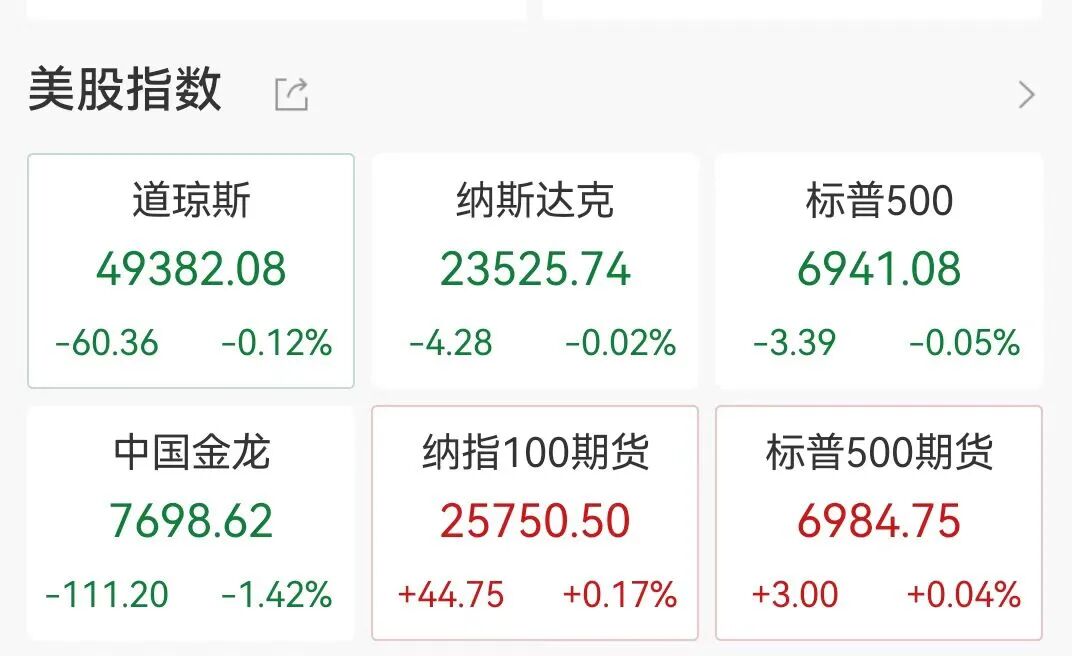
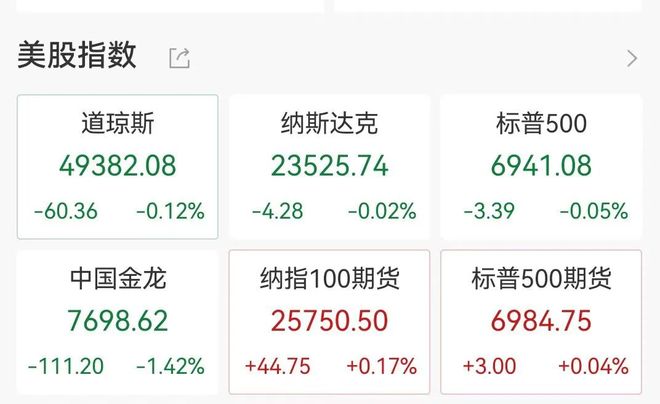
Market Overview - US stock indices showed mixed performance, with the Dow Jones down 60.36 points (-0.12%), Nasdaq down 4.28 points (-0.02%), and S&P 500 down 3.39 points (-0.05%) [1] - The aerospace and defense sectors led gains in the US market, with semiconductor stocks experiencing significant increases, particularly Micron Technology, which rose over 8% following insider buying [1] Semiconductor Sector - Micron Technology's board member purchased 23,200 shares for approximately $7.8 million, contributing to the stock's surge [1] - Morgan Stanley predicts that ASML could see a further 70% increase as chip manufacturers ramp up spending to meet soaring AI demand [1] Chinese Stocks - The Chinese concept stock index fell over 1.42%, with notable declines in companies such as Su Xuan Tang Pharmaceutical (-14%) and Zhihu, Century Internet, and others dropping over 5% [2] Energy and Commodities - US electric company stocks declined, with Talen Energy down 8%, Vistra Energy down 6.9%, and Constellation Energy down 6.3% [3] - Precious metals experienced a collective drop, with spot gold falling to $4,590 per ounce (-0.58%) and silver dropping to $89 per ounce (-3.28%) [3] - Copper prices fell over 2% due to Nvidia's significant downward revision of copper demand projections [3] Cryptocurrency Market - Major cryptocurrencies saw collective declines, with Bitcoin dropping below $96,000 and Ethereum falling below $3,300, leading to nearly 110,000 liquidations in the past 24 hours [4] Storage Chip Market - Citigroup analysts predict that storage chip prices will experience "out-of-control" increases by 2026, with DRAM average price increase expectations raised from 53% to 88% and NAND from 44% to 74% [5] - The AI investment trend is expected to continue throughout the year, with potential winners and losers as part of the creative destruction associated with new technologies [5]
美股异动 | 联电(UMC.US)涨逾5% 拟投入7亿新台币增资欣兴电子
智通财经网· 2026-01-16 15:52
Core Viewpoint - UMC (United Microelectronics Corporation) has seen a stock increase of over 5%, reaching $9.27, following a strategic partnership with Unimicron Technology Corporation focused on high-end manufacturing needs in the AI era [1] Group 1: Partnership Details - UMC plans to invest NT$700 million in Unimicron's cash capital increase [1] - Unimicron intends to issue unsecured corporate bonds not exceeding NT$15 billion [1] Group 2: Strategic Implications - The collaboration aims to integrate Unimicron into UMC's advanced semiconductor packaging supply chain [1] - This partnership is designed to address TSMC's CoWoS capacity bottleneck by enhancing the "wafer manufacturing + PCB/substrate + packaging testing" ecosystem [1]

美股三大股指全线跳水,芯片股大涨,中概股多数下跌,阿里跌超4%,贵金属集体下挫,伦锡暴跌8%
2 1 Shi Ji Jing Ji Bao Dao· 2026-01-16 15:35
Market Overview - US stock indices opened higher with the Dow Jones up 0.11%, Nasdaq up 0.47%, and S&P 500 up 0.22%, but later turned negative [1] - The aerospace and defense sectors led gains, with semiconductor stocks experiencing significant increases, particularly Micron Technology, which rose over 8% [3] Semiconductor Sector - Micron Technology's board member Teyin Liu purchased 23,200 shares for approximately $7.8 million, indicating confidence in the company's future [3] - Analysts from Morgan Stanley predict ASML could see a further 70% increase as chip manufacturers ramp up spending to meet surging AI demand [3] Technology Giants - The performance of the "Big Seven" tech companies was mixed, with Nvidia and Tesla rising nearly 1%, while Apple, Google, and Amazon saw declines [4] Chinese Stocks - The Chinese stock index fell over 1.42%, with notable declines in companies like Su Xuan Tang Pharmaceutical down over 14% and others like Zhihu and Century Internet down over 5% [4] Commodity Market - Precious metals experienced a collective decline, with spot gold falling to $4,590 per ounce, down 0.58%, and silver dropping to $89 per ounce, down 3.28% [4] - Copper prices dropped over 2% due to Nvidia's significant downward revision of copper demand projections [4] Storage Chip Market - Citi analysts expect storage chip prices to see "explosive increases" by 2026, raising DRAM price increase forecasts from 53% to 88% and NAND from 44% to 74% [6] - The AI investment trend is anticipated to continue throughout the year, with potential winners and losers as companies navigate this new technology [6]
台积电(TSM):FY25Q4 业绩点评:AI需求真实且强劲,全面上修业绩指引及资本开支
GUOTAI HAITONG SECURITIES· 2026-01-16 15:15
Investment Rating - The investment rating for TSMC is "Buy" [7] Core Insights - TSMC confirms the strength and sustainability of AI demand, leading to an upward revision of long-term guidance and boosting the AI narrative [3] - Capital expenditures have been raised beyond expectations, with wafer manufacturing remaining a bottleneck, indicating a positive outlook for computing power [3] Financial Summary - Total revenue projections for TSMC are adjusted to NT$ 4,880,557 million for FY2026, NT$ 6,151,836 million for FY2027, and NT$ 7,532,792 million for FY2028, reflecting growth rates of 28%, 26%, and 22% respectively [5] - GAAP net profit is projected to be NT$ 2,362,106 million for FY2026, NT$ 2,976,546 million for FY2027, and NT$ 3,650,595 million for FY2028, with growth rates of 38%, 26%, and 23% respectively [5] - The gross profit margin is expected to increase to 63.5% in FY2026 and 64.0% in FY2028 [5] Earnings Forecast and Investment Recommendations - The earnings forecast for TSMC has been adjusted to NT$ 4,880.6 billion for FY2026, NT$ 6,151.8 billion for FY2027, and NT$ 7,532.8 billion for FY2028, with GAAP net profit projected at NT$ 23,621 million, NT$ 29,765 million, and NT$ 36,506 million respectively [11] - The target price for TSMC's stock is set at $407 for FY2027, based on a PE ratio of 22x [11]

科技股助推美股指全线上涨,纳指涨0.5%,白银价格逆势重挫5%
Sou Hu Cai Jing· 2026-01-16 15:02
Market Overview - The latest wave of enthusiasm in technology stocks has led to a collective rise in major U.S. stock indices, with the S&P 500 opening up 16.07 points (+0.23%) at 6960.54, the Dow Jones Industrial Average up 24.26 points (+0.05%) at 49466.70, and the Nasdaq Composite up 109.67 points (+0.47%) at 23639.69 [1] - Most sector ETFs in the U.S. opened higher, with the semiconductor ETF rising by 1.97% and the technology sector ETF by 0.89% [1] Key Company Movements - Micron Technology saw a pre-market increase of over 5% due to executives purchasing $7.8 million in company stock, indicating confidence in performance outlook [2] - AMD experienced a pre-market rise of over 2%, benefiting from the overall uptrend in the semiconductor sector [2] - Blackstone Group's stock rose over 1% after announcing a $4.65 billion investment in building data centers in Germany, enhancing its European market presence [2] - Ideal Automotive's stock fell over 1% after Citigroup lowered its target price to $18.50, maintaining a "neutral" rating due to cautious short-term sales expectations [2] Technology Sector Insights - Nvidia's stock rose nearly 1% after the company revised its technical paper, significantly reducing the projected copper usage in data centers, alleviating market concerns about raw material costs [3] - The strong performance outlook from TSMC has been pivotal in reversing market sentiment, reigniting investor optimism in the AI sector [8] - Morgan Stanley raised the target price for ASML by 40%, reflecting continued institutional confidence in core equipment suppliers despite a generally subdued European tech sector [8] Financial Market Dynamics - The current earnings season has shown positive signs, with 89% of the 28 companies that have reported so far exceeding expectations, indicating a healthy consumer environment and robust trading activity [9] - The corporate credit market is experiencing heightened sentiment, with corporate debt yield premiums dropping to their lowest since 2007, and the additional yield demanded for junk bonds reaching a near 20-year low [9]

2300亿半导体巨头,82岁董事长拟减持千万市值股票,他60岁归国创业,已恢复中国籍
Xin Lang Cai Jing· 2026-01-16 15:01
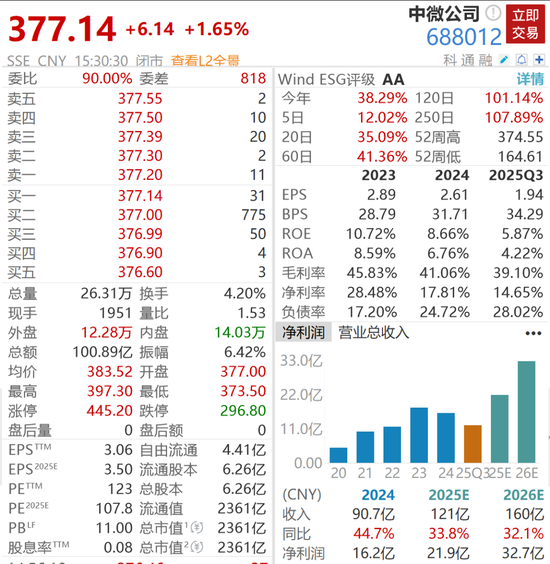
炒股就看金麒麟分析师研报,权威,专业,及时,全面,助您挖掘潜力主题机会! 2026年1月8日,中微公司(688012.SH)发布了一则公告:公司董事长、总经理尹志尧拟于1月30日至4 月29日减持0.046%股权,原因是由于其从外籍恢复中国籍,出于依法办理相关税务需要而进行的减 持。截至1月9日收盘,中微公司股价报336.68元/股,总市值为2108亿元。尹志尧拟减持股票市值约为 9764万元。 一纸公告,将即将82岁的尹志尧和中微公司推至台前,引起市场关注。目前,尹志尧持有中微公司 0.664%股权。 | | 377.14 +6.14 +1.65% | | | | 中微公司 1 立即 | | | --- | --- | --- | --- | --- | --- | --- | | | | | | | | 688012 交易 | | | SSE CNY 15:30:30 闭市 查看L2全景 | | | | | 科通 / 0 + | | 菱比 | 90.00% 委差 | 818 | Wind ESG评级 AA | | | 详情 | | 卖五 | 377.55 | 2 | 交生 | 38.29% 120日 | ...


美股三大指数集体高开 大型科技股多数上涨 美光科技大涨超8%
Xin Lang Cai Jing· 2026-01-16 14:58
Market Performance - The three major U.S. stock indices opened higher, with the Dow Jones Industrial Average up by 0.11%, the Nasdaq Composite up by 0.47%, and the S&P 500 up by 0.22% as of the latest update [1]. Company Highlights - AST SpaceMobile, a U.S. satellite communications company, surged by 6.2% after confirming its role as the main contractor for the U.S. Missile Defense Agency's "SHIELD" project [2]. - ASML, a leading global lithography equipment manufacturer, reached a historic high in market capitalization, becoming the third European stock to surpass $500 billion, driven by strong demand in the AI investment wave [4]. - Micron Technology's stock rose over 5% following the purchase of 23,200 shares by board member Teyin Liu, totaling approximately $7.8 million [2]. Industry Trends - The AI chatbot market is dominated by OpenAI, which significantly outperforms competitors like Anthropic and Google, contrasting with earlier concerns about Google's Gemini chatbot potentially overtaking ChatGPT [5]. - Apple announced a partnership with Google to utilize the Gemini model for enhancing its AI capabilities, particularly for improving the Siri voice assistant, indicating a strategic move in the competitive AI landscape [5].
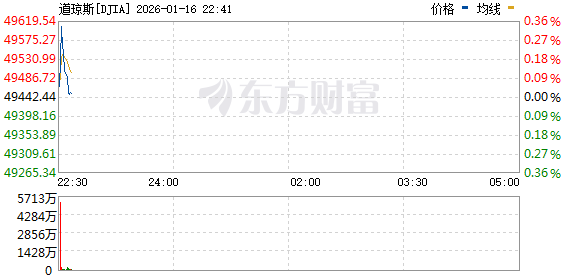
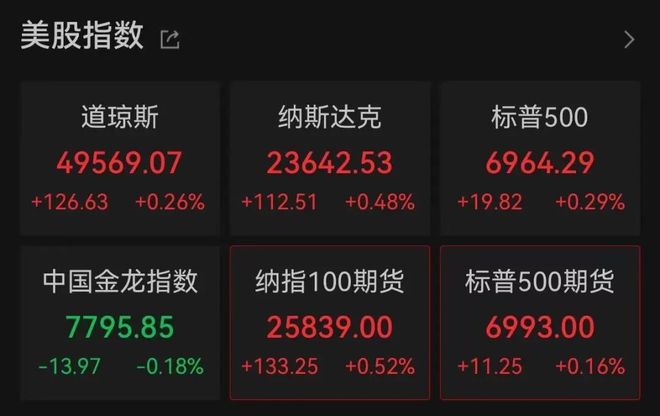
美股大型科技股集体上涨
Di Yi Cai Jing Zi Xun· 2026-01-16 14:56
| 美股指数 △ | | | | --- | --- | --- | | 道琼斯 | 纳斯达克 | 标普500 | | 49569.07 | 23642.53 | 6964.29 | | +126.63 +0.26% | +112.51 +0.48% | +19.82 +0.29% | | 中国金龙指数 | 纳指100期货 | 标普500期货 | | 7795.85 | 25839.00 | 6993.00 | | -13.97 -0.18% | +133.25 +0.52% | +11.25 +0.16% | 大型科技股普涨,美光科技涨超7%,闪迪涨近4%,超威半导体、台积电涨逾2%,英伟达、特斯拉、谷 歌、英特尔均走高。 | 名称 | 现价 | 涨跌幅 | | --- | --- | --- | | 英伟达(NVIDIA) | 190.150 | 1.66% | | NVDA.O | | | | 闪迪 | 424.500 | 3.73% | | SNDK.O | | | | 美光科技(MICRON T | 360.246 | 7.02% | | MU.O | | | | 台积电 | 349.388 | 2 ...