天齐锂业

Search documents
国泰海通晨报-20260210
GUOTAI HAITONG SECURITIES· 2026-02-10 01:41
Group 1: Precision Medicine and Robotics - The report highlights Jingfeng Medical-B as a leader in surgical robotics in China, driving advancements in surgical procedures through continuous technological innovation, with rapid growth in global clinical surgeries and domestic sales [2][3] - The company is projected to achieve revenues of 432 million, 811 million, and 1.236 billion yuan from 2025 to 2027, with a target price of 73.20 yuan for 2026 based on a 35X PS valuation [3] - Jingfeng Medical has established a comprehensive surgical solution with its innovative multi-port and single-port robotic systems, becoming the first in China and the second globally to obtain regulatory approval for multiple robotic systems [3][4] Group 2: Market Performance and Sales Growth - In 2024, Jingfeng Medical sold 20 multi-port surgical robots, ranking first among domestic manufacturers, with clinical applications covering over 220 hospitals across 30 provinces in China [4] - The company's total revenue is expected to increase from 48 million yuan in 2023 to 160 million yuan in 2024, with a significant rise from 30 million yuan in the first half of 2024 to 149 million yuan in the first half of 2025 [4] - The report indicates that Jingfeng Medical's international expansion has led to explosive growth in overseas orders, with 72 out of 118 signed global sales agreements for core products being from overseas markets [5] Group 3: Precision Manufacturing and Emerging Industries - The report covers Xingrui Technology as a leading precision manufacturing enterprise in China, focusing on automotive electronics and actively expanding into emerging industries, with a target price of 32.11 yuan [6][8] - Revenue projections for Xingrui Technology are 1.626 billion, 1.980 billion, and 2.482 billion yuan from 2025 to 2027, with an expected EPS of 0.48, 0.69, and 0.95 yuan respectively [6] - The company has established a robust product matrix, including electronic connectors and structural components, with applications in new energy vehicle systems and consumer electronics, enhancing its competitive advantage in the automotive electronics sector [7] Group 4: Strategic Partnerships and Market Expansion - Xingrui Technology has formed strategic partnerships to expand into the liquid cooling industry, collaborating with Green Cloud to develop advanced technologies and products for data centers [8] - The company has a strong customer base, collaborating with renowned brands in consumer electronics and new energy sectors, and has established a global business layout with factories in multiple locations [7][8] - The report emphasizes the potential for Xingrui Technology to benefit from the growing demand for liquid cooling solutions driven by energy efficiency upgrades in data centers [8]


锂电产业链历史不会重演,但会押韵
Zhong Guo Neng Yuan Wang· 2026-02-10 01:01
Core Viewpoint - The lithium battery supply chain has experienced significant price increases from 2020 to 2022, driven by strong demand and a smooth transmission of price hikes across the industry [2][3]. Group 1: Price Trends - Electrolyte prices started at 70,000 CNY/ton in September 2020, rising to 100,000 CNY/ton by the end of the year, and reaching a peak of 580,000 CNY/ton in February 2022, with long-term contract prices stabilizing between 200,000 to 300,000 CNY/ton [2][3]. - Iron lithium cathode prices, including phosphoric acid iron and processing fees, doubled in 2021, peaking at over 40,000 CNY/ton by the end of that year [2][3]. - Anode prices began to rise in Q3 2021 due to graphite production constraints, increasing from 12,000 CNY/ton to a high of 25,000 to 28,000 CNY/ton by Q2 2022 [2][3]. Group 2: Supply Chain Dynamics - Lithium carbonate prices rebounded from a low of 40,000 CNY/ton at the end of 2020 to 50,000 CNY/ton in early 2021, and surged to 300,000 CNY/ton by the end of 2021, eventually reaching 520,000 CNY/ton by February 2022 [2][3]. - The battery sector has effectively transmitted raw material price increases, with battery prices rising by 1 cent/wh in Q1 2021 and accelerating to 2-3 cents/wh in Q1 and Q2 of 2022, reaching over 1 CNY/wh [2][3]. Group 3: Future Outlook - Current market conditions resemble Q4 2020, with expectations for continued price increases due to strong demand and low profitability levels compared to previous years [3]. - The industry's expansion willingness is significantly lower than in 2021, with limited new supply expected by 2026, suggesting a more stable price environment [3]. - The anticipated price increases are not expected to be as dramatic as in 2021, with supply-demand tightness projected to be lower, particularly for hexafluorophosphate and lithium carbonate [3]. Group 4: Investment Recommendations - The current valuation of leading companies is considered reasonable, with expected industry growth of 20% in 2027, suggesting potential for investment in the battery sector, including companies like CATL, Yiwei Lithium Energy, and others [4]. - Material leaders such as Keda Lithium and others are also highlighted as strong investment opportunities, alongside companies in the lithium carbonate sector [4]. - The solid-state battery sector is recommended for investment, particularly with catalysts expected to materialize in Q4 2025 [4].




——金属新材料高频数据周报(20260202-20260208):铼粉价格连续2个月上涨-20260209
EBSCN· 2026-02-09 13:30
2026 年 2 月 9 日 有色金属 铼粉价格连续 2 个月上涨 ——金属新材料高频数据周报(20260202-20260208) 要点 军工新材料:电解钴价格下跌。(1)本周电解钴价格 42.00 万元/吨,环比 -5.2%。本周电解钴和钴粉价格比值 0.73 ,环比-5.2%;电解钴和硫酸钴价格 比值为 4.28 ,环比-5.2%。(2)碳纤维本周价格 83.8 元/千克,环比+0%。 毛利-9.19 元/千克。 新能源车新材料:氢氧化锂价格下跌。(1)本周碳酸锂和氢氧化锂价格分别 为 13.44 、13.25 万元/吨,环比-16.2%、-16.1%。(2)本周硫酸钴价格 9.53 万元/吨,环比+0%。(3)本周磷酸铁锂、523 型正极材料价格分别为 5.24 、18.00 万元/吨,环比+0%、-3.5%。(4)本周氧化镨钕价格 757.72 元/公斤,环比+1.2%。 光伏新材料:多晶硅价格下跌。(1)本周光伏级多晶硅价格 6.19 美元/千 克,环比 -6.5%。(2)本周 EVA 价格 9,650 元/吨,环比+0%,处于 2013 年 来较低位置。(3)本周 3.2mm 光伏玻璃镀膜价格 ...
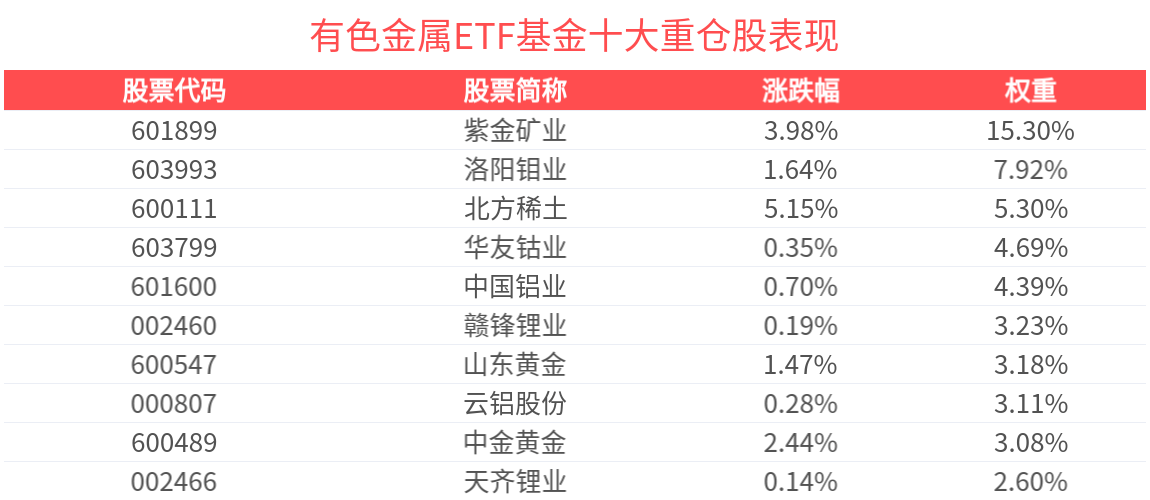
有色金属ETF基金(516650)开盘涨1.90%,重仓股紫金矿业涨3.50%,洛阳钼业涨2.14%
Xin Lang Cai Jing· 2026-02-09 12:53
Group 1 - The core viewpoint of the article highlights the performance of the Non-ferrous Metals ETF Fund (516650), which opened with a gain of 1.90% at 2.145 yuan [1] - Major holdings in the Non-ferrous Metals ETF include Zijin Mining, which rose by 3.50%, and other companies such as Luoyang Molybdenum, Northern Rare Earth, and Huayou Cobalt, which also experienced gains [1] - The fund's performance benchmark is the CSI Sub-Industry Non-ferrous Metals Theme Index return, managed by Huaxia Fund Management Co., with a return of 110.83% since its inception on June 9, 2021, and a 4.15% return over the past month [1]



有色ETF鹏华(159880)开盘涨2.06%,重仓股紫金矿业涨3.50%,洛阳钼业涨2.14%
Xin Lang Cai Jing· 2026-02-09 12:19
Group 1 - The core point of the article highlights the performance of the Penghua Nonferrous ETF (159880), which opened with a gain of 2.06% at 2.233 yuan [1] - Major holdings in the ETF include Zijin Mining, which rose by 3.50%, and other companies such as Luoyang Molybdenum (2.14%), Northern Rare Earth (2.97%), and Huayou Cobalt (1.49%) [1] - The ETF's performance benchmark is the National Index of Nonferrous Metals Industry, managed by Penghua Fund Management Co., Ltd., with a return of 118.94% since its inception on March 8, 2021, and a 5.03% return over the past month [1]
碳酸锂周报:碳酸锂市场宽幅巨震,节前资金离场与累库预期主导-20260209
Zhong Yuan Qi Huo· 2026-02-09 11:40
1. Report Title and Period - The report is "Carbonate Lithium Weekly Report 2026.02.02 - 2026.02.06", focusing on the carbonate lithium market [1] 2. Report Industry Investment Rating - No investment rating information provided 3. Core Viewpoints - The market is in a wide - range shock stage after the high - price collapse. The core contradiction lies in the game between the short - term domestic supply contraction expectation and the long - term import increment and inventory accumulation expectation. Pre - holiday capital flight amplifies price fluctuations, and the weakening spot price and high warehouse receipt inventory put pressure on the market, with overall weak sentiment. It is expected that the high - volatility of the market will continue in the next 1 - 2 weeks, with prices seeking direction in the range of 130,000 - 140,000 yuan/ton, and post - holiday import arrivals and downstream resumption of work need to be closely monitored [3] 4. Summary by Directory 4.1 Lithium Salt Market Introduction - **Price Changes**: Carbonate lithium futures prices dropped 10.31% week - on - week to 132,920 yuan/ton. Battery - grade carbonate lithium spot prices fell 13.23% week - on - week to 138,400 yuan/ton, and industrial - grade carbonate lithium spot prices dropped 13.15% to 136,000 yuan/ton. Hydroxide lithium spot prices also declined, with the price of electric - carbon (coarse - grained) down 6.13% to 145,500 yuan/ton, electric - carbon (fine powder) down 5.93% to 150,700 yuan/ton, and industrial - grade down 6.35% to 140,200 yuan/ton [3][5] - **Premium and Discount Changes**: The premium and discount of various raw materials and enterprises have changed. For example, the premium of辉石料 increased by 250 yuan/ton, and that of Ganfeng Lithium Co., Ltd. increased by 400 yuan/ton [8] 4.2 Lithium Salt Fundamentals 4.2.1 Supply - **Carbonate Lithium Production**: The domestic carbonate lithium capacity utilization rate remained at a high level of 87.14%, but the hydroxide lithium capacity utilization rate decreased 5.41% week - on - week to 35%. Policy disturbances in Jiangxi mica mines and planned overhauls in some lithium salt plants strengthened the market's expectation of supply contraction in February [3] 4.2.2 Demand - **Downstream Consumption**: Downstream demand shows structural support, with the operating rate of energy - storage battery cells rising. However, due to the seasonal slowdown during the Spring Festival, the downstream production plan for February is expected to decline month - on - month, and the procurement of high - price raw materials is cautious [3] 4.2.3 Import and Export - **Lithium Ore Import**: The export volume from Chile increased significantly in January, and the market expects the import volume in March to reach a new high, which has led to concerns about inventory accumulation during the peak season and suppressed prices [3] - **Lithium Ore Transportation Cost**: The transportation costs from most African countries remained stable, with only the container transportation cost from Nigeria increasing by 6.67% week - on - week [29] 4.2.4 Inventory - **Carbonate Lithium Warehouse Receipt Inventory**: The exchange warehouse receipt inventory increased 10.27% week - on - week to 33,777 lots. Warehouses such as COSCO Shipping Nanchang Warehouse and JF Shanghai Warehouse had significant increases, intensifying inventory pressure [3][42] 4.2.5 Cost and Profit - **Carbonate Lithium**: The raw material cost decreased in line with the lithium price. The production cost of externally purchased lithium concentrate/mica decreased 13.07%/12.32% week - on - week. The profit of the externally purchased lithium mica route shrank 29.8% to 5,830 yuan/ton, while the externally purchased lithium concentrate route remained in a loss state [3] 4.3 Lithium Battery Fundamentals - The report also covers the market conditions, supply, demand, import and export, cost - profit, and recycling of lithium battery materials, as well as the production, sales, and other key data of new energy vehicles, but specific data details are not fully presented in the provided content [45]
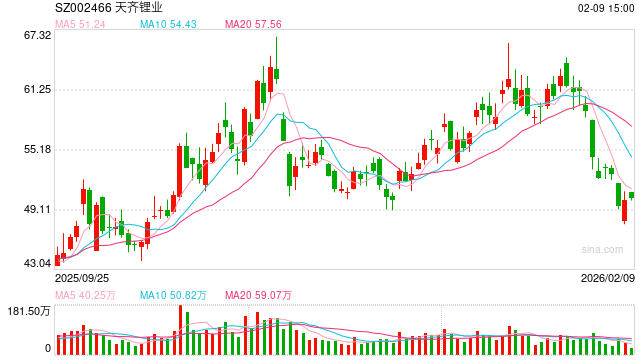
天齐锂业配股发债抛资产筹资或超70亿 不缺钱却大规模“屯粮”意欲何为?
Xin Lang Zheng Quan· 2026-02-09 09:56
热点栏目 自选股 数据中心 行情中心 资金流向 模拟交易 客户端 炒股就看金麒麟分析师研报,权威,专业,及时,全面,助您挖掘潜力主题机会! 出品:新浪财经上市公司研究院 作者:昊 近日,天齐锂业宣布配售新H股及发行可转换公司债券,同时拟出售中创新航和SQM部分股权。通过上述资本运作,天齐锂业募资和套现合计或将超过70亿 元。 事实上,从目前财务指标看,天齐锂业资金和债务压力并不大。考虑到天齐锂业表示筹资将继续锂资源并购,同时碳酸锂价格近一年出现大涨,是否将进 行"高抛低吸"值得关注。 2024年4月,二代掌门人蒋安琪接班,推行"夯实上游、做强中游、渗透下游"的长期战略。然而,蒋安琪上任后却立即叫停澳大利亚奎纳纳二期氢氧化锂项 目,并全额计提14.84亿元减值准备,此次又出售下游电池头部厂商中创新航股权。 不仅如此,天齐锂业研发投入长期大幅低于赣锋锂业,与后者积极布局锂电全产业链形成鲜明对比,公司或仍在延续豪赌上游资源的老路。 配股发债再卖关键资产 筹资超70亿或"高抛低吸"? 2月3日晚,天齐锂业发布公告,公司拟按每股45.05港元的价格,向独立投资者配售6505万股新H股,同时发行本金总额26亿元的可转换公 ...


国泰海通:关注企稳后的有色金属布局机会
智通财经网· 2026-02-09 06:20
Group 1: Precious Metals - The decline in market risk appetite has led to adjustments in precious metal prices, with gold supported by continued purchases from the People's Bank of China and rising ETF holdings [2] - Silver prices are influenced by stable leasing rates and a rapid decline in U.S. silver inventories [2] Group 2: Copper - The expectation of strategic reserves for copper provides support despite macroeconomic pressures, with a focus on upstream resources to counter overseas supply disruptions [3] - The demand for copper is driven by AI computing infrastructure and grid modernization, indicating strong resilience in pricing [3] Group 3: Aluminum - Aluminum prices are under pressure due to seasonal demand weakness, with a decline in processing rates and an increase in social inventory [4] - The macroeconomic environment shows mixed signals, with the ISM services PMI returning to expansion but ADP employment figures falling short of expectations [4] Group 4: Tin - Tin prices are under downward pressure due to overseas macroeconomic factors and reduced funding, but there is increased purchasing interest from downstream sectors as prices decline [5] - The supply side may see marginal easing with increased activity in Indonesian tin transactions and the resumption of production in Myanmar [5] Group 5: Energy Metals - Lithium demand remains strong despite a four-week inventory reduction, with expectations of preemptive battery demand due to changes in export tax policies [6] - Cobalt prices are high due to tight upstream raw material supply, while companies are extending their reach into electric new energy sectors to enhance competitive advantages [6] Group 6: Rare Earths - The supply-demand balance for light rare earths remains tight, with prices continuing to rise due to pre-holiday stocking needs [7] - The investment value of rare earths as a strategic resource is highlighted, with specific companies recommended for investment [7] Group 7: Strategic Metals - Tungsten prices are experiencing a systematic increase driven by supply-demand dynamics, with significant price hikes reported by leading companies [8] - The market for uranium is expected to continue rising due to persistent supply-demand gaps and the development of nuclear power [9]

贵金属、有色金属集体走强,有色金属ETF基金(516650)涨超2%
Sou Hu Cai Jing· 2026-02-09 05:31
Group 1 - Precious metals and non-ferrous metals collectively strengthened on February 9, with the non-ferrous metal ETF fund (516650) rising by 2.09%, and stocks like Shenghe Resources increasing by 9.49% [1] - Silver and rare earth stocks also saw significant gains, with silver rising by 5.94%, and companies like China Rare Earth and Northern Rare Earth following suit [1] - The price consumption is relatively flat as the Spring Festival approaches, and the increase in non-ferrous metals is limited compared to precious metals, indicating a potential return to fundamentals after the price surge [1] Group 2 - According to CITIC Securities, copper is testing the key support level of 100,000 yuan/ton, with expectations for downstream inventory replenishment likely to occur after the Spring Festival [1] - Global copper inventory has risen to 1.11 million tons, with 589,000 tons locked in the COMEX market, while aluminum prices are supported at 23,500 yuan/ton despite current inventory accumulation [1] - The prices of non-ferrous metals are influenced by both financial and commodity attributes, with the Federal Reserve entering a rate-cutting cycle and global copper and aluminum inventories remaining relatively low, suggesting improved demand driven by economic recovery and the new energy sector [1] Group 3 - As of January 30, 2026, the top ten weighted stocks in the CSI Non-Ferrous Metals Industry Theme Index (000811) include Zijin Mining, Luoyang Molybdenum, Northern Rare Earth, and China Aluminum, collectively accounting for 51.85% of the index [2] - The weightings of the top stocks are as follows: Zijin Mining at 15.30%, Luoyang Molybdenum at 7.92%, and Northern Rare Earth at 5.30% [3] - The non-ferrous metal ETF fund (516650) has several off-market connections, including the Huaxia Non-Ferrous Metal ETF Connect A (016707) and C (016708) [3]

有色金属:关注企稳后的布局机会
GUOTAI HAITONG SECURITIES· 2026-02-09 05:15
Investment Rating - The report assigns an "Overweight" rating for the non-ferrous metals industry [4] Core Insights - The report emphasizes the importance of macroeconomic factors such as monetary policy, macro expectations, geopolitical dynamics, and supply disruptions in influencing metal price trends [2] - The report highlights the need to focus on investment opportunities following stabilization in the market [8] Summary by Sections 1. Industry and Stock Performance - The non-ferrous metals sector experienced a decline of 8.51% last week, underperforming major indices [14][16] 2. Metal Prices and Inventory - Copper prices decreased by 3.45% to 100,100 CNY/ton, while aluminum prices fell by 5.07% to 23,315 CNY/ton [24] - SHFE gold prices dropped by 8.92% to 1,090.12 CNY/gram, while COMEX gold rose by 5.13% to 4,988.60 USD/ounce [26] - SHFE silver prices decreased by 37.17% to 18,799 CNY/kg, with COMEX silver down by 1.28% to 77.53 USD/ounce [26] 3. Macro Data Tracking - The report tracks key macroeconomic indicators, including the U.S. CPI and PCE, which show a year-on-year increase of 2.7% and 2.79%, respectively [29][30] - China's CPI and PPI for December were reported at 0.8% and -1.9%, respectively [30] 4. Precious Metals: Low Inventory Disturbances - The report notes that low inventory levels continue to disrupt precious metal prices, with significant fluctuations observed in both gold and silver markets [52][53] 5. Copper: Price Fluctuations - The report indicates that copper prices are expected to fluctuate, with supply-side adjustments and demand dynamics playing crucial roles [65][72] 6. Aluminum: Price Adjustments - Aluminum prices are under pressure due to macroeconomic sentiment and seasonal demand fluctuations, with a noted decrease in processing rates [10][80] 7. Energy Metals: Strong Demand - The report highlights robust demand for energy metals, particularly lithium, despite some price pressures due to macroeconomic factors [89][92] 8. Rare Earths: Price Trends - Prices for rare earth elements, particularly praseodymium and neodymium oxides, continue to rise, supported by tight supply conditions [11]