
上海家化

Search documents
十月以来四十五股评级上调 食品饮料行业受关注
Zheng Quan Shi Bao· 2025-11-05 18:28
Group 1: Industry Overview - The food and beverage industry has received significant attention from institutions, with multiple brokerages maintaining a positive outlook on its future performance [2] - The food and beverage sector is characterized by "low base, low holdings, and low expectations," making it highly sensitive to positive signals, with any favorable changes in supply and demand potentially catalyzing stock price increases [2] - The white liquor sector is currently at a historical low valuation, and policy-driven recovery in consumer confidence is expected to drive valuation recovery [2] Group 2: Stock Performance - Since October, 45 stocks have had their ratings upgraded by institutions, with an average increase of 6.66%, and 14 stocks have seen cumulative gains exceeding 10% [2] - GuoDun Quantum has experienced the highest increase of 58.68% since October, attributed to successful verification of key technologies for quantum secure communication networks [2] - Artis has also seen a significant rise of 58.33%, driven by strong performance in its energy storage business, with a 32% year-on-year increase in large energy storage product shipments [3] Group 3: Company Financials - Yangguang Electric's revenue for the first three quarters reached 66.402 billion, a year-on-year increase of 32.95%, with net profit growing by 56.34% [3] - Several companies, including Jiantou Energy and Shanghai Jahwa, reported net profit growth exceeding 100% year-on-year for the first three quarters, with Jiantou Energy's net profit increasing by 231.79% [3][4] - Shanghai Jahwa's net profit for the first three quarters was 4.05 billion, reflecting a year-on-year growth of 149.1% [4] Group 4: Valuation Metrics - As of November 5, 12 stocks have a rolling price-to-earnings ratio below 20, with 4 stocks having a ratio below 10, including Ningbo Bank and China Life Insurance [4]
+25.51%,丸美生物如何成为A股美妆“增速第一”?
FBeauty未来迹· 2025-11-05 15:20
Core Viewpoint - The domestic beauty market in 2025 is experiencing a "growth cold wave," with many leading companies facing revenue declines or significantly slowed growth. However, Guangdong Marubi Biotechnology Co., Ltd. (Marubi) has reported impressive growth, achieving a 25.51% year-on-year increase in revenue for the first three quarters, making it one of the few companies in the industry to achieve both revenue and profit growth during this challenging period [2][3]. Industry Overview - The beauty industry is entering a competitive phase characterized by slow consumer recovery and peak channel benefits. Rational consumption has become mainstream, making growth for leading companies increasingly difficult [5]. - Among eight leading domestic beauty companies, four reported a year-on-year revenue decline, with three experiencing declines exceeding 10%. Marubi stands out with a significant revenue increase of 25.51% [8][9]. Financial Performance of Marubi - Marubi's revenue for the first three quarters reached 2.450 billion yuan, a year-on-year increase of 25.51%. In Q3 alone, revenue was 686 million yuan, up 14.28% year-on-year. The net profit attributable to shareholders was 244 million yuan, reflecting a year-on-year growth of 2.13% [11][12]. - The company's operating cash flow for the first three quarters was 1.589 billion yuan, a substantial increase of 132.19%, indicating that revenue growth is supported by actual sales collections [13]. Growth Drivers - Marubi's growth is attributed to internal factors rather than external market benefits, focusing on product, cost, and operational improvements. The company has optimized its product structure and upgraded to higher-end products, particularly in the eye care category, which saw a price increase of 52.83% year-on-year [14][16][18]. - The skincare category has become the primary revenue driver, contributing 306 million yuan in Q3, aligning with Marubi's strategy to transition from an eye care expert to a leader in comprehensive anti-aging solutions [19]. Cost Management and R&D - Marubi has implemented refined cost control through bulk purchasing and the use of quality domestic raw materials, enhancing profitability and pricing flexibility. The company has balanced marketing expenses and R&D investments, with sales expenses increasing by 32.09% and R&D expenses growing by 15.34% [20]. - The company has maintained a strong focus on technological innovation, receiving multiple awards and patents, which solidifies its competitive edge in the market [23]. Strategic Positioning - Marubi's strategic upgrades encompass brand positioning, technological development, and product matrix enhancements, providing sustained momentum for growth. The company has shifted its branding to emphasize anti-aging and has engaged well-known celebrities to enhance brand recognition [22][24]. - The company has achieved significant recognition in the market, being named the top brand in several product categories, which reflects its effective "R&D-product-market" closed-loop strategy [26][29]. Conclusion - Marubi's performance in Q3 2025 not only highlights its financial growth but also underscores its strategic advantages in product structure, operational efficiency, and market positioning. The company's transition from a marketing-driven to a technology-driven approach is crucial for sustaining competitive advantages in a challenging industry landscape [30].



“口红效应”失灵?2025美妆行业迎来艰难时刻
3 6 Ke· 2025-11-05 12:11
Core Insights - The domestic beauty industry in China, once thriving due to traffic dividends, is showing signs of fatigue as evidenced by the financial reports for the first three quarters of 2025, with major brands experiencing significant declines in revenue and profit [2][3][8] Financial Performance - Proya's revenue for the first three quarters reached 7.098 billion yuan, a year-on-year increase of 1.89%, while net profit was 1.026 billion yuan, up 2.65%. However, in Q3 alone, revenue fell to 1.736 billion yuan, a decrease of 11.63%, and net profit dropped to 227 million yuan, down 23.64% [2][8] - Other domestic brands like Fulejia, Betaini, Huaxi Biological, and Aimeike reported declines in both revenue and net profit, with Fulejia's revenue down 11.54% and net profit plummeting 36.73% [2][8] Market Trends - The beauty market in China has grown from 131.8 billion yuan in 2014 to 420.3 billion yuan in 2024, with domestic brands achieving a compound annual growth rate of 13.18%, surpassing foreign brands for the first time in 2023 [4][5] - The "lipstick effect" is failing as consumer confidence and willingness to spend among young people have significantly decreased, impacting sales in the beauty sector [3][9] Consumer Behavior - Young consumers are increasingly opting not to wear makeup due to busy lifestyles and a shift in priorities, with many expressing a preference for sleep over makeup application [9][10] - The perception of makeup as a necessary tool for professional success is changing, with more women focusing on their professional abilities rather than appearance [10] Industry Challenges - Many domestic beauty brands are facing a "path dependence" issue, relying heavily on established marketing strategies that are becoming less effective as the market matures [11][12] - The over-reliance on social media marketing and influencer partnerships is leading to diminishing returns, with brands struggling to maintain growth in a saturated market [11][12] R&D and Innovation - There is a growing need for product innovation as consumers become more discerning and demand transparency regarding product ingredients and efficacy [15][16] - Proya's R&D expenditure was only 2.1 billion yuan in 2024, significantly lower than its sales expenses, highlighting a trend of prioritizing marketing over innovation [16][17] Strategic Shifts - Proya is shifting its focus towards digitalization and technological innovation, appointing experienced executives to enhance its product development and marketing strategies [17][18] - The company aims to leverage digital tools for better product iteration and to integrate AI into various business functions, indicating a strategic pivot towards long-term sustainability [18][19]


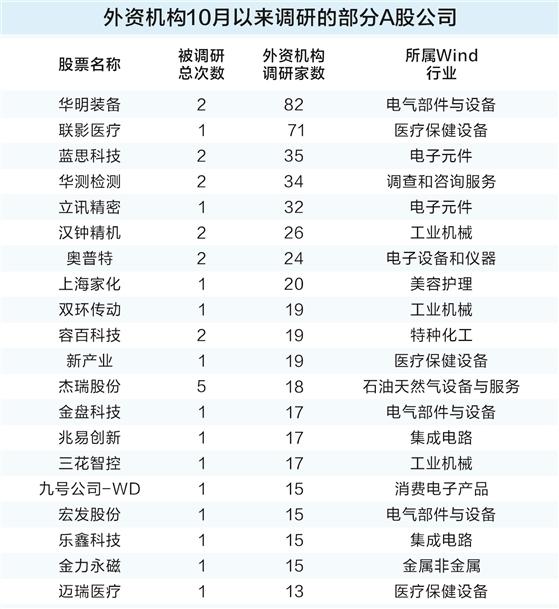
外资10月以来密集调研A股 覆盖309家公司 重视“含科”量
Zheng Quan Shi Bao· 2025-11-04 17:48
Group 1: Foreign Investment Focus - Since October, foreign institutions have conducted research on 309 A-share listed companies, primarily focusing on high-growth industries such as artificial intelligence, industrial automation, new energy, semiconductors, and consumer electronics [1][3] - Notably, 35 companies received attention from more than 10 foreign institutions, indicating a strong interest in companies like Huaming Equipment, United Imaging Healthcare, Lens Technology, and others [3] - Major foreign institutions involved in the research include Goldman Sachs, UBS, and Morgan Stanley, with Goldman Sachs alone researching over 50 A-share companies since October [5][6] Group 2: Company-Specific Insights - Huaming Equipment was the most researched company, with 82 foreign institutions focusing on its Q3 performance and future export orders [3][4] - United Imaging Healthcare attracted 71 foreign institutions, which were particularly interested in its performance in overseas markets and project deliveries [4] - Other companies like Lixun Precision, Han's Laser, and Jereh Group also received significant attention, reflecting a trend towards sectors like industrial machinery and medical equipment [1][3] Group 3: Economic Outlook and Policy Implications - Foreign institutions are optimistic about China's "14th Five-Year Plan," with Goldman Sachs raising its forecasts for China's export growth and GDP growth [2][6] - The focus on building a robust domestic market and enhancing advanced manufacturing capabilities is expected to positively impact A-shares, particularly in sectors related to self-sufficiency and emerging industries [6][7] - Goldman Sachs predicts that China's export volume will grow by 5% to 6% annually over the next few years, contributing to overall economic expansion [7]


美护商社行业周报:黄金税收新政落地,泡泡玛特中东首店开业-20251104
Guoyuan Securities· 2025-11-04 10:42
Investment Rating - The report maintains an "Overweight" rating for the industry, with a focus on new consumption sectors such as beauty care, IP derivatives, and gold jewelry [5][32]. Core Insights - The report highlights the recent tax policy changes regarding gold, which exempts value-added tax for standard gold transactions, potentially boosting market activity [3][22]. - The beauty care sector shows mixed performance, with some companies reporting significant revenue growth while others face declines [4][25]. - The report emphasizes the importance of domestic brands in the beauty market, with notable rankings in the Douyin beauty list indicating a shift towards local products [22][23]. Market Performance - During the week of October 27 to October 31, 2025, the retail trade, social services, and beauty care sectors experienced changes of +1.63%, +0.45%, and -2.21% respectively, ranking 8th, 17th, and 30th among 31 primary industries [13][15]. - The cosmetics sector faced a decline of -2.57%, while segments like trade and e-commerce performed well with increases of +3.44% and +2.97% [15][18]. Key Company Announcements - Shanghai Jahwa reported a revenue of 4.961 billion yuan for the first three quarters of 2025, a year-on-year increase of 10.8%, with a net profit growth of 149.1% [25]. - Proya Cosmetics achieved a revenue of 7.098 billion yuan, reflecting a modest growth of 1.89% [25]. - The opening of Pop Mart's first store in the Middle East marks a significant expansion for the brand [29]. Investment Recommendations - The report suggests focusing on companies such as Shiseido, Giant Bio, Marubi, Runben, Proya, Chaohongji, and Furuida as potential investment targets within the recommended sectors [5][32].





格局生变,优选成长
Haitong Securities International· 2025-11-04 09:08
Group 1: Industry Overview - The cosmetics retail sales in China grew by 3.9% year-on-year from January to September 2025, slightly underperforming the overall retail market by 0.6 percentage points, indicating a stable demand environment [4][14]. - Online platforms like Tmall and Douyin are experiencing a shift, with Tmall showing signs of recovery due to flash sales and member subsidies, while Douyin's growth has slightly slowed down [17][20]. - The demand for high-end and cost-effective products is increasing, while the mid-range segment is facing pressure due to a more conservative consumer environment [5][41]. Group 2: Competitive Landscape - The trend of domestic brands replacing foreign ones is slowing down, with leading foreign brands like L'Oréal and Estée Lauder showing signs of recovery in the Chinese market [23][24]. - The growth of domestic brands is becoming more differentiated, with some brands like Proya and Shiseido experiencing declines, while others like Youngor and Shanghai Jahwa continue to grow [23][24]. - The industry is witnessing an acceleration in the multi-brand matrix among leading companies, which is expected to increase market concentration [27][28]. Group 3: Key Companies - The report highlights several companies with strong growth potential, including Ruya Chen, Shumei Co., and Maogeping, which are expected to benefit from their brand strength and market positioning [3][54]. - Companies like Dekang Oral Care and Shanghai Jahwa are noted for their stable fundamentals and potential for marginal improvement, while others like Jinbo Biological and Huaxi Biological are anticipated to reach turning points [54]. - Ruya Chen's self-owned brand, Zhenjia, has shown significant growth, with a revenue increase of 345% year-on-year in Q3 2025, indicating strong brand development capabilities [60].


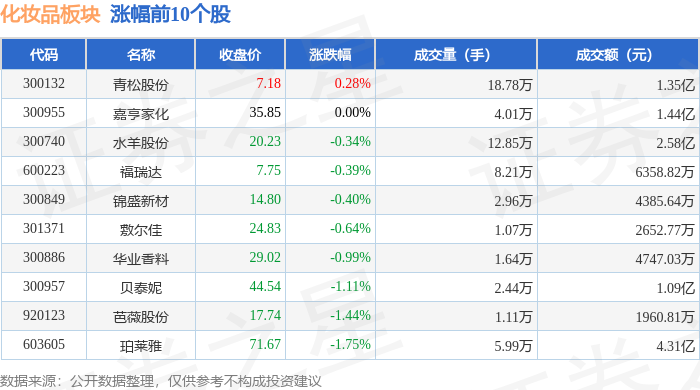
化妆品板块11月4日跌1.75%,丸美生物领跌,主力资金净流出2.08亿元
Zheng Xing Xing Ye Ri Bao· 2025-11-04 08:51
Core Viewpoint - The cosmetics sector experienced a decline of 1.75% on November 4, with Marubi Biotechnology leading the drop [1][2] Group 1: Market Performance - The Shanghai Composite Index closed at 3960.19, down 0.41%, while the Shenzhen Component Index closed at 13175.22, down 1.71% [1] - Major stocks in the cosmetics sector showed varied performance, with Qing Song Co. slightly up by 0.28% and Marubi Biotechnology down by 3.92% [1][2] Group 2: Trading Volume and Value - The trading volume and value for key stocks in the cosmetics sector were significant, with Qingdao Kingway recording a trading volume of 576,600 shares and a transaction value of 470 million yuan [2] - The total net outflow of main funds in the cosmetics sector was 208 million yuan, while retail investors saw a net inflow of 155 million yuan [2] Group 3: Fund Flow Analysis - The main funds showed a net outflow in several companies, including Marubi Biotechnology with a net outflow of 7.54 million yuan, while retail investors had a net inflow of 17.24 million yuan [3] - LaFang Co. had a net inflow of 8.17 million yuan from retail investors, despite a net outflow from main funds [3]



主品牌增速放缓珀莱雅赴港筹资
Xin Lang Cai Jing· 2025-11-03 21:07
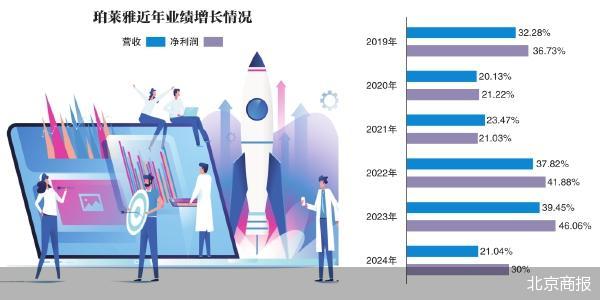
Core Viewpoint - Proya is initiating a Hong Kong listing to enhance its international strategy and overseas business development, aiming to increase its financing capabilities and support future global acquisitions [3][4]. Financial Performance - In the first three quarters of 2025, Proya achieved a revenue of 7.098 billion yuan, a year-on-year increase of 1.89%, and a net profit of 1.026 billion yuan, up 2.65% [3][4]. - The revenue for the first half of 2025 was 5.4 billion yuan, maintaining a leading position in the domestic beauty market [3][4]. - Proya's revenue growth from 2019 to 2024 was as follows: 32.28%, 20.13%, 23.47%, 37.82%, 39.45%, and 21.04% respectively, with net profit growth rates of 36.73%, 21.22%, 21.03%, 41.88%, 46.06%, and 30% [4]. Market Position and Competition - Proya is currently the leading domestic cosmetics brand, but faces increasing competition from brands like Maogeping, Shangmei, and others, making it challenging to maintain its market position [4][5]. - The phenomenon of Proya having the highest revenue but a declining stock price is attributed to concerns over its main brand's performance, leading to significant institutional investor withdrawals [3][4]. Research and Development Focus - Proya plans to use funds raised from the Hong Kong listing to enhance its R&D, brand building, and overseas market expansion [4][5]. - The company's R&D expenditure has been relatively low, hovering around 2%, with 2022 R&D expenses at 128 million yuan [4][5]. - Competitors like Huaxi Biological and Betaini have significantly higher R&D expenditure rates, indicating a potential area for Proya to improve [4][5].
上海家化「中式根源养美」体系,全新定义中国美
FBeauty未来迹· 2025-11-03 10:48
Core Viewpoint - The article discusses the launch of Shanghai Jahwa's "Chinese Root Beauty System" as a significant milestone in the Chinese cosmetics industry, marking a shift from ingredient competition to innovative concepts in skincare [6][25][31]. Group 1: Background and Context - The cosmetics industry has historically been dominated by Western scientific principles, leaving "Chinese skincare" underrepresented despite China's rich herbal culture and traditional medicine [4][6]. - Shanghai Jahwa released the first "Chinese Root Beauty White Paper" in September 2025, aiming to establish a systematic theoretical framework for Chinese skincare [4][5]. Group 2: The Chinese Root Beauty System - The white paper introduces the "Chinese Root Beauty System," which integrates traditional Chinese philosophy with modern skin science, proposing a comprehensive framework for skincare [8][19]. - The system redefines beauty as a reflection of overall bodily health, emphasizing the importance of internal balance and vitality over superficial treatments [8][19]. Group 3: Methodology and Principles - The system is based on a four-step cycle: Purify, Balance, Nourish, and Strengthen, which aligns with traditional Chinese medicine's holistic approach [9][10][26]. - Each step addresses different aspects of skin health, from detoxification to nourishment, creating a dynamic and sustainable skincare routine [9][10][26]. Group 4: Scientific Validation and Cultural Significance - The white paper has been positively received by experts, who recognize its scientific rigor and cultural depth, bridging traditional Chinese medicine with modern consumer understanding [14][18][23]. - The framework not only preserves traditional wisdom but also adapts it to contemporary skincare needs, establishing a credible and replicable model for the industry [14][18][23]. Group 5: Market Implications and Future Directions - The introduction of the "Chinese Root Beauty System" signifies a paradigm shift in the cosmetics industry, moving towards a more philosophical and systematic approach to skincare [25][31]. - This innovation positions Shanghai Jahwa as a leader in defining Chinese skincare standards, potentially influencing the global beauty market [26][30][31].

VE、硫酸价格涨幅居前,建议关注六氟磷酸锂板块、低估值成长股
CMS· 2025-11-03 09:35
Investment Rating - The report suggests focusing on the lithium hexafluorophosphate sector and undervalued growth stocks [5] Core Viewpoints - The chemical sector showed a 2.50% increase in the week of October 5, outperforming the Shanghai A-share index by 2.38 percentage points [2][11] - The report highlights the significant price increases in products such as vitamin VE and sulfuric acid, indicating a positive trend in the chemical market [4][18] - Recommended stocks include Duofluorite, which benefits from rising lithium hexafluorophosphate prices, and Huagong Technology, which is a stable growth leader in surfactants [5] Summary by Sections Industry Performance - The chemical sector had 26 sub-industries rising and 6 declining, with the top gainers being phosphate and phosphate salts (+11.32%) and inorganic salts (+8.94%) [3][15] - The dynamic PE of the chemical sector is 24.39 times, higher than the average PE of 8.06 since 2015 [2][11] Chemical Prices and Spreads - The top five products with the highest weekly price increases include liquid chlorine (+12.78%) and vitamin VE (+8.7%) [4][18] - The spreads for products like styrene-butadiene rubber increased significantly, with the highest being +26.39% for styrene-butadiene rubber spread [38][41] Inventory Changes - Significant inventory changes were noted, with polyester filament showing a decrease of 33.30% [5][61] Industry News Recap - Recent industry news indicates a substantial increase in imports and production recovery in the chemical sector, driven by lower costs and improved demand [88]