
南钢股份

Search documents
红利低波ETF(512890)近20个交易日累计成交金额达141.84亿元,银行板块对长期资金的吸引力增强
Xin Lang Cai Jing· 2025-12-12 07:13
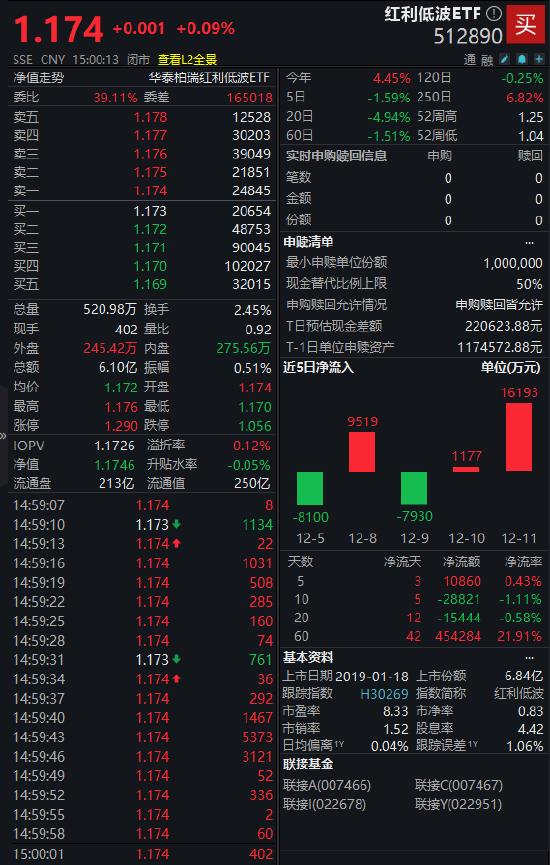
Core Viewpoint - The market is showing signs of recovery, with the three major indices closing in the green. The Dividend Low Volatility ETF (512890) has seen a slight increase of 0.09%, closing at 1.174 yuan, with a trading volume of 6.10 billion yuan, leading in its category [1][5]. Trading Performance - As of December 12, the Dividend Low Volatility ETF (512890) recorded a trading volume of 6.10 billion yuan, with a turnover rate of 2.45% [1][5]. - The ETF's price increased by 0.09%, closing at 1.174 yuan, with a maximum price of 1.176 yuan and a minimum of 1.170 yuan during the trading session [2][6]. Liquidity - Over the past 20 trading days, the ETF has accumulated a trading amount of 14.184 billion yuan, averaging 709 million yuan per day. Since the beginning of the year, the total trading amount has reached 109.795 billion yuan, with an average daily trading amount of 4.77 billion yuan [3][8]. Holdings - The latest report indicates that the top ten holdings of the Dividend Low Volatility ETF (512890) include major companies such as COFCO Sugar, Nanjing Steel, Chengdu Bank, and others, with significant weightings in the portfolio [4][8]. Historical Performance - The Dividend Low Volatility ETF (512890) was established in December 2018 and has shown a cumulative return of 134.92% as of December 11, 2025, indicating a stable historical performance [5][10].

信达证券:钢铁板块具备较强“反内卷”属性且盈利修复空间较大 维持行业“看好”评级
Zhi Tong Cai Jing· 2025-12-12 03:47
Core Viewpoint - The steel sector is positioned for a strong recovery due to favorable conditions such as PPI at a cyclical low, ample market liquidity, and an improved risk premium, indicating significant medium to long-term investment opportunities in quality steel companies [1] Supply Side - The steel industry is experiencing a dual decline in supply and demand, with structural optimization and marginal profit improvement [2] - Total supply is contracting with a weak growth trend in capital expenditure, expected to enter negative growth by 2025 due to multiple factors including "anti-involution" policies and a downturn in the real estate sector [2] - From January to October, China's crude steel production reached 820 million tons, a year-on-year decrease of 3.9%, with a notable decline in monthly production [2] - There is a significant structural differentiation in production, with high-end manufacturing steel products like cold-rolled sheets and seamless pipes showing growth, while construction steel rebar production has declined by approximately 1.2% [2] Demand Side - Domestic demand continues to shrink, with a 6.4% year-on-year decline in crude steel demand for January to October 2025, totaling 710 million tons [3] - Traditional steel demand from real estate and infrastructure remains weak, with new construction areas and ongoing construction areas in real estate dropping significantly [3] - Despite high net financing from local government special bonds, the impact on steel consumption has weakened, making exports a crucial support for the steel industry [3] - Steel exports reached 97.74 million tons from January to October, a 6.4% increase year-on-year, with expectations to exceed 110 million tons for the year, effectively offsetting domestic demand decline [3] Profitability - The profit distribution pattern in the coal-coke-steel supply chain has led to a noticeable improvement in the steel industry's profitability [4] - The industry is gradually recovering from low levels since 2022, with gross profit margins rising to 6.4% in Q3 2025, at the 45th percentile level since 2012 [4] - From January to October 2025, profits for large-scale industrial enterprises in the black metal smelting and rolling processing industry reached 105.3 billion yuan, showing significant growth compared to the same period in 2024 [4] Policy and Price Dynamics - The steel industry is a key focus of "anti-involution" policies, which aim to guide steel prices to a reasonable range, essential for achieving positive PPI [5] - Steel prices significantly influence the PPI, with the steel sector accounting for approximately 5.9% of PPI, and its price fluctuations typically exceeding those of most industries [5] - As of November 11, 2025, the steel price index is around 3,500 yuan/ton, reflecting a return to historical low levels, with current prices at 3,415 yuan/ton indicating weak industry conditions [5] Future Outlook - The steel PPI is expected to turn positive by the second quarter of 2026, supported by seasonal trends and anticipated price recoveries in Q4 2025 [6] - The transition of PPI from negative to positive is a critical indicator of industrial economic recovery and presents an important investment window [7] - Historical data shows that prior PPI recovery phases have led to significant increases in steel sector valuations, particularly for small to mid-cap companies with strong growth potential [7] Investment Recommendations - Focus on regional leading companies with advanced equipment and environmental standards such as Hualing Steel, Shougang, and Shandong Steel [8] - Consider companies with excellent growth potential and restructuring capabilities like Baosteel and Nanjing Steel [8] - Target high-quality special steel enterprises benefiting from the new energy cycle [8] - Invest in upstream raw material suppliers with competitive advantages [8]

钢铁2026年度策略:破内卷启新篇
Xinda Securities· 2025-12-12 03:25
Core Insights - The steel industry is experiencing a dual decline in supply and demand, with structural optimization and marginal profit improvement. Supply side: total contraction and structural differentiation, with capital expenditure continuing to show weak growth. The steel industry's capital expenditure has been slowing for four consecutive years, entering negative growth in 2025 due to multiple factors including "anti-involution" policies, a downturn in the real estate sector, and limited infrastructure support [2][10] - The domestic crude steel consumption has decreased significantly, with a 6.4% year-on-year decline in demand from January to October 2025, amounting to 710 million tons. The demand in traditional steel usage areas remains weak, particularly in real estate and infrastructure [2][32] - Exports have become a crucial support for the steel industry, with steel exports reaching 97.74 million tons from January to October 2025, a 6.4% increase year-on-year. The total annual export volume is expected to exceed 110 million tons, effectively offsetting the pressure from declining domestic demand [2][48] Group 1: Marginal Improvement in the Steel Industry - The average steel price has continued to decline, with the comprehensive price index for ordinary steel dropping to 3,447 yuan/ton as of November 24, 2025, down approximately 200 yuan from the year's peak [10][60] - The profit margin of the steel industry has shown significant improvement, with the gross profit margin reaching 6.4% in Q3 2025, marking a recovery from the low levels seen since 2022 [13][15] - The proportion of loss-making enterprises in the steel industry has slightly decreased but remains high at 37.18%, indicating ongoing challenges within the industry [17] Group 2: PPI Turnaround Expectations - The Producer Price Index (PPI) for the steel industry is expected to turn positive by Q2 2026, driven by improvements in supply structure and demand dynamics [53][60] - Historical data shows that the steel industry plays a significant role in PPI fluctuations, with past PPI turnarounds in 2016 and 2021 coinciding with significant steel industry performance [54][60] - The steel industry accounts for approximately 5.9% of the PPI, making its price movements critical for overall industrial price trends [53][54] Group 3: Investment Recommendations - The report suggests focusing on high-efficiency, low-emission regional leading enterprises such as Hualing Steel, Shougang, and Shandong Steel, as well as companies with strong growth potential like Baosteel and Nanjing Steel [4][60] - The steel sector is viewed as having strong "anti-involution" attributes and significant profit recovery potential, making it a strategic investment opportunity for the medium to long term [4][60] - The report emphasizes the importance of monitoring the performance of small and medium-sized steel companies, particularly those with strong earnings growth and valuation appeal [4][60]


险资股票投资风险因子下调,国企红利ETF(159515)涨0.09%
Sou Hu Cai Jing· 2025-12-12 02:37
风险提示:中证国有企业红利指数(000824)由中证指数有限公司("中证")编制和计算,其所有权归属中 证及/或其指定的第三方。中证对于标的指数的实时性、准确性、完整性和特殊目的的适用性不作任何 明示或暗示的担保,不因标的指数的任何延迟、缺失或错误对任何人承担责任(无论是否存在过失)。中 证对于跟踪标的指数的产品不作任何担保、背书、销售或推广,中证不承担与此相关的任何责任。本基 金为被动投资的交易型开放式指数基金,主要采用完全复制策略,跟踪标的指数市场表现,具有与标的 指数所表征的市场相似的风险收益特征。投资者投资于本基金面临标的指数回报与相应市场平均回报偏 离、标的指数波动、跟踪误差控制未达约定目标、标的指数变更、指数编制机构停止服务、成份股停牌 或退市等潜在风险。 12月12日,三大股指早盘小幅低开,而国企红利板块小幅上涨。截至上午10:00,国企红利ETF(159515) 涨0.09%。相关成分股中,山煤国际涨0.98%、南钢股份涨0.85%,山西焦煤、恒源煤电等小幅跟涨。 (所列示个股信息仅为展示指数成分股构成情况,取自市场公开信息,不构成任何的投资建议,也不代 表本公司对任何股票做出的判断或倾向) ...

国企红利ETF(159515)盘中涨0.18%,机构:2026投资双主线围绕科技与红利
Xin Lang Cai Jing· 2025-12-12 02:29
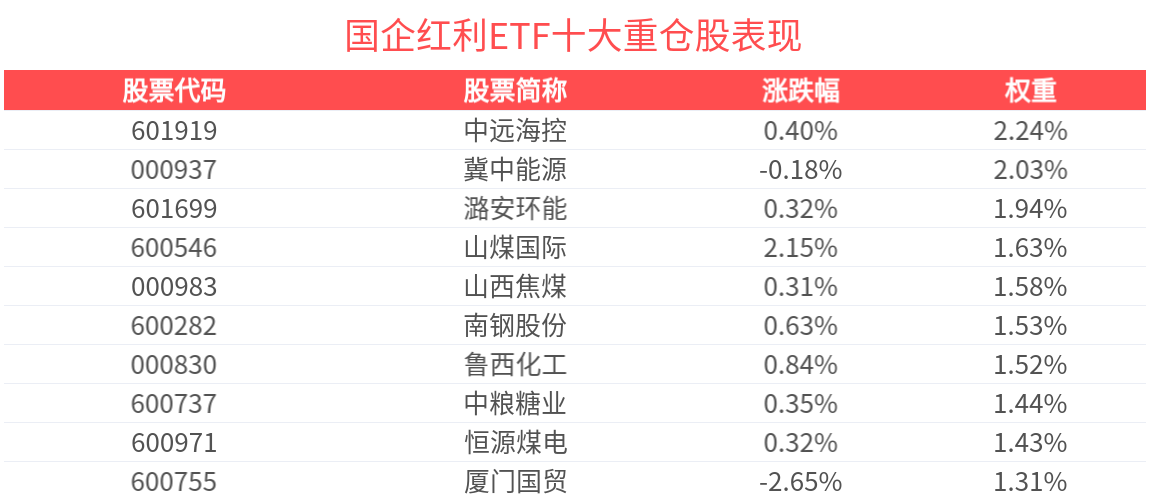
Group 1 - The core viewpoint of the news highlights the performance of the China State-Owned Enterprises Dividend Index, which has shown a slight increase, with specific stocks like Huayang Co., Ltd. and Western Mining experiencing notable gains [1] - The China State-Owned Enterprises Dividend ETF (159515) has seen a recent increase of 0.18%, with an average daily trading volume of 2.8974 million yuan over the past month [1] - The Federal Open Market Committee (FOMC) of the Federal Reserve announced a 25 basis point interest rate cut, lowering the target range to 3.50%-3.75%, aligning with market expectations [1] Group 2 - Since the beginning of 2025, China's economy has demonstrated two unexpected strengths: resilient exports and a robust capital market, supported by external factors like the Fed's easing cycle and proactive domestic policies [2] - The Central Political Bureau meeting in December reaffirmed the implementation of a moderately loose monetary policy, opening up space for further reserve requirement ratio cuts and interest rate reductions [2] - The ongoing structural transition in China's economy is expected to lead to a focus on technology and dividend stocks in the A-share market for 2026, with technology being a long-term strategic direction [2] Group 3 - As of November 28, 2025, the top ten weighted stocks in the China State-Owned Enterprises Dividend Index include COSCO Shipping Holdings, Jizhong Energy, and Shanxi Coal International, collectively accounting for 16.99% of the index [3] - The performance of individual stocks within the index varies, with notable movements such as COSCO Shipping Holdings increasing by 0.40% and Jizhong Energy decreasing by 0.18% [4]
把中国式现代化底色擦得更亮 ——加快经济社会发展全面绿色转型,建设美丽中国
Ren Min Ri Bao· 2025-12-11 22:03
Core Viewpoint - Green development is a prominent feature of Chinese-style modernization, emphasizing the importance of ecological environment protection and a comprehensive green transformation of economic and social development [2][4]. Group 1: Green Transformation Initiatives - The 14th Five-Year Plan emphasizes accelerating the comprehensive green transformation of economic and social development, with a focus on building a beautiful China [2]. - The central economic work conference has prioritized "dual carbon" goals, promoting a comprehensive green transformation as a key task for the upcoming year [2]. - The ecological environment department highlights that achieving carbon peak and carbon neutrality is a strategic decision made by the central government, requiring a planned and step-by-step implementation of carbon peak actions [3]. Group 2: Energy System and Carbon Market - The construction of a new energy system is underway, with projects like the hydrogen-electric coupling demonstration in Ningbo, which has already consumed over 8.6 million kilowatt-hours of clean energy [3]. - The national carbon market has expanded to include industries such as steel, cement, and aluminum, covering over 60% of national CO2 emissions [5]. - The carbon market aims to stimulate internal motivation for carbon reduction, promoting a low-carbon development awareness across society [5]. Group 3: Energy Consumption and Efficiency - By the end of the 14th Five-Year Plan, the majority of new electricity demand will be met by new clean energy generation, with a significant reduction in coal consumption [4]. - Jiangsu's Nanjing Steel Group has implemented a smart energy management platform, achieving energy savings of over 80 million yuan in 2024 and a 4.7% reduction in energy consumption per ton of steel [7]. Group 4: Green Production and Lifestyle - The establishment of a green manufacturing system is progressing, with over 6,430 national green factories contributing to more than 20% of production value [9]. - The adoption of green lifestyles is increasing, with over 90% of urban residential communities implementing waste sorting and over 60% of consumers opting for new energy vehicles [10]. Group 5: Pollution Prevention and Ecosystem Optimization - Continuous efforts are being made to combat pollution and optimize ecosystems, with a focus on integrated protection of natural resources [12]. - The construction of a natural protection area system is advancing, with the implementation of the National Park Law marking a new phase in ecological protection [13]. Group 6: Large-scale Afforestation and Green Initiatives - Large-scale afforestation efforts have been initiated, with significant progress in ecological construction in regions like Inner Mongolia, achieving an 80% governance rate of desertified land [14]. - The 14th Five-Year Plan period is critical for accelerating the green transformation of economic and social development, with a commitment to achieving carbon peak goals [14].
AI智能体市场迎爆发式增长!江苏呈现“三极引领” 格局
Yang Zi Wan Bao Wang· 2025-12-11 12:05
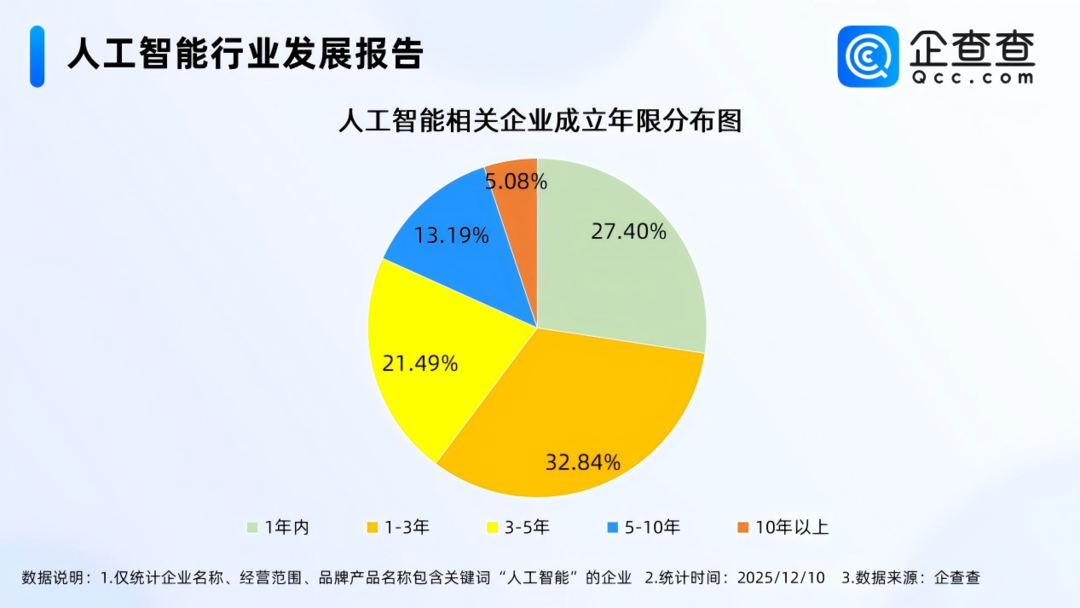
Core Insights - The AI intelligent agent has broken the limitations of human-computer interaction that relied on explicit commands, establishing a smart connection bridge between the digital and physical worlds, effectively addressing the "brain without hands" dilemma of large models, and becoming a key carrier for unleashing the value of the entire AI industry chain [1] Group 1: Industry Growth - As of December 10, there are 2.5787 million AI-related enterprises in China, with over 60% established in the last three years [3] - The registration of AI-related enterprises has shown an overall growth trend over the past decade, with 2023 seeing a record high of 549,700 new registrations, a year-on-year increase of 24.12% [3] - In 2024, it is projected that 544,500 AI-related enterprises will be registered, slightly down from the previous year but still at a high level [3] Group 2: Regional Distribution - In terms of regional distribution, Jiangsu province has a high concentration of AI enterprises, with Suzhou, Nanjing, and Wuxi accounting for over 70% of the province's total [5] - The new AI-related enterprises registered this year are predominantly located in East China, accounting for 32.08%, followed by South China at 21.16% and North China at 15.15% [3] Group 3: Market Potential - The global AI intelligent agent market is expected to experience explosive growth, reaching a market size of $11.3 billion by 2025 and nearly $50 billion by 2030 [6] - The Chinese AI intelligent agent market is projected to reach 6.9 billion yuan by 2025 and nearly 30 billion yuan by 2030, with a compound annual growth rate expected to exceed 30% from 2025 to 2030 [6]
钢铁行业2026年投资策略:减量提质,价利回稳
GF SECURITIES· 2025-12-11 09:08
Core Viewpoint - The steel industry is expected to experience a reduction in production capacity and an improvement in quality, leading to stabilization in prices and profits in 2026 [1] Group 1: Supply - A new capacity replacement policy is set to be implemented, which is expected to continue reducing crude steel production in 2026 [6] - The capacity replacement policy will increase the reduction ratio in non-key areas to at least 1.5:1, enhancing long-term capacity constraints [14][18] - The overall crude steel production is anticipated to decrease year-on-year due to differentiated production restrictions and proactive production control by enterprises [6][28] Group 2: Demand - Investment stability and domestic demand expansion are expected to lead to a recovery in steel demand in 2026 [6] - The construction sector is projected to see a recovery in fixed asset investment, supported by policies aimed at stabilizing the real estate market [36] - Manufacturing sectors such as automotive, machinery, and home appliances are expected to maintain growth in steel demand due to supportive policies [6][57] Group 3: Costs - Steel cost pressures are expected to continue easing in 2026, with iron ore supply slightly increasing and demand stabilizing [6][61] - The global iron ore supply is projected to see a slight increase, with the four major mining companies expected to have a production growth rate of about 1.8% in 2026 [66] - The overall balance between iron ore supply and demand is expected to remain weak, with prices anticipated to fluctuate downward [6][61] Group 4: Prices and Profits - The reduction in production and improvement in quality are expected to help stabilize steel prices and profits in 2026 [6] - Demand for flat steel is expected to remain stronger than for long steel, with policies aimed at further tapping into consumption potential [6] - The anticipated decline in crude steel production, primarily driven by loss-making enterprises and policy-induced reductions, will contribute to a mild improvement in the steel supply-demand landscape [6] Group 5: Investment Recommendations - The report suggests focusing on leading companies in the ordinary steel sector and those involved in restructuring and integration, such as Baosteel, Hualing Steel, and Nanjing Steel [6] - In the special steel sector, high-performance steel products are encouraged, with companies like Jiuli Special Materials and Yongjin Co. expected to benefit from policy support [6][7]


红利低波ETF(512890)年内规模增长超百亿元,机构继续看好银行板块配置价值
Xin Lang Cai Jing· 2025-12-11 04:05
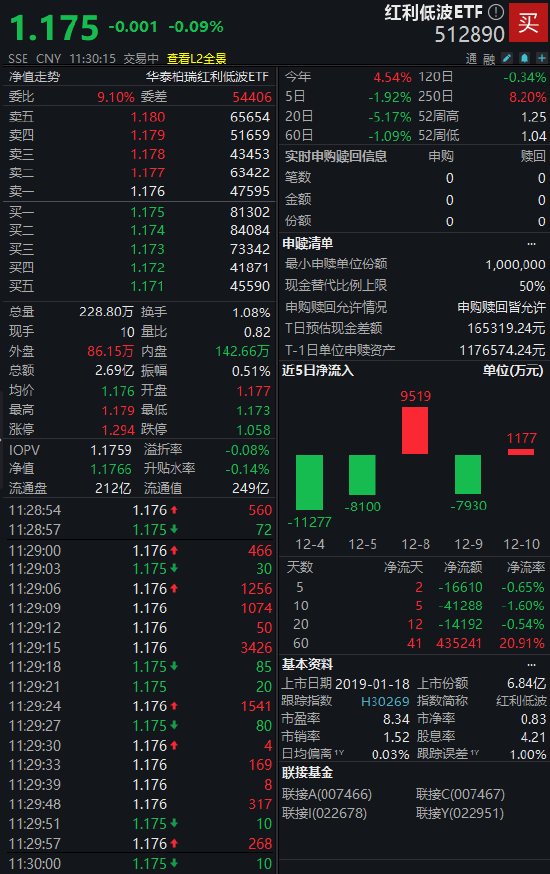
Core Viewpoint - The news highlights the performance and growth of the Hongli Low Volatility ETF (512890), which has shown significant increases in both share volume and total assets in 2025, indicating strong investor interest and market positioning. Group 1: ETF Performance - As of December 10, 2025, the Hongli Low Volatility ETF (512890) has a total share count of 21.163 billion and total assets of 24.901 billion yuan, reflecting a year-to-date increase of 72.59% in shares and 81.10% in assets compared to the previous year [3][7]. - The ETF's price slightly decreased by 0.09% to 1.175 yuan, with a trading volume of 2.69 billion yuan, making it the leading ETF in its category [1][5]. Group 2: Top Holdings - The latest report lists the top ten holdings of the Hongli Low Volatility ETF, which include major companies such as COFCO Sugar, Nanjing Bank, and Agricultural Bank of China, with significant weightings in the portfolio [3][9]. Group 3: Market Context - The banking sector's average dividend yield is currently at 3.94%, which is 2.08% higher than the ten-year government bond yield, reinforcing the attractiveness of bank stocks as high-dividend investments [4][9]. - The report emphasizes the importance of dividend value in the banking sector, suggesting that ongoing shareholder and executive buybacks will help stabilize market expectations and attract long-term capital [4][9].
中国金属学会特板数智分会在宁成立,南钢系支撑单位与发起者——
Nan Jing Ri Bao· 2025-12-11 02:54
特种板材是国家高端装备、绿色能源、海洋工程等战略领域的"核心基石",其发展水平直接关乎我 国重大工程自主安全与高端制造核心竞争力。12月10日,中国金属学会特板数智分会成立大会暨技术 交流会在南京举行,为特种板材产业数智化转型提供新助力。 作为分会支撑单位与核心发起者,我市制造业标杆企业南京钢铁集团有限公司(以下简称南钢)全 程主导筹备工作,并以自身数智化转型实践为行业高质量发展树立典范。 "分会的成立是行业发展的必然选择,更是南钢践行产业责任的具体体现。"南钢相关负责人表示, 企业始终以"产业智慧化、智慧产业化"为目标,凭借在特种板材领域的技术积累与数智化转型经验,为 分会搭建提供了坚实支撑。据了解,南钢已入选国家首批领航级智能工厂培育名单,连续3年斩获冶金 科学技术奖特等奖,拥有45个高端研发平台,211项产品(技术)达到国际先进以上水平,这些成果都 成为分会引领行业发展的重要底气。 为何在南京成立? 从自我革新到行业标杆,"南钢模式"赋能行业发展 上月底,2025世界智能制造大会在宁举行,南钢入选国家首批领航级智能工厂培育名单,同时凭 借"钢铁企业全要素资源优化与智慧运营中心"成功入选2025中国智能制 ...