字节跳动

Search documents
电子行业开年观点汇报
2026-02-24 14:16
电子行业开年观点汇报 20260223 摘要 国产算力正从硬件驱动转向模型和应用驱动,字节跳动等头部互联网公 司加大自研芯片投入,计划量产 AI 推理芯片,有望占据市场份额,信源 股份等公司受益于豆包大模型需求超预期。 海外 AI 热点集中在 OpenAI 项目,其数字员工模式深度嵌入工作流,推 动推理算力需求数量级跃升,利好 Minimax、智谱 GLM 等国产模型企 业级 API 调用量增长,对 AI 芯片及基础设施是重大利好。 各大互联网公司、服务器厂商及 GPU 公司发力研发国产超级计算机方案, Switch 芯片环节受益,建议关注盛科通信等独立第三方以太网 switch 芯片厂商,以及光模块、液冷散热、PCB 等细分赛道。 2026 年一、二季度,高密度光纤连接器和高功率连续激光芯片的新需 求将成为 A 股细分赛道价值重估的核心变量,英伟达新一代 AI 芯片的曝 光也将为 GPU 的发展指引新的增长方向。 英伟达最新旗舰产品 120.4T 交换机将推动高端 PCB、CCL 材料及上游 核心元件供应商发展,相关厂商如胜宏、生益、菲利华等有望受益, HVLP 铜箔和树脂供应商可能面临供不应求。 Q&A ...
存储供需错配仍将延续-产业链公司持续受益-存储巨头与台股2025年2026年1月经营总结
2026-02-24 14:16
存储供需错配仍将延续,产业链公司持续受益 ——存储巨 头与台股 2025 年 2026 年 1 月经营总结 20260223 摘要 存储产品价格自 2025 年以来显著上涨,DRAM 价格涨幅达三倍。尽管 涨势趋稳,但市场寡头垄断格局预示未来价格将维持高位,难以回落至 历史低点,对模组厂成本控制构成挑战。 存储巨头扩产面临物理性能瓶颈,HBM 后端验证周期长达一年半,洁净 室空间不足亦构成制约。从建厂到量产需两到三年,限制了短期内高端 产品供给的爆发性增长。 预计 2026 年 DRAM 和 NAND 供需缺口将达峰值,分别为负 4.9%和负 4.2%,主要受 AI 需求和 CSP 厂商资本支出驱动。2027 年底,中国厂 商扩产有望缓解供需紧张,2028 年供给状况或将改善。 台企受益于 AI 需求和存储市场结构调整,业绩显著增长。南亚科收入连 续五个月增长,同比增幅达 608%;华邦电营收创新高并计划扩产 NAND Flash;威刚 1 月营收同比增长 200%。 2025 年存储行业整体营收同比增长 8.09%,达 145.76 亿新台币。三 大巨头削减产能,供应链呈现多点开花局面。QLC 在服务器中应 ...
春节AI大事全梳理
2026-02-24 14:15
Summary of Key Points from Conference Call Industry Overview - The conference call primarily discusses advancements in the AI industry, focusing on major companies such as Google, OpenTropic, Alibaba, and XAI, along with their product releases and market performance. Key Company Insights Google - **Gemini 3.1 Pro**: Achieved a historic high score of 77 in AICAGI ratings, doubling the capabilities of the previous GPT-3 model. It includes innovations like generating complex maps, simulating city operations, and enhanced programming capabilities, allowing literary works to be converted into code. The model's hallucination rate decreased from 88% to 50% [1][2][3]. - **Pricing Strategy**: The pricing for Gemini 3.1 Pro remains unchanged, reflecting Google's strategy of increasing value without raising prices, potentially accelerating future iterations [3]. OpenTropic - **Sunnet 4.6**: Launched as a cost-effective general-purpose model with performance comparable to high-end models. It supports management of million-token contexts and has shown significant improvements in code generation and tool usage capabilities. The model's score improved from 15 to 60 over two years [4]. - **Revenue Growth**: Expected to quadruple revenue in 2026 compared to 2025, indicating strong market demand [4]. Alibaba - **Qianwen 3.5 Plus**: Open-sourced with 397 billion total parameters and 17 billion active parameters. Its API pricing is approximately 1/18 of Gemini 3 Pro, with a reasoning speed 19 times faster. Since 2023, Alibaba has released over 400 models, achieving over 1 billion downloads [9]. - **Market Performance**: During the Spring Festival, Alibaba's promotional activities led to significant user engagement, with 1.3 billion shopping transactions completed [9]. XAI - **Grok 4.20**: Introduced a parallel agent mechanism that enhances accuracy and logic through discussions among models. It was the only profitable model in a simulated stock trading competition, achieving an average return rate of 10% and a maximum of 47% [6]. Zhiyun Technology - **Market Valuation**: The company's market value surpassed 300 billion RMB, with revenue expectations reaching 200 times the price-to-sales ratio. Following the release of GLM 5, domestic and international versions saw price increases of 30% and 100%, respectively [10][11]. Other Notable Developments - **Doubao**: Achieved significant user engagement during the Spring Festival, with 1.7 billion interactions and 500 million generated avatars. It has become a national-level application with strong marketing capabilities [7][8]. - **Market Competition**: Companies are actively engaging in advertising and promotional activities to capture a wider customer base, reflecting the competitive nature of the current market [13]. Conclusion - The AI industry is witnessing rapid advancements and competitive dynamics, with major players releasing innovative models and achieving significant user engagement. The focus on cost-effective solutions and enhanced capabilities is driving growth and market interest.
传媒有望承接AI应用新场景
2026-02-24 14:15
Summary of Conference Call Records Industry Overview - The conference call discusses the media industry, particularly focusing on the impact of AI applications on the sector and the performance of various companies during the 2026 Spring Festival period [1][2][3]. Key Points and Arguments AI Applications in Media - ByteDance's AI application scenarios are frequent, with daily active users reaching 155 million and the Doubao model generating 67.633 billion tokens per minute [1] - Alibaba's Qianwen AI saw 200 million uses of its "one-sentence order" feature during the Spring Festival, indicating widespread AI adoption [1][2] - Tencent's Yuanbao saw a significant drop in ranking, highlighting the competitive landscape where ByteDance and Alibaba lead in AI entry points [1][2] Commercialization of AI in Media - The development of AI technology is pushing the media industry into a new phase of commercialization, with a focus on efficiency and output [3] - Advertising and digital marketing are expected to play crucial roles, with the GU strategy already demonstrating market performance [3] - The CDS 2.0 driven AIGC technology is transitioning video generation from a technical demonstration to a commercially viable stage, impacting various verticals like film, gaming, and animation [3] Spring Festival Film Market Performance - The 2026 Spring Festival film market showed a clear performance divide, with "Fast and Furious 3" leading with a box office prediction of 54.3 billion, capturing over 50% of the total box office [4] - Companies benefiting from this include unlisted Pingdu Film and listed Bona Film, Wanda Film, and others [4][5] - Despite a slight decline from the previous year's high base, the overall film market is expected to show a low-open, high-rise trend throughout 2026 [4][5] Impact of AI Films on the Industry - The official release of AI films in 2026 is anticipated to boost the AI film sector, despite challenges such as copyright issues faced by ByteDance's C station [6] - The resistance from the U.S. towards China's C-Dance 2.0 reflects a conflict between new technological revolutions and established interests, suggesting a need for balance between innovation and copyright protection [6][8] Role of AI in Content Creation - AI is increasingly integrated into various stages of film content creation, including scriptwriting and visual effects [7] - Companies that do not embrace AI technology risk being left behind, similar to past transitions in the film industry [7] Strategies for Traditional Film Companies - Traditional film companies should leverage their strengths in digital content, copyright, and IP by incorporating AI to enhance competitiveness [9] Future Outlook for ByteDance and the Film Market - ByteDance's industry chain shows strong potential for growth, driven by innovation despite facing short-term challenges [10] - The overall film market in 2026 is expected to perform well, with companies like Bona Film and Wanda Film poised for success [11] New Developments in the Gaming Sector - The gaming sector is highlighted with new product launches and developments from companies like Shunwang Technology and Perfect World [12] Investment Opportunities in Digital Marketing - The digital marketing sector presents investment opportunities in companies such as BlueFocus, Shunwang Technology, and others, with a focus on AI applications enhancing their business lines [13]



春节AI综述-大模型-CPO与光纤光缆
2026-02-24 14:15
Summary of Key Points from Conference Call Industry Overview - The conference call primarily discusses the **AI**, **CPU**, and **optical fiber communication** industries, highlighting the performance of companies like **Lumentum**, **长飞 (Changfei)**, and **亨通 (Hengtong)** during the 2026 Spring Festival period [1][2]. Core Insights and Arguments - **AI and Agent Technology**: The application of Agent technology is driving demand for personal terminal devices, with significant updates from major players like **字节跳动 (ByteDance)** and **阿里巴巴 (Alibaba)**, as well as overseas models like **GPT-3.1** and **Cloud 4.6** [2]. - **CPU Market Performance**: Companies in the CPU sector, particularly **Lumentum**, have shown strong performance despite challenges in the market, with expectations for rationality as new product launches approach [2]. - **Optical Fiber Communication Growth**: Companies like **长飞** and **亨通** are benefiting from domestic infrastructure projects and global division of labor, with high-end product exports contributing to growth potential [1][2]. - **CPO Technology Impact**: CPO technology has a limited impact on power consumption reduction (2%-4%), and the stability of AI infrastructure is deemed crucial for large capital expenditure projects [7][8]. - **NPU Adoption**: The NPU (Network Processing Unit) solution is expected to gain traction, potentially increasing shipment volumes significantly by 2027 [9]. Emerging Trends - **Cabinet Market Dynamics**: The optical communication field is seeing a shift towards low-power, high-efficiency optical interconnection solutions, with CPU and NPU becoming mainstream choices [3]. - **Silicon Photonics Development**: Companies like **新易盛 (NewEase)** are advancing in silicon photonics, with the potential for large-scale production of core components [11][12]. - **Challenges in Silicon-Based Technology**: The industry faces challenges related to light emission, heat control, and signal modulation, necessitating collaboration across the supply chain [13]. Market Opportunities - The optical communication market is viewed as a growth opportunity for both established and emerging companies, with various regions (Mainland China, Taiwan, North America) having unique advantages [5]. - A-share companies in the optical communication sector are considered to have investment value, particularly in the context of an expanding market [6]. Additional Insights - **AI Application Penetration**: Currently, only about 0.01% of the population is paying for AI services, but this is expected to grow rapidly with advancements in model capabilities [16]. - **User Behavior Changes**: There is a notable shift in user behavior from app engagement to API interactions via agents, leading to increased uncertainty in software ecosystems [17]. - **Domestic Inference Computing Limitations**: Domestic inference computing is currently insufficient to meet the demand for agent overflow, highlighting a need for improved infrastructure [19]. - **Future AI Trends**: The proliferation of personal agents is anticipated to lead to exponential growth in token consumption and hardware demand, particularly for GPUs [20][21].
AI主线开年布局-春节期间海内外大模型产业动态
2026-02-24 14:15
Summary of Key Points from the Conference Call Industry Overview - The conference call discusses the developments in the AI industry, particularly focusing on domestic models like Zhipu and Minimax, which have shown strong performance in Agent AI and cost optimization, leading in usage on third-party platforms like Open Router [1][2]. Core Insights and Arguments - **Domestic Model Performance**: Zhipu and Minimax have released new versions (GM5 and M2.5) that excel in coding and agent capabilities, with Zhipu performing well in benchmark tests and Minimax leading in agent capabilities and cost optimization [2]. - **Token Demand Growth**: The rise of Agent AI has significantly increased token demand, making global developers more price-sensitive. Domestic models are capturing substantial demand due to their high cost-performance ratio [1][2]. - **Revenue Growth**: Kimi's K2.5 version generated revenue equivalent to its entire previous year's income within 20 days post-launch, with a higher proportion of revenue coming from overseas [4]. - **ByteDance's C-DOS 2.0**: ByteDance's C-DOS 2.0 is recognized as a leader in video generation, outperforming competitors in effectiveness, cost-performance, and usability, especially during the Spring Festival [5]. - **Alibaba's Progress**: Alibaba's Qianwen 3.5 has improved in multi-modal understanding and reasoning capabilities, maintaining a strong open-source approach despite a slower C-end deployment compared to ByteDance [6]. - **OpenAI's Revenue Goals**: OpenAI aims for $280 billion in revenue by 2030, planning to invest $665 billion in computing power, indicating strong commercial expectations [7]. - **Google's Gemini 3.1**: Google released Gemini 3.1, which is considered to have the leading comprehensive capabilities globally, competing closely with OpenAI's GPT-5.2 [7]. Additional Important Insights - **Future Trends**: The AI industry is expected to see significant advancements in reasoning technology by 2026, with unified models being a key trend that integrates content understanding and generation across various media [3][9]. - **SaaS Model Challenges**: The SaaS model faces challenges, particularly with user-based pricing, but underlying demand for AI infrastructure remains strong, benefiting companies in cloud computing and related fields [11]. - **Investment Opportunities**: Despite short-term pressures, companies with strong industry knowledge and customer barriers are expected to prove their value in the long term, with high-margin companies like TaxFriend and Glodon maintaining significant advantages in the AI era [12]. - **Multi-Agent Collaboration**: The Multi-Agent Scaling Law suggests that collaborative agents can significantly enhance overall efficiency, as demonstrated by Kimi K2.5, which utilizes multiple agents for improved task performance [17]. Conclusion - The AI industry is rapidly evolving, with domestic companies gaining ground through innovative models and competitive pricing. Key players like ByteDance and Alibaba are making strides in multi-modal capabilities, while global giants like OpenAI and Google set ambitious revenue targets. Investors should focus on the ongoing demand for AI solutions and the potential for significant advancements in technology and infrastructure.
AI催生巨量Token消耗 算力租赁供不应求
Mei Ri Jing Ji Xin Wen· 2026-02-24 12:37
Group 1: AI and Token Consumption - The AI industry is experiencing a surge in token consumption, driven by major internet platforms investing heavily to transition users from traditional search to chatbots, thereby increasing reasoning volume and accelerating token consumption [1][4] - By December 2025, ByteDance's Doubao model is expected to reach a daily token usage of over 50 trillion, a tenfold increase from the previous year, while Google's platforms are projected to handle 1.3 trillion tokens monthly, up from 97 billion a year prior [4] - The rising demand for tokens is leading cloud service providers to increase their prices, with Amazon and Google announcing price hikes for their machine learning services in early 2026 [4][5] Group 2: Power and Cooling Solutions - The demand for AI computing power is escalating, but stricter policies on data center energy consumption are pushing the industry towards more efficient cooling solutions, such as liquid cooling, which can achieve a Power Usage Effectiveness (PUE) of 1.1 to 1.2 compared to traditional air cooling systems [1][11] - Companies like 算想科技 are transitioning to liquid cooling solutions, with expectations that the share of liquid-cooled servers will rise from 5% to 60-70% in the coming years due to technological advancements that reduce costs [12] - The first commercial immersion liquid cooling project using silicon-based cooling fluids has been launched, demonstrating the reliability and economic viability of these materials in real-world conditions [13] Group 3: Market Dynamics and Trends - The AI computing power rental market is experiencing significant growth, with many AI companies shifting from building their own computing power to renting it due to rising hardware prices [6][7] - Industry leaders are investing heavily in AI cloud infrastructure, as evidenced by NVIDIA's $2 billion investment in CoreWeave to enhance AI computing capabilities [8] - The market is witnessing structural contradictions, with traditional computing power rental models still dominant, but a shift towards edge computing and inference power is becoming more pronounced as AI applications expand [9][10]
“烧钱”80亿发红包,四款AI轮流登顶榜首,背后公司股价却集体走低,靠“撒钱”能留住用户吗?
Xin Lang Cai Jing· 2026-02-24 12:30
Core Insights - The "AI Red Packet War" among internet companies has concluded following the Spring Festival holiday, with significant financial investments made in AI tools and related apps [1][11] - A total of over 8 billion yuan was reportedly spent by multiple internet companies during this period, raising questions about user retention beyond the monetary incentives [3][13] Investment and User Engagement - Alibaba's Qianwen invested 3 billion yuan, Tencent's Yuanbao distributed 1 billion yuan, and ByteDance's Doubao offered tech gifts during the campaign [3][13] - Yuanbao reported over 50 million daily active users (DAU) and 114 million monthly active users (MAU) during the event, with users participating in over 36 billion lottery draws and completing over 1 billion AI creations [14] - Qianwen facilitated nearly 200 million orders during the Spring Festival, with significant sales in beverage categories [14] App Performance - Four apps, Yuanbao, Qianwen, Antifortune, and Doubao, dominated the iOS free app rankings, with varying durations at the top [4][14] - Post-campaign, Yuanbao's ranking dropped significantly, indicating potential challenges in maintaining user engagement [18] Market Reaction - The capital market showed skepticism towards the "AI Red Packet War," with the Hang Seng Technology Index experiencing declines, and major companies like Alibaba and Tencent seeing their stock prices fall [6][16] User Retention Challenges - Experts suggest that user retention will depend more on the core value and experience of the products rather than the size of the red packets [8][19] - Successful AI tools must integrate into real-life scenarios and provide personalized services to maintain user interest [19][20] Future Outlook - The "AI Red Packet War" may signify a pivotal shift from mobile internet to AI internet in China, similar to how WeChat red packets transformed payment landscapes [19] - The AI assistant market is expected to evolve into a competitive landscape with differentiated offerings, where leading players leverage ecosystems and scale [20]



腾讯元宝跌出下载榜前30,没能重现马化腾希望当年微信红包的“爆款效应”
Sou Hu Cai Jing· 2026-02-24 12:05
腾讯元宝的热度回落并非偶然。尽管其在春节期间DAU一度突破5000万,MAU达到1.14亿,春节主会场累计抽奖次数超36亿次。 但随着活动结束,用户留存问题迅速暴露。22日尚位列第10,23日便跌出前30,显示出其在用户粘性和产品竞争力方面的短板。 字节阿里霸榜AI应用,腾讯元宝未能重现微信红包盛世 据雷锋网报道,曾凭借"分10亿现金红包"活动在春节期间一度登顶苹果AppStore免费应用榜首的腾讯元宝,近日却迅速滑落。 截至2月23日,腾讯元宝已跌出榜单前30,下载量持续走低,显示出用户对短期激励活动的依赖性极强,活动结束后难以维持热度。 与之形成鲜明对比的是,字节跳动与阿里巴巴系产品在榜单中占据绝对优势。数据显示,豆包位居榜首,千问紧随其后位列第二,蚂蚁阿福也成功跻身前 四。榜单前十名中,阿里与字节旗下产品共占据8席,仅云闪付(凭借发票抽奖活动)和12306(依托出行刚需)突围上榜。 | 中营模 | | 11 | | 21 | 悟空浏览器-看短剧小说影视 | | --- | --- | --- | --- | --- | --- | | | | | 家庭聚会 No.1 Chengdu Kingsoft S ...

从春晚到景区科技buff叠满!这届中国年太会了
3 6 Ke· 2026-02-24 11:28
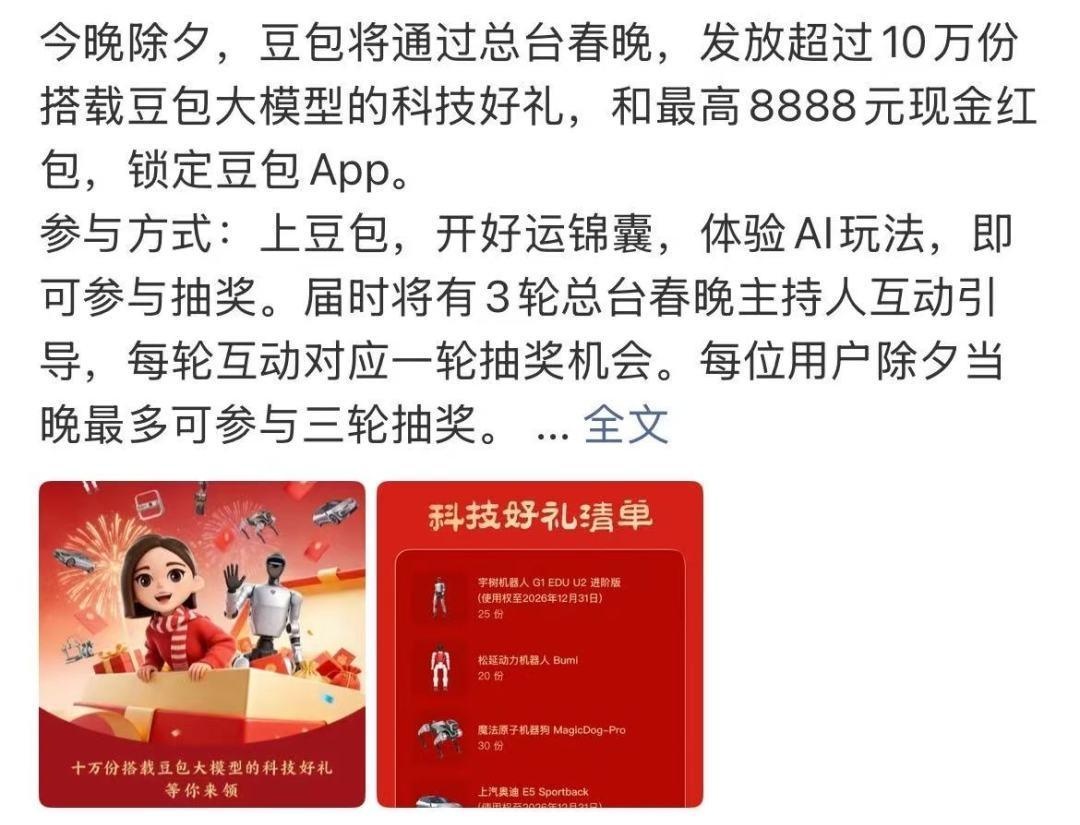
春晚上豆包的新春红包活动,你中奖了没?! 作为央视春晚独家AI云合作伙伴,豆包这次直接把"全能"焊在了身上。全新Seedance 2.0、Seedream以及空间视频技术全面赋能春晚舞台,将中国传统文化 与AI科技来了一场深度融合。就连春晚的具身机器人表演,也靠豆包语音模型实现深度语义理解,精准分析对话语境与情绪变化,让机器人语言表达更生 动、更拟人,互动感直接拉满。 图源:豆包官方微博 用户端的科技体验也没落下,春节AI入口战早早打响,阿里、腾讯、百度等大厂狂撒超45亿元红包和补贴,字节跳动旗下豆包则联手火山引擎的"算力+大 模型"组合强势入局,让大家在抢红包的快乐中,感受AI的魅力。 舞台上的机器人"天团",更是承包了今年春晚所有燃点和萌点。还记得去年穿大红袄扭秧歌的机器人么,今年它们直接组团整活。魔法原子、银河通用、宇 树科技、松延动力四大科技大佬同台亮相,各展神通。三登春晚的宇树科技,派出16台G1/H1人形机器人,在《骐骥新姿》里完成高难度群舞,动作整齐划 一超吸睛;魔法原子秀出多机协同技术,银河通用则展示了具身大模型自主决策能力,让机器人摆脱了标准化动作,能灵活互动,朝着生活化场景大步迈进 相信今 ...