
中兴通讯

Search documents
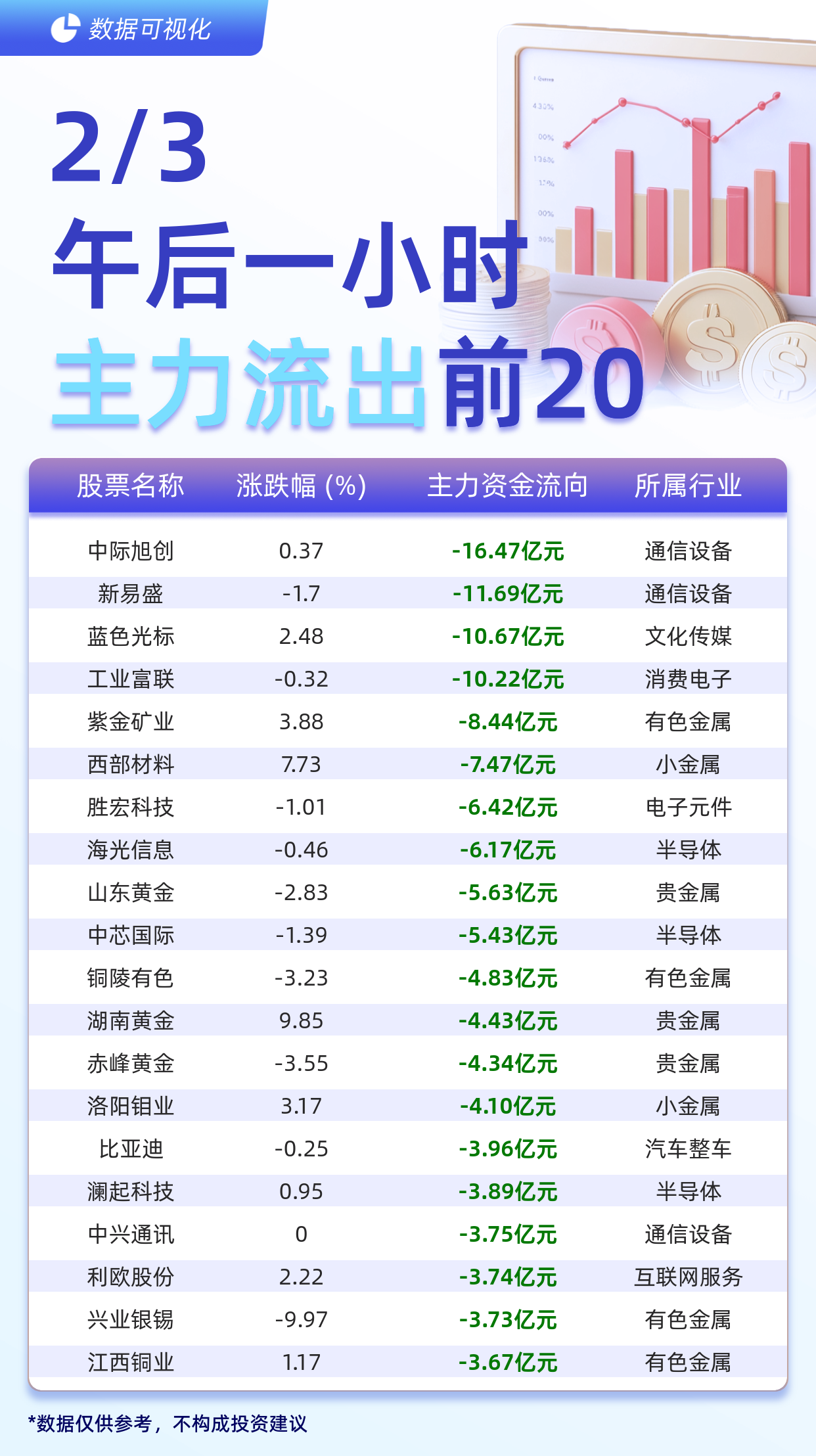
主力个股资金流出前20:中际旭创流出16.47亿元、新易盛流出11.69亿元
Jin Rong Jie· 2026-02-03 06:12
Core Viewpoint - The data indicates significant outflows of capital from various stocks, with notable amounts leaving the communication equipment and precious metals sectors [1][2][3] Group 1: Stock Performance and Capital Outflow - Zhongji Xuchuang experienced a capital outflow of 1.647 billion, with a slight increase in stock price of 0.37% [2] - Xinyi Sheng saw a capital outflow of 1.169 billion, with a decline in stock price of 1.7% [2] - BlueFocus Media had a capital outflow of 1.067 billion, with a stock price increase of 2.48% [2] - Industrial Fulian faced a capital outflow of 1.022 billion, with a decrease in stock price of 0.32% [2] - Zijin Mining reported a capital outflow of 0.844 billion, with a stock price increase of 3.88% [2] - Western Materials had a capital outflow of 0.747 billion, with a notable stock price increase of 7.73% [2] Group 2: Sector Analysis - The communication equipment sector is facing significant capital outflows, with Zhongji Xuchuang and Xinyi Sheng leading the outflows [1][2] - The precious metals sector, including companies like Shandong Gold and Zijin Mining, is also experiencing notable capital outflows [1][3] - The automotive sector, represented by BYD, has a capital outflow of 0.396 billion, with a slight decrease in stock price of 0.25% [3]





港股午评:恒指微涨0.2%、科指跌1.32%,商业航天概念股走高,黄金股反弹,科网股集体低迷
Jin Rong Jie· 2026-02-03 04:10
Market Overview - The Hong Kong stock index experienced a "V" shaped movement, with the Hang Seng Index rising by 0.2% to 26,830.23 points, while the Hang Seng Tech Index fell by 1.32% to 5,453.46 points [1] - Major technology stocks declined, with Alibaba down 1.78%, Tencent down 3.09%, and JD Group down 0.45% [1] - Commercial aerospace stocks saw significant gains, with Asia Pacific Satellite rising over 9% [1] - Chinese brokerage stocks weakened, with CICC falling over 2% [1] - Gold and silver stocks rebounded, with WanGuo Gold rising over 6% and Luoyang Molybdenum up over 4% [1] Company News - Cloud Factory (02512.HK) secured a contract for the second phase of an AI industrial base project valued at RMB 520 million [2] - ZTE Corporation (00763.HK) plans to invest RMB 117 million in the Jianxing Zhanlu Fund to support innovation businesses and related industries [2] - XPeng Motors (09868.HK) delivered 20,011 new vehicles in January [3] - Laijin Entertainment (08172.HK) received authorization from Ant Group to become an official service provider for "Ant Treasure Box" [4] - Jun Dong Holdings (08277.HK) signed a timber harvesting and sales agreement with Jinda Forestry [5] - Universal Medical (02666.HK) plans to issue corporate bonds totaling up to RMB 1 billion [6] - Blue River Holdings (00498.HK) entered into a cooperation framework agreement with Energy Storage Investment Company [7] - China Merchants Jinling (00978.HK) reported a contract sales total of approximately RMB 32.308 billion for 2025, a year-on-year decrease of 23.91% [8] - Junsheng Tai Pharmaceutical (02511.HK) appointed Dr. Filip Surmont as Chief Medical Officer to strengthen its focus on cardiovascular and metabolic diseases [8] Institutional Insights - Huatai Securities noted a significant pullback in A-shares and Hong Kong stocks, driven by the "Wall Street" trading sentiment, leading to liquidity pressure [9] - The adjustment is seen as more technical and emotional, with a positive medium-term outlook for Chinese assets [9] - Galaxy Securities highlighted ongoing geopolitical risks and a decrease in expectations for Fed rate cuts, predicting continued volatility in Hong Kong stocks [9] - Recommended sectors include technology, energy, precious metals, and consumer stocks, which are expected to rebound as consumption policies increase ahead of the Spring Festival [9] - Huatai Securities indicated that the sentiment index has shifted from panic to optimism, suggesting that current volatility may persist but is more likely to be a pullback rather than a reversal [10]
AI入口成大厂“兵家必争高地”
Nan Fang Du Shi Bao· 2026-02-03 03:58
Core Viewpoint - The competition in the AI sector is intensifying, with companies like Tencent, ByteDance, and Alibaba exploring different approaches to AI assistants and smart devices, highlighting the importance of user privacy and security in their strategies [1][4][8]. Group 1: Company Strategies - Tencent's CEO, Ma Huateng, criticized the security risks associated with the "Doubao" phone's screen recording and cloud uploading features, emphasizing the need for responsible practices in technology [1][4]. - ByteDance, in collaboration with ZTE, aims to integrate AI directly into smartphones with the "Doubao" assistant, focusing on cross-application tasks without waiting for app interfaces to open [2][6]. - Alibaba's "Qianwen" AI application emphasizes a controlled ecosystem, integrating shopping recommendations and payment processes within its own platforms, which allows for better transaction and risk management [3][6]. Group 2: User Privacy and Security - The "Doubao" assistant claims to operate under strict user authorization and compliance, ensuring that no data is stored or used for training, with encrypted transmission and robust protective measures [5][6]. - Concerns about privacy and security have escalated, with users experiencing restrictions on popular apps like WeChat and Alipay due to the assistant's operations, raising questions about the balance between functionality and safety [5][6]. - Industry experts highlight that as AI assistants approach system-level capabilities, the challenges of ensuring user privacy and data security become more complex, necessitating clearer regulations and standards [6][7]. Group 3: Industry Trends and Future Directions - The AI industry is shifting from simple Q&A capabilities to more complex tasks, with a focus on creating intelligent agents that can perform actions on behalf of users, thus changing the interaction dynamics [2][8]. - There are two main approaches emerging in the market: the "screen reading + simulated clicking" method, which is more universal but faces platform barriers, and the "API interface calling" method, which is more structured and manageable [6][7]. - The competition among "Doubao," "Qianwen," and Tencent's "Yuanbao" signifies a new phase in the AI entrance battle, characterized by product innovation and the need for regulatory frameworks to support safe and effective AI deployment [8].



平安证券(香港)港股晨报-20260203
Ping An Securities Hongkong· 2026-02-03 03:37
Market Overview - The Hong Kong stock market experienced a decline, with the Hang Seng Index closing at 23,831 points, down 145 points or 0.61% [1][5] - The Hang Seng Technology Index fell by 3.36%, while the Hang Seng China Enterprises Index decreased by 2.54% [1][5] - The market turnover decreased to 82.799 billion [1][5] U.S. Market Performance - The U.S. stock market saw gains, with the Dow Jones Industrial Average rising over 500 points, closing up 1.05% at 49,407.66 points [2] - The Nasdaq and S&P 500 also recorded increases of 0.56% and 0.54%, respectively [2] - Over 100 companies in the S&P 500 are set to report earnings this week, including major players like Amazon and Alphabet [2] Investment Opportunities - The report highlights the potential for long-term growth in sectors supported by the "self-reliance in technology" policy, particularly in AI applications, semiconductors, and industrial software [3] - The infrastructure and copper mining sectors, particularly China Railway (0390.HK), are noted for their recent performance, with a weekly increase of 11.0% before a slight pullback [3] - The report suggests continued focus on sectors benefiting from domestic consumption policies, including sports apparel and non-essential services [3] Key Company Insights - China Telecom (0763.HK) is recognized for its comprehensive product line and solutions in the telecommunications sector, despite a slight decline in revenue and net profit for 2024 [10] - The company maintains a high gross margin of 37.91% and is expected to leverage its advancements in computing power to sustain competitive advantages [10] - The projected net profits for 2025 and 2026 are 7.98 billion and 8.81 billion RMB, respectively, indicating a relatively low valuation compared to its earnings potential [10] Market Trends - The report emphasizes the importance of the low-altitude economy, with a guideline established for its standardization by 2027, which is expected to drive demand in this sector [9] - Companies like AVIC (2357.HK) and ZTE (0763.HK) are recommended for their potential in the low-altitude economy [9] - The report also notes the government's initiatives to boost consumer spending during the Spring Festival, which may benefit companies in the automotive and home appliance sectors [9]
推动AI Agent走向企业生产力 中兴通讯上线Co
Huan Qiu Wang· 2026-02-03 03:30
中兴通讯认为,AI Agent 的上半场是热闹,下半场是生产力。如果无法完成"最后一公里"的工程化落地,再强大的模型也难以转化为真实的生产效益。Co- Claw 企业版的诞生,正是为了跨越这道分水岭。它不仅是一个工具,更是一套赋能体系。从业界火爆的 OpenClaw 到中兴 Co-Claw企业版,补齐的不是功 能,而是企业级落地能力。 通过补齐企业级部署、安全治理与能力复用等关键短板,Co-Claw 让 AI Agent 在中兴通讯内部正式迈入"规模化应用"与"价值深耕"的新阶段。 让智能体 " 跑得住 " :把运行、模型与部署变成企业级底座能力 要让 AI Agent 真正成为生产力,第一件事往往不是更会"聊天",而是更会"长期在线+处理业务"。在企业里,智能体如果依赖个人设备状态运行,就很难做 到 7×24 小时稳定可用,也难以实现统一运维和安全管控。 Co-Claw 企业版选择把运行环境统一落在企业内部的云电脑之上,以企业级运行底座替代业界常见的本地小主机方式(如 Mac mini 等),让智能体可以持 续在线、统一管理,像一名"始终在岗的数字员工"一样稳定响应任务与执行流程。中兴通讯使用自有的已规模商 ...

2025年中国光电子器件产量为19233.9亿只(片、套) 累计增长8.8%
Chan Ye Xin Xi Wang· 2026-02-03 03:07
Core Viewpoint - The report by Zhiyan Consulting highlights the trends and forecasts for the optoelectronic device industry in China from 2026 to 2032, indicating a slight decline in production in December 2025 but an overall growth in annual production for the year [1] Group 1: Industry Overview - In December 2025, China's optoelectronic device production reached 173.3 billion units, reflecting a year-on-year decrease of 0.6% [1] - For the entire year of 2025, the cumulative production of optoelectronic devices in China was 1,923.39 billion units, showing a cumulative growth of 8.8% [1] Group 2: Market Research and Insights - Zhiyan Consulting is recognized as a leading industry consulting firm in China, specializing in in-depth industry research reports, business plans, feasibility studies, and customized services [1] - The firm emphasizes its commitment to providing comprehensive industry solutions to empower investment decisions through professional insights and quality services [1]





SpaceX宣布收购xAI;智元将办机器人晚会丨新鲜早科技
2 1 Shi Ji Jing Ji Bao Dao· 2026-02-03 02:39
Group 1: Mergers and Acquisitions - SpaceX has confirmed its merger with xAI, aiming to integrate AI with rocket technology and space-based internet solutions, highlighting the need for sustainable energy sources for AI development [2] Group 2: Technological Advancements - Tesla has achieved mass production of dry electrode technology, a significant breakthrough in lithium battery production that reduces costs and energy consumption while enhancing scalability [3] - The launch of Step 3.5 Flash by Jiyue Xingchen introduces a powerful open-source model with advanced reasoning capabilities, designed for complex tasks and efficient processing [7] Group 3: Market Developments - Long Fiber announced that the global fiber optic cable market remains stable, despite fluctuations in product prices, and emphasized the minor impact of new data center products on overall demand [8] - TrendForce has revised its projections for memory prices in Q1 2026, anticipating significant increases in DRAM and NAND Flash prices due to heightened demand from AI and data centers [12] Group 4: Investments and Financing - ZTE plans to invest 117 million yuan in the Jianxing Zhanlu Fund, focusing on new information technology, renewable energy, AI, and advanced manufacturing [6] - Zhujijidong has completed a $200 million Series B financing round, with participation from various notable investors, aiming to increase R&D and market investments in 2026 [13] - Wofei Changkong has secured nearly 1 billion yuan in financing to support the certification and commercialization of its AE200 eVTOL aircraft [14]




未知机构:中金军工商业航天信科移动更新点评市场部分投资者传言1-20260203
未知机构· 2026-02-03 02:20
Summary of Conference Call Notes Company and Industry Involved - The focus is on **信科移动 (Xinke Mobile)** and the **satellite internet industry** in China, particularly in relation to competitors like **华为 (Huawei)** and **中兴 (ZTE)** Core Points and Arguments 1. **Market Concerns**: There are rumors among investors that: - Chinese satellite internet may not achieve commercialization - Xinke Mobile's second-generation satellite payload is inferior to those of Huawei and ZTE - As a result, Xinke Mobile's stock dropped by 8.4% in early trading [1] 2. **Starlink's Validation**: - Starlink has demonstrated the commercial and strategic value of global communication infrastructure - Xinke Mobile, leveraging China's manufacturing advantages, is expected to be economically competitive with Starlink once satellite and rocket capabilities are established [1][2] 3. **User Preferences**: - Overseas users are seeking alternatives to US-based services for reasons of economic viability and information security [1] 4. **Competitive Landscape**: - Xinke Mobile's main competitor in the domestic satellite internet and 6G industrialization process is Huawei - Xinke Mobile is a key player in developing communication protocols for the satellite network, holding a significant position in the global 5G NTN standards [1] 5. **Progress and Partnerships**: - Xinke Mobile has completed payload in-orbit verification, leading ahead of competitors like Huawei and ZTE [2] - The second-generation system involves numerous suppliers, with the final market share dependent on technology, cost, and efficiency [2] 6. **Feasibility and Future Plans**: - The second-generation system has completed feasibility studies, with Xinke Group planning approximately 30,000 satellite launches [2] - The system will adopt a 5G NTN framework, which is expected to unify standards for 6G and global satellite internet [2] Other Important but Overlooked Content - There is a concern among end-users and some satellite manufacturers regarding the collaborative culture of certain companies, which may affect partnerships and market dynamics [2]

继续看多航天-AI投资机会
2026-02-03 02:05
Summary of Key Points from Conference Call Records Industry Overview - The conference call discusses the AI industry and its impact on hardware and software sectors, highlighting significant growth driven by capital expenditure in AI, particularly in overseas markets [1][2]. Core Insights and Arguments - **AI Capital Expenditure**: The hardware sector has seen substantial performance improvements due to AI-driven capital expenditures, especially from overseas investments [2]. - **Software Industry Disparity**: There is a notable gap between domestic and international software industries in cloud computing, with domestic companies primarily using hybrid cloud architectures, leading to lower standardization and productization levels [1][4]. - **Rapid AI Application Development**: Since the end of 2025, AI applications have accelerated, with major companies entering the market and product iterations speeding up [1][4]. - **Multimodal Technology Advancements**: Multimodal technology has reached a stage where it can fully replace traditional production methods, with significant improvements in image recognition and video generation capabilities [1][5][6]. - **Emergence of AI Social Products**: New AI social products have been launched by various companies, utilizing innovative methods like red envelope distribution to attract users and establish a foundation for future commercialization [1][7]. Additional Important Content - **2026 Predictions**: The year 2026 is anticipated to be a pivotal year for AI applications and commercial space ventures, with companies like ByteDance, Alibaba, and Tencent expected to accelerate their growth in traffic and business expansion [1][8]. - **Token Usage Growth**: The integration of agents and multimodal technology in workflows is expected to significantly increase token usage, benefiting cloud and edge computing demands, as well as terminal device markets like AI glasses [3][9]. - **SpaceX Developments**: SpaceX is actively pursuing an IPO and plans to raise over $40 billion, with applications for millions of AI satellites that could enhance satellite deployment rates globally [3][9]. - **Apple's Collaboration with SpaceX**: Apple is in discussions with SpaceX to integrate Starlink connectivity into the iPhone 18 Pro, indicating a shift towards satellite communication as a potential alternative to cellular networks [9]. This summary encapsulates the key points discussed in the conference call, providing insights into the current state and future trends of the AI and commercial space industries.
光连接专家交流-CPO-NPO-LPO-AOC技术进展-客户订单-价值量及拆分-供应商
2026-02-03 02:05
Summary of Conference Call Notes Industry Overview - The conference discusses advancements in optical connection technologies, specifically AOC (Active Optical Cable), LPO (Linear Photonic Module), and NPO (Network Photonic Module) technologies, along with customer orders and market dynamics in the optical module industry [1][2][20]. Key Points AOC Technology - AOC is primarily used for in-cabinet and scale-out first-layer network connections, with transmission distances of 30-50 meters [4]. - The industry is expected to ship approximately 10 million AOC units by 2025, with 3 million units being 800G products and 5 million units being 400G products [6]. - Pricing for AOC products: 800G AOC (30 meters) is priced above $1,000, while 400G AOC (10-30 meters) ranges from $500 to $600 [7]. LPO Technology - LPO differs from traditional optical modules by omitting the DSP (Digital Signal Processor), allowing for shared BOM (Bill of Materials) [11]. - LPO currently supports transmission distances of up to 500 meters and is primarily based on silicon photonics [11]. - Google is expected to require approximately 2 million LPO units in 2027, initially supplied by Acacia [2][13]. - The LPO market in North America is projected to reach 3-4 million units in 2027, potentially doubling by 2028 due to increased demand from other clients like Amazon and Microsoft [14]. NPO Technology - NPO is compact, low-power, and does not require DSP, making it suitable for GPU applications [22]. - NPO can be used for both Scale Up and Scale Out applications, offering lower power consumption and cost compared to traditional optical modules [29]. - Major domestic players like XunChuang and XinSheng are advancing their NPL projects, with sample deliveries expected in the first half of 2027 [30]. Market Dynamics - The market for AOC and LPO products is becoming increasingly concentrated, with established players like Coherent dominating the North American market [20]. - The transition to LPO and AOC products is not expected to significantly disrupt existing optical module companies, as the market structure is largely established [20]. Supplier Landscape - Major suppliers in North America include Acacia and NewEase, while domestic suppliers like BoChuang and TangXingSheng have significant shipments to clients like Alibaba and Tencent [10]. - Google plans to mass-produce single-mode 200G LC products by 2027 using silicon photonics technology [9]. Future Developments - The 1.6T LPM module is still in development and is expected to take another 2-3 years to mature [2][17]. - The industry is facing challenges in achieving 1.6T speeds due to the immaturity of existing technologies and the need for further breakthroughs [8]. Pricing and Cost Considerations - LPO modules are priced at approximately 60% of DSP module prices [16]. - NPO solutions are significantly cheaper than AEC (Active Electrical Cable) solutions, which have high costs and power consumption [36]. Additional Insights - The conference highlighted the importance of partnerships, with Acacia and Google having a close collaboration on LPO technology [12]. - The transition from traditional optical modules to newer technologies like LPO and NPO is expected to enhance performance while reducing costs [20]. This summary encapsulates the key insights and projections from the conference call, providing a comprehensive overview of the current state and future outlook of the optical module industry.
