Figure AI

Search documents
人形机器人崛起:Figure AI创始人预言将成为AI时代新基石
Sou Hu Cai Jing· 2025-07-23 02:52
Core Insights - Figure AI is leading a revolution in humanoid robotics, attracting significant attention and investment from major tech companies like Microsoft, Nvidia, OpenAI, and Jeff Bezos [1][3] - The company believes humanoid robots are essential infrastructure in the AI era, comparable to the impact of the iPhone on the mobile internet [3][5] - Figure AI's strategy includes a dual-track market approach, focusing on labor markets in the short term while aiming for household integration in the long term [5][6] Technology and Innovation - Breakthroughs in hardware and AI have enabled unprecedented growth in humanoid robotics, with advancements in all-electric systems enhancing stability and safety [3][5] - The Helix robot, powered by the S1 Helix neural network, can perform complex tasks with efficiency comparable to humans after minimal training [3][6] Market Strategy - Figure AI targets structured environments like manufacturing, logistics, and retail for early deployment, while envisioning a future where robots are commonplace in homes [5][6] - The company emphasizes the importance of design, interaction, and safety in ensuring societal acceptance of humanoid robots [6] Future Vision - Adcock posits that humanoid robots will serve as the ultimate deployment vehicle for artificial general intelligence (AGI), transforming work and productivity [6]



技术狂热过后,人形机器人下半场开拼:谁的订单先落地?
硬AI· 2025-07-22 08:22
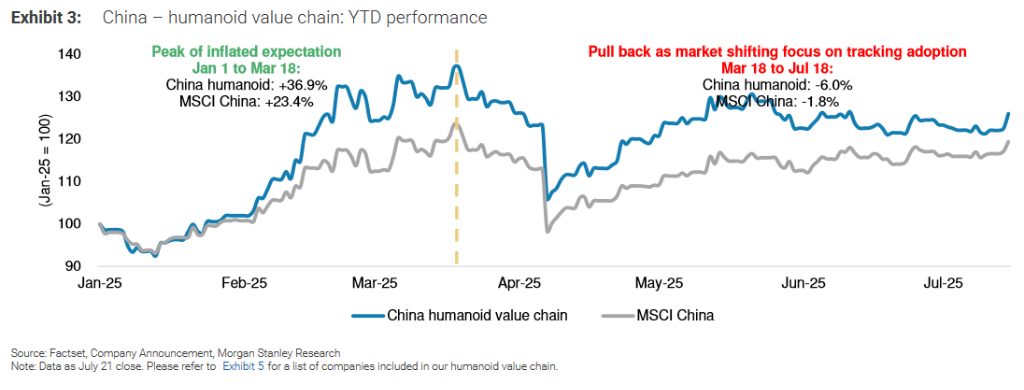
Core Viewpoint - The humanoid robot industry is transitioning from a phase of technological hype to a focus on commercial viability, with market sentiment driven by actual order acquisition and application [2][3][11]. Group 1: Market Dynamics - The humanoid robot value chain experienced a strong surge in Q1 2025, with related Chinese stocks rising by 37% from January to March, significantly outperforming the MSCI China Index [4]. - Major tech companies like Huawei, Nvidia, Google, and Meta are increasing their investments in humanoid robots, boosting market confidence [4]. - Companies have set ambitious production targets, with Tesla's CEO Elon Musk aiming to produce 5,000-10,000 Optimus robots by 2025, and Figure AI planning to deliver 100,000 units within four years [4]. - However, from March to July, the market shifted focus to actual delivery results, leading to a 6% stock pullback due to some companies lowering their production targets [2][7]. Group 2: Commercialization Focus - The focus for the second half of 2025 will be on the progress of commercial adoption, with significant contracts already emerging, such as AiZhi Robotics and Yushu Technology securing contracts worth 124 million yuan from China Mobile [12]. - Most integrators have set targets to deliver hundreds to thousands of units by 2025, with AiZhi Robotics planning to deliver 6,500 units and Tesla aiming for several thousand [13]. - The actual achievement of these targets will be a key indicator of industry progress [13]. Group 3: Technological Developments - The report highlights that several important technological updates are expected in the second half of 2025, including Tesla's Optimus Gen 3 and Figure AI's next-generation robot, Figure 03 [18]. - Hardware improvements are focused on rotary and linear actuators, as well as innovations in visual-language-behavior models [19][20]. Group 4: Upcoming Events - Key upcoming events include Tesla's Q2 2025 earnings call, the World Artificial Intelligence Conference, and the World Robot Conference, which will provide insights into the industry's progress [21]. - Morgan Stanley has updated its list of stocks in the Chinese humanoid robot supply chain, covering 45 stocks across various categories, indicating a competitive landscape where order fulfillment and commercial validation will be crucial for market performance [21].

技术狂热过后,人形机器人下半场开拼:谁的订单先落地?
Hua Er Jie Jian Wen· 2025-07-22 06:40
Core Insights - The humanoid robot industry is transitioning from a phase of technological hype to a focus on commercial viability, with order acquisition and practical applications becoming key market drivers by the second half of 2025 [1][2][5]. Market Dynamics - In Q1 2025, the humanoid robot value chain experienced a strong surge, with Chinese stocks rising by 37% from January to March, significantly outperforming the MSCI China Index [2][3]. - Major tech companies, including Huawei, Nvidia, Google, and Meta, are increasing investments in humanoid robots, boosting market confidence [2]. - High production targets have been set by companies, such as Tesla aiming to produce 5,000-10,000 Optimus robots and Figure AI planning to deliver 100,000 units within four years [2]. - Technological advancements, particularly in visual-language-action (VLA) models, have shown significant improvements in robot intelligence [2]. Government Support - Government policies are increasingly supportive, with mentions of "embodied intelligence" in official reports and high-profile showcases like Yushutech's H1 robot at the CCTV Spring Festival [3]. Market Adjustments - From March to July, the market shifted focus to actual deployment, leading to a 6% stock pullback due to companies lowering their production targets, including Tesla's adjustment for Optimus [3][5]. - The market is now demanding tangible commercial value to validate investment logic in the humanoid robot sector [3]. Commercialization Focus - The second half of 2025 will see a heightened focus on commercial adoption, with significant orders already emerging, such as contracts worth 124 million yuan from China Mobile to Aizhi Robotics and Yushutech [5]. - Companies are setting ambitious delivery targets for 2025, with Aizhi Robotics planning to deliver 6,500 units, Tesla aiming for several thousand, and UBTech targeting 1,100-1,300 units [5]. Technological Developments - Upcoming technological releases include Tesla's Optimus Gen 3, which is expected to have human-like agility, and Figure AI's next-generation robot designed for affordability and mass production [11]. - Hardware improvements are focused on actuator designs and the development of new manufacturing techniques to enhance efficiency [12]. Upcoming Events - Key upcoming events include Tesla's Q2 2025 earnings call, the World Artificial Intelligence Conference, and the World Robot Conference, which will be critical for monitoring industry developments [13]. Industry Landscape - Morgan Stanley has updated its list of 45 stocks in the Chinese humanoid robot supply chain, indicating a competitive landscape where the ability to secure orders and demonstrate commercial value will be crucial for market performance [13].
东海证券晨会纪要-20250721
Donghai Securities· 2025-07-21 08:02
Key Insights - The report emphasizes a longer investment cycle, transitioning from price rebounds to performance realization, highlighting the importance of sustained earnings in equity markets compared to commodity investments [6][8] - A fire incident at Covestro's German plant has disrupted TDI supply, leading to price increases due to limited availability and strong overseas demand [11][12] - Forklift sales in the first half of 2025 have shown double-digit growth, with domestic sales increasing by 27.3% and exports by 15.2%, driven by strong demand in manufacturing and logistics sectors [16][17] - The humanoid robot industry is experiencing a significant shift from concept to mass production, with major companies ramping up investments and production plans, indicating a burgeoning market potential [21][22] Group 1: Investment Logic and Market Overview - The global asset review indicates a mixed performance in stock markets, with the Hang Seng Tech Index outperforming other indices, while commodity prices have shown varied trends [6][8] - The RJ/CRB commodity price index has increased by 2.97% since early July, reflecting a broader trend of price fluctuations in commodities [8] - The report notes that the domestic equity market is characterized by a growth-oriented style, with a daily average trading volume of 15,260 billion yuan [7] Group 2: Chemical Industry Insights - The incident at Covestro has resulted in a significant supply disruption for TDI, with an estimated 117,000 tons of capacity affected globally, representing 35% of total capacity [12][13] - Domestic TDI prices have surged, with prices in East China reaching 13,700-14,200 yuan per ton, reflecting a rise of over 2,000 yuan since July [12][14] - The report suggests that Chinese companies are well-positioned to capture increased export opportunities in the TDI market due to shrinking overseas capacity [13][15] Group 3: Machinery and Robotics Sector - The forklift market is projected to continue its growth trajectory, supported by improving macroeconomic indicators and increasing logistics demands [17][19] - The report highlights the rapid growth of the unmanned forklift market, with a 46.6% increase in sales in 2023, driven by rising labor costs and the need for automation [19][20] - The humanoid robot sector is set to expand significantly, with projections indicating a market size of 150 billion yuan by 2029, driven by advancements in core components and increased production capacity [22][23]
【Tesla每日快訊】 Optimus充電有多智能?與Figure、UBTECH的電池技術大對決!🔥Robotaxi/Cybercab(2025/7/18-2)
大鱼聊电动· 2025-07-18 10:09
Robot Battery Technology - Figure AI's F03 robot battery achieves a 78% cost reduction and a 94% increase in energy density, reaching 2300Wh, with 2kW fast charging and robust safety features [1] - UBTECH's Walker S2 robot features a 3-minute battery swap capability, enabling 24/7 operation with dual-battery balancing and standardized battery modules, suitable for continuous factory operations [1] - Tesla's Optimus robot uses a 2300Wh battery and autonomous navigation to charging stations, leveraging Tesla's AI and self-driving expertise, though specific charging details are not yet public [1] Tesla Production and Operations - Tesla is contacting US users who registered interest in Robotaxi to discuss vehicle upgrades, suggesting a private initiative to prepare for Robotaxi services, with newer vehicles like those equipped with AI 4 being more suitable [1] - Tesla patented a paint-free body panel manufacturing process (WO 2025/151308) using a special mold surface and high-gloss layer, reducing costs and VOC emissions, aligning with Tesla's unbox manufacturing process [1][2] - Tesla is collaborating with Australian and New Zealand authorities to launch FSD, starting with Hardware 4 (HW4) vehicles like some Model Y and Model S models, aiming for a full rollout by the end of 2025 [2] Vehicle Safety - Tesla vehicles have a fire incident rate of one per 130 million miles, which is eight times lower than the US average of one per 18 million miles, attributed to lithium-ion battery safety, advanced Battery Management System (BMS), and rigorous testing [2]

东海证券:政策叠加资金推动人形机器人加速落地 关注核心零部件机遇
Zhi Tong Cai Jing· 2025-07-17 08:16
Group 1 - The human-shaped robot industry is experiencing a significant turning point and transformation opportunity due to substantial investments and resources from domestic and international giants, driven by funding and policy support [1] - The 2025 government work report highlights embodied intelligence as a key focus for future industry cultivation, marking it as an important lever for upgrading China's manufacturing sector [1] Group 2 - The cost of using human-shaped robots in factory warehousing and home services is significantly lower than labor costs, providing higher stability and economic benefits [2] - Major companies are unveiling mass production plans, with Tesla's Optimus aiming for 50,000 units by May 2026 and 500,000 to 1 million units by 2029, while Figure AI has launched its first automated production line with an annual capacity of 12,000 units [2] - The global production capacity of human-shaped robots is expected to reach at least 1 million units by 2029, with a market size projected to reach 150 billion yuan [2] Group 3 - Core mechanical components are crucial for the performance and functionality of human-shaped robots, directly affecting motion precision, load capacity, flexibility, and overall reliability [3] - The market demand for core mechanical components, such as joint modules, reducers, dexterous hands, and sensors, is expected to see significant growth in the context of the expanding human-shaped robot market [3]
灵巧手深度-灵巧之“手”
2025-07-16 06:13
Summary of Conference Call Notes Industry or Company Involved - The discussion primarily revolves around the field of humanoid robotics, specifically focusing on the development and technology of dexterous hands, referred to as "灵巧手" (Lingqiao Shou) in the notes. Core Points and Arguments 1. **Comprehensive Research on Dexterous Hands** The report provides an in-depth analysis of the structure, technology directions, and key participants in the dexterous hand market, highlighting the significant market potential and technological advancements expected in the coming years [1][2][6]. 2. **Market Dynamics and Investment Opportunities** The rapid iteration and innovation in dexterous hand technology are expected to create substantial investment opportunities. The market is projected to see significant enhancements in functionality and applications over the next couple of years [2][6]. 3. **Key Components of Dexterous Hands** The dexterous hand is primarily composed of four major modules: drive, transmission, control, and perception. The trend is leaning towards hybrid mechanical solutions that balance freedom of movement and load capacity [2][4][6]. 4. **Technological Challenges and Innovations** The development of tactile sensors and the integration of various sensing technologies are crucial for enhancing the dexterous hand's performance. Current technologies are still in a multi-route development phase, with significant room for innovation [3][4][6]. 5. **Cost Structure and Market Pricing** The pricing for dexterous hands currently ranges from 50,000 to 100,000 yuan, with expectations to decrease to between 5,000 and 30,000 yuan as production scales up. The cost structure is estimated to have a reasonable material cost of around 20% [5][6][44]. 6. **Key Players and Recommendations** Recommended companies include 雷赛智能 (Leisai Intelligent) and 赵威基电 (Zhaowei Electric), which are noted for their capabilities in both dexterous hand solutions and component supply [6][44]. 7. **Future Market Potential** By 2030, the market for dexterous hands is projected to reach approximately 900 billion yuan, with significant contributions from key components like sensors and micro actuators. Major companies are expected to see profit contributions ranging from 500 million to 700 million yuan [44][45]. 8. **Technological Trends in Dexterous Hands** The industry is observing a shift towards more sophisticated designs that incorporate higher degrees of freedom and improved precision. The performance of dexterous hands is currently estimated to meet only 30-40% of the required standards, indicating a need for further development [12][39]. Other Important but Possibly Overlooked Content 1. **Diverse Technological Approaches** Various driving and transmission methods are being explored, including direct drive and hybrid systems, each with its advantages and challenges [13][14][25]. 2. **Sensor Technology Development** The integration of tactile sensors is critical for the dexterous hand's functionality, with ongoing developments in pressure sensors and visual-tactile systems [27][30][32]. 3. **Market Segmentation and Product Differentiation** There is a clear distinction between local manufacturers and independent firms, with local firms focusing on high-performance solutions while independent firms tend to adopt a more gradual approach to product development [34][39]. 4. **Performance Metrics** Key performance indicators for dexterous hands include degrees of freedom, precision, load capacity, and sensory feedback, which are essential for their operational effectiveness [10][11][12]. 5. **Future Innovations and Material Development** The potential for new materials to enhance the dexterous hand's performance is being explored, particularly in the context of reducing weight and increasing durability [24][25][30]. This summary encapsulates the key insights and projections regarding the dexterous hand technology and its market implications, providing a comprehensive overview for stakeholders interested in this emerging field.


Windsurf之外,OpenAI投资真正在拼的那块图是什么?
Founder Park· 2025-07-15 13:43
Core Viewpoint - OpenAI's investment strategy focuses on building a comprehensive ecosystem of AI applications rather than merely filling gaps in the programming field, as evidenced by its early investments in companies like Cursor and Magic.dev [3][4]. Investment Landscape - OpenAI has invested in a diverse range of AI-native projects, with notable companies including: - Harvey: AI legal assistant, raised $300 million in D round, valued at approximately $3 billion [4]. - Speak: AI English conversation partner, raised $16 million in B-2 round, total funding around $162 million, valued at $1 billion [4]. - Cursor: AI programming IDE, raised $8 million in seed round, $60 million in A round, and $105 million in B round, valued at $2.5 billion [4]. - Ambience Healthcare: Medical voice transcription assistant, raised $70 million in B round, total funding around $100 million [4]. - Magic.dev: AI code generation agent, raised $23 million in A round and nearly $117 million in subsequent funding, total funding around $465 million [4]. - Nearly 30% of these investments have grown into unicorns, indicating a high success rate driven by OpenAI's strategic approach [4][5]. Industry and Scenario Distribution - OpenAI's investments reflect a structured approach to building a future city of AI applications, with each company serving as a critical component in various sectors such as education, healthcare, and industrial systems [5]. - The applications span daily human-AI collaboration, addressing real tasks and validating the usability and adaptability of GPT technology [5][6]. Performance Variability - The performance of the selected companies varies, with some thriving while others struggle or exit the market. Successful companies often focus on specific, well-defined pain points [6][8]. - For instance, Harvey effectively addresses the structured workflow of legal professionals, while Ambience Healthcare simplifies the documentation process for doctors [11][12]. Key Success Factors - Successful AI products often target real, pressing pain points, even if they seem mundane. For example, Harvey and Ambience focus on specific tasks that professionals encounter daily [17][19]. - The distinction between enhancing existing processes versus outright replacement is crucial. Gradual improvements often yield better results than disruptive innovations [18][19]. - Founders with deep industry experience and understanding of user needs tend to create more effective solutions [19][20]. Future Outlook - The next generation of successful AI products is likely to emerge from addressing genuine problems in everyday scenarios rather than from flashy technology demonstrations [20][21].
无人机电池也疯狂!宁德、赣锋已开启“跨界混战”
Hua Xia Shi Bao· 2025-07-13 00:03
Group 1: Industry Trends - The application of lithium batteries is expanding from electric vehicles to emerging industries such as drones, manned aircraft, and robots, with leading battery manufacturers accelerating their layouts in these areas [1][7] - The low-altitude economy in China is projected to reach a scale of approximately 1.3 trillion yuan by 2027, with the drone manufacturing and operation services accounting for 55% of the total scale [2] - The civil drone industry in China reached a scale of 117.43 billion yuan in 2023, with consumer drones holding 74% of the global market share [3] Group 2: Battery Technology and Requirements - High-performance batteries, particularly solid-state and semi-solid batteries, are seen as essential for the development of drones and manned aircraft, with safety and energy density being critical factors [1][10] - The cost of batteries can account for over 60% of the total operating costs of certain drones, indicating the significant impact of battery technology on the overall economics of these vehicles [7] - Current battery requirements for drones are relatively low, with many using soft-pack batteries similar to those used in smartphones, although performance may not meet ideal standards [3][9] Group 3: Investment and Collaboration - Major battery manufacturers like CATL and BYD are actively investing in and collaborating with drone and robotics companies, indicating a strategic focus on these emerging markets [1][5] - The investment landscape for humanoid robots has seen significant funding, with companies like Figure AI and Boston Dynamics attracting substantial capital, highlighting the growing interest in robotics [4][5] - The collaboration between battery manufacturers and drone companies is still in the testing phase, with many products not yet ready for mass production [7][10]
下一代 AI 系统怎么改?让 AI 自己改?!
机器之心· 2025-07-12 10:54
Group 1 - The core idea of the article revolves around the evolution of AI systems, particularly the concept of "self-evolution" where AI can improve itself without human intervention, marking a shift from traditional training methods [4][5][10] - The "Era of Experience" proposed by Richard Sutton and David Silver emphasizes that AI will learn primarily from its own experiences, moving beyond human knowledge limitations [4][6] - The Darwin Gödel Machine (DGM) is highlighted as a significant development in self-evolving AI, capable of modifying its own code to enhance performance, particularly in coding tasks [6][10] Group 2 - The article discusses the limitations of current AI models due to the depletion of human-generated data, prompting the need for new modeling paradigms that allow machines to interact with the world and generate their own experiences [4][5] - DGM's performance improvements are quantified, showing a rise from 20.0% to 50.0% on SWE-bench and from 14.2% to 30.7% on Polyglot after 80 iterations, demonstrating its self-learning capabilities [6] - The article contrasts self-evolution with traditional supervised learning (SL) and reinforcement learning (RL), noting that self-evolution relies on models generating their own training data, which introduces new challenges and opportunities [7][8]