
华西证券

Search documents
华西证券(002926) - 关于延长华西证券股份有限公司2026年面向专业投资者公开发行公司债券(第一期)簿记建档时间的公告
2026-01-13 09:56
关于延长华西证券股份有限公司 2026 年面向专业投资者公开发 行公司债券(第一期)簿记建档时间的公告 华西证券股份有限公司(以下简称"发行人"或"公司")已于 2025 年 2 月 27 日获得中国证券监督管理委员会证监许可〔2025〕366 号文注册公开发行面值不 超过 100.00 亿元的公司债券。 根据《华西证券股份有限公司 2026 年面向专业投资者公开发行公司债券(第 一期)发行公告》,发行人和簿记管理人将于 2026 年 1 月 13 日 15:00 至 18:00 以簿记建档的方式向网下投资者进行利率询价,并根据簿记建档结果在预设的利 率区间内确定本期债券的最终票面利率。 因簿记建档日部分投资者履行程序的原因,经簿记管理人、发行人及投资人 协商一致,现将簿记建档结束时间由 2026 年 1 月 13 日 18:00 延长至 2026 年 1 月 13 日 19:00。 特此公告。 (以下无正文) (本页无正文,为《关于延长华西证券股份有限公司 2026 年面向专业投资者公 开发行公司债券(第一期)簿记建档时间的公告》之签章页) 簿记管理人:西南证券股份有限公司 2026 年 月 日 (本页无正 ...

内险股表现强势 2026年开门红数据超预期 到期存款有望向保险配置转移
Zhi Tong Cai Jing· 2026-01-13 02:33
Core Viewpoint - The strong performance of insurance stocks is driven by better-than-expected data for the 2026 New Year sales, with leading insurance companies showing significant growth in new policies [1] Group 1: Stock Performance - China Ping An (601318) rose by 2.85% to HKD 70.45 [1] - China Pacific Insurance (02328) increased by 2.52% to HKD 16.66 [1] - China Life (601628) saw a rise of 2.32% to HKD 32.62 [1] - New China Life (601336) grew by 2.14% to HKD 62.15 [1] Group 2: Market Drivers - Huaxi Securities reported that the strong performance in new policy sales during the 2026 New Year period, with some leading insurers showing over 70% year-on-year growth in new policies, is a direct catalyst for the current rise in insurance stocks [1] - The low base from the previous year contributes to the strong momentum observed in the leading insurance companies this year [1] Group 3: Investment Trends - Insurance products are expected to attract part of the funds from savings due to their relative yield advantages [1] - Concerns regarding interest margin losses have significantly eased, leading to a gradual elimination of valuation pressures on the sector [1] Group 4: Future Projections - Guojin Securities anticipates that the shift of bank insurance will drive high growth in new policies and new business value (NBV) in 2026 [1] - Since 2020, residents have increased their precautionary savings, with new deposits consistently exceeding CNY 10 trillion, particularly in 2021, 2023, and 2024, with new deposits of CNY 9.9 trillion, CNY 16.67 trillion, and CNY 14.26 trillion respectively [1] - A significant portion of these high-interest deposits is expected to mature in 2026, with a potential shift of funds towards insurance products amid declining deposit rates and a shortage of medium to long-term deposit supply [1]



港股异动 | 内险股表现强势 2026年开门红数据超预期 到期存款有望向保险配置转移
智通财经网· 2026-01-13 02:31
Core Viewpoint - The strong performance of Chinese insurance stocks is driven by better-than-expected data for the 2026 New Year sales, with leading insurers showing significant growth in new policies [1] Group 1: Stock Performance - China Ping An (02318) increased by 2.85%, reaching HKD 70.45 [1] - China Pacific Insurance (02328) rose by 2.52%, reaching HKD 16.66 [1] - China Life Insurance (02628) gained 2.32%, reaching HKD 32.62 [1] - New China Life Insurance (01336) increased by 2.14%, reaching HKD 62.15 [1] Group 2: Market Drivers - Huaxi Securities reported that leading insurers saw a more than 70% year-on-year increase in new policy sales over the first three days of 2026, supported by a low base from the previous year [1] - The insurance sector is expected to attract part of the funds from savings due to the relative yield advantage of insurance products [1] - Concerns over interest margin losses have eased, gradually eliminating valuation pressures on the sector [1] Group 3: Future Growth Potential - Guojin Securities indicated that the shift of bank insurance is expected to drive high growth in new policies and new business value (NBV) in 2026 [1] - Since 2020, household savings have increased significantly, with new deposits consistently exceeding CNY 10 trillion, including CNY 9.9 trillion in 2021, CNY 16.67 trillion in 2023, and CNY 14.26 trillion in 2024 [1] - A significant portion of these early high-interest deposits is expected to mature in 2026, with two-thirds of 2/3/5-year deposits likely to shift towards insurance investments amid declining deposit rates and a shortage of medium to long-term deposit supply [1]


新规引导长期投资 十万亿元债基市场迎新变化
Shang Hai Zheng Quan Bao· 2026-01-12 18:35
Core Viewpoint - The implementation of the "Regulations on the Management of Sales Expenses for Publicly Raised Securities Investment Funds" has made the redemption fee rates a focal point in the bond market, allowing fund managers to negotiate redemption fee standards for individual and institutional investors under specific holding periods [1][2]. Group 1: Impact on Bond Market Development - The new regulations are expected to provide significant directional guidance for the future development of bond funds, promoting a shift from a "trading-oriented" to a "allocation-oriented" industry [2][3]. - The revised redemption fee rates aim to balance the needs of different investors, ensuring convenience for individual investors while encouraging long-term allocations from institutional investors [3][4]. Group 2: Differentiated Redemption Fee Arrangements - The regulations introduce differentiated redemption fee arrangements, allowing individual investors to redeem after seven days and institutional investors after thirty days, which is designed to increase the cost of short-term trading for institutions [4][5]. - This differentiation respects the varying liquidity needs of different institutions, such as banks and insurance companies, and aims to avoid a "one-size-fits-all" approach [4][5]. Group 3: Pressure on Bond Fund Liabilities - The bond fund sector has faced pressure on its liabilities, with a reported increase of only 256.1 billion yuan in open-end bond fund scale from January to October 2025, the lowest since 2021 [6]. - The new regulations are expected to alleviate redemption pressure on bond funds and provide structural support for the market, particularly benefiting bond ETFs [6][7]. Group 4: Strategic Adjustments for Fund Managers - Fund managers are anticipated to adjust their investment strategies to focus on long-term perspectives, optimizing portfolio management and enhancing liquidity management in response to the new regulations [7][8]. - The shift in investment paradigms under low interest rates is prompting fund managers to explore "fixed income plus" strategies, incorporating convertible bonds and equities to enhance returns [8].
从“辅助”到“引擎”:互联网分公司成券商转型胜负手
Zheng Quan Ri Bao Zhi Sheng· 2026-01-12 17:08
Core Viewpoint - The securities industry is undergoing a significant transformation, marked by the closure of over 180 offline branches and the rapid rise of internet subsidiaries, indicating a trend towards digitalization and smart transformation in the sector [1][2]. Group 1: Industry Trends - The establishment of internet subsidiaries is becoming a new strategy for securities firms to capture online market share and expand customer bases, driven by favorable market conditions and increased trading activity [2][6]. - By 2025, the total number of new investor accounts in the capital market is expected to reach 30.0571 million, providing ample opportunities for securities firms to enhance their internet business [2]. - Major firms like China Galaxy Securities and Dongwu Securities are actively setting up internet subsidiaries, reflecting a broader trend of digital transformation in the industry [2][3]. Group 2: Differences Between Internet Subsidiaries and Traditional Branches - Internet subsidiaries differ from traditional branches in strategic focus, targeting a broader customer base through standardized and centralized operations, while traditional branches primarily serve high-net-worth and corporate clients [3]. - The operational logic of internet subsidiaries is data and algorithm-driven, contrasting with the reliance on personal experience and social networks in traditional branches [3][4]. - Internet subsidiaries operate as independent units with unified rights, responsibilities, and benefits, allowing for quicker decision-making and a full-cycle approach to customer acquisition and revenue generation [3][4]. Group 3: Functional Roles of Internet Subsidiaries - The core functions of internet subsidiaries include conducting targeted marketing and lead generation on external platforms, managing daily operations of various online platforms, providing refined customer service, and acting as a "smart brain" for data monitoring and AI application across all business processes [4][5]. - Internet subsidiaries aim to address traditional pain points in the securities industry, such as inadequate service for long-tail customers and low operational efficiency due to dispersed operations [5][6]. Group 4: Performance and Effectiveness - The effectiveness of internet subsidiaries is being validated through various practices, with firms like Guotai Junan and Dongwu Securities reporting significant growth in customer acquisition and asset management [6][7]. - Guotai Junan's internet subsidiary has doubled its customer acquisition on new media platforms in 2025 compared to 2024, while Dongwu Securities has successfully attracted nearly 3 million followers and accumulated 150 million yuan in assets [6][7]. Group 5: Challenges and Future Outlook - Despite the progress, internet subsidiaries face challenges such as internal collaboration barriers and the need for alignment with headquarters on operational strategies [8][9]. - Not all securities firms are suited to establish internet subsidiaries, as some leading firms have already integrated internet capabilities into their operations, while smaller firms may prefer to focus resources on key business areas [8][9]. - The future of internet business in the securities industry will depend on advancements in technology, business models, and organizational structures, with a focus on creating long-term customer engagement and breaking down traditional departmental barriers [9][10].



A股单日成交额突破3.6万亿元
Mei Ri Jing Ji Xin Wen· 2026-01-12 13:35
Market Overview - On January 12, the total trading volume of the Shanghai and Shenzhen stock markets reached 3.6 trillion yuan, marking the highest single-day trading amount in history. However, the current trading volume is still significantly lower than the historical peak observed during the "9.24" market period in 2024 [1][4]. Investor Sentiment - There is a strong bullish sentiment among domestic and foreign institutions, with many foreign investment firms expressing a more favorable view towards Chinese assets. This shift indicates a significant change in overseas investors' attitudes [3][8]. Sector Performance - The "technology bull" characteristics remain prominent in the market, with high-tech sectors such as media, computer, defense, and communication leading the gains on January 12. This mirrors the sector performance during the historical peak on October 8, 2024 [6][5]. Institutional Insights - Institutions are generally optimistic about the market outlook, with discussions at the recent China Chief Economist Forum focusing on the revaluation opportunities for Chinese assets as the yuan gradually appreciates. There is a consensus on the structural opportunities in the technology growth sector [7][8]. Foreign Investment Trends - International investors are increasingly interested in participating in the Chinese market, with a 32% year-on-year increase in investor attendance from regions including the US, Europe, the Middle East, and Africa at recent forums. By the third quarter of 2025, the underweight position of foreign capital in Chinese stocks has narrowed from -2.5% to -1.3% [9]. Market Dynamics - Looking ahead to 2026, the A-share market is expected to experience structural differentiation, characterized by industry, profit, and demand disparities. Key investment themes include high-value manufacturing, global expansion of Chinese consumer goods, and the impact of passive investment flows on index-weighted stocks [10].

首席经济学家共议资产前景: 权益仍是主线,商品轮动深化
Di Yi Cai Jing· 2026-01-12 12:56
Group 1: Market Outlook - The core logic of asset allocation in China is shifting from "total game" to "structural evolution" over the next one to three years, with equity assets remaining the main focus for the medium to long term [1] - The bond market may present phase-specific allocation opportunities due to intertwined expectations of easing and risk aversion [1] Group 2: Institutional Reforms and Asset Revaluation - Continuous institutional reforms in the capital market over the past two years are changing the underlying logic of asset pricing in China, emphasizing investment returns over mere financing [2] - The establishment of a "lower limit" in market fluctuations is crucial for attracting long-term capital, as concerns over extreme drawdowns have eased [2] Group 3: Equity Assets - Equity assets are viewed positively, with technology remaining a key focus, although there is increasing divergence in rhythm and structure among economists [3] - The strategy of "dividend base and technology for elasticity" is recommended as the Chinese economy transitions [3] - Caution is advised regarding valuation and industry realization capabilities, as some segments within technology have become crowded [3] Group 4: Commodity Market - The commodity market is expected to experience both volatility and opportunities, with a shift from financial attributes to supply-demand logic [4] - Gold remains a safe-haven asset, while industrial metals and new energy products are gaining traction, indicating a transition in market dynamics [4] Group 5: Bond Market - The bond market is currently viewed with caution, but there are still potential opportunities, especially if monetary policy shifts unexpectedly [6] - Bonds are seen as a defensive and balancing tool within asset portfolios rather than a core offensive strategy [6] Group 6: Currency and Cross-Border Allocation - The stability and gradual appreciation potential of the RMB are enhancing the international attractiveness of Chinese assets [7] - A shift in resident asset allocation from a "721" model (real estate and fixed income) to a "442" structure (40% stable assets, 40% equity, 20% commodities) is anticipated [7] - Dynamic adjustment capabilities in asset allocation will be crucial in a volatile environment, with recommendations for quarterly rebalancing strategies [7]
A股高光开局
Jing Ji Guan Cha Wang· 2026-01-12 11:36
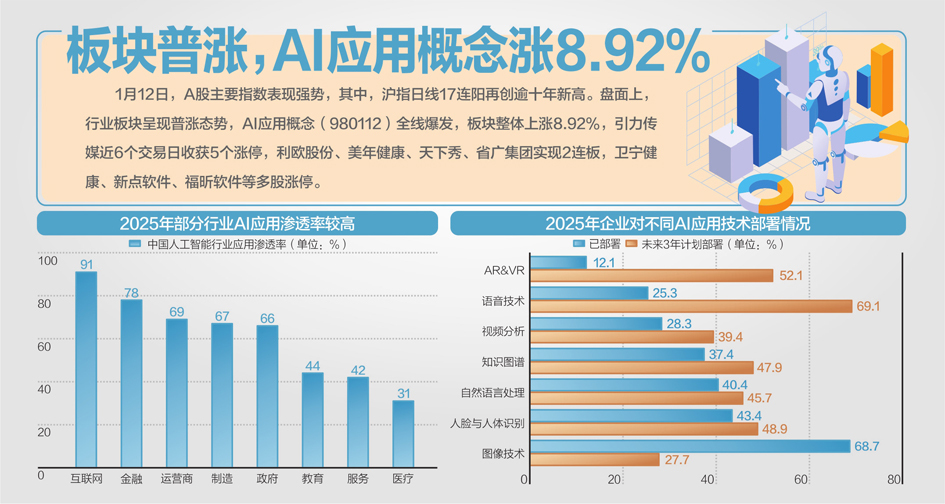
从成交量来看,1月12日,沪深两市成交额突破3.6万亿元,较上一个交易日放量4787亿元,刷新此前在2024年10月8日创下的成交额历史记录。 "17连阳,每天都见证历史。"一位投资者在朋友圈发出感慨。 "涨到怀疑人生。""一眼望过去全是涨停,除了我买的。""大A都17连阳了我在哪? ""这个行情大家都盈了吗?""我在白酒躲牛市"……微博上,A股也成为 投资者正在热议的话题。 谁在引领? 东吴证券统计A股历史上沪指10连阳及以上的情况发现,自1990年开市以来仅有7次(含本次),其中10连阳2次(1991年1月10日、1991年9月9日),11连 阳3次(2018年1月12日、2006年6月29日、1992年5月19日),12连阳1次(1992年3月11日)。 东吴证券称,统计沪指10连阳后的涨跌表现,短期(5日)上涨概率极高,但伴随时间周期的拉长,上证涨跌互现,因此需要进一步考虑催化上涨的核心因 素。 A股市场迎来"高光时刻"。 2026年开年以来,A股持续演绎"开门红"行情,指数节节攀升。Wind数据显示,截至2026年1月12日收盘,沪指涨逾1%豪取17连阳,从3822.51点上涨至 4165.29点, ...

科创债ETF鹏华(551030)近19个交易日“吸金”25.98亿,风险偏好对债券的压制可能是阶段性的
Xin Lang Cai Jing· 2026-01-12 09:46
Group 1 - The bond market is currently under pressure from equity risk appetite, with the Penghua Sci-Tech Bond ETF (551030) experiencing a slight pullback and a trading volume of 1.33 billion yuan, accumulating 2.598 billion yuan over the past 19 trading days [1] - Zhongyou Securities indicates that the relative pricing between stocks and bonds has reached a balance, and the suppression of bonds by risk appetite is expected to be temporary, as the fundamental environment has not reversed [1] - The Penghua Sci-Tech Bond ETF tracks the Shanghai Stock Exchange AAA-rated Sci-Tech Innovation Company Bond Index, which selects bonds with AAA ratings and above, offering advantages such as low fees, low trading costs, high transparency, and high efficiency in redemption [1] Group 2 - Huaxi Securities believes that the policy dividends will create a broad market space for Sci-Tech bonds, and the Sci-Tech Bond ETF is expected to continue to highlight its long-term allocation value and market influence [2] - Penghua Fund has established a long-term strategy for fixed-income tools since the second half of 2018, actively laying out various fixed-income index products and aiming to become a domestic expert in fixed-income indices [2] - The total scale of bond ETFs has surpassed 30 billion yuan, reflecting the growing demand for bond index investment tools [2]
资管一线 | 资本市场“水涨船高” 投资聚焦科技主线——首席经济学家共话2026资产配置
Xin Hua Cai Jing· 2026-01-12 08:21
Group 1 - The core viewpoint of the articles emphasizes that the capital market in 2026 will present both opportunities and challenges, with a focus on deepening reforms and asset allocation strategies [1][2] - The goal of capital market reform is to cultivate a "slow bull" market, enhancing market vitality by attracting patient capital and long-term funds [2][3] - Experts suggest that the stock market is gradually forming a "slow bull" pattern, with key support levels for the Shanghai Composite Index expected to rise from 3800-3900 points to 4000 points [2] Group 2 - Recommendations for institutional investors include strengthening internal mechanisms, expanding investment ranges, and improving delisting mechanisms to enhance market efficiency [3][4] - The commodity market is expected to show a clear rotation pattern, with significant opportunities for investment in various sectors, including precious metals and industrial metals [6][7] - The bond market is anticipated to perform better than expected in a loose monetary environment, serving as a potential switch option after stock and commodity price increases [7][8] Group 3 - Investment strategies for 2026 should focus on technology as a core theme, with an emphasis on balancing offensive and defensive positions while being cautious of potential risks [8][9] - Experts recommend diversifying investments into advanced manufacturing, reasonably valued cyclical leaders, and high-dividend assets to enhance overall portfolio resilience [9][10] - The importance of timing and market rhythm is highlighted, suggesting that investors should avoid a passive buy-and-hold strategy and instead actively manage their portfolios [9]