
奔驰

Search documents
智驾“中国方案”双强格局:Momenta与华为NOA合计占比超80%
Guan Cha Zhe Wang· 2026-01-15 03:50
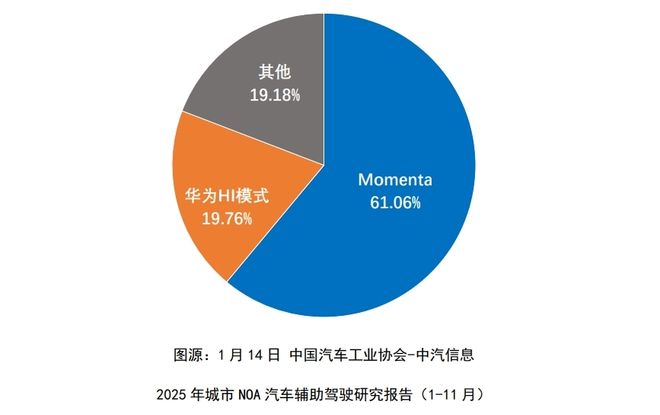
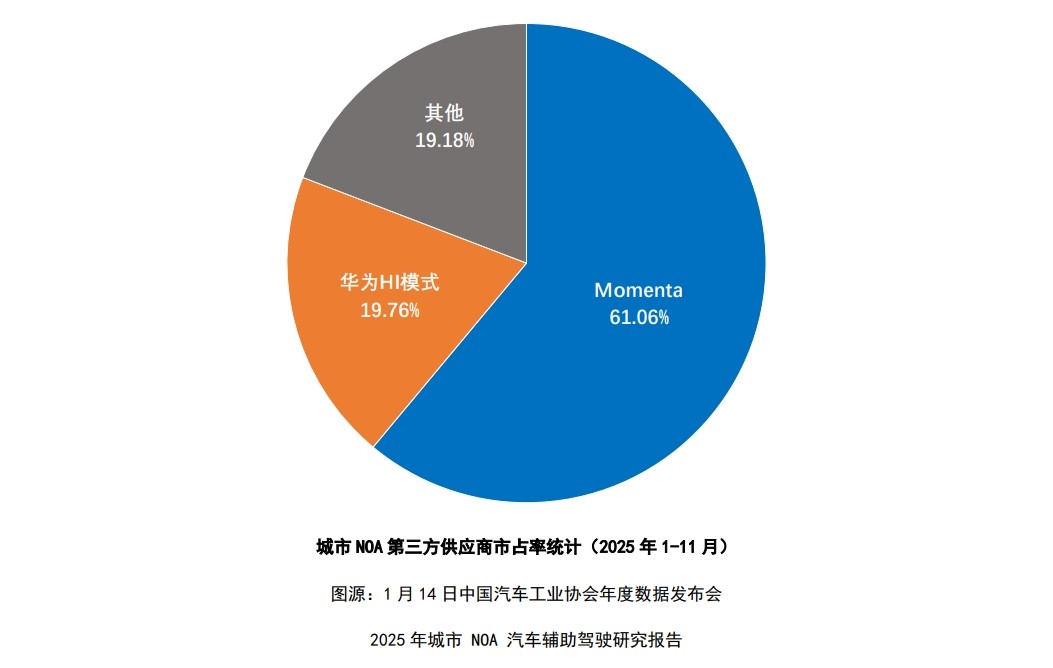
Core Insights - The report highlights the rapid expansion of the urban NOA (Navigation Assisted Driving) market in China, with cumulative sales reaching 3.129 million units from January to November 2025, accounting for 15.1% of passenger car insurance volume, an increase of 5.6 percentage points compared to the entire year of 2024 [1][2] Industry Overview - The urban NOA technology is becoming a core configuration in automotive intelligence, with 2025 identified as a key year for its commercialization [2] - The market is characterized by a "dual strong" pattern among third-party urban NOA suppliers, with Momenta and Huawei leading, together holding over 80% of the market share [1][2] Company Performance - Momenta's urban NOA deployment reached 414,400 units, representing 61.06% of the third-party supplier market, with partnerships covering major domestic passenger car manufacturers and 8 out of the top 10 global automakers [2] - Huawei's HI model achieved a deployment of 134,100 units, accounting for 19.76% of the third-party supplier market [2] - Domestic brands excelled in the urban NOA segment, with related model sales reaching 2.5373 million units, making up 81.1% of the total [2] Competitive Landscape - Global automotive brands such as Mercedes-Benz, BMW, Audi, Cadillac, Buick, and Toyota are accelerating their urban NOA strategies through collaborations with leading Chinese intelligent driving suppliers [2] - The report indicates that the "Chinese solution" for intelligent driving, developed by companies like Huawei and Momenta, is attracting deep cooperation from renowned automotive brands in Germany, the US, Japan, and South Korea, enhancing China's influence in the global automotive value chain [2] Technological Advancements - The report suggests that as high-level assisted driving enters a phase of large-scale implementation, key factors determining supplier market position include algorithm strength, data loop capabilities, and experience in large-scale production [3][5] - The urban NOA is driving systemic changes in the intelligent driving sector, with applications extending from highway NOA to urban environments, and a shift towards integrated system architectures [3][5] Future Outlook - The report predicts that the integration of multimodal models and end-to-end technologies, along with continuous upgrades to computing platforms, will further enhance the safety experience of urban NOA [5] - Competition in the industry is shifting from a focus on individual technical metrics to a comprehensive competition based on product experience, technological limits, and scalability, with leading companies building systematic advantages through algorithms, data loops, and large-scale production [5]



中国智驾双强:Momenta与华为NOA合计占比超80%
Guan Cha Zhe Wang· 2026-01-15 03:44
Core Insights - The report highlights the rapid expansion of the urban NOA (Navigation Assisted Driving) market in China, with a cumulative sales of 3.129 million units from January to November 2025, accounting for 15.1% of passenger car insurance volume, an increase of 5.6 percentage points compared to the entire year of 2024 [1][2] Market Dynamics - The market for third-party urban NOA suppliers is characterized by a "dual strong" pattern, with Momenta and Huawei significantly leading, together holding over 80% of the market share among third-party suppliers [1][2] - Momenta's urban NOA deployment reached 414,400 units, representing 61.06% of the third-party supplier market, with partnerships covering major domestic passenger car manufacturers and 8 out of the top 10 global automakers [2] - Huawei's HI model achieved a deployment of 134,100 units, accounting for 19.76% of the third-party supplier market [2] Competitive Landscape - Domestic brands excelled in the urban NOA segment, with related model sales reaching 2.5373 million units, representing 81.1% of the total, showcasing the innovation and market competitiveness of Chinese automakers [2] - Global brands such as Mercedes-Benz, BMW, Audi, Cadillac, Buick, and Toyota are accelerating their strategies by collaborating with leading Chinese intelligent driving suppliers to implement urban NOA features [2] Technological Advancements - The report indicates that high-level assisted driving is entering a phase of large-scale implementation, where algorithm strength, data loop capabilities, and mass production experience are critical for determining suppliers' market positions and growth rates [3] - The urban NOA is driving systemic changes in the intelligent driving field, with applications extending from highway NOA to urban environments, and a shift towards integrated system architectures [5] - The end-to-end large model has become the core engine for NOA technology iteration, facilitating a transition from modular architectures to integrated perception and planning systems [5] Future Outlook - The report predicts that the integration of multimodal models and end-to-end technologies, along with continuous upgrades to computing platforms, will further enhance the safety experience of urban NOA [5] - The industry competition is shifting from a focus on individual technical metrics to a comprehensive competition based on product experience, technological limits, and mass production capabilities [5]
中汽协2025城市NOA报告发布:Momenta第三方供应商市场市占率超60%
Zhong Jin Zai Xian· 2026-01-15 03:01
Core Insights - The report highlights the rapid growth of the urban NOA (Navigation on Autopilot) market in China, with a cumulative sales of 3.129 million passenger cars equipped with urban NOA from January to November 2025, achieving a penetration rate of 15.1%, an increase of 5.6 percentage points compared to the entire year of 2024 [3][4]. Group 1: Market Dynamics - The urban NOA market is characterized by a "dual strong" pattern among third-party suppliers, with Momenta and Huawei leading the market, together accounting for over 80% of the market share among third-party suppliers [3][4]. - Momenta has a leading position with 414,400 units of urban NOA equipped vehicles, representing approximately 61.06% of the third-party supplier market, while Huawei's HI model has around 134,100 units, accounting for about 19.76% [3][4]. Group 2: Competitive Landscape - Domestic brands have shown significant strength, with sales of urban NOA-equipped vehicles reaching 2.5373 million units, making up 81.1% of total sales, indicating their innovation and competitiveness in the smart connected vehicle sector [4]. - Global automotive brands are increasingly collaborating with leading domestic third-party suppliers to enhance their smart driving capabilities, with notable partnerships including Mercedes-Benz, BMW, Audi, Cadillac, Buick, and Toyota [4]. Group 3: Technological Advancements - The report emphasizes that algorithms, data closed-loop capabilities, and experience in large-scale production are critical factors determining the market position and development speed of autonomous driving suppliers [4][5]. - The end-to-end large model has become the core engine for the iteration of NOA auxiliary driving technology, promoting a shift from modular architecture to an integrated perception and planning system [5][6]. Group 4: Future Trends - The competition among autonomous driving suppliers is evolving from a focus on single technical indicators to a comprehensive capability that includes product experience, technological potential, and scalability [7]. - The integration of multi-modal models and end-to-end technology, along with continuous upgrades of computing platforms, is expected to enhance the safety experience of urban NOA technology [6][7].
你给奔驰的年终总结和工作计划打多少分?
Zhong Guo Jing Ji Wang· 2026-01-15 02:16
Core Viewpoint - The company aims to maintain its leading market share in the high-end luxury car segment priced above 1 million yuan and the core luxury market priced above 400,000 yuan by 2025 [1] Group 1 - The company plans to focus on three main objectives for 2026: improving product quality, enhancing luxury service and experience, and continuing investment in China [1]
车企自研、第三方合作“双轮驱动”,城市NOA规模化加速
Zhong Guo Jing Ji Wang· 2026-01-15 02:12
Core Insights - 2025 is identified as a critical year for the commercialization of urban NOA (Navigation Assisted Driving) in China, with a projected market scale growth [1] - The report indicates that from January to November 2025, the cumulative sales of passenger cars equipped with urban NOA reached 3.129 million units, with a penetration rate of 15.1%, an increase of 5.6 percentage points compared to the entire year of 2024 [1] Industry Background - NOA technology is seen as a key driver for smart connected vehicles, bridging advanced driver assistance and fully autonomous driving, which is crucial for enhancing user travel experience and asserting China's competitive voice in the global automotive industry [3] - The report highlights that among the passenger cars sold with urban NOA, domestic brands accounted for 2.5373 million units, representing 81.1% of the total, showcasing innovation and competitiveness in the smart connected vehicle sector [3] Market Dynamics - The current market for urban NOA is characterized by a dual-driven model of self-research by car manufacturers and collaboration with third-party suppliers [5] - Major players in self-research include Tesla, NIO, Xpeng, Li Auto, Xiaomi, and others, while approximately 29 brands collaborate with third-party suppliers [5] - The third-party supplier market is dominated by two key players, Momenta and Huawei, which together hold about 80% market share; Momenta's urban NOA installations reached 414,400 units, accounting for 61.06% of third-party suppliers, while Huawei's HI model accounted for 19.76% with 134,100 units [5] Technological Advancements - The rapid iteration of technology and market competition is driving systemic changes in smart driving technology, core architecture, and industrial ecology [9] - The report emphasizes that end-to-end large models are becoming the core engine for NOA technology iteration, facilitating a shift from modular architecture to integrated systems [10] - New energy vehicle manufacturers are building technological barriers through full-stack self-research, while traditional automakers are accelerating technology deployment through partnerships with third-party suppliers [10] Future Outlook - The report anticipates that by 2030, urban NOA will become a mainstream feature in both assisted and autonomous driving [10] - Recommendations for enhancing the high-quality development of NOA include improving top-level design, strengthening technological innovation, enhancing industry collaboration, and exploring global competitiveness for supply chain enterprises [11]


2025年超越300万辆!城市NOA规模化普及加速
Guo Ji Jin Rong Bao· 2026-01-15 02:09
Core Insights - The report by the China Automobile Industry Association indicates that from January to November 2025, the cumulative sales of passenger cars equipped with urban NOA (Navigation Assisted Driving) reached 3.129 million units, with a penetration rate of 15.1%, an increase of 5.6 percentage points compared to the entire year of 2024 [1] Group 1: Market Dynamics - The urban NOA market is characterized by a "dual-engine" model of self-research by car manufacturers and partnerships with third-party suppliers [1] - The third-party urban NOA supplier market is dominated by two major players, Momenta and Huawei, who together hold over 80% market share [1] - In the same period, Momenta's urban NOA installations reached 414,400 units, accounting for approximately 61.06% of third-party suppliers, with eight of the top ten global automakers collaborating with Momenta [1] Group 2: Brand Performance - Among the passenger cars equipped with urban NOA, domestic brands sold 2.5373 million units, representing 81.1% of the total [2] - Global automotive brands are increasingly partnering with leading domestic third-party suppliers to achieve breakthroughs in intelligent driving, with brands like Mercedes-Benz, BMW, Audi, Cadillac, Buick, and Toyota implementing urban NOA features through these collaborations [2] Group 3: Technological Advancements - The report highlights that in the phase of scaling high-level assisted driving, factors such as algorithms, data loop capabilities, and mass production experience are critical for determining the market position and development speed of assisted driving suppliers [2] - End-to-end large models have become the core engine for the iteration of NOA assisted driving technology, driving the industry towards an integrated approach and enhancing safety experiences [3] - New car manufacturers are building technological barriers through full-stack self-research, while traditional automakers are accelerating technology deployment by collaborating with third-party suppliers [3]
2025年NOA乘用车销售超300万辆,《2025城市NOA汽车辅助驾驶研究报告》发布
Zhong Guo Qi Che Bao Wang· 2026-01-15 02:03
Core Insights - The report titled "2025 Urban NOA Automotive Assisted Driving Research Report" was officially released at the China Automotive Industry Association's information conference, aiming to analyze the development trends of urban NOA technology and industry, providing references for high-quality development of China's intelligent connected vehicle industry [1] Group 1: Market Growth and Trends - By the end of 2025, it is projected that over 3 million urban NOA-equipped vehicles will be sold in China, with a penetration rate of 15.1% for urban NOA features in passenger vehicles from January to November 2025, an increase of 5.6 percentage points compared to the entire year of 2024 [3][4] - The sales of new passenger cars with Level 2 driving assistance functions increased by 21.2% year-on-year in the first three quarters of 2025, with a penetration rate reaching 64%, expected to rise to 66.1% by the end of 2025 [3] Group 2: Competitive Landscape - Domestic brands accounted for 81.1% of urban NOA-equipped vehicle sales from January to November 2025, showcasing their innovation and competitiveness in the intelligent connected vehicle sector [4] - Major global automotive brands are collaborating with leading domestic third-party suppliers to achieve breakthroughs in intelligent driving, with companies like Mercedes-Benz, BMW, Audi, and Toyota implementing urban NOA features [4][6] Group 3: Technology and Innovation - The current market for third-party urban NOA suppliers is dominated by Momenta and Huawei, which together hold approximately 80% of the market share, with Momenta leading at 61.06% and Huawei at 19.76% [6] - The report highlights that the end-to-end large model has become the core engine for NOA technology iteration, driving a shift from modular architecture to integrated deep restructuring [7][8] Group 4: Future Outlook and Recommendations - The report anticipates that by 2030, urban NOA will become a mainstream feature in assisted and autonomous driving, with significant value creation expected in the automotive industry [11] - Recommendations for enhancing the urban NOA industry ecosystem include improving top-level design, strengthening technological innovation, and exploring collaborative development models among various technological routes [11]
奔驰、宝马2026年预测不足50万辆,退回十年前
3 6 Ke· 2026-01-15 01:25
Group 1 - The core viewpoint of the articles highlights the contrasting market strategies and performance expectations between domestic high-end car brands and German luxury brands in China for 2026 [1][4][10] - Domestic brands such as NIO and Xiaomi are setting aggressive sales targets, with NIO aiming for a 40-50% growth to approximately 460,000 units, and Xiaomi targeting 550,000 units, a 34% increase [1][2] - In contrast, German brands like Mercedes-Benz and BMW are projecting lower sales volumes, with estimates of less than 500,000 units each, reflecting a return to their sales levels from a decade ago [1][4] Group 2 - The domestic brands have shown significant progress in high-end market penetration, with NIO's ES8 achieving 22,000 units in December alone, and Hongmeng Zhixing's models surpassing 100,000 units in annual sales [2][3] - German luxury brands are experiencing a decline, with Mercedes-Benz and BMW reporting significant drops in sales for 2025, with declines of 19% and 12.5% respectively [4][10] - Despite a rich lineup of new models planned for 2026, including over 15 from Mercedes-Benz and more than 20 from BMW, these brands maintain a cautious outlook on the competitive landscape [5][11] Group 3 - The market is shifting towards electric vehicles, with predictions indicating that the penetration rate for new energy vehicles in China will exceed 60% in 2026 [6][10] - Traditional luxury brands are struggling with their electric vehicle transitions, as evidenced by low sales figures for their new electric models, which have not significantly contributed to overall growth [7][10] - Domestic brands are aggressively targeting the luxury market, with Hongmeng Zhixing's luxury brand, Zun Jie, achieving impressive sales figures that surpass traditional luxury competitors [9][12]
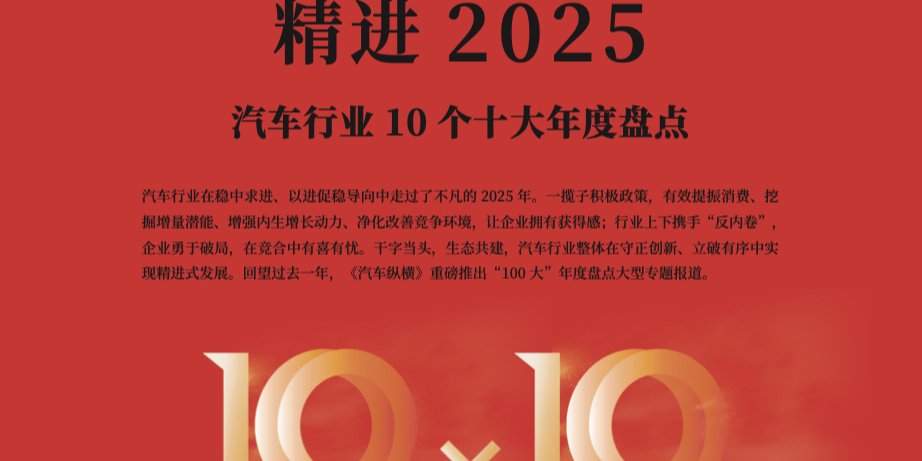
2025汽车供应链十大年度热点 | 精进2025——汽车行业10个十大年度盘点
Jing Ji Guan Cha Wang· 2026-01-15 00:31
Core Insights - The automotive industry in 2025 has experienced significant growth driven by proactive policies that enhance consumption, stimulate internal growth, and improve the competitive environment [2] - The industry is undergoing a transformation characterized by electric and intelligent vehicle development, geopolitical challenges, and supply chain restructuring [4] Group 1: Supply Chain Developments - The takeover of Nexperia by the Dutch government has disrupted the global automotive chip supply chain, leading to production halts and capacity adjustments among major automakers [5][6] - The introduction of a 60-day payment term for suppliers aims to alleviate financial pressures on small and medium-sized enterprises, fostering a healthier supply chain ecosystem [7][8] - Chinese automotive supply chain companies are increasingly focusing on overseas markets, with significant investments in Southeast Asia, North America, and Europe to enhance local production capabilities [11][12] Group 2: Financing and Market Trends - A surge in Chinese automotive technology companies listing in Hong Kong reflects a growing trend towards capitalizing on the smart vehicle sector, with several firms successfully raising funds for technological advancements [9][10] - The automotive supply chain is witnessing a wave of mergers and acquisitions, with companies seeking to enhance their market positions and technological capabilities [13][14] Group 3: Technological Innovations - The automotive industry is moving towards an "oil-electric intelligence" model, with advancements in technology enabling the integration of intelligent features into traditional fuel vehicles [15][17] - The battery industry is experiencing rapid advancements, particularly in solid-state battery technology, which is crucial for the future of electric vehicles [20][21] - The proliferation of L2+ level advanced driver-assistance systems (ADAS) is reshaping the automotive supply chain, emphasizing the importance of safety and compliance [22][23] Group 4: Industry Challenges and Opportunities - A wave of bankruptcies among European and American automotive suppliers highlights the challenges faced during the transition to electric vehicles, revealing vulnerabilities in traditional supply chains [18][19] - The 2025 China Automotive Supply Chain Conference has set the stage for future developments, focusing on internationalization and innovation within the industry [24][26]


新能源车全年渗透率首超燃油车
Mei Ri Shang Bao· 2026-01-14 23:16
Core Insights - In 2025, China's passenger car retail reached 23.744 million units, a year-on-year increase of 3.8%, with new energy vehicles (NEVs) surpassing 57% penetration rate, marking a significant shift in market dynamics [1] - BYD topped the global pure electric vehicle sales with 4.6024 million units, while China's total vehicle exports exceeded 7 million units, setting a new historical record [1] - The competition in the automotive market has shifted from price wars to value comparisons, with models like Geely's Xingyuan and Wuling's Hongguang MINIEV leading their respective segments [1] Industry Performance - In the 2025 sales rankings, domestic brands occupied seven out of the top ten spots, with NEVs leading significantly; Geely's Xingyuan sold 465,775 units, becoming the annual "dark horse" [2] - Wuling Hongguang MINIEV ranked second with 435,599 units sold, contributing nearly half of SAIC-GM-Wuling's NEV sales [2] - The top three models included Nissan's Sylphy, which sold 319,990 units, maintaining a strong market presence despite the rise of NEVs [2] New Entrants and Innovations - Among new entrants, Xiaomi's SU7 performed well with 258,164 units sold, but faced challenges due to safety concerns and controversies [3] - Leap Motor led the new force segment with 596,600 units sold, achieving a completion rate of 119.3%, marking it as the fastest-growing new force brand [3] Upcoming Models and Market Trends - The 2026 automotive market is set to intensify with the release of several flagship models, focusing on diverse technologies and smart features [4] - New models include Xiaomi's SU7, which is set to launch at a starting price of 229,900 yuan, and NIO's flagship SUV ES9, aimed at competing with luxury models like BMW X7 and Mercedes GLS [4] - The market is expected to shift from "incremental expansion" to "stock competition," with domestic brands pushing for high-end development and joint ventures accelerating technological transitions [5]
