
燕京啤酒

Search documents
产品创新+场景深耕 深市消费类上市公司发力春节消费市场
Zheng Quan Ri Bao Wang· 2026-02-23 10:59
多元供给点燃新春消费热潮 马年春节,一股"健康、智能、绿色"的消费新风尚席卷全国。据商务大数据,2月15日,重点平台智能 穿戴设备销售额增长1.3倍,智能血压仪、血糖仪增长超60%,有机食品增长52%,用实打实的数据,彰 显出春节消费市场品质升级趋势。 在此背景下,深市食品饮料类上市公司以产品创新为核心,从节庆专属产品打造到健康品类研发,从供 应链效率提升到消费场景营造,全方位满足不同消费群体的新春需求,让节日消费既有"年味"更有"品 质"。 商超卖场年味浓郁、优质食品供销两旺、智能家电备受青睐……2026年丙午马年春节,恰逢最长春节假 期叠加消费政策红利释放,国内消费市场人气与活力双向攀升。 在这一过程中,深圳证券交易所市场(以下简称"深市")消费类上市公司紧抓春节消费热潮,立足自身 主业优势,以产品创新贴合消费需求、以多元营销激活市场活力、以全球化布局拓展发展空间,在食品 饮料、家电等核心赛道展现出强劲的发展韧性,成为新春消费市场的活力因子,也为全年消费市场复苏 注入强劲动力。 产品创新锚定需求 例如,深耕速冻食品领域三十年的三全食品(002216)股份有限公司(以下简称"三全食品"),作为国 内速冻米面 ...



新春消费“马”力全开,深市消费龙头活力迸发
Bei Jing Ri Bao Ke Hu Duan· 2026-02-23 09:57
2026年春节假期,国内消费市场呈现出蓬勃生机,节日经济活力加速释放。"乐购新春"主题活动如火如 荼,普惠消费、商圈新业态、以旧换新等多重利好叠加,推动消费潜力集中释放,为全年经济发展注入 了强劲动力。记者从多家深市消费龙头企业获悉,春节期间,各企业紧扣消费热点,推出丰富多样的营 销活动,积极抢抓旺季机遇,为新一年市场拓展打下坚实基础。机构分析认为,在春节消费旺季的良好 开局带动下,消费类企业有望在今年实现业绩持续回暖。 "春节期间,我们积极拓展广告宣传渠道,成效显著。多维度、广覆盖的广告投放,有效提升了公司的 品牌知名度与影响力,为新一年的市场拓展奠定了良好基础,这不仅是品牌传播的有力实践,更彰显我 们迈向国际舞台、引领行业发展的坚定决心与强大实力。"燕京啤酒相关负责人告诉记者,公司在北 京、长春、广州、合肥、石家庄、济南、西安、南京、昆明9座城市投放户外LED大屏广告,覆盖核心 商圈,吸引大众目光;在天津、哈尔滨、沈阳、长春、赣州、贵阳、昆明等22个城市高铁站投放灯箱广 告,精准触达出行人群。国际市场上,公司也通过在热门区位投放LED广告大屏,展示"中国燕京邀请 世界欢度中国年"的品牌气度,向全球展示品牌 ...
从“大绿棒子”到U8,一瓶8元啤酒如何救活45岁老国企
Guan Cha Zhe Wang· 2026-02-23 07:52
(作者|周琦 编辑|张广凯) 北京老牌啤酒,正上演一场复兴大戏。 1月底,燕京啤酒发布2025年业绩预告,预计全年归母净利润为15.84亿元至17.42亿元,同比增长50%至65%,扣非净 利润同比增长40%至50%。 | 项目 | 本报告期 | 上年同期 | | --- | --- | --- | | 归属于上市公司 | 盈利: 158,352万元-174,187万元 | 盈利:105,567.85万元 | | 股东的净利润 | 比上年同期增长:50.00%-65.00% | | | 扣除非经常性损 | 盈利:145,689万元-156,096万元 | 盈利:104,063.74万元 | | 益后的净利润 | 比上年同期增长:40.00%-50.00% | | | 基本每股收益 | 盈利:0.5618元/股-0.6180元/股 | 盈利:0.3745元/股 | 公司公告 在此之前,燕京啤酒经历了至暗时刻。 2013-2017年,公司营收连续四年下滑,净利润一度跌至谷底,2017年扣非后实际亏损了3716万元。 但到2025年,燕京啤酒净利润由2021年的2.28亿元飙升超过15亿元,增长近7倍。 这家45岁 ...


【干货】啤酒产业链全景梳理及区域热力地图
Qian Zhan Wang· 2026-02-21 06:08
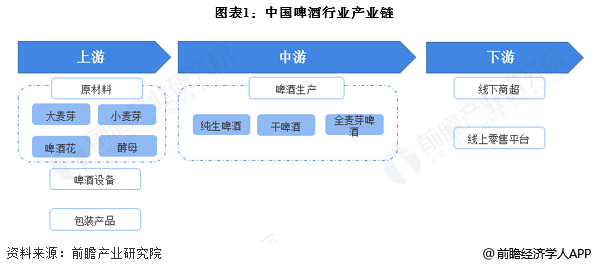
Core Insights - The article discusses the current state of the beer industry in China, highlighting the dominance of major players in the market and the structure of the industry chain [1][5]. Industry Overview - The beer industry in China has a mature supply chain, with upstream suppliers providing raw materials, brewing equipment, and packaging [1]. - Major players in the midstream beer production segment include China Resources Beer, Tsingtao Brewery, Budweiser APAC, Chongqing Beer, and Yanjing Beer, which collectively hold approximately 80% of the market share [1][5]. Supply Chain Structure - Upstream suppliers consist of companies like Angel Yeast and Yongshuntai for raw materials, and CIMC Anrui and Lehui International for brewing equipment [5]. - The downstream market includes physical supermarkets such as Yonghui Supermarket and online retail platforms like Alibaba, JD.com, and Suning [5]. Regional Distribution - The beer industry chain is primarily concentrated in the Guangdong-Hong Kong-Macau Greater Bay Area, followed by Zhejiang, Beijing, and Fujian [7]. - Midstream beer manufacturers are mainly located in the Guangdong-Hong Kong-Macau Greater Bay Area, Shandong, and Chongqing [8]. Investment Trends - A summary of investment activities from 2020 to 2026 in the beer industry indicates various funding rounds and investments in emerging companies [12]. - Notable investment events include multiple funding rounds for companies like Xuanbo Beer and Aigulu, with amounts ranging from millions to tens of millions of RMB [14].



骏马贺新春 京彩中国年|跨国夫妻的新春时光
Bei Jing Ri Bao Ke Hu Duan· 2026-02-19 13:33
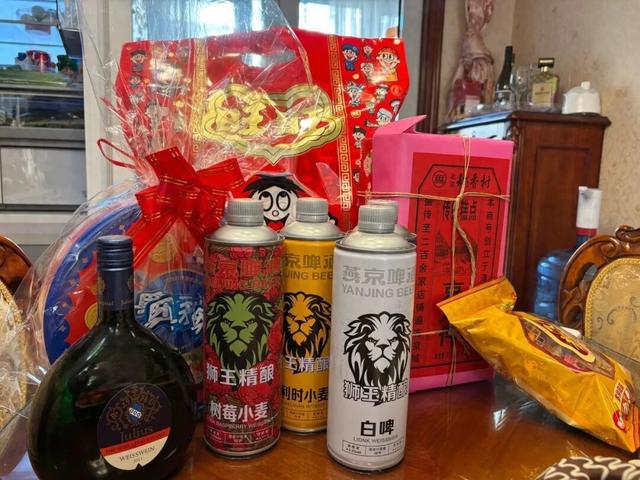
Core Viewpoint - The article highlights the cultural fusion and warmth of the Chinese New Year celebrations experienced by a cross-national couple, Zhang Dingran and his German wife, Jenny, in Shunyi, Beijing, showcasing how traditional Chinese customs blend with Western elements [1][10]. Group 1: Cultural Practices - The couple incorporates various traditional Chinese New Year elements, such as festive snacks, decorations, and the preparation of dumplings, which symbolize family unity and cultural heritage [1][9]. - Jenny has become familiar with Chinese New Year customs over the years, demonstrating her integration into local traditions by actively participating in activities like making dumplings and explaining customs to their children [9]. Group 2: Local Products and Brands - The couple's celebration features local Shunyi products, including Yanjing beer and Shunxin Pengcheng meat products, which represent the quality and cultural significance of local brands [5][9]. - The presence of local brands in their New Year celebration serves as a bridge connecting foreign friends and local culture, enhancing the festive atmosphere in Shunyi [9][10]. Group 3: Community and Cultural Exchange - The article emphasizes the growing appreciation among foreign residents for traditional Chinese customs, indicating a broader cultural exchange that enriches the local community [10]. - The celebration of Chinese New Year is portrayed as a shared experience that transcends cultural boundaries, making it a warm and inclusive occasion for both locals and expatriates [10].

白酒企业仍然青睐春晚舞台,但玩法变了
Xin Lang Cai Jing· 2026-02-18 09:20
Core Viewpoint - The competition for sponsorship of the 2026 CCTV Spring Festival Gala is intensifying among liquor companies, particularly in the white liquor sector, which has a long-standing partnership with the event due to its alignment with the festive atmosphere and consumer behavior during the Spring Festival [1][5]. Group 1: Sponsorship and Marketing Strategies - CCTV has officially announced four white liquor sponsors for the 2026 Spring Festival Gala, with Wuliangye being the most talked-about due to its prominent presence in the magic performance segment [2][4]. - Wuliangye has been the exclusive interactive partner for the "Heavenly Gifts" segment of the Spring Festival Gala for four consecutive years, distributing 136,000 gifts valued at 100 million yuan during the event [4]. - Yanghe has been the exclusive timekeeping partner for the seventh consecutive year, while Gujinggongjiu and Langjiu also maintain significant sponsorship roles [4][5]. Group 2: Industry Trends and Consumer Behavior - The number of white liquor sponsors for the 2026 Spring Festival Gala has increased by one compared to the previous year, indicating sustained enthusiasm for sponsorship despite economic pressures [5]. - White liquor companies are increasingly focusing on creative and engaging marketing strategies, moving beyond traditional advertising to more integrated product placements in various segments of the gala [5][6]. - Local television stations are also seeing increased collaboration with liquor companies, showcasing a broader marketing strategy that emphasizes regional brand recognition and consumer engagement [5][6]. Group 3: Financial Performance and Market Challenges - The financial outlook for white liquor companies is challenging, with significant profit declines reported by major players such as Yanghe and Kweichow Moutai, indicating a tough market environment [6][8]. - Despite the high costs associated with sponsoring the Spring Festival Gala, companies view it as a strategic investment to maintain brand visibility and consumer engagement during a period of economic downturn [6][10]. - The industry is shifting towards more cost-effective marketing strategies, focusing on key moments and channels that can directly influence sales, rather than relying solely on broad advertising campaigns [10].





旺季白酒消费分化,高端酒动销亮眼
Xiangcai Securities· 2026-02-14 12:28
Investment Rating - The report maintains a "Buy" rating for the food and beverage industry [2] Core Insights - The food and beverage industry experienced a decline of 2.33% from February 9 to February 13, 2026, underperforming the CSI 300 index by 2.69 percentage points [6][9] - The industry is currently at a historical low valuation, with a PE ratio of 21X, ranking 24th among Shenwan's primary industries [5][18] - High-end liquor sales showed strong performance during the Spring Festival, with leading brands like Moutai and Wuliangye experiencing significant growth, while mid-range products faced a decline of approximately 20% [6][7] Summary by Sections Industry Performance - From February 9 to February 13, 2026, the food and beverage sector's relative return was -2.5% over one month, -5.3% over three months, and -21.6% over twelve months [4] - The overall market indices showed positive movement, with the Shanghai Composite Index up by 0.41% and the Shenzhen Component Index up by 1.39% during the same period [9] Valuation Metrics - As of February 13, 2026, the food and beverage industry's PE ratio stands at 21X, with sub-sectors like other alcoholic beverages (52X), snacks (37X), and health products (34X) having higher valuations, while liquor (19X), beer (22X), and dairy (23X) are lower [5][18] Investment Recommendations - The report suggests focusing on three main investment lines: 1. Industry leaders with stable demand and strong risk resilience 2. Companies actively developing new products, channels, and consumption scenarios 3. Segments of the mass consumer goods industry that have shown growth potential and reasonable valuations after adjustments [7][44] - Specific companies to watch include Moutai, Shanxi Fenjiu, Anjuke Foods, Andeli, Yanjinpuzi, Babi Foods, Yanjing Beer, and Yili [7][44]
白酒稳基盘、低度酒寻增量:中国酒类市场的结构分化与投资机会
QYResearch· 2026-02-14 00:48
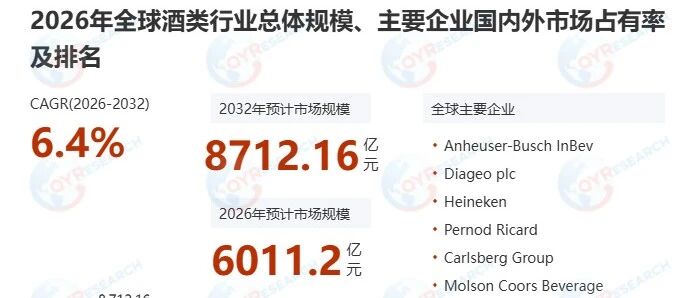
Core Insights - The Chinese alcoholic beverage market is projected to reach USD 254.1 billion by 2032, with a CAGR of 6.63% during the forecast period [2] - The market is highly concentrated, with baijiu (Chinese liquor) expected to account for 78.57% of revenue by 2025, significantly higher than beer (11.22%) and other categories [2] Market Structure - Baijiu dominates the market, while beer is experiencing a shift towards premiumization and craft options, and low-alcohol/no-alcohol products are gaining traction among new consumer demographics [2] - The structure indicates that the base of the market is determined by baijiu, but growth and structural changes are driven by the premiumization of beer and the penetration of low-alcohol products [2] Technical Features and Product Classification - The alcoholic beverage industry is characterized by a combination of raw material systems, fermentation/distillation processes, aging systems, blending capabilities, and packaging/channel adaptation, which ultimately contribute to brand premium and price segmentation [5] - Baijiu is defined by solid-state fermentation and aging techniques, leading to high margins and strong brand characteristics, but also slower capacity ramp-up and sensitivity to inventory and pricing [5] - Beer is the most industrialized, focusing on scale and channel efficiency, with recent competition shifting towards high-end and craft products [5] Competitive Landscape - The Chinese market shows a concentration in baijiu, with leading companies like Kweichow Moutai and Wuliangye dominating the high-end segment, while regional players seek growth through local market penetration [7] - The beer market is characterized by competition among major players like Tsingtao Brewery and China Resources Snow Breweries, focusing on product upgrades and channel penetration [8] - The wine and yellow wine markets are smaller, where brand and channel efficiency are more critical than scale [9] Future Trends and Challenges - Over the next 3-5 years, the market is expected to stabilize with baijiu, while beer will focus on premiumization and low-alcohol/no-alcohol products will drive growth [17] - Challenges include consumer segmentation, price pressure, raw material cost fluctuations, and stricter regulatory requirements [20]
春节走访:成都市场跟踪
GF SECURITIES· 2026-02-13 11:41
Investment Rating - The industry investment rating is "Buy" indicating an expected performance that will exceed the market by more than 10% over the next 12 months [27]. Core Insights - The report highlights that the Chinese liquor market, particularly in Chengdu, is showing signs of recovery as the Spring Festival approaches, with increased sales velocity for major brands like Guojiao and Wuliangye [6][8]. - The seasoning market is also experiencing improved sales, with brands like Qianhe and Haitian gaining market share, and promotional activities increasing in supermarkets [11][12]. - The report suggests a positive outlook for the liquor sector in 2026, with recommendations for key stocks including Luzhou Laojiao, Shanxi Fenjiu, and Kweichow Moutai among others [2][4]. Summary by Sections Chengdu Liquor Market Tracking - Sales velocity for Wuliangye and Guojiao has accelerated as the Spring Festival approaches, with Wuliangye's current batch price at 790 CNY per bottle and Guojiao at 850 CNY per bottle [7][9]. - Feedback from distributors indicates that inventory levels are healthy, with a focus on maintaining good stock levels to avoid excess [8][9]. Chengdu Seasoning Market Tracking - Soy sauce sales have improved year-on-year, with Qianhe and Haitian leading in market share, and promotional activities in supermarkets have increased significantly [11][12]. - The overall health of inventory levels in the seasoning market is noted, with major brands maintaining shorter inventory ages, indicating strong sales performance [11][15]. Investment Recommendations - For the liquor sector, the report recommends stocks such as Luzhou Laojiao, Shanxi Fenjiu, and Kweichow Moutai, anticipating a new growth cycle starting in 2026 [2][4]. - In the consumer goods sector, companies like Anjuke Foods and Yanjing Beer are highlighted as having potential for outperforming the market due to new products and channels [2][4].



百威亚太在中国不好卖了,销量连跌两年
Jin Rong Jie· 2026-02-13 09:05
Core Viewpoint - Budweiser is facing unprecedented growth pressure in the Chinese market, with declining sales and profits reported in its latest earnings report [1][2]. Financial Performance - Budweiser APAC reported a revenue of $5.764 billion (approximately 39.787 billion RMB) for 2025, a year-on-year decrease of 6.1% [1]. - Beer sales reached 7.966 billion liters, down 6.0% year-on-year [1]. - The profit attributable to equity holders was $489 million (approximately 3.375 billion RMB), a significant decline of 32.6%, marking a low point in net profit over recent years [1]. Market Challenges - The company has experienced a continuous decline in key metrics, with beer sales and revenue in China dropping by 8.6% and 11.3% respectively in 2025 [2]. - The decline is attributed to a slowdown in high-end dining and entertainment channels, which have traditionally been strong for Budweiser [2]. - The company has been slow to adapt to new retail and e-commerce channels, with a lower proportion of non-on-premise sales compared to competitors [2]. Strategic Initiatives - Budweiser is increasing investments in non-on-premise channels and enhancing its sales team capabilities, particularly in Guangdong [2]. - The company is also focusing on marketing its core sub-brands, including new endorsements for Harbin Beer to strengthen connections with younger consumers [2]. Cost Pressures - Increased investments to support distributors and brand promotion in emerging channels have created additional profit pressures for Budweiser [3]. - The company plans to maintain high-intensity marketing and channel investments in 2026, coinciding with the World Cup events [3]. Industry Context - The domestic beer industry is entering a contraction phase, with local brands accelerating their premiumization and channel transformation, increasing pressure on international giants like Budweiser [3][4]. - Competitors such as Yanjing Beer and Chongqing Beer are forecasting significant profit growth, with Yanjing expected to achieve a net profit of 1.584 billion to 1.742 billion RMB, a year-on-year increase of 50%-65% [3][4]. Leadership Focus - CEO Cheng Yanjun has emphasized the need to reignite growth and rebuild market share in China as a primary task [4].