
华润微

Search documents
MEMS,中国势不可挡
3 6 Ke· 2025-11-07 02:56
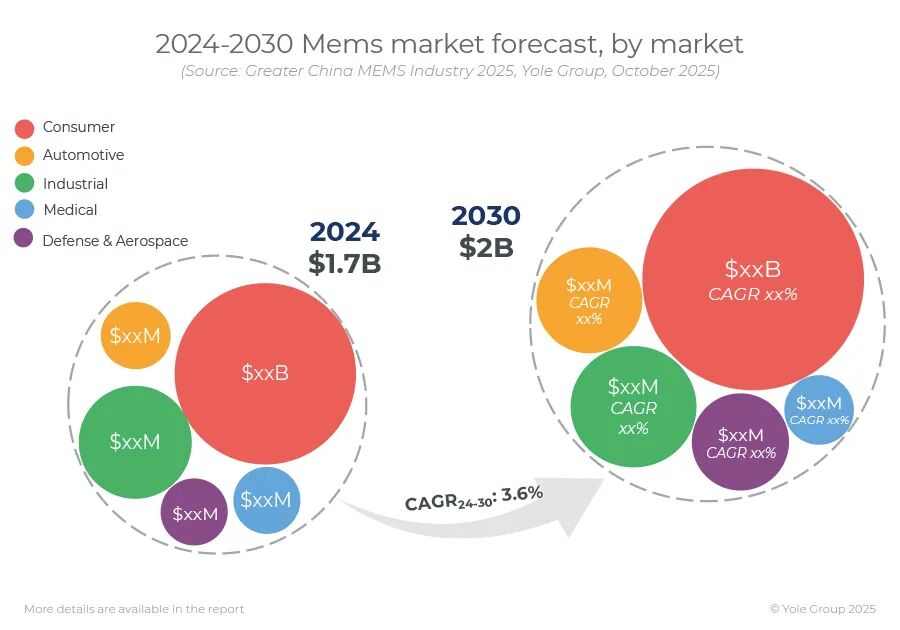
Core Insights - The MEMS industry in Greater China is projected to reach $1.7 billion in revenue in 2024, with a year-on-year growth of 8.4% and an estimated shipment of 5.4 billion units [1] - The market is expected to grow at a compound annual growth rate (CAGR) of 3.6% from 2024 to 2030, reaching $2 billion in revenue and 6.6 billion units sold by 2030 [1] - Chinese manufacturers are positioned to capitalize on this growth, particularly in the "AI + IoT + automotive electronics" wave [1] Market Dynamics - Consumer electronics remain the largest application segment for MEMS, with strong demand for inertial sensors, microphones, and pressure sensors in wearable devices like TWS headphones and smartwatches [3] - Major Chinese companies such as Silan Microelectronics, AAC Technologies, Goermicro, MiraMEMS, and MEMSensing are key players in the supply chain, leveraging performance, reliability, and cost advantages [3] - Goermicro is projected to achieve over 4.5 billion yuan in revenue in 2024, making it the largest smart sensor interaction solution provider in China [3] Revenue Growth - Silan Microelectronics reported a 10% increase in revenue for its MEMS sensor products in the first half of 2025, with a market share of 20%-30% in domestic smartphone brands [3] - AAC Technologies' sensor and semiconductor business revenue reached 608 million yuan in the first half of 2025, a 56.2% increase, driven by high signal-to-noise ratio microphones [4] - MEMSensing achieved a record revenue of 300 million yuan in the first half of 2025, a 47.82% increase, with significant upgrades in acoustic sensor technology [5] Industry Expansion - Chinese MEMS manufacturers are expanding into high-value sectors like automotive and industrial applications, with Silan Microelectronics developing high-precision inertial sensors for automotive use [6] - The automotive sector is seeing increased demand for MEMS microphones due to the rise of smart cockpits and voice control systems [6] - The industrial sector is leveraging MEMS accelerometers and microphones for equipment health monitoring, aligning with the cost and manufacturing flexibility of Chinese firms [7] Emerging Applications - The medical market is expected to be one of the fastest-growing segments for MEMS, particularly with the opening of the OTC hearing aid market in the U.S. and China [7] - MEMS technology is also being integrated into AI infrastructure, with demand for MEMS optical switches and micro-mirrors in optical communication systems [8] Device Maturity - The variety of MEMS devices includes inertial, acoustic, environmental, optical, medical, and energy-related types, with applications expanding beyond consumer electronics [9] - Chinese manufacturers have achieved near-complete domestic production of MEMS microphones, reaching international performance standards [10] Manufacturing Advancements - The MEMS foundry sector in Greater China is projected to grow by 14.3% in 2024, becoming a new growth engine for the industry [13] - Companies like Chipone Integrated Circuits and Huazhong University of Science and Technology are emerging as key players in MEMS wafer foundry [16][17] - The transition from 8-inch to 12-inch wafer production lines is underway, with Guangzhou Zengxin launching the first 12-inch MEMS sensor production line in China [18] Future Outlook - Chinese MEMS companies are expected to gain unprecedented development opportunities, benefiting from their position as a core manufacturing hub for consumer electronics, automotive, and industrial sectors [12] - The focus on manufacturing capabilities is shifting from "filling gaps" to "building advantages," enhancing China's bargaining power and technological influence in the global MEMS market [21]


MEMS,中国势不可挡
半导体行业观察· 2025-11-07 01:00
Core Viewpoint - The MEMS (Micro-Electro-Mechanical Systems) industry in the Greater China region is projected to reach a global revenue of $1.7 billion in 2024, with a year-on-year growth of 8.4%, driven by the convergence of AI, IoT, and automotive electronics [2]. Group 1: Market Dynamics - The MEMS market is expected to have a compound annual growth rate (CAGR) of 3.6% from 2024 to 2030, with sales reaching 6.6 billion units and revenue hitting $2 billion by 2030 [2]. - Consumer electronics remain the largest application segment, particularly in TWS earbuds, smartwatches, and AR glasses, where demand for inertial sensors, microphones, and pressure sensors is strong [4][5]. Group 2: Chinese Manufacturers' Role - Chinese companies such as Silan Microelectronics, AAC Technologies, Goermicro, MiraMEMS, and MEMSensing are becoming key drivers in the MEMS market, leveraging advantages in performance, reliability, and cost [5]. - The domestic MEMS microphone industry has achieved nearly complete localization, forming a complete ecosystem from wafer to packaging, with performance metrics approaching international standards [12]. Group 3: Technological Advancements - MEMS acoustic sensors are set to undergo significant upgrades in technical specifications, particularly in signal-to-noise ratio, creating new market opportunities [6]. - The automotive and industrial sectors are seeing increased demand for high-reliability MEMS products, with applications in safety-related systems and device health monitoring [7]. Group 4: Emerging Markets - The medical market is anticipated to be one of the fastest-growing segments for MEMS, especially with the opening of the OTC hearing aid market in the U.S. and China [8]. - The demand for MEMS in communication and AI infrastructure is also rising, driven by the surge in data traffic and AI training scales [8]. Group 5: Manufacturing and Supply Chain - The MEMS foundry sector in Greater China is expected to grow by 14.3% in 2024, with companies like Chipone, Silex, and Huazhong University of Science and Technology leading the charge [17]. - The transition from 8-inch to 12-inch wafer production lines is underway, which will significantly reduce costs and increase output [19][21]. Group 6: Future Outlook - Chinese MEMS companies are positioned to seize unprecedented growth opportunities, benefiting from their proximity to key markets and the ability to respond quickly to customer needs [14][15]. - The next decade will be crucial for achieving breakthroughs in high performance, intelligence, and system integration within the MEMS industry [24].

来势迅猛,安世启动二次反制!荷兰断供,中方对阵欧盟27国
Sou Hu Cai Jing· 2025-11-06 18:29
Core Viewpoint - The conflict between ASML and its Chinese subsidiary highlights the fragility of global supply chains and the unintended consequences of political maneuvers in the semiconductor industry [1][3][10] Group 1: Supply Chain Disruption - ASML's temporary CEO announced a halt in wafer supply due to alleged payment defaults by the Dongguan factory, which ASML China refuted, claiming ASML owed 1 billion yuan [1][5] - The Dutch government's takeover aimed to sever Chinese control over ASML but resulted in a significant disruption, as 70% of ASML's end production capacity is concentrated in the Dongguan facility, leading to panic among European automakers [3][5] - Major European car manufacturers like Volkswagen and Mercedes-Benz rushed to stockpile chips, causing a 20% short-term price increase, while Dutch wafer factories faced inventory pile-up due to halted production [3][5] Group 2: Political and Economic Repercussions - The Dutch government's actions have been criticized for prioritizing political motives over market logic, with the German media noting that the automotive industry is facing real costs due to these decisions [5][7] - In response to the supply halt, the Chinese Ministry of Commerce implemented export controls on ASML's automotive chips, while allowing for flexible exemptions for affected companies, leading to a split in the European automotive sector [5][7] - ASML China indicated that its existing inventory could meet customer demands until the end of the year, and domestic wafer manufacturers are stepping in to fill the gap, accelerating the shift towards local alternatives [5][8] Group 3: Global Supply Chain Dynamics - The incident underscores the complexities of global supply chains, with ASML's model relying on a "Dutch wafer - Chinese packaging - global sales" approach, making the packaging stage a critical point of control [10] - The situation has prompted discussions about the sustainability of political interventions in market operations, with warnings from the German business community about the costs of such political maneuvers [10] - The broader implications of this conflict raise questions about the future of globalization and whether nations can maintain efficiency in supply chains while pursuing absolute autonomy [10]

嘉宾更新|2025集成电路特色工艺与先进封装测试产业技术论坛暨电子科技大学集成电路行业校友会年会
半导体芯闻· 2025-11-06 09:55
指导单位: 中国半导体行业协会、 成都市投资促进局 主办单位: 电子科技大学、电子科技大学校友总会 支持单位: 崇州市人民政府 承办单位: 电子薄膜与集成器件全国重点实验室、电子科技大学集成电路科学与工程学院(示范性微电子学院)、电子科技大学集成电路行业校友会、华润微电子有 限公司、三叠纪(四川)科技有限公司、 天府绛溪实验室、 CEIA电子智造|导电高研院、西部半导体产业生态平台 协办单位: 电子科技大学重庆微电子产业研究院、四川省电子学会、成都市集成电路行业协会、成都市电子信息行业协会、成都新型显示行业协会、 电子元器件可靠 性技术全国重点实验室、 成电创投30人俱乐部、郫都高新技术产业园管委会(筹) 集成电路产业是关系国民经济和社会发展的战略性、基础性、先导性产业。川渝作为国家重大生产力优化布局和新时代战略腹地建设的核心承载区,正快 速发展成为全国集成电路产业的重要高地。 承继首届活动成功经验,本次 "2025集成电路特色工艺及先进封装测试产业技术论坛暨电子科技大学集成电路行业校友会年会" 以 " 特色工艺及功率半导体技术 " 、" TGV及先进封装产业生态 "和" 集成电路校友生态建设 "为核心专题, ...
部分汽车芯片组件价格大涨数倍,交货周期也从12周延长至20周以上
Xuan Gu Bao· 2025-11-05 23:31
Group 1 - Nissan will reduce production of its best-selling SUV model Rogue in Japan due to a chip supply shortage from Anshi Semiconductor [1] - The crisis, initiated by the Netherlands, has extended delivery times for related products from 12 weeks to over 20 weeks, with some chip component prices increasing by 10 times [1] - Anshi Semiconductor is a leading company in the global power semiconductor sector, with products including MOSFETs, IGBTs, and diodes, widely used in electric vehicle motor control, onboard power management, and lighting control systems [1] Group 2 - The power semiconductor device and module market is projected to reach $32.3 billion in 2024, a decrease of approximately 10% from $35.7 billion in 2023, indicating an industry downturn [1] - Huatai Securities believes the sector is nearing the end of its bottoming phase, with overseas recovery potentially lagging domestic recovery by 3-4 quarters [1] - AI chip computing power growth is significantly increasing power consumption, driving the need for power materials in various applications, with AI expected to become a second major growth driver alongside the new energy market [1] Group 3 - Companies such as China Resources Microelectronics, Silan Microelectronics, and Chiplink Integrated are experiencing tight utilization rates for 12-inch power capacity, with no large-scale expansion plans for power devices in the short term [2]
华润微:IGBT产品快速增长 功率器业务稳中向好
Quan Jing Wang· 2025-11-04 09:37
Core Viewpoint - The event "Capital 'X' Gravity, Innovation High Ground - Wuxi's First Investor Reception Day for Listed Companies" was successfully held, highlighting the positive outlook for the IGBT product market and the company's growth potential [1] Company Summary - Huazhong Microelectronics (688396) reported that its IGBT product structure and market structure are continuously optimizing, leading to rapid year-on-year growth [1] - The company expressed a cautiously optimistic attitude towards maintaining growth in the power device market, which has entered a stable and improving phase [1]

AIDC供电新方案有望助力SiC/GaN打开成长空间
Orient Securities· 2025-11-04 08:16
Investment Rating - The report maintains a "Positive" investment rating for the electronic industry, particularly focusing on the potential growth of SiC/GaN power devices driven by new power supply solutions for AI data centers [6]. Core Insights - The demand for AI servers and data centers is expected to open up growth opportunities for SiC/GaN power devices, with new power supply solutions like HVDC and SST becoming increasingly important [3][11]. - The report highlights that the transition to 800V HVDC power supply architecture is anticipated to significantly enhance power efficiency and reduce operational costs for data centers [9][28]. Summary by Sections 1. AI Data Center Power Requirements - The power requirements for AI data centers are increasing, with single cabinet power rising from 5-8 kW to 20-50 kW, and potentially exceeding 100 kW [19]. - NVIDIA is promoting the transition to an 800V HVDC power supply architecture, which is expected to be fully implemented by 2027 [26][28]. 2. SST (Solid State Transformer) - SSTs are characterized by high efficiency and compact size, making them suitable for modern power supply needs [37]. - The adoption of SST technology is expected to become mainstream in future power supply solutions, significantly improving space utilization and power efficiency in data centers [47]. 3. HVDC and SST Impact on Power Semiconductors - The report indicates that HVDC and SST solutions will enhance the performance requirements for power semiconductors, creating a favorable environment for the penetration of SiC/GaN devices [56]. - The market for SiC/GaN devices is projected to reach $2.7 billion by 2030, driven by their application in 800V HVDC data center power systems [11][68]. 4. SiC/GaN Growth Potential - The report identifies key companies that are well-positioned to benefit from the growth in SiC/GaN devices, including industry leaders like Innoscience and Tianyu Advanced [3][14]. - The penetration rates for SiC and GaN in the power semiconductor market are expected to increase, with forecasts suggesting a rise in demand due to AI computing facilities [68].


华泰证券今日早参-20251103
HTSC· 2025-11-03 02:32
Macro Overview - 2025 is characterized as a turning point for China's macroeconomic landscape, with expectations for a brighter macroeconomic outlook in 2026 [2] - The U.S. economy is experiencing a dual-speed growth pattern, with rapid expansion in AI-related investments and slightly below-trend growth in traditional sectors [2][3] Investment Strategy - The profit cycle is expected to rebound due to approaching turning points in capacity and inventory cycles, with positive signals from the real estate cycle and overseas expansion [3] - Relative valuations in the Chinese market still have room for improvement, making Chinese assets attractive [3] - The market style is anticipated to rebalance rather than switch, focusing on seven key investment themes including policy, technology, real estate, and capital market reforms [3][4] Fixed Income Market - The global investment landscape is expected to see a shift with a focus on domestic demand and technology, leading to a potential recovery in nominal GDP growth [6] - The bond market is likely to exhibit characteristics of low interest rates and high volatility, with a projected yield range for ten-year government bonds between 2.0% and 2.1% [6] Equity Market Insights - The insurance sector is shifting towards dividend insurance products, with positive sales trends expected to continue into 2026 [8] - The securities market is undergoing a transformation, with low interest rates enhancing the attractiveness of equity assets and sustainable inflows of new capital [9] Company-Specific Analysis - Xinquan Co., Ltd. reported Q3 revenue of 3.954 billion yuan, a year-on-year increase of 14.91%, but net profit decreased by 27.10% due to competitive pressures [10] - Jifeng Co., Ltd. achieved Q3 revenue of 5.608 billion yuan, with a net profit increase of 116.62% year-on-year, indicating strong order backlog and production ramp-up [11] - Guobo Electronics reported Q3 revenue of 498 million yuan, with a focus on mobile terminal expansion and military product recovery [12] - Icewheel Environment's Q3 revenue grew by 6.88% year-on-year, supported by recovery in commercial cold chain and new applications in data centers [13] - Changfei Optical Fiber's Q3 revenue increased by 16.27% year-on-year, driven by AI data communication demand [14] Sector Performance - The traditional energy sector, represented by Gansu Energy, showed a revenue increase of 1.33% year-on-year in Q3, benefiting from strong profitability in hydropower [26] - The pump manufacturing sector, led by Southern Pump, is expanding into new applications such as liquid cooling and data centers, with Q3 revenue showing a slight decline but net profit growth [27]


“国家大基金”持仓路径曝光 三季度重仓股名单来了
Xin Lang Cai Jing· 2025-11-02 03:23
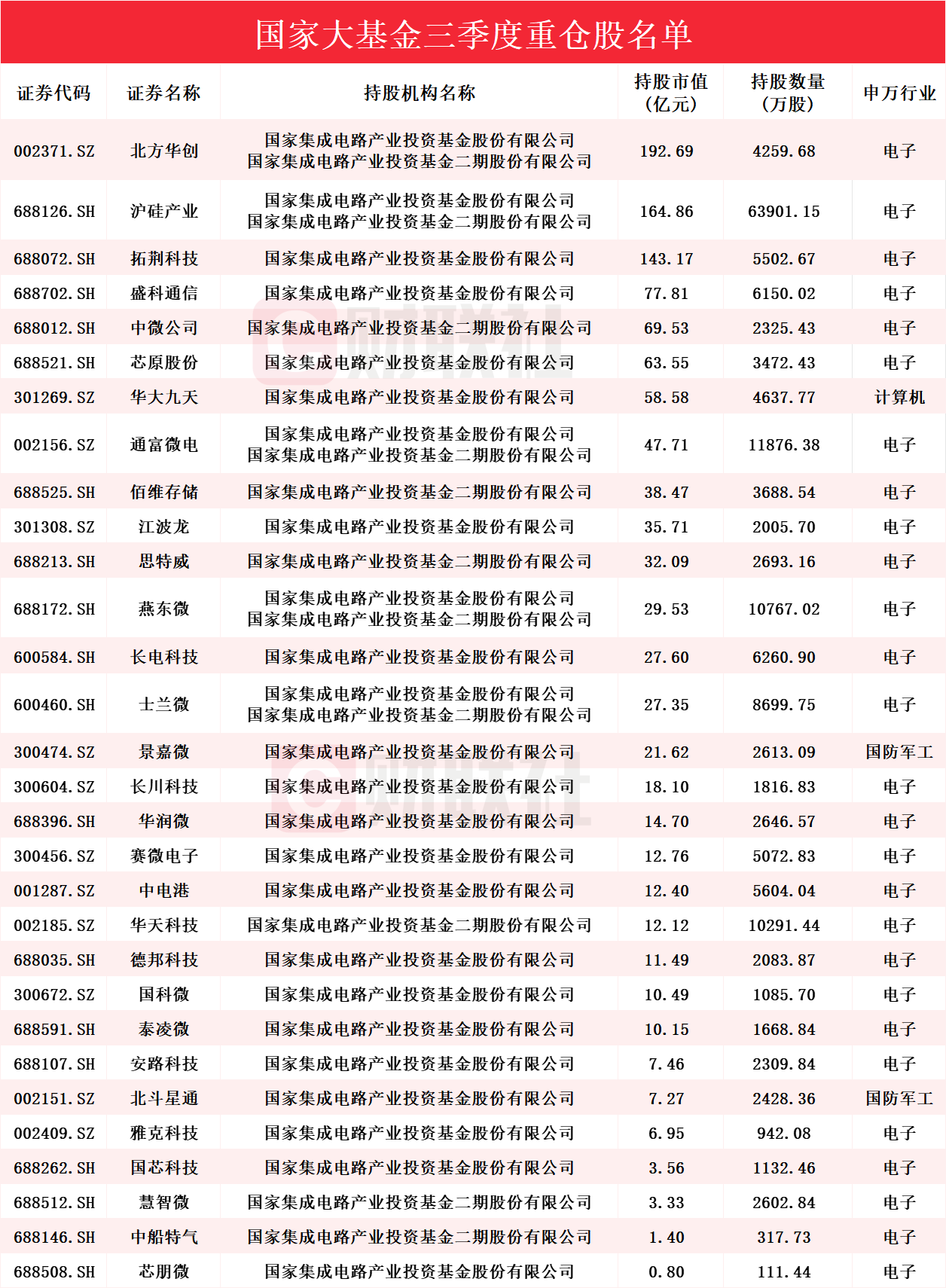
Core Insights - The latest investment direction of the "National Big Fund" has emerged, with 30 A-share listed companies having the fund as a significant shareholder [1] Group 1: Investment Holdings - The "National Big Fund" has significant holdings in companies such as Northern Huachuang, Hushi Silicon Industry, and Tuojing Technology, among others [1] - The fund's investments are primarily in the semiconductor and integrated circuit sectors, reflecting a strategic focus on these industries [1] Group 2: Company Performance - Northern Huachuang reported a Q3 revenue of 11.16 billion yuan, a year-on-year increase of 38.31%, with a net profit of 1.92 billion yuan, up 14.60% [3] - Hushi Silicon Industry achieved a Q3 revenue of 944 million yuan, a 3.79% increase, but reported a net loss of 265 million yuan [4] - Tuojing Technology saw a significant Q3 revenue increase of 124.15% to 2.27 billion yuan, with a net profit of 462 million yuan, up 225.07% [5]


华润微电子- 收入稳健增长,盈利面临压力
2025-11-04 01:56
Summary of China Resources Microelectronics Limited Conference Call Company Overview - **Company**: China Resources Microelectronics Limited (688396.SS) - **Industry**: Technology Semiconductors - **Market Cap**: Rmb70,216.1 million - **Current Stock Price**: Rmb53.49 (as of October 30, 2025) - **Price Target**: Rmb40.00, indicating a downside of 25% from the current price [6][6][6] Financial Performance - **3Q25 Earnings**: - Revenue: Rmb2.9 billion (flat Q/Q, up 5% Y/Y) - Gross Margin: 27.9% (up from 25.9% in 2Q25) - Operating Margin: 10.3% (down from 10.7% in 2Q25) - EPS: Rmb0.14 (down 27% Q/Q, down 15% Y/Y), which was 64% below Morgan Stanley estimates and 36% below consensus [1][1][1] - **4Q25 Outlook**: - Targeting 10% revenue growth for 2025, with expected revenue of Rmb3.1 billion in 4Q25 (up 7% Q/Q, 16% Y/Y) - Anticipated slight decrease in gross margin due to annual maintenance in December [2][2][2] Competitive Landscape - **Market Position**: CR Micro is recognized as a key player in China's power semiconductor localization trend - **Competition**: The company is aware of peers' capacity expansion plans, but actual capacity ramp-up may take two years [3][3][3] Investment Rating - **Current Rating**: Equal-weight (EW) - **Analyst View**: While CR Micro is a significant player in the market, competition in the analog foundry sector remains intense due to overcapacity in mature nodes over the past 2-3 years [3][3][3] Financial Projections - **Future EPS Estimates**: - 2025: Rmb1.15 - 2026: Rmb1.56 - 2027: Rmb2.04 [6][6][6] - **Revenue Projections**: - 2025: Rmb11,649 million - 2026: Rmb13,511 million - 2027: Rmb15,178 million [6][6][6] Valuation Methodology - **Methodology**: Residual income model with an 8.2% cost of equity, a payout ratio of 20%, medium-term growth rate of 16.0%, and terminal growth rate of 5.5% [9][9][9] Risks - **Upside Risks**: Higher than expected self-sufficiency rate for MOSFETs in China and increased MOSFET content per electric vehicle - **Downside Risks**: Lower than expected self-sufficiency rate and pricing pressure from local peers [10][10][10] Conclusion - The financial results indicate steady revenue growth but highlight pressures on earnings. The competitive landscape remains challenging, and while the company is positioned well within the industry, the outlook suggests cautious optimism with potential risks to both upside and downside.