南方基金

Search documents
千亿级ETF 跌停
Shang Hai Zheng Quan Bao· 2026-02-02 23:16
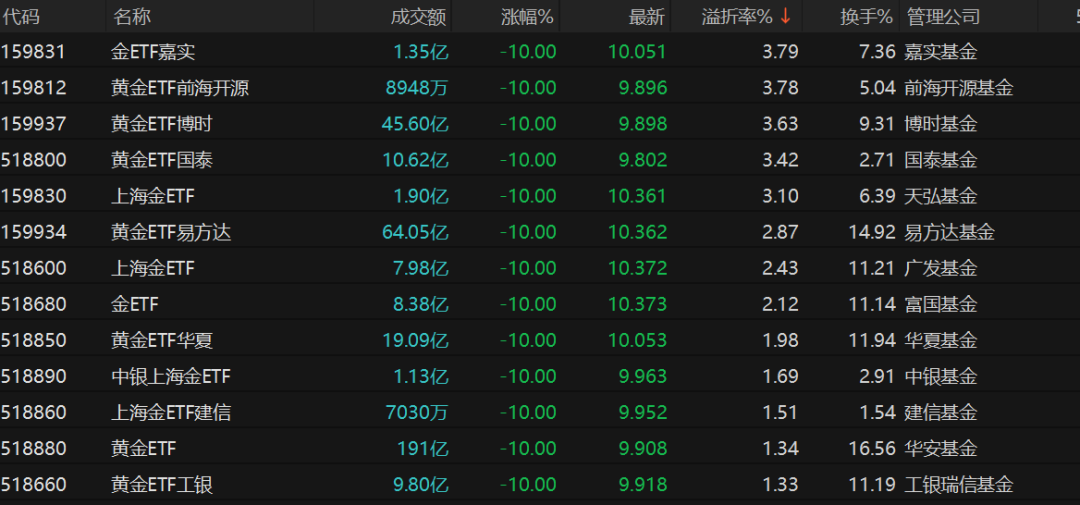
Group 1: Market Overview - Gold-related ETFs experienced significant declines, with multiple ETFs hitting the daily limit down [2][5] - The Huashan Gold ETF recorded a trading volume of 19.1 billion yuan, marking the third-highest trading day since its inception in 2013 [2][4] - The total scale of gold-related commodity ETFs reached 333.3 billion yuan as of January 30, up from 70.4 billion yuan at the beginning of 2025 [4] Group 2: Trading Performance - Several gold ETFs, including E Fund Gold ETF and Bosera Gold ETF, also saw high trading volumes, with E Fund Gold ETF at 6.4 billion yuan and Bosera Gold ETF exceeding 4.5 billion yuan [2][3] - The performance of various gold-related ETFs showed a uniform decline of 10% on the trading day [3][6] Group 3: Investor Sentiment and Recommendations - Analysts suggest that the recent drop in gold prices is a short-term technical adjustment and emotional release, emphasizing the importance of avoiding irrational trading behaviors [8] - Investment firms recommend that investors focus on long-term strategies and be cautious of leverage risks, especially in a high-volatility environment [8]

今年首月公募“打新”获配超12亿元
Xin Lang Cai Jing· 2026-02-02 23:02
本报记者 方凌晨 公募排排网统计数据显示,今年1月份,公募机构共参与了5只新股的网下配售,获配金额超12亿元。在 业内人士看来,公募机构参与"打新",主要出于收益增厚、优化组合配置、战略布局等多方面考量。未 来公募"打新"热情有望延续,综合实力强劲的公募机构有望主导"打新"市场。 新股各具行业代表性 上述数据显示,1月份公募机构参与新股网下配售合计获配6022.33万股,获配金额达12.50亿元。 深圳市融智私募证券投资基金管理有限公司FOF(基金中的基金)基金经理李春瑜对《证券日报》记者 分析,一方面,新股网下配售具有风险相对较低、收益兑现较快的特点,能够有效增厚基金收益,尤其 在市场震荡期间,"打新"收益可以成为基金重要的收益稳定器;另一方面,"打新"也是公募机构布局高 成长赛道的重要方式,通过参与新股配售,公募机构可以提前锁定优质资产,与现有权益组合形成互 补,进一步优化配置结构。 具体来看,公募机构参与网下配售的5只新股分别是恒运昌、振石股份、北芯生命、至信股份和世盟股 份,从申万行业分类来看,这些新股各具行业代表性,分别隶属于半导体、玻璃玻纤、医疗器械、汽车 零部件和物流五大行业。 在南开大学金融学 ...
公募1月份调研近4000次 脑机接口技术突破受关注
Zheng Quan Ri Bao· 2026-02-02 16:41
Core Insights - Public fund institutions have significantly increased their research activities in January, focusing on AI computing power, high-end medical technology, and new energy as the three core investment themes [1][3][5] Group 1: Research Activity - A total of 156 public fund institutions participated in A-share research in January, covering 486 stocks across 17 industries, with a total of 3,992 research instances [1] - Leading institutions such as Bosera Fund, Huaxia Fund, and Penghua Fund conducted the most research, with Bosera Fund leading at 116 instances [2] - The most researched stocks included Zhongji Xuchuang in the communications sector with 61 instances, followed by Aipeng Medical and Xiangyu Medical in the medical sector with 57 and 47 instances respectively [2] Group 2: Industry Focus - The electronics industry was the most researched, with 603 instances covering 71 stocks, followed by the machinery equipment industry with 591 instances covering 67 stocks [2][3] - Other industries such as medical biology, electric equipment, and basic chemicals also saw significant research activity, each exceeding 276 instances [3] Group 3: Emerging Trends - Brain-computer interfaces have emerged as a key focus within the high-end medical sector, driven by technological breakthroughs and commercial progress [4] - Companies like Aipeng Medical and Meihai Medical are actively engaging in brain-computer interface developments, with Aipeng Medical discussing advancements in brainwave technology [4] - The year 2026 is anticipated to be pivotal for the commercialization of invasive brain-computer interfaces, with several companies already in clinical stages [4]



今年首月公募“打新”获配超12亿元 易方达基金拔得头筹
Zheng Quan Ri Bao Zhi Sheng· 2026-02-02 16:40
Group 1 - Public funds participated in the offline allocation of 5 new stocks in January, with a total allocation amount exceeding 1.25 billion yuan [1][2] - The participation of public funds in "new stock subscription" is driven by multiple factors, including profit enhancement, portfolio optimization, and strategic layout [1][3] - The new stocks allocated to public funds represent various industries, including semiconductors, glass fiber, medical devices, auto parts, and logistics [2] Group 2 - In January, public funds received a total of 60.22 million shares, with the highest allocation amounting to 423 million yuan for the semiconductor equipment company Hengyun Chang [3][4] - A total of 107 public fund institutions participated in the offline allocation, with 20 institutions receiving over 10 million yuan [4] - Leading public funds such as E Fund, Southern Fund, and ICBC Credit Suisse Fund were in the top tier of "new stock subscription," each receiving over 100 million yuan [4][5] Group 3 - The ongoing interest in sectors like semiconductors and new energy is expected to sustain the enthusiasm for public funds in "new stock subscription" [5] - Increased competition in offline allocations may lead to a higher difficulty in winning shares and a potential divergence in returns [5] - Top public funds with strong research capabilities and financial strength are likely to dominate the "new stock subscription" market, while smaller funds may need to focus on niche sectors and optimize their bidding strategies [5]
2/2财经夜宵:得知基金净值排名及选基策略,赶紧告知大家
Sou Hu Cai Jing· 2026-02-02 16:12
写在文章前的声明:在本文之前的说明:本文中所列的投资信息,只是一个对基金资产净值进行排行的客观描述,并无主观倾向性,也不是投资建议,纯属 娱乐性质。 | 基金简称 PK | | | 人民新闻播放台官方法律师 | | --- | --- | --- | --- | | 1 | 招商中证白 ... A | 0.7243 | 1.71% | | | 161725 | 2026-2-2 | | | 2 | 招商中证白 ... C | 0.7210 | 1.71% | | | 012414 | 2026-2-2 | | | 3 | 服装:星C | 0.5626 | 1.64% | | | 012043 | 2026-2-2 | | | 4 | 鹏华酒A | 0.3413 | 1.64% | | | 160632 | 2026-2-2 | | | 5 | 中欧甄选3个 ... C | 1.0101 | 1.47% | | | 013382 | 2026-1-29 | | | 6 | 中欧甄选3个... A | 1.0451 | 1.47% | | | 013381 | 2026-1-29 | | | 7 | 汇安丰融混合 ...

ETF周报2026年1月第3期:宽基流出边际趋缓,个人投资者积极-20260202
East Money Securities· 2026-02-02 13:11
Overall ETF Fund Flow Overview - During the period from January 26 to 30, 2026, the overall market stock ETFs (excluding cross-border) experienced a net outflow of 314.93 billion, with a notable decrease in outflow scale towards the end of the week as the market weakened [11][14] - A-share industry and thematic ETFs saw a net inflow of 71.75 billion, an increase of 12.88 billion compared to the previous period, indicating strong market entry willingness from individual investors who view market pullbacks as opportunities for allocation [14][16] - Hong Kong stock ETFs recorded a net inflow of nearly 10 billion, continuing the inflow trend, while cross-border industry and thematic ETFs had a net inflow of 1.16 billion, a decrease of 6.35 billion from the previous week [16] Sector Analysis - The inflow into sectors such as non-ferrous metals, semiconductors, chemicals, and gold stocks showed strong sustainability, while the oil and petrochemical sector saw a significant increase in net inflow, although recent market volatility may affect price direction [20][22] - In the cross-border sector, emerging markets, Hong Kong's Hang Seng Technology, and major industry categories like technology and financial real estate saw relatively high inflows [25] Representative ETF Fund Flow - For stock ETFs, the top five by net inflow from January 26 to 30 were: - Huaxia CSI Non-ferrous Metals Industry Thematic ETF (6.46 billion) - Southern CSI Shenwan Non-ferrous Metals ETF (5.63 billion) - Penghua CSI Chemical Industry ETF (4.01 billion) - Huaxia CSI Shanghai-Hong Kong Gold Industry Stock ETF (3.82 billion) - Fortune CSI Chemical Industry Thematic ETF (2.78 billion) - The top five by net outflow were: - E Fund CSI 300 ETF (-74.73 billion) - Huatai-PB CSI 300 ETF (-74.20 billion) - Huaxia CSI 300 ETF (-54.71 billion) - Huaxia SSE 50 ETF (-41.73 billion) - Jiashi CSI 300 ETF (-40.63 billion) [28] Cross-Border ETF Representative Products - The top five cross-border ETFs by net inflow were: - GF CSI Hong Kong Stock Connect Non-bank ETF - Tianhong Hang Seng Technology ETF - Southern Fund Southern Dongying FTSE Asia Pacific Low Carbon Selected ETF (QDII) - GF CSI Hong Kong Innovative Medicine (QDII-ETF) - E Fund CSI Hong Kong Stock Connect Consumer Thematic ETF [3]
超30只ETF,批量跌停!
Zhong Guo Zheng Quan Bao· 2026-02-02 12:24
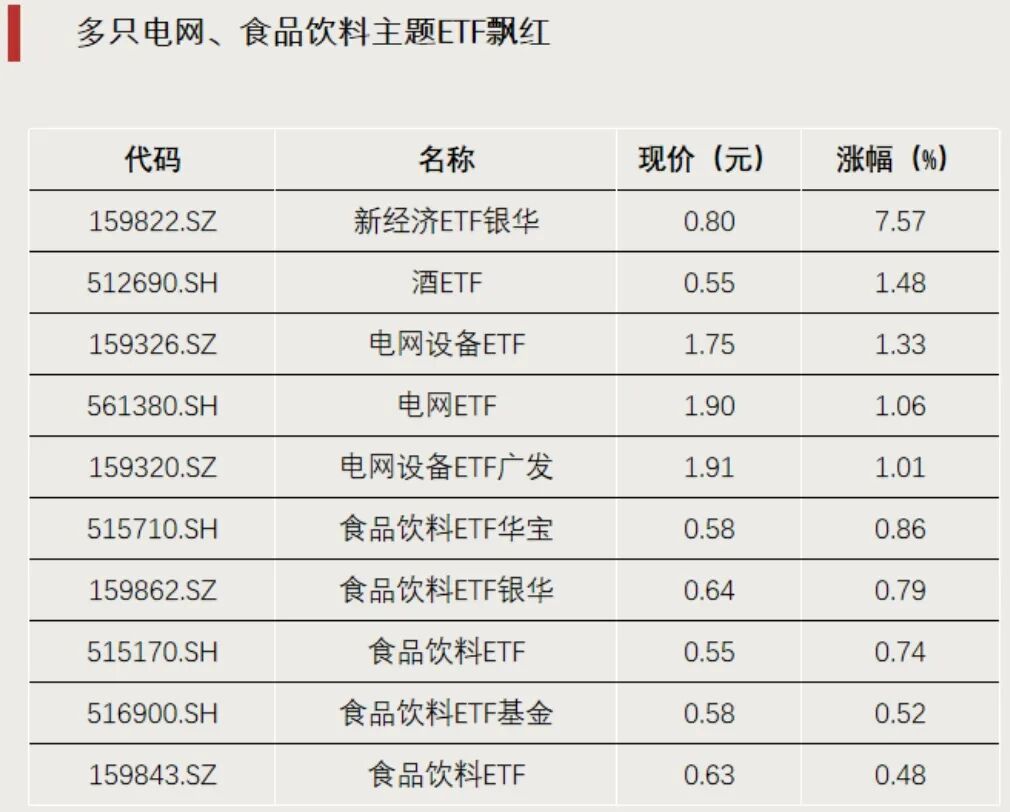
Market Overview - On February 2, over 30 ETF products hit the daily limit down, primarily from the gold and non-ferrous metal sectors, while ETFs related to electric grids, food and beverages, and banks showed resilience with gains [1][5] - The overall ETF market saw only about 50 products in the green at the close of trading [3] ETF Performance - The New Economy ETF by Yinhua (159822) recorded the highest single-day gain of over 7% on February 2 [3] - Several ETFs in the electric grid and food and beverage sectors demonstrated significant anti-drawdown characteristics, with notable performances including: - New Economy ETF Yinhua: 0.80 CNY, +7.57% - Food and Beverage ETF: 0.55 CNY, +1.48% - Electric Grid Equipment ETF: 1.75 CNY, +1.33% [4] Fund Flows - In January, multiple broad-based ETFs experienced significant net outflows, with a total exceeding 570 billion CNY from four major Hu-Shen 300 ETFs [8] - The specific net outflows for January included: - Huatai-PineBridge Hu-Shen 300 ETF: -190.84 billion CNY - E Fund Hu-Shen 300 ETF: -152.66 billion CNY - China Asset Hu-Shen 300 ETF: -137.59 billion CNY - Harvest Hu-Shen 300 ETF: -98.69 billion CNY [9] Market Sentiment - Current market conditions are characterized as a short-term emotional disturbance period, with expectations of a spring rally not yet concluded [3] - Analysts suggest that while there may be short-term volatility, the underlying logic supporting risk assets remains intact due to anticipated easing in 2026 and limited tightening actions from the Federal Reserve [3][7] Precious Metals Market - The precious metals market has seen a significant correction, attributed to a combination of speculative trading and increased margin requirements, leading to a technical clearing rather than a fundamental policy shift [6][7] - Despite recent volatility, long-term trends suggest continued support for precious metals due to weakening dollar credit and ongoing central bank purchases [7]
食品饮料ETF领涨;14只ETF单月扩容超百亿元丨ETF晚报
2 1 Shi Ji Jing Ji Bao Dao· 2026-02-02 11:54
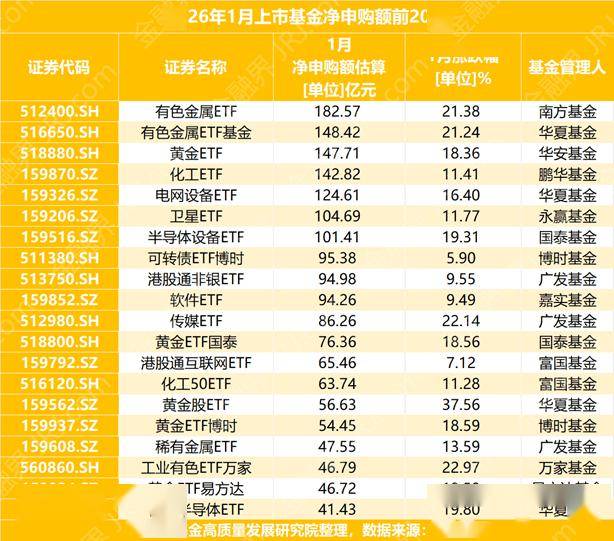
ETF Industry News - The three major indices experienced fluctuations and declines, with the Shanghai Composite Index down 2.48%, the Shenzhen Component Index down 2.69%, and the ChiNext Index down 2.46%. However, several ETFs in the food and beverage sector saw gains, including the Wine ETF (512690.SH) up 1.48%, the Huabao Food and Beverage ETF (515710.SH) up 0.86%, and the Yinhua Food and Beverage ETF (159862.SZ) up 0.79% [1] - The non-ferrous metal sector saw multiple ETFs decline significantly, with the Industrial Bank Gold ETF (159315.SZ) down 10.02%, the Gold Stocks ETF (159321.SZ) down 10.01%, and the Guotai Non-ferrous Metal ETF (159881.SZ) down 10.01% [1] - Guotai Junan Securities predicts a positive outlook for the food and beverage sector by 2026, highlighting four main lines of focus: cost dividend release, operational efficiency improvement, innovation-driven growth, and opportunities for reversal in certain sub-industries. The upcoming Spring Festival is expected to be a significant catalyst, and the imminent introduction of national standards for prepared dishes is also seen as a positive for the industry [1] ETF Market Performance - In January, the stock ETF market experienced a cumulative net outflow of over 790 billion yuan, with the last trading day seeing a net outflow of over 3.7 billion yuan. Popular thematic ETFs such as non-ferrous metals, chemicals, and satellite ETFs saw inflows, while broad-based ETFs like the CSI 300 ETF and the SSE 50 ETF faced significant outflows [2] - The thematic ETFs have gained popularity, with 14 ETFs expanding by over 10 billion yuan each in January. Resource-related and technology-related ETFs have shown particularly strong performance, with the Gold ETF seeing a scale increase of 33.54 billion yuan and the Southern CSI Non-ferrous Metal ETF increasing by 24.22 billion yuan [3][4] - The overall performance of ETFs varied, with money market ETFs showing the best average performance at 0.00%, while commodity ETFs had the worst average performance at -8.88% [11] Sector Performance - In terms of sector performance, the food and beverage, banking, and household appliance sectors ranked highest today, with daily gains of 1.11%, 0.17%, and -0.49% respectively. Conversely, the non-ferrous metals, steel, and basic chemicals sectors ranked lowest, with daily declines of -7.62%, -5.93%, and -5.69% respectively [8] - Over the past five trading days, the food and beverage, communication, and banking sectors have shown positive performance, with gains of 3.14%, 2.47%, and 0.59% respectively, while the non-ferrous metals, steel, and comprehensive sectors have shown declines of -8.68%, -7.66%, and -7.6% respectively [8]
贵金属资金流向逆转:投机资金集中撤离,品种分化行情将至!
Sou Hu Cai Jing· 2026-02-02 11:21
除了宏观政策面的风向突变,交易层面的因素也放大了波动。在1月份价格飙升至历史高位的过程中, 黄金的相对强弱指数(RSI)等技术指标已进入严重超买区间,积累了巨大的获利了结压力。早期涌入 的投机资金与高杠杆交易盘在价格转向时集中平仓,引发了连锁式的技术性抛售。其中,白银因市场规 模相对较小、金融与工业属性交织且投机资金参与度更高,其价格波动较黄金更为剧烈。 针对后市走向,光大期货认为,贵金属价格剧烈调整是对前期极端超买与过度拥挤交易的一次"挤泡沫 和降杠杆"式的强制性清算,但支撑贵金属的长期核心变量(如美元信用体系重构、去美元化储备趋 势、地缘政治裂痕常态化)并未发生逆转,长期驱动逻辑依然完整。进入2月,市场将更加关注宏观、 政策信号与地缘事件驱动寻求贵金属的支撑点,波动率仍将维持高位,但各品种将走向分化。 从长周期来看,国联期货表示,贵金属整体趋势依然稳定。在全球秩序重构大势不可逆、地缘政治仍处 于高度不确定性、全球信用货币体系重构(美元信用松动)的长期宏观趋势背景下,黄金作为重要储备 资产,在避险、货币对冲及抗通胀的配置需求支持下,仍将维持强势格局。而白银在全球战略资产储备 需求升温、结构性供需缺口长期存在 ...

ETF周报|4000点保卫战打响,你慌了吗?
Sou Hu Cai Jing· 2026-02-02 11:10
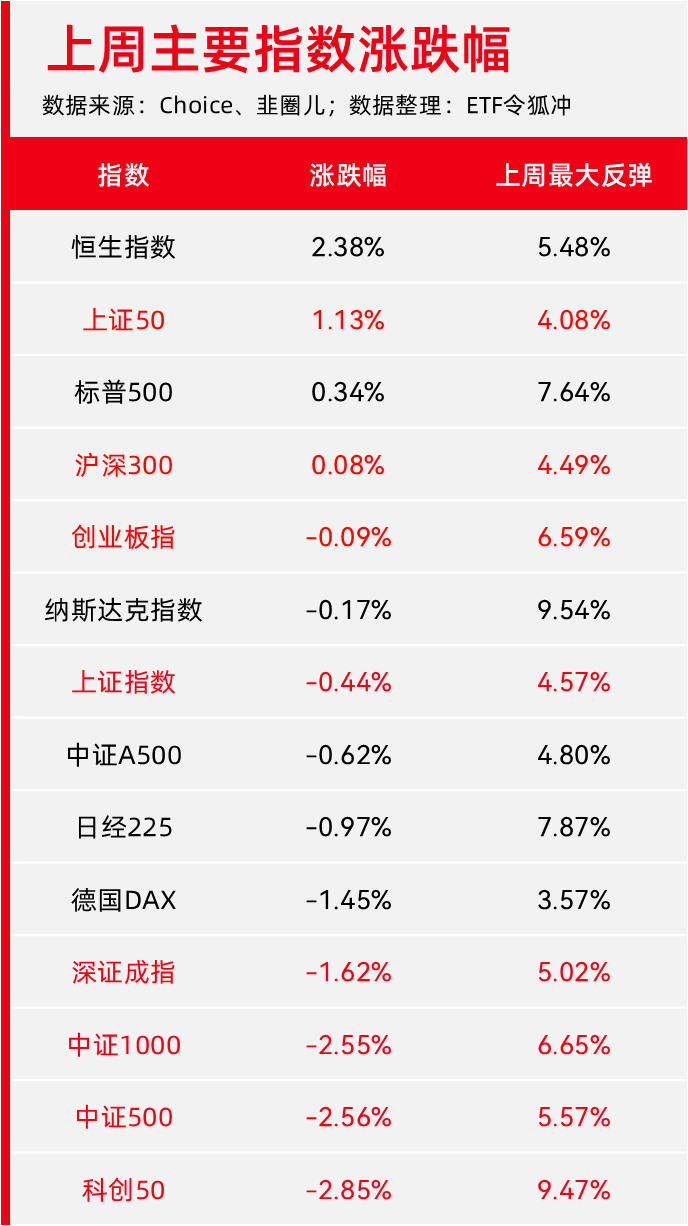
Overall Market Trends - The market experienced significant fluctuations, with the Shanghai Composite Index showing a decline of 0.44% last week, while the Hang Seng Index rose by 2.38% [3][4] - The overall market sentiment has shifted, with a noticeable rotation from small-cap stocks to undervalued large-cap stocks, particularly in the banking and consumer sectors [22][23] ETF Performance - Major ETFs such as the CSI 300 ETF saw a substantial decrease in scale, with the total assets of the top four CSI 300 ETFs shrinking from 1.19 trillion yuan to 570 billion yuan, a drop of over 50% [13][28] - The Gold ETF experienced a significant increase in scale, rising by 12.28% last week, making it the third-largest ETF in terms of scale [14][24] Sector Analysis - The banking sector showed resilience, with the Bank ETF increasing by 0.78% and the scale rising by 7.15% [22] - The consumer sector, particularly the liquor and food and beverage ETFs, saw a surge in trading volume, with the liquor ETF's trading volume increasing over 100% [22][23] - The agricultural sector is showing signs of recovery, supported by rising pork prices and favorable government policies [23] Global Market Context - Global indices such as the Nasdaq and DAX experienced declines, indicating a broader market fatigue after a prolonged period of growth [4][7] - The Fear and Greed Index indicated a drop to 78.99, reflecting a shift in market sentiment towards caution, although it remains in the greed zone [7][10] Fund Management Trends - Major fund management companies like E Fund and Huatai-PB saw significant reductions in their ETF scales due to major shareholders reducing their holdings [28] - Despite the overall decline in ETF scales, companies like Guotai and Huaan managed to grow their scales, benefiting from balanced industry allocations and strong gold ETFs [28]