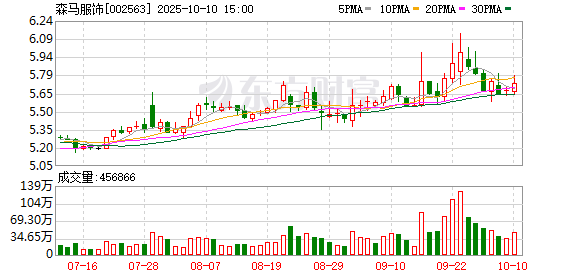
森马服饰

Search documents
1.55亿元资金今日流入纺织服饰股
Zheng Quan Shi Bao Wang· 2025-10-17 10:09
Core Viewpoint - The Shanghai Composite Index fell by 1.95% on October 17, with the power equipment and electronics sectors experiencing the largest declines of 4.99% and 4.17%, respectively. The textile and apparel sector also saw a decrease of 0.61% [1]. Textile and Apparel Sector Summary - The textile and apparel sector experienced a net inflow of 155 million yuan, with 105 stocks in the sector. Out of these, 34 stocks rose, including 5 that hit the daily limit, while 70 stocks fell, with 1 hitting the lower limit [1]. - The top three stocks with the highest net inflow were: - Jihua Group: 293 million yuan, up 9.97% - Furui Shares: 158 million yuan, up 10.02% - Cuihua Jewelry: 80.5 million yuan, up 4.20% [1]. - The sector also had 20 stocks with net outflows exceeding 10 million yuan, with the largest outflows from: - Wanlima: 67.1 million yuan, down 6.69% - Seven Wolves: 44.6 million yuan, down 7.68% - Semir Apparel: 42.9 million yuan, down 3.35% [2][3].


森马服饰10月15日获融资买入1721.96万元,融资余额2.04亿元
Xin Lang Cai Jing· 2025-10-16 01:20
Core Insights - On October 15, Semir Apparel's stock rose by 2.18%, with a trading volume of 215 million yuan. The financing data indicated a net financing outflow of 6.89 million yuan for the day [1] - As of June 30, 2025, Semir Apparel reported a revenue of 6.149 billion yuan, a year-on-year increase of 3.26%, while the net profit attributable to shareholders decreased by 41.17% to 325 million yuan [2] Financing Overview - On October 15, Semir Apparel had a financing buy-in of 17.22 million yuan, with a current financing balance of 204 million yuan, accounting for 1.34% of the market capitalization. This financing balance is above the 90th percentile of the past year [1] - The company had a margin balance of 3.4018 million yuan, with a short-selling volume of 60.53 million shares, also exceeding the 90th percentile of the past year [1] Shareholder Information - As of June 30, 2025, the number of shareholders for Semir Apparel increased by 65.36% to 41,400, while the average circulating shares per person decreased by 39.34% to 53,283 shares [2] - Since its A-share listing, Semir Apparel has distributed a total of 12.585 billion yuan in dividends, with 2.694 billion yuan distributed in the last three years [3]
走进叮咚买菜与柠季,找到AI落地柔性供应链的解法【AI落地研学营】
虎嗅APP· 2025-10-16 00:09
Core Insights - The article emphasizes the importance of integrating AI into business operations, particularly in supply chain management, to transform it from a cost center to a value center [5][23][24]. Group 1: AI Implementation in Supply Chain - Dingdong Maicai utilizes Agentic AI to enhance traceability and accountability in its fresh supply chain, addressing issues of high loss, volatility, and time sensitivity [7][8]. - The company has achieved a 95% accuracy rate in sales forecasting for overall orders and popular items, showcasing the effectiveness of AI in decision-making processes [8]. - The approach involves a full-chain upgrade from human-driven processes to algorithm-driven operations, ensuring clarity and accountability at every stage [8]. Group 2: Digital Transformation Strategies - Ningji adopts a light-asset, rapid expansion model, focusing on data-driven decision-making to reduce reliance on individual expertise, allowing the CEO to "work less" [9][10]. - The company emphasizes the importance of completing foundational steps like information and online transformation before advancing to AI applications [10]. - AI applications at Ningji are centered around efficiency and revenue generation, with practical implementations in customer service and site selection [10]. Group 3: Content Supply Chain Innovation - Tezign views content as a new SKU, advocating for a content supply chain that allows for the reuse and combination of creative assets [13][14]. - The company employs AI to manage and produce marketing content efficiently, enabling rapid generation without requiring design skills from operators [14]. - This approach positions content production as a core asset for businesses, moving away from one-time use to reusable modules [14]. Group 4: Gradual AI Integration - Shuhai Supply Chain emphasizes a methodical approach to AI integration, focusing on cost reduction, efficiency enhancement, and quality improvement [15][17]. - The company has invested over 400 million yuan in developing a comprehensive SaaS system to streamline operations across various business functions [17]. - AI implementation is approached in stages, starting with simpler tasks to build a foundation before tackling more complex scenarios [17][21]. Group 5: Industry Challenges and Consensus - Participants in the roundtable discussion highlighted the challenges of aligning consumer demands with supply chain capabilities, particularly in the fashion industry [18][19]. - There is a shared concern about measuring the value of AI, as business growth results from multiple factors, complicating the attribution of success to specific AI tools [19][20]. - A consensus emerged that AI is not a panacea but rather a complex system engineering challenge that requires a structured approach to implementation [20][22].



超1.7万家实体店,倒在2025上半年
商业洞察· 2025-10-15 09:24
Core Viewpoint - The retail industry in China is undergoing significant adjustments, with a notable increase in store closures across various sectors, including supermarkets, department stores, tea and coffee shops, and apparel brands, driven by changing consumer habits and market dynamics [2][3][7][9][12][19][24]. Supermarket Sector - In the first half of 2025, at least 720 supermarkets closed, including major brands like Yonghui and Walmart, due to factors such as operational strategy adjustments and lease expirations [4][6]. - The online retail growth rate of 8.5% significantly outpaces the 3.75% growth in offline retail, indicating a shift in consumer shopping habits towards online platforms [7]. - Traditional supermarkets face challenges from aging infrastructure and expiring leases, prompting a shift towards closing underperforming stores and enhancing online operations [8]. Department Store Sector - The department store retail total saw a 1.2% year-on-year increase in the first half of 2024, recovering from a 3% decline the previous year, but still lagging behind overall retail growth [9]. - At least 23 department stores and shopping centers closed in the first half of 2025, with closures attributed to outdated business models and lease expirations [10][11]. Tea and Coffee Sector - A total of 6,673 tea and coffee shops closed in the first half of 2025, reflecting a market reshuffle [12][15]. - Major brands like Xinyue and Nayuki saw significant store reductions, with Nayuki closing 159 stores, marking an 18.32% decrease in its total store count [15][18]. Apparel Sector - The apparel retail sector experienced a 3.1% year-on-year growth, which is below the overall retail growth rate of 5.0% [19]. - At least 4,563 apparel stores closed in the first half of 2025, with brands like Semir and H&M leading in closures due to high inventory levels and outdated brand appeal [20][23]. Cinema Sector - The cinema industry faced a high vacancy rate of 30-40%, leading to the closure of at least 38 cinemas in the first half of 2025 [25][26]. - Factors contributing to the cinema industry's struggles include high fixed costs, reliance on film content for revenue, and competition from streaming platforms [26]. Other Industries - Other sectors, such as the pet industry and home improvement, also experienced closures, indicating a broader trend of contraction across various retail formats [28].

渤海证券研究所晨会纪要(2025.10.14)-20251014
BOHAI SECURITIES· 2025-10-14 01:47
Group 1: Fund Market Overview - In September, the market saw a total of 126 new funds issued, with a total issuance scale of 1,096.71 billion yuan, including 27 active equity funds with an issuance scale of 168.61 billion yuan and 76 index funds with an issuance scale of 807.51 billion yuan [3][4] - The performance of funds in September was generally positive, with all major fund types rising except for pure bond funds, which fell by 0.10%. Commodity funds had the highest increase, rising by 9.40% [3][4] - The average increase for large funds (over 10 billion yuan) was 7.43%, while small funds (1-10 billion yuan) had an average increase of 4.98% [4] Group 2: Financing and Margin Trading - As of September 30, the margin trading balance in the A-share market was 23,867.40 billion yuan, an increase of 1,327.62 billion yuan from the previous month [8] - The financing balance was 23,709.72 billion yuan, up by 1,328.72 billion yuan, while the securities lending balance decreased slightly to 157.68 billion yuan [8] - The electronic, power equipment, and communication sectors saw significant net buying in financing, while the defense, agriculture, and oil sectors had lower net buying [9] Group 3: Industry Insights - The price of packaging paper has been rising, with average prices for various types of paper increasing by 30 to 140 yuan per ton compared to late September [11] - The light manufacturing industry outperformed the CSI 300 index by 1.23 percentage points, while the textile and apparel industry outperformed by 2.12 percentage points during the period from October 9 to October 10 [11] - The report indicates that the recent increase in U.S. tariffs poses short-term risks, but the long-term competitiveness of Chinese manufacturing remains strong [12]
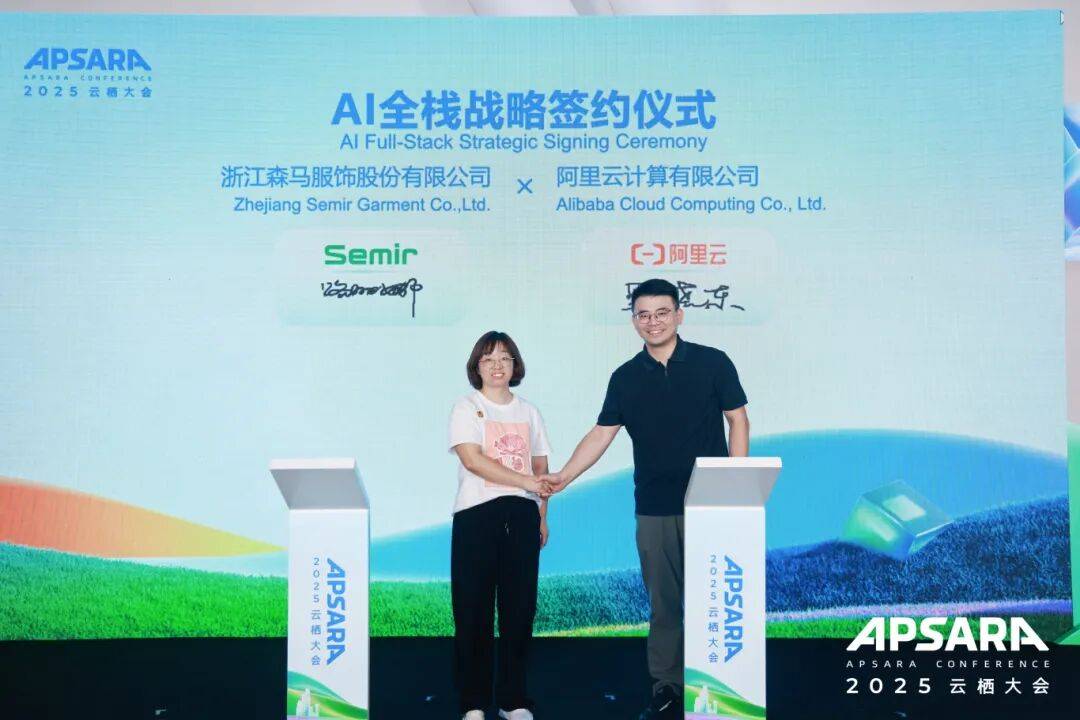
森马与阿里云达成AI全栈战略合作
Sou Hu Cai Jing· 2025-10-13 17:04
Core Insights - The signing of the "AI Full-Stack Strategic Cooperation Agreement" between Semir and Alibaba Cloud marks a significant upgrade in their collaboration, focusing on comprehensive ecological cooperation for digital transformation [1][3] Group 1: Partnership Details - Alibaba Cloud will provide Semir with comprehensive AI technical support, including computing resources, model training, platform architecture, and joint application development [3] - The partnership aims to promote digital transformation in the apparel industry and enhance the intelligence of retail business systems, establishing a benchmark for AI applications in the sector [3] Group 2: AI Implementation - Semir is leveraging large models and is in the process of building an AI aggregation platform (Dashen 3.0) based on Alibaba Cloud's full-stack AI capabilities, covering various application scenarios [3] - The platform includes four layers: scenario center, application center, model center, and infrastructure, supporting five business areas: product design and development, supply chain management, retail management, sales and marketing, and organizational support [3] Group 3: Marketing and Efficiency - In marketing, Semir has widely implemented AI-generated images across different brands, starting from the concept phase to generating background images for extreme shooting conditions, achieving significant results [3] - The internal application rate of AIGC key business AI at Semir has reached nearly 90%, with efficiency improvements exceeding 30% in some core scenarios [3] Group 4: Strategic Vision - Semir's digital capabilities are viewed as a multiplier for brand strength, product power, and retail power, with AI serving as a core driver for reshaping the value chain and human-machine collaboration [3] - Alibaba Cloud expressed enthusiasm for exploring new paths for intelligent upgrades in the fashion industry through this partnership, leveraging its deep expertise in full-stack AI technology [3]
超1.7万家实体店,倒在2025上半年
Sou Hu Cai Jing· 2025-10-11 03:27
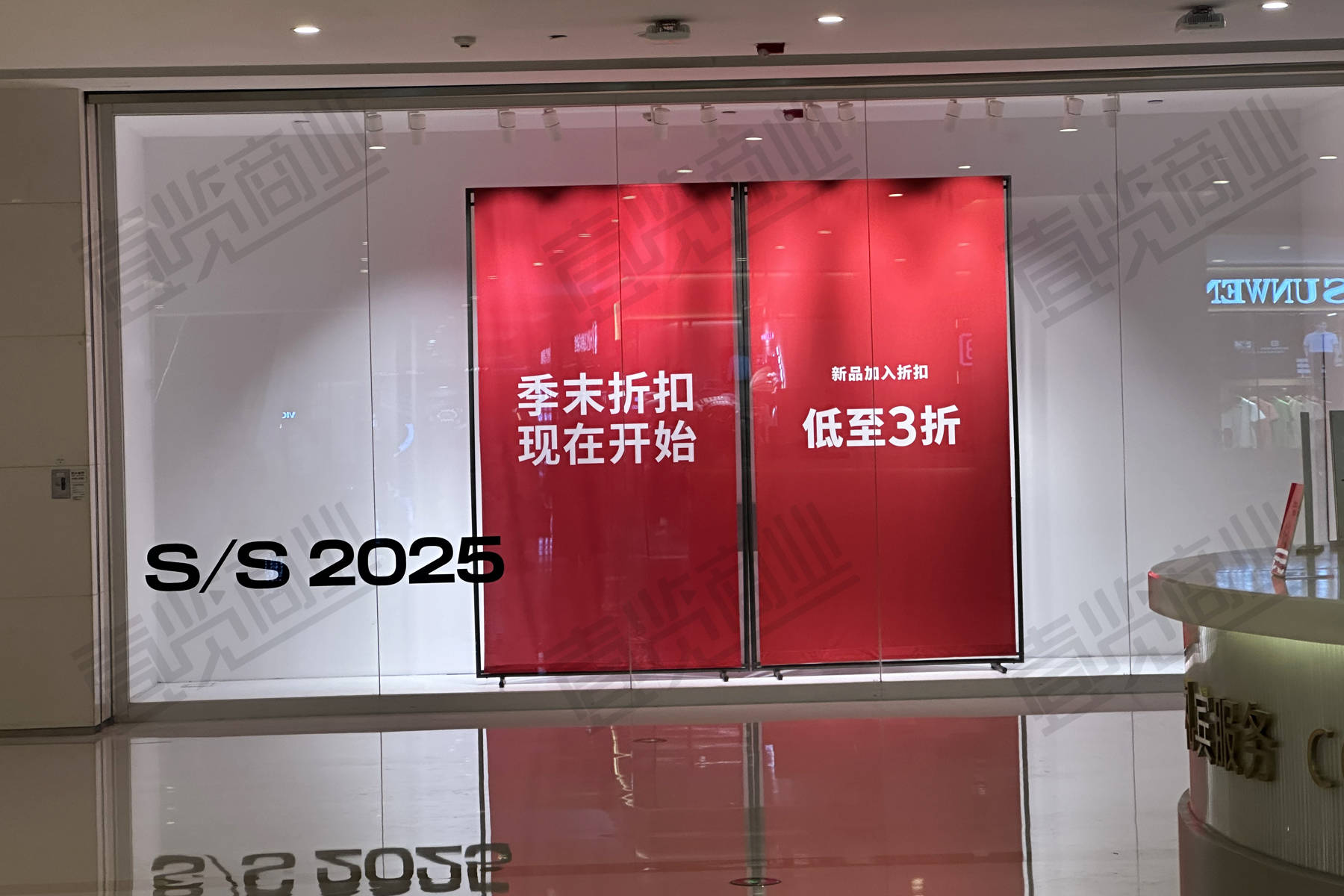
Retail Industry Overview - The total retail sales of consumer goods in China reached 24.55 trillion yuan in the first half of the year, with a year-on-year growth of 5.0%, slightly up from 3.7% in the same period last year [2] - Online retail sales amounted to 7.43 trillion yuan, growing by 8.5%, while offline retail sales were 17.12 trillion yuan, with a growth of 3.75%, indicating a shift in consumer shopping habits towards online platforms [2][5] Store Closures - In the first half of 2025, at least 1.71 million stores closed across various sectors, including major brands like Walmart, Starbucks, and Haidilao [2] - The supermarket sector saw at least 720 store closures, including national and regional brands such as Yonghui Supermarket and Hema [3][4] - The restaurant industry faced nearly 10,000 closures, while the apparel sector saw around 4,500 stores shut down [2][6] Supermarket Sector Challenges - Traditional supermarkets are experiencing accelerated closures due to increased competition from e-commerce and the rise of instant retail, which has grown from 36.6 billion yuan in 2017 to 650 billion yuan in 2023 [6] - Many supermarkets are closing underperforming stores and focusing on online business to adapt to changing consumer preferences [6][7] Department Store and Shopping Center Decline - The department store sector reported a year-on-year growth of only 1.2%, with at least 23 department stores and shopping centers closing in the first half of 2025 [8][9] - The decline is attributed to outdated business models and a lack of unique product offerings, leading to decreased foot traffic [11][12] Tea and Coffee Shop Closures - The tea and coffee sectors saw significant closures, with at least 6,673 tea and coffee shops shutting down in the first half of 2025 [13] - Brands like Heytea and Nayuki faced substantial store reductions, reflecting a market consolidation where only strong brands survive [15][20] Apparel Industry Adjustments - The apparel sector experienced a 3.1% year-on-year growth, with at least 4,563 clothing stores closing, including major brands like Semir and GU [21][24] - The closures are driven by high inventory levels, brand aging, and a shift towards larger store formats, which require higher operational efficiency [24][25][27] Cinema Industry Struggles - The cinema industry is facing a crisis, with a high vacancy rate of 30-40% and at least 38 cinemas closing in the first half of 2025 [28][30] - Factors contributing to this decline include high fixed costs, reliance on blockbuster films, and competition from streaming services [30][31][32] Other Industries - Various other sectors, including pet care, home improvement, and education, also experienced closures, indicating a broader trend of market contraction [34]



东南亚要“装不下”出海的国产服装品牌了
Hu Xiu· 2025-10-11 03:07
Core Viewpoint - The trend of A-share companies listing in Hong Kong is increasing, with 11 companies having done so this year, and over 50 more in the pipeline. The primary motivation for this move is to pursue global strategic expansion, as exemplified by the clothing brand HLA [1]. Group 1: Market Expansion - HLA has opened 50 stores in Malaysia since its first store in 2017, with a total of 78 stores across Southeast Asia as of January this year [2]. - Semir, another clothing brand, has also accelerated its overseas strategy, with 70 stores by the end of 2023 and plans to exceed 100 stores in 2024 [2][3]. - Major Chinese brands, including Anta and Li Ning, are also focusing on Southeast Asia for their international expansion, with Anta planning to establish 1,000 stores in the region over the next three years [5]. Group 2: Challenges in Overseas Markets - Despite the growth in overseas revenue for brands like HLA, the contribution to total revenue remains low, with HLA's overseas revenue accounting for only 1.76% in 2024 [7][8]. - Many traditional Chinese clothing brands struggle to achieve significant overseas market penetration, with most having less than 2% of their revenue coming from international sales [8][9]. - The slow urbanization process in Southeast Asia limits the effectiveness of the business models that have worked in China, as brands primarily target major cities, leaving smaller cities underserved [12][13]. Group 3: E-commerce and Retail Dynamics - The rise of e-commerce in Southeast Asia poses a challenge for traditional retail, as online platforms like Shopee and TikTok Shop gain traction [15][16]. - HLA has seen an increase in online sales, but overall revenue has declined, indicating difficulties in adapting to the online market [16]. - The reliance on physical stores in major cities may not be sustainable if e-commerce continues to grow, potentially impacting the profitability of brands that do not adapt [17].
东南亚“装不下”出海的国产服装品牌了
Xin Lang Cai Jing· 2025-10-11 02:42
Core Viewpoint - The trend of A-share companies listing in Hong Kong is increasing, with 11 companies having done so this year, including Haier Home, which plans to list in Hong Kong as part of its global strategy [1] Group 1: Company Expansion - Haier Home has opened 50 stores in Malaysia since its first store in 2017, with a total of 78 stores in Southeast Asia as of January this year [2] - Semir, another Chinese brand, has also accelerated its overseas expansion, with 70 stores by the end of 2023 and plans to exceed 100 stores in 2024 [2] - Other brands like UR, E-PRANCE, and Anta are also expanding aggressively in Southeast Asia, with Anta planning to open 1,000 stores in the region over the next three years [3] Group 2: Market Challenges - Despite the growth in store numbers, the overseas revenue for many Chinese apparel brands remains low, with Haier Home's overseas revenue accounting for only 1.76% of total revenue by 2024 [6] - Semir's overseas revenue is projected to be less than 1% of its total revenue in 2024, indicating a common struggle among Chinese brands to penetrate the Southeast Asian market [6][7] - The traditional business model that worked in China may not be effective in Southeast Asia, where brands are primarily targeting large cities, leaving smaller cities underserved [8] Group 3: E-commerce Impact - The rise of e-commerce in Southeast Asia, exemplified by platforms like Shopee, poses a challenge to traditional retail models, as many consumers are shifting towards online shopping [10][11] - Haier Home has seen an increase in online sales, but overall revenue has decreased, highlighting the difficulties in transitioning to an online model [11][12] - The potential for e-commerce growth in Southeast Asia could undermine the current strategy of Chinese brands that focus heavily on physical stores [12]

森马服饰:近期公司旗下巴拉巴拉品牌与意大利罗马地中海集团签署战略合作协议
Mei Ri Jing Ji Xin Wen· 2025-10-10 10:36
(文章来源:每日经济新闻) 森马服饰(002563.SZ)10月10日在投资者互动平台表示,近期,公司旗下巴拉巴拉品牌与意大利罗马 地中海集团(Mediterraneo 1996 Srl)签署战略合作协议,罗马地中海集团正式成为巴拉巴拉品牌在意 大利市场的战略合作伙伴,并以此为基础,逐步辐射拓展欧洲市场。 每经AI快讯,有投资者在投资者互动平台提问:注意到贵公司在研发方面与法国等欧盟国家合作,请 问贵公司是否将产品出口至欧盟国家? ...