
石头科技

Search documents
从代工到控股:杉川押注iRobot的全球化赌注
Zhong Guo Jing Ying Bao· 2026-01-12 07:43
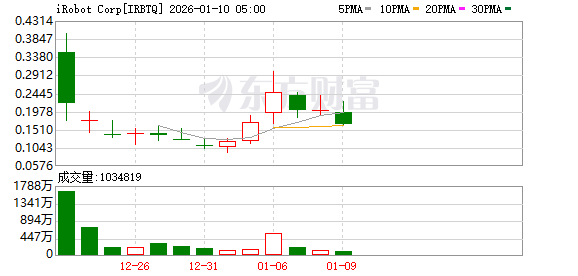
Core Viewpoint - iRobot has entered into a restructuring support agreement with its creditor Shenzhen Picea Robotics, which will acquire iRobot through a court-supervised bankruptcy process, highlighting the strategic shift of Chinese manufacturers towards global brand leadership amid increasing competition in the robotic vacuum industry [2][4]. Group 1: Acquisition Details - The acquisition involves a "debt-to-equity" swap, allowing Picea to take control of iRobot, which is facing operational and financial difficulties [2]. - iRobot has filed for bankruptcy protection in Delaware, with the restructuring process expected to be completed by February 2026 [2]. - Upon completion, iRobot will become a wholly-owned subsidiary of Picea and will be delisted from NASDAQ, with existing shareholders losing all rights to their shares [4]. Group 2: Financial Performance - iRobot's revenue for the first three quarters of 2025 was $375 million, a year-on-year decline of 26.47%, with a net loss of $130 million, nearly a 90% increase compared to the previous year [7]. - Cash and cash equivalents for iRobot dropped to $24.8 million by September 27, 2025, down from $134 million at the end of 2024, indicating severe cash flow pressure [7]. Group 3: Market Context - The robotic vacuum industry is experiencing a shift, with Chinese brands dominating the market; iRobot has fallen out of the top five global brands for the first time [7]. - Picea, as a leading ODM manufacturer, has a significant production capacity and serves multiple major brands, indicating a strong operational background to support the acquisition [5][6]. Group 4: Strategic Implications - The acquisition reflects Picea's strategy to transition from an OEM role to a brand leader, aiming to leverage iRobot's existing brand and market presence to enhance its competitive position [9][10]. - Challenges include potential conflicts with existing clients due to brand competition and the need for effective integration of operations and product development [10][11].

科创AIETF鹏华(589090)上涨5.4%,GEO生成式引擎优化有望重塑营销版图
Xin Lang Cai Jing· 2026-01-12 06:38
Group 1 - The core concept of GEO (Generative Engine Optimization) is gaining traction, focusing on advertising technology for generative AI applications, which enhances the probability of ad content being referenced in AI-generated content [1] - According to Dongfang Securities, AI tools can empower various processes such as content creation, customer service, and translation, thereby improving work efficiency and strengthening inventory management through massive data analysis [1] - The AI-driven B2B platform is expected to create a new entry point for traffic, transitioning from SEO to GEO [1] Group 2 - As of January 12, 2026, the Shanghai Stock Exchange Sci-Tech Innovation Board Artificial Intelligence Index (950180) surged by 5.47%, with notable stock performances including Xindian Software up by 20.01%, Haitan Ruisheng up by 20.00%, and Xinghuan Technology up by 19.75% [1] - The Penghua Sci-Tech AI ETF (589090) rose by 5.40%, marking its third consecutive increase, with the latest price reported at 1.23 yuan [1] - The Shanghai Stock Exchange Sci-Tech Innovation Board Artificial Intelligence Index comprises 30 large-cap stocks that provide foundational resources, technology, and application support for the AI sector, reflecting the overall performance of representative AI industry stocks listed on the Sci-Tech Innovation Board [1] Group 3 - As of December 31, 2025, the top ten weighted stocks in the Shanghai Stock Exchange Sci-Tech Innovation Board Artificial Intelligence Index (950180) include Kingsoft Office, Lianqi Technology, Cambricon, Chipone, Stone Technology, Amlogic, Fudan Microelectronics, Hengxuan Technology, Zhongke Xingtu, and Yuntian Lefe, collectively accounting for 67.08% of the index [2]
第一创业晨会纪要-20260112
First Capital Securities· 2026-01-12 06:25
Macro Economic Group - In December, China's CPI increased by 0.8% year-on-year, matching expectations, and up from 0.7% in November. Core CPI also remained stable at 1.2% year-on-year [5] - December's PPI decreased by 1.9% year-on-year, slightly better than the expected decline of 2% [6] - The U.S. non-farm payrolls increased by 50,000 in December, below the expected 60,000, while the unemployment rate fell to 4.4% [7][8] Industry Comprehensive Group - TSMC reported a revenue of NT$335 billion in December 2025, a 2.5% decrease from November but a 20.4% increase year-on-year. The fourth quarter revenue reached NT$1.05 trillion, approximately US$33.1 billion, exceeding market expectations [10] - The competition for satellite orbital resources between China and the U.S. has officially begun, with significant implications for satellite manufacturing and commercial rocket industries [11] Advanced Manufacturing Group - Starting April 1, 2026, China will cancel the VAT export rebate for photovoltaic products and reduce the rebate for battery products from 9% to 6%. This is expected to stabilize export prices and enhance product structure upgrades in the battery industry [13] - In December, the retail sales of new energy passenger vehicles reached 1.337 million units, a year-on-year increase of 2.6%, with a penetration rate of 59.1% in the domestic market [14] Consumer Group - Mao Geping has launched new products and formed a strategic partnership with LVMH's investment firm, aiming to enhance its global presence in the beauty market. This collaboration focuses on expanding high-end retail channels and establishing a beauty investment fund [16] - The CES 2026 highlighted the importance of LiDAR technology, which is expected to drive the growth of smart lawn mowers and other intelligent devices, with the global market projected to reach US$4 billion by 2028 [17]
机器人超脑平台重磅突破,科大讯飞涨超8%,机器人ETF基金(159213)大涨3%,连续10日"吸金"2.4亿元,人形机器人赛道百家争鸣,CES成中国科技秀
Sou Hu Cai Jing· 2026-01-12 05:47
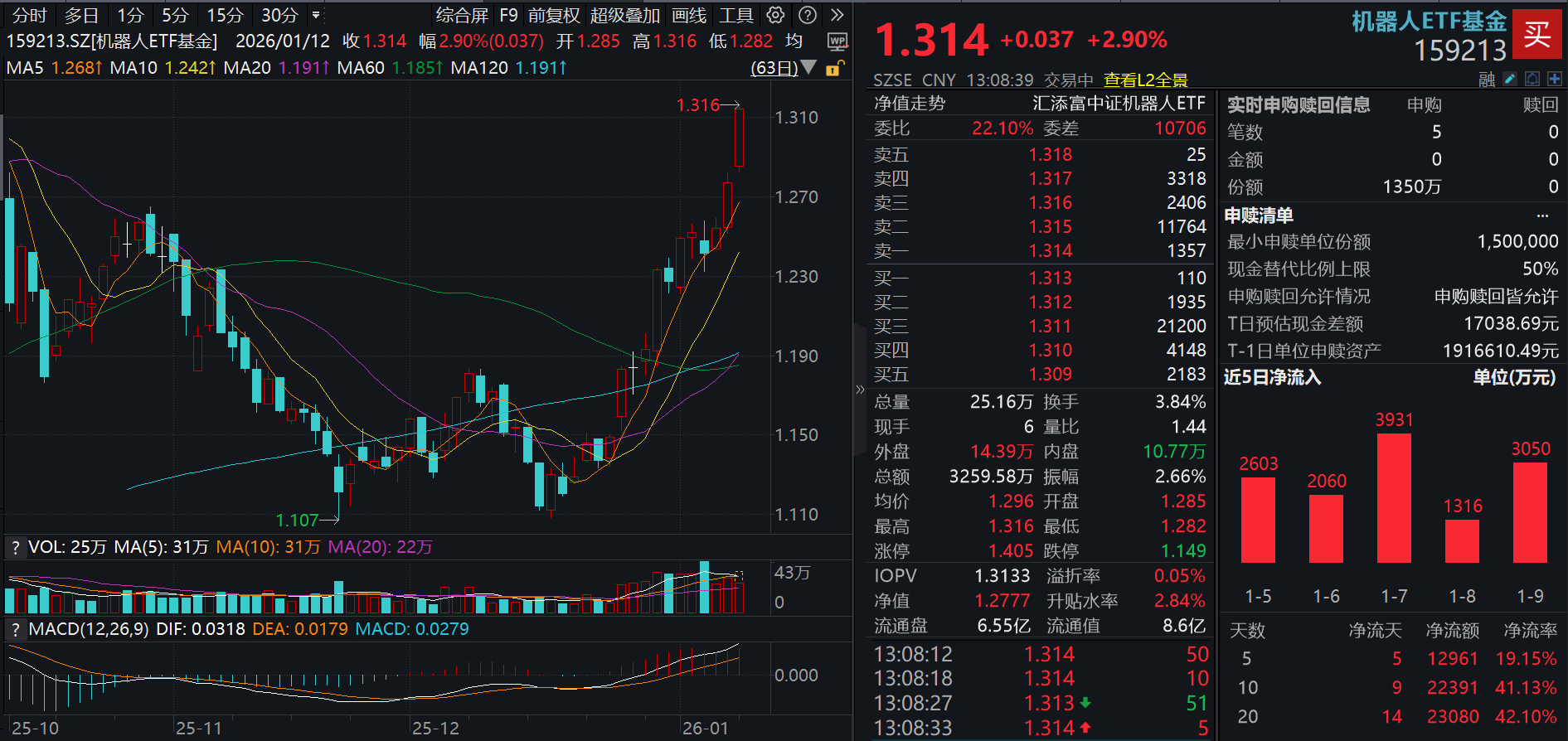
Core Viewpoint - The A-share market is experiencing a strong upward trend, particularly in the hard technology sector, with the Robot ETF fund (159213) showing significant inflows and performance [1][3]. Group 1: Market Performance - The A-share market is on a rising trend, with the Shanghai Composite Index aiming for a 17-day consecutive increase [1]. - The Robot ETF fund (159213) has seen a 2.9% increase, marking its third consecutive day of gains, with over 17 million yuan in inflows today alone [1]. - Cumulatively, the Robot ETF fund has attracted over 240 million yuan in net inflows over the past 10 days [1]. Group 2: Component Stocks Performance - Most component stocks of the Robot ETF fund have risen, with notable increases such as iFlytek up over 8%, Zhongkong Technology up 6.9%, and Dahua Technology up 3.66% [3][4]. - The performance of key stocks includes: - iFlytek: +8.35% [4] - Zhongkong Technology: +6.90% [4] - Dahua Technology: +3.66% [4] - Robot: +2.53% [4] Group 3: Industry Insights - The humanoid robot sector is in its early production phase, with significant advancements in technology and commercialization expected [6]. - By 2025, the cumulative order volume for domestic humanoid robots is projected to exceed 20,000 units, with total order values surpassing 3 billion yuan [6]. - The market for humanoid robots in China is expected to reach 238.3 billion yuan by 2030, representing over 40 times growth from 2025 [7]. Group 4: Technological Development - The key challenges for humanoid robots include the development of a highly capable AI brain, which is crucial for practical applications and mass production [11]. - The hardware aspect of humanoid robots is nearing convergence, while the AI brain remains a significant hurdle for the industry [11]. - Tesla is actively working on advancing the AI capabilities of its humanoid robots, which is expected to accelerate production opportunities in 2026 [12].

“制造强国”实干系列周报-20260112
Shenwan Hongyuan Securities· 2026-01-12 04:41
Group 1: Commercial Aerospace - China has submitted applications for over 200,000 satellite constellations, with the largest being CTC-1 and CTC-2, each comprising 96,714 satellites[6] - The commercial aerospace sector is expected to see significant growth, with a focus on satellite payloads, platforms, and application terminals[3] - Key companies to watch include Xinke Mobile, Fenghuo Communication, and China Satellite Communications[21] Group 2: Space Photovoltaics - The focus from 2024 to 2026 will be on P-type HJT and perovskite tandem batteries, with companies like Dongfang Risen and Junda Co. highlighted for their capabilities[33] - P-type HJT batteries are expected to penetrate low Earth orbit applications due to their superior radiation resistance and cost advantages[40] - The global photovoltaic market is dominated by China, which holds over 90% of the production capacity in polysilicon, wafers, and battery cells[46] Group 3: Controlled Nuclear Fusion - 2025 is projected to be a pivotal year for nuclear fusion development in China, marking the start of significant capital expenditure[51] - Key players in the nuclear fusion sector include Hezhong Intelligent and Lianchuang Optoelectronics, focusing on core components and supporting technologies[51] - The BEST project in Anhui has made significant progress, with key components successfully installed, indicating a shift towards engineering validation[50] Group 4: Robotics and Automation - The CES 2026 showcased advancements in cleaning robots and intelligent lawn mowers, indicating a trend towards embodied intelligence in consumer products[54] - The cleaning robot market is experiencing rapid growth, benefiting from government subsidies, with major players like Ecovacs and Roborock leading the market[60]
又一机器人企业获得10亿融资;机器人ETF易方达(159530)盘中获净申购2100万份
Sou Hu Cai Jing· 2026-01-12 04:26
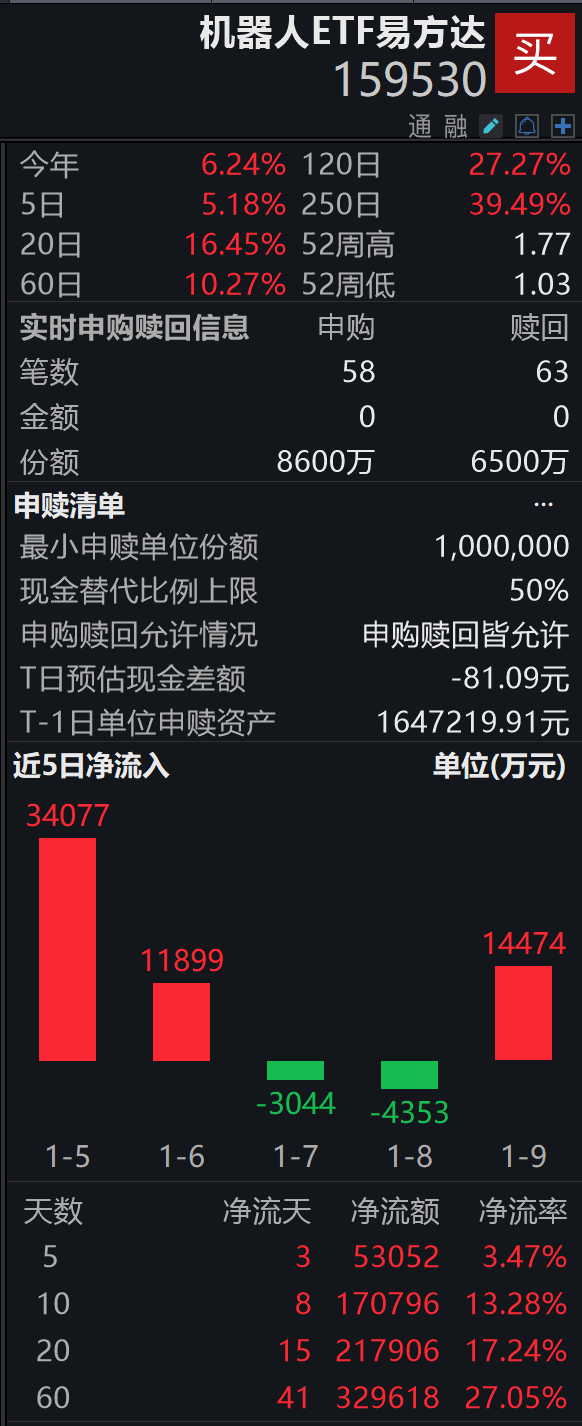
相关产品: 机器人ETF易方达(159530)通过跟踪国证机器人产业指数,为投资者提供一键布局机器人全产业链的 高效工具。 消息面上,自变量机器人已于近期完成10亿元A++轮融资。本轮融资由字节跳动、红杉中国、北京信息 产业发展基金、深创投、南山战新投、锡创投等顶级投资机构及多元地方平台联合投资。 华源证券认为,2026年人形机器人行业进入量产加速期,国内外路径呈现分化:特斯拉等海外龙头以工 厂内部验证为主,而优必选、宇树科技等国内厂商已实现千万级订单交付,率先进入商业化兑现阶段。 国证机器人产业指数特点鲜明:1.指数人形机器人含量居首:指数中人形机器人相关公司权重显著高于 同类指数;2.指数聚焦高成长龙头:前十大权重股占比约40%,涵盖汇川技术、科大讯飞、石头科技等 细分领域龙头,技术壁垒高、市场竞争力强。 截至中午收盘,国证机器人产业指数(980022)涨2.33%,成分股中,昊志机电涨12.11%、航天智装涨 10.41%、科大讯飞涨8.38%,震裕科技跌2.29%、奥比中光跌1.69%、拓普集团跌1.29%。 资金方面,机器人ETF易方达(159530)跟踪国证机器人产业指数,持续受资金青睐,近5日" ...

人形机器人T链一级供应商冲刺IPO,机器人ETF(159770)、科创综指ETF天弘(589860)标的指数双双冲高涨近2%!
Sou Hu Cai Jing· 2026-01-12 02:33
Core Insights - The Robot ETF (159770) has shown significant trading activity, with a turnover of 2.08% and a transaction volume of 229 million yuan, while the underlying index, the CSI Robot Index (H30590), increased by 1.60% [1] - The Robot ETF has experienced substantial growth, with an increase of 333 million yuan over the past two weeks and 18.47 billion shares over the last three months [1] - The Tianhong Sci-Tech ETF (589860) also performed well, with a transaction volume of 2.8849 million yuan and the underlying SSE Sci-Tech Innovation Board Composite Index (000680) rising by 1.93% [1] Product Highlights - The Robot ETF (159770) closely tracks the CSI Robot Index, providing investors with an efficient tool to invest in the entire robot industry chain [2] - The Tianhong Sci-Tech ETF (589860) closely follows the Sci-Tech Composite Index, featuring leading technology companies with strong brand advantages and research capabilities [2] Related Products - The Robot ETF (159770) corresponds to the off-market linked funds (A: 014880; C: 014881) [3] - The Tianhong Sci-Tech ETF (589860) corresponds to the off-market linked funds (A: 023721; C: 023722) [3] Industry Events - Tesla's core supplier for the Optimus robot, Xinjian Transmission, has initiated IPO counseling, focusing on components for humanoid robots, which is expected to accelerate the industry chain [3] - According to Omdia, global shipments of humanoid robots are projected to reach 13,000 units by 2025, with Chinese manufacturers dominating the market, holding the top six positions in shipment volume [4] - The leading Chinese brand, Zhiyuan Robotics, accounted for 5,168 units, representing 39% of the global market share, while Yushu Technology followed closely with 4,200 units, together controlling 71% of the market [4] Institutional Views - Recent advancements in consumer robots are moving towards embodied intelligence, with companies showcasing robots with enhanced environmental adaptability at CES 2026 [5] - The push for domestic supply chain development is expected to lower core component costs, further promoting the large-scale deployment of consumer robots [5]


CES-2026-扫地割草机器人篇-具身智能引领家庭消费机器人新方向
2026-01-12 01:41
Summary of Key Points from the Conference Call Industry Overview - The conference call discusses advancements in the home robotics industry, particularly focusing on vacuum and lawn mowing robots showcased at CES 2026. [1][2] Key Companies Mentioned - **Stone Technology (石头科技)**: Introduced the G Rover, a stair-climbing vacuum cleaner with a unique wheeled leg structure. - **Dreame (追觅)**: Launched the Cyber X, a bionic track-based stair-climbing vacuum. - **Mova**: Presented the Pilot 70, a flying module for cross-floor cleaning. - **Ecovacs (科沃斯)**: Showcased the X12 vacuum with advanced cleaning features and the GOAT series integrating lawn mowing with edge trimming. - **9号 (9号)**: Introduced the H2 lawn mower with advanced navigation technology. Core Insights and Arguments - **Technological Advancements**: The G Rover's design allows it to handle complex environments effectively, outperforming competitors like Cyber X and Mova in usability and versatility. [2][3] - **Market Potential**: The lawn mowing robot market in North America has low penetration, under 2%, but CES 2026 provided opportunities for brands to enhance their offerings with advanced technologies like LiDAR and all-wheel drive systems. [5][6] - **Sales Projections**: For 2026, Stone Technology is expected to generate revenue of 23 billion RMB with a net profit of approximately 2.4 billion RMB, while Ecovacs is projected to achieve 23.5 billion RMB in revenue and a net profit of around 2.35 billion RMB. Both companies have a price-to-earnings ratio of under 20. [2][14] Innovations in Cleaning Technology - **Vacuum Robots**: Innovations include the use of infrared stain detectors and high-pressure nozzles for deep cleaning (Ecovacs X12) and dual RGB cameras for object recognition (Yunzhihui Flow 2). [4] - **Lawn Mowing Robots**: Key innovations involve multi-sensor fusion navigation, all-wheel drive systems, and edge mowing optimizations, enhancing adaptability to various terrains. [7] Market Dynamics - **Domestic Market Outlook**: The domestic vacuum cleaner market is expected to benefit from potential subsidies for smart home products, alleviating concerns about sales. [9] - **International Market Growth**: Leading companies are anticipated to maintain rapid growth due to market expansion in Europe and Asia, alongside the exit of iRobot from the U.S. market, which opens up additional market share. [9] Strategic Differences Between Companies - **Stone Technology vs. Ecovacs**: Stone Technology aims to reduce costs through the introduction of roller products while maintaining a diverse product matrix. Ecovacs focuses on leveraging roller products to enhance its overseas market presence. [10] Profit Margin Expectations - **Profitability Trends**: Both companies are expected to see their domestic vacuum cleaner profit margins converge, with Ecovacs focusing on domestic profitability and Stone Technology stabilizing its overseas profit margins above 20%. [11][12] Future Growth Areas - **Washing Machines and Lawn Mowers**: Stone Technology's washing machine segment is expected to grow rapidly, while Ecovacs is positioned for significant growth in the lawn mowing sector due to its established channels and new products. [13] Valuation Insights - **Market Valuation**: The market has a clearer understanding of Ecovacs' valuation, while Stone Technology's advancements in embodied intelligence have not yet been fully reflected in its valuation, indicating potential for upward adjustment post-CES. [14]


预见2025:《2025年中国全屋智能行业全景图谱》(附市场现状和发展趋势等)
Qian Zhan Wang· 2026-01-12 01:35
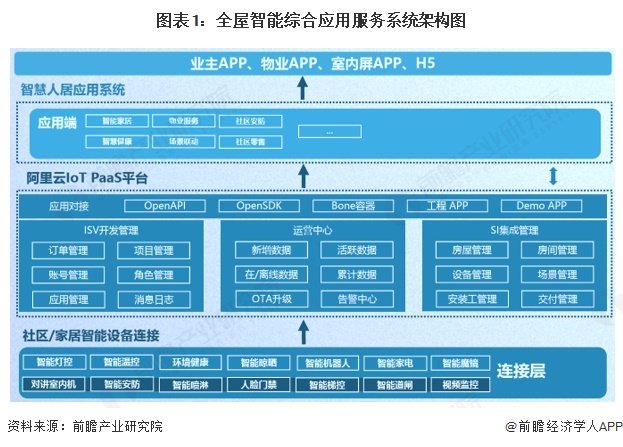
Industry Overview - The concept of "whole-house intelligence" refers to an integrated smart home system that combines smart lighting, security, audio-visual, and appliance control into a comprehensive home solution. This system allows for automated operations based on environmental and personal needs, enabling connectivity between individual smart products for a more personalized home experience [1][2] - The whole-house intelligent system relies on cloud platform capabilities and channel resources to create mature smart home applications, smart community applications, and market solutions, forming an IoT ecosystem that includes home device connectivity, automated control, data analysis, health care, community services, and new retail [1] Industry Chain Analysis - The whole-house intelligent field has developed a complete industrial chain, with upstream consisting of component suppliers, middleware suppliers, and software technology providers. The midstream includes whole-house smart home brand manufacturers that sell products directly to consumers and provide solutions to real estate and home decoration companies [2][5] Industry Development Status - The global whole-house intelligent industry is in a rapid development phase, supported by the maturity and integration of IoT, AI, and 5G technologies. This has facilitated easier interconnectivity between devices and enhanced system intelligence and interactivity. Market demand for convenient, healthy, and safe home environments is driving the transition from niche to mass markets [13][15] - In China, the whole-house intelligent industry is experiencing rapid growth driven by both policy and market forces, with a projected market size of approximately 222.4 billion yuan in 2024 [15][25] Competitive Landscape - The competitive landscape of China's whole-house intelligent industry can be categorized into three factions: traditional home appliance companies (e.g., Haier, Midea, Gree), internet companies (e.g., Xiaomi, Huawei), and other specialized firms. Traditional companies leverage supply chain and brand advantages, while internet firms possess strong technological and financial capabilities [17][19] Industry Development Trends - The Chinese whole-house intelligent industry is moving towards standardization in technology, market scenario development, and ecological competition. The combined push from policies, technology, and consumer demand is expected to facilitate a transition from rapid expansion to high-quality development, gradually building a more complete smart living ecosystem [23][25] - The market is expected to see a compound annual growth rate of 9.8%, with the market size projected to reach approximately 390 billion yuan by 2030 [25]
中国扫地机器人正在成为全球消费者的热门选择
Yang Shi Wang· 2026-01-12 01:29
Core Insights - Chinese robotic vacuum cleaners are becoming a popular choice among global consumers, particularly in Europe and Southeast Asia [1][2] Group 1: Market Presence - In Germany, Chinese brands like Roborock and Dreame occupy prominent positions in the robotic vacuum cleaner section, with prices ranging from €200 to €2000 [1] - In Western Europe, over 60% of robotic vacuum cleaners sold are from China, while in Southeast Asia, the market share increased from 38.8% in 2024 to 64.1% [1] Group 2: Sales Performance - According to IDC, the global shipment of smart robotic vacuum cleaners reached 17.424 million units in the first three quarters of 2025, marking an 18.7% year-on-year growth [2] - Chinese brands, including Roborock, Ecovacs, Dreame, Xiaomi, and Yunji, dominate the global market, collectively holding nearly 70% of the market share [2] Group 3: Competitive Advantage - The strong performance of Chinese brands is attributed to their robust supply chain advantages and superior innovation capabilities, allowing them to lead in technology iterations by one to two generations compared to overseas markets [2]
