石药集团

Search documents
智通港股解盘 | 英国首相访华提振市场情绪 涨价概念集体走强
Zhi Tong Cai Jing· 2026-01-27 11:22
Market Overview - US stock markets rebounded collectively, with Hong Kong stocks jumping 1.35%, pushing the Hang Seng Index above 27,000 points [1] - Gold prices surpassed $5,000 for the first time, with a monthly increase expected to be the largest in 40 years [1] - Zijin Mining and Zijin Gold International announced a cash acquisition of all issued shares of Golden Joint for approximately CAD 5.5 billion (around RMB 28 billion or USD 4 billion) [1][2] Company Insights - Golden Joint, a Canadian gold mining company, has significant assets including the Sadiola gold mine and the Côte d'Ivoire gold complex, with gold resources of 533 tons and production forecasts of 10.7 tons in 2023 and 11.1 tons in 2024 [2] - Zijin Gold International's stock rose nearly 11% in January, with a cumulative increase of 70% for the month [2] Insurance Sector - A significant amount of household deposits will mature this year, leading to increased demand for wealth management products, particularly participating insurance policies [3] - Major insurance companies like China Life and AIA saw stock increases of over 5% and 3% respectively due to this demand [3] Technology Sector - Semiconductor companies are experiencing price increases, with companies like Huahong Semiconductor reaching new highs [4] - IC design companies are also expected to raise prices, with MediaTek and Analog Devices indicating price adjustments [4] - Tencent's AI assistant "Yuanbao" launched a new social AI feature, which is expected to stimulate cloud business growth [4] Aviation Industry - COMAC's C919 aircraft has completed assembly and is entering the delivery process, aiming for a delivery rate of one aircraft every 10 to 15 days, with a target of at least 28 aircraft for the year [6] - The domestic production rate of C919 has increased from 10% to an expected 70% by 2026, with the European Aviation Safety Agency starting flight test evaluations [6] Semiconductor Industry - Semiconductor company SMIC reported a revenue of RMB 17.162 billion for Q3 2025, a year-on-year increase of 9.95%, with a net profit of RMB 1.517 billion, up 43.15% year-on-year [8] - The company is experiencing increased capacity utilization and expects a price increase in wafer foundry services in 2026 [9] - SMIC's average sales price for wafers increased by 3.8% due to a shift in product mix and increased demand [8][9]


ETF盘中资讯 创新药出海BD仍然火爆!港股通创新药ETF(520880)跌1.5%延续高溢价,最新单周吸金2.36亿元
Jin Rong Jie· 2026-01-26 05:58
Core Viewpoint - The Hong Kong stock market is experiencing a downturn, particularly in the innovative drug sector, with the Hong Kong Stock Connect Innovative Drug ETF (520880) declining by 1.5% on January 26, despite a positive buying attitude reflected in high premiums [1][3]. Group 1: Market Performance - The Hong Kong Stock Connect Innovative Drug ETF (520880) has seen a cumulative decline of 3.2% over the past week, with over 236 million yuan in funds being used to buy on dips [1]. - Major stocks in the sector are experiencing widespread declines, with leading companies such as CSPC Pharmaceutical falling by 3%, and Innovent Biologics dropping nearly 4% [1]. Group 2: Industry Transactions - Several innovative drug business development (BD) transactions have been completed at the beginning of the year, indicating a positive trend for Chinese innovative drugs going overseas. Key transactions include: 1. Rongchang Biologics granting AbbVie overseas rights for RC148 (PD-1/VEGF) dual antibody, receiving a $650 million upfront payment and up to $4.95 billion in milestone payments [3]. 2. Haisco granting overseas rights for HSK39004 (PDE3/4) to AirNexis, with an upfront payment of $108 million and up to $955 million in milestone payments [3]. 3. Zai Lab granting AbbVie overseas rights for ZG006 (CD3xDLL3xDLL3 tri-antibody), receiving a $100 million upfront payment and milestone payments totaling $1.135 billion [3]. 4. Yilian Biologics granting Roche overseas rights for YL201 (B7-H3ADC), with upfront and near-term milestone payments totaling $570 million [3]. Group 3: Investment Opportunities - Investors are encouraged to consider core assets in innovative drugs during market dips, with a focus on the high elasticity T+0 tool, the Hong Kong Stock Connect Innovative Drug ETF (520880), and its associated funds [3]. - The index for the ETF (Hang Seng Hong Kong Stock Connect Innovative Drug Select Index) has three unique advantages: 1. 100% purity, covering only innovative drug R&D companies [3]. 2. A significant concentration of leading companies, with the top ten innovative drug leaders accounting for over 73% of the index [4]. 3. Better risk control through forced de-weighting of less liquid constituent stocks [5].

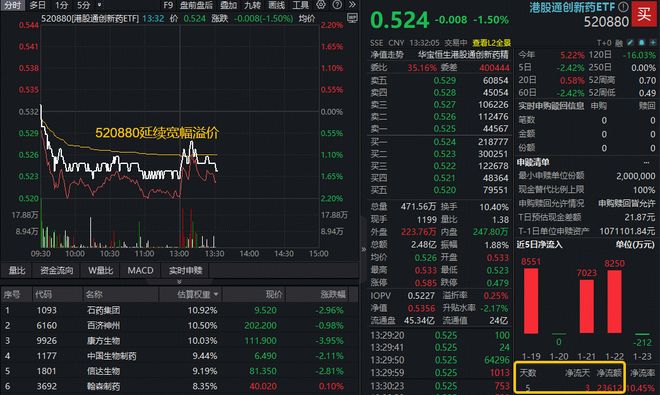
创新药出海BD仍然火爆!港股通创新药ETF(520880)跌1.5%延续高溢价,最新单周吸金2.36亿元
Xin Lang Cai Jing· 2026-01-26 05:47
Group 1 - The Hong Kong stock market is experiencing a downturn, with the innovative drug sector declining again, as evidenced by the Hong Kong Stock Connect Innovative Drug ETF (520880) falling by 1.5% [1][6] - Last week, the ETF accumulated a total decline of 3.2%, with over 236 million yuan in funds being used to buy on dips [1][6] - Major stocks in the sector are generally down, including CSPC Pharmaceutical Group down 3%, CanSino Biologics down nearly 4%, and China Biologic Products and Innovent Biologics both down over 2% [1][6] Group 2 - Multiple innovative drug business development (BD) transactions have been completed at the beginning of the year, indicating a positive trend for Chinese innovative drugs going overseas [8] - Key transactions include: 1) Rongchang Biologics granting AbbVie overseas rights for RC148 (PD-1/VEGF) dual antibody, receiving a $650 million upfront payment and up to $4.95 billion in milestone payments [8] 2) Haisco granting overseas rights for HSK39004 (PDE3/4) to AirNexis, receiving a $108 million upfront payment and up to $955 million in milestone payments [8] 3) Zai Lab granting AbbVie overseas rights for ZG006 (CD3xDLL3xDLL3 tri-antibody), receiving a $100 million upfront payment and milestone payments totaling $1.135 billion [8] 4) Yilian Biologics granting Roche overseas rights for YL201 (B7-H3ADC), with upfront and milestone payments reaching $570 million [8] Group 3 - The Hong Kong Stock Connect Innovative Drug ETF (520880) and its associated funds are highlighted as high-elasticity investment tools, with the underlying index (Hang Seng Stock Connect Innovative Drug Select Index) offering three unique advantages [9] - The ETF has a 100% purity, excluding CXO, and fully covers innovative drug R&D companies [9] - The top ten innovative drug leaders account for over 73% of the ETF, showcasing the strength of the innovative drug sector [9][10]

医药行业周报:重视供给端的变量-20260126
Huaxin Securities· 2026-01-26 05:33
Investment Rating - The report maintains a "Recommended" investment rating for the pharmaceutical industry as of January 26, 2026 [1] Core Insights - The report emphasizes the importance of supply-side variables, particularly the operating rates of raw material drugs, and highlights the potential for price recovery in the antibiotic market due to changes in competition and supply dynamics [2] - Multi-departmental policy support is enhancing the value positioning of pharmacies, transforming them from mere sales points to comprehensive health service platforms [3] - The trend of Chinese innovative drugs going global is gaining momentum, with significant licensing deals and the need for continuous clinical data validation to support long-term investment confidence [4] - Major companies are increasingly investing in the small nucleic acid field, which is expected to accelerate the development of the supporting industrial chain [5] - A new pricing system for GLP-1 drugs is forming in China, with expectations for market growth driven by a large patient population [6] - The report highlights the market value of oral autoimmune drugs, with promising clinical trial results for new treatments [7] Summary by Sections 1. Pharmaceutical Market Tracking - The pharmaceutical industry outperformed the CSI 300 index by 0.23 percentage points in the last week, ranking 27th among 31 sectors [20] 2. Pharmaceutical Sector Trends and Valuation - The pharmaceutical sector index increased by 4.98% over the past month, outperforming the CSI 300 index by 3.21 percentage points [37] - The current PE (TTM) for the pharmaceutical sector is 38.51, above the five-year historical average of 31.06 [43] 3. Recent Research Achievements - The report includes various deep-dive studies on topics such as the growth of the blood products industry and the impact of policies on inhalation formulations [45] 4. Recent Industry Policies and News - Recent policies include the approval of numerous medical device registrations and the promotion of high-quality development in the pharmaceutical retail sector [46][48]
中国医药:创新药出海BD仍然火爆,关注IO2.0抢位赛
Zhao Yin Guo Ji· 2026-01-26 03:31
Investment Rating - The report assigns a "Buy" rating to several companies in the pharmaceutical sector, indicating a potential upside of over 15% in their stock prices over the next 12 months [29]. Core Insights - The MSCI China Healthcare Index has increased by 9.2% since the beginning of 2026, outperforming the MSCI China Index, which rose by 5.6% [1]. - The pharmaceutical industry has seen significant growth, driven by strong institutional investor interest and the ongoing trend of innovative drugs going global [1]. - The report emphasizes the importance of clinical progress and data validation for pipelines that have already gone overseas, suggesting that this trend will continue in the long term [1]. Summary by Sections Industry Overview - The report highlights a robust trend in the outbound licensing of innovative drugs, with multiple business development (BD) transactions occurring at the start of 2026, reflecting a high level of activity in the sector [4]. - Key transactions include significant upfront and milestone payments for various drugs, indicating strong market interest and potential for future growth [4]. Company Ratings and Valuations - The report provides detailed valuations for several companies, including: - **Sangfor Technologies (1530 HK)**: Market cap of $7,598.4 million, target price of $37.58, with a 54% upside potential [2]. - **Gusongtang (2273 HK)**: Market cap of $963.3 million, target price of $44.95, with a 46% upside potential [2]. - **WuXi AppTec (2268 HK)**: Market cap of $10,551.0 million, target price of $88.00, with a 28% upside potential [2]. - **China National Pharmaceutical Group (1177 HK)**: Market cap of $15,951.4 million, target price of $9.40, with a 42% upside potential [2]. Market Trends - The report notes that the competition in the PD-(L)1/VEGF space is intensifying, with several companies advancing their clinical trials and aiming for first-line indications [4]. - The report suggests that the efficiency and breadth of clinical trials, as well as the richness of combination therapies, will be critical factors in determining success in this competitive landscape [4].
2026年中国心脑血管药物行业市场政策汇总、产业链图谱、市场规模、竞争格局及发展趋势分析:需求群体庞大[图]
Chan Ye Xin Xi Wang· 2026-01-26 01:40
Core Insights - The aging population in China is leading to an increase in cardiovascular diseases, with rising prevalence of chronic conditions such as hypertension and hyperlipidemia, driving demand for cardiovascular drugs [1][8] - There is a significant increase in health awareness among residents, leading to earlier screening and treatment of cardiovascular diseases, which expands the applicable population for cardiovascular medications [1][8] - The implementation of centralized drug procurement policies is causing a downward trend in drug prices, putting pressure on the overall market size, which is projected to decline to 954.1 billion yuan for traditional Chinese medicine and 1,415.8 billion yuan for chemical drugs by 2025 [1][8] Market Overview - Cardiovascular diseases encompass both cardiovascular and cerebrovascular diseases, primarily caused by conditions like hyperlipidemia, blood viscosity, atherosclerosis, and hypertension [2] - Cardiovascular drugs are classified into two main categories: cardiovascular system drugs and cerebrovascular system drugs, targeting various heart and brain-related conditions [2] Policy Environment - The pharmaceutical manufacturing industry, including cardiovascular drugs, is a key focus of national policy support, with various regulations aimed at correcting malpractices and promoting industry development [3][4] Industry Chain - The upstream of the cardiovascular drug industry includes chemical raw materials, traditional Chinese medicinal materials, and pharmaceutical packaging materials, while the midstream involves research, production, and registration processes [4][5] Demand Dynamics - Cardiovascular diseases are the leading cause of death in China, with hypertension cases expected to reach 370 million and coronary heart disease cases at 30 million by 2025, indicating a growing demand for cardiovascular medications [6][8] Competitive Landscape - The market has developed a dual competitive structure, with foreign companies dominating the chemical drug sector and local companies leading in traditional Chinese medicine, creating a competitive environment [10] - Notable domestic players include Shijiazhuang Pharmaceutical Group and Shandong Buchang Pharmaceutical, which have established strong market positions through unique products and effective distribution networks [10][11] Development Trends - The industry is shifting from reliance on generic drugs to innovation, focusing on high-value drug development, including targeted and biological drugs [12] - There is a growing integration of chronic disease management with digital tools, enhancing patient adherence and treatment precision [13] - Policy reforms are reshaping market dynamics, emphasizing high clinical value drugs and expanding the market for basic medications in primary healthcare [14] - The industry is moving towards a collaborative ecosystem, with increased internationalization efforts and participation in global clinical trials [15]




2025年药品BD出海回顾:显著提速,关注双抗、ADC、GLP-1RA、小核酸等方向
Southwest Securities· 2026-01-26 00:45
Investment Rating - The report indicates a "Buy" rating for several companies within the pharmaceutical sector, including 恒瑞医药 (Hengrui Medicine), 百济神州-U (BeiGene), and others [22]. Core Insights - The pharmaceutical industry has seen a significant increase in BD (business development) activities, with Chinese pharmaceutical companies securing upfront payments exceeding $7.03 billion in 2025, marking a year-on-year growth of over 226.8% [15][20]. - The industry has a total market capitalization of approximately 544.85 billion yuan, with a TTM (trailing twelve months) P/E ratio of 38.5, significantly higher than the 14.1 P/E ratio of the CSI 300 index [3][6]. - The best-performing sub-sectors this week include offline pharmacies, hospitals, and medical R&D outsourcing, with year-to-date increases of 17.2%, 14.8%, and 10.7%, respectively [6][31]. Summary by Sections Industry Performance - The pharmaceutical index decreased by 0.39% this week, outperforming the CSI 300 index by 0.23 percentage points. Year-to-date, the pharmaceutical sector has risen by 6.66%, surpassing the CSI 300 index by 5.10 percentage points [6][24]. - The current valuation level (P/E-TTM) for the pharmaceutical industry stands at 30.31 times, with a premium of 65.36% over the entire A-share market [6][26]. Business Development Trends - In 2025, the domestic dual-antibody BD projects achieved upfront payments of $3.5 billion, a staggering increase of 414.7%, accounting for 49.8% of all BD upfront payments for the year [16]. - The ADC (Antibody-Drug Conjugates) sector has also seen substantial growth, with upfront payments reaching $1.63 billion, a 676.2% increase year-on-year [17]. - The GLP-1RA (Glucagon-Like Peptide-1 Receptor Agonists) segment reported upfront payments of $470 million, reflecting a 109.8% increase compared to 2024 [18]. Notable Collaborations - The report highlights significant collaborations, such as 舶望制药 (Bohua Pharmaceutical) partnering with Novartis to explore the potential of siRNA in hypertension treatment, securing an upfront payment of $160 million [19]. - The MNC (Multinational Corporation) procurement model remains dominant, with local companies securing $4.71 billion in upfront payments from MNCs, representing 67.0% of total BD upfront payments [20]. Recommended Companies - The report suggests a robust investment strategy focusing on companies like 恒瑞医药 (Hengrui Medicine), 百济神州-U (BeiGene), and others, which are expected to benefit from innovation and international expansion [20][21].

广发策略:从不买就跑输到买了就跑输——再看南下定价权
智通财经网· 2026-01-25 23:38
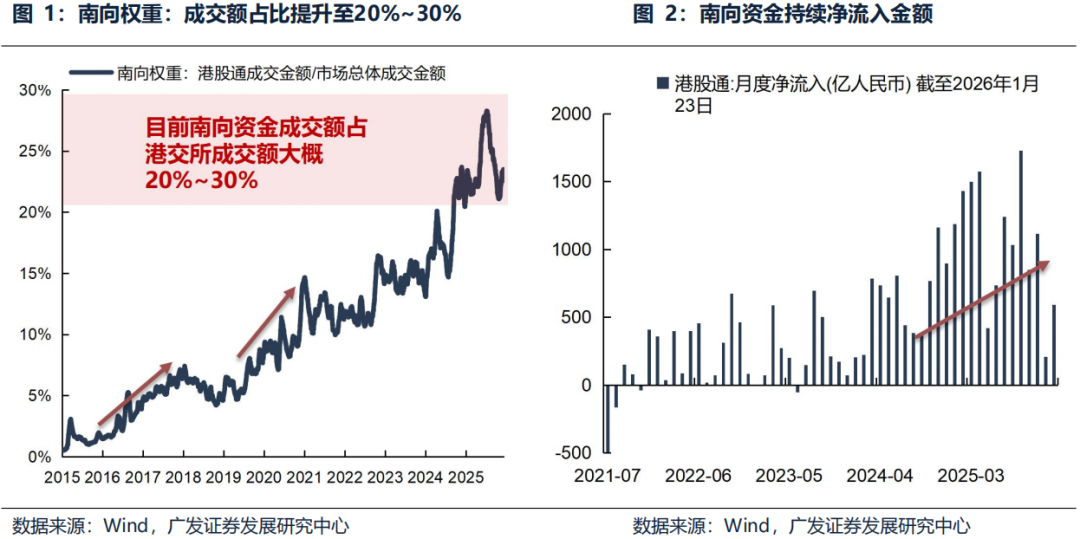
Group 1 - Since September 2024, the proportion of southbound capital transactions has rapidly increased to 20%-30%, nearly doubling compared to before 2024 [2][5] - In 2025, both active and passive foreign capital have become synchronous indicators of the Hong Kong stock market, showing no leading characteristics [2][5] - During sharp declines or corrections in the Hong Kong stock market, southbound capital tends to buy against the trend [2][5] Group 2 - Each round of pricing power competition typically begins with the optimization of the Stock Connect policy or the influx of incremental capital, which usually flows into dividend and scarce assets [5] - Net outflows of southbound capital often occur in response to adverse industry policies or external macroeconomic environments, particularly in sectors where foreign capital pricing power is increasing, such as software services, hardware equipment, consumer services, and discretionary retail [5][12] - Industries less likely to experience significant net outflows include those favored by long-term capital, such as banking, telecommunications, and public utilities, unless there are clear adverse policies affecting the sector [5][12] Group 3 - The proportion of medium to long-term capital in the current round of southbound capital inflow into Hong Kong stocks has increased, with insurance capital making 41 stakes, 35 of which are in H-shares, marking the highest record in the past decade [8] - Key industries for increased holdings include discretionary retail, finance (banking, insurance), innovative pharmaceuticals, software services, and hardware equipment [8] Group 4 - Current industries with pricing power for southbound capital and Chinese capital include semiconductors and dividend stocks, while industries lacking pricing power include internet, hardware equipment, software services, home appliances, and media [11][12] - Active management public funds have low pricing power in the Hong Kong stock market, focusing heavily on AI-related CSP giants, electronics, and innovative pharmaceuticals [16]
QDII基金交出亮眼“成绩单”后市看好创新药和科技方向
Shang Hai Zheng Quan Bao· 2026-01-25 14:24
Group 1 - The QDII funds have shown impressive performance since 2025, with an average net value increase of 27.9%, particularly driven by funds heavily invested in Hong Kong innovative pharmaceuticals [2] - Notable funds such as Huatai-PB Korea Semiconductor ETF and E Fund Global Growth Select Mixed A have seen net value increases of 127.55% and 102.91% respectively, with several other funds also exceeding 80% growth [2] - The top holdings of these high-performing funds predominantly include Hong Kong innovative pharmaceutical stocks, with examples like Kelun-Botai Biotech and Innovent Biologics among the top five holdings of Huatai-PB Hong Kong Advantage Select Mixed A [2] Group 2 - The technology sector is also a key focus for many high-performing products, with E Fund Global Growth Select Mixed A holding major global tech stocks such as TSMC and Google-A among its top ten holdings [3] - Fund managers express optimism for the future of the innovative pharmaceutical and technology sectors, citing a recent phase of adjustment in the innovative drug industry as a temporary market sentiment issue rather than a fundamental change [4][5] - The innovative drug sector's valuation has become attractive, with expectations of upward potential, and the industry is anticipated to show resilience and technological attributes over the next 2 to 3 years [5] Group 3 - The pharmaceutical industry is expected to see positive changes in 2026, with contract development organizations (CXO) gaining confidence from solid data, and new technologies like artificial intelligence and brain-machine interfaces opening new application scenarios [5] - The semiconductor sector, particularly in storage, is projected to continue its cycle, with local market trends favoring leading storage manufacturers and potential IPOs supporting capacity expansion [6]


【转|太平洋医药-26年度策略】聚焦创新,共赴新程
远峰电子· 2026-01-25 11:53
Market Overview - The pharmaceutical sector is experiencing a structural bull market in 2025, with the CITIC Pharmaceutical Index rising nearly 30% in the first three quarters, driven by the global recognition of the value of innovative drugs and devices [2][3] - The industry is expected to enter a critical phase of innovation realization and global expansion in 2026, shifting investment logic from expectation-driven to closely tracking clinical data, commercialization progress, and international achievements [2][3] Valuation Insights - The pharmaceutical sector's valuation remains at historical lows, with significant investment opportunities still available. As of December 31, 2025, various sub-sectors are trading at relatively low valuations, such as biopharmaceuticals at 35.16X and medical devices at 33.07X [7][9] - The medical services, chemical raw materials, and chemical preparations sectors have shown impressive growth, with increases of 29.22%, 22.03%, and 20.44% respectively [7] Revenue and Profit Trends - From January to November 2025, China's pharmaceutical manufacturing industry reported total revenue of 220.65 billion yuan, a year-on-year decline of 2.51%, while total profit decreased by 1.79% [9] - The performance of the biopharmaceutical, medical services, and pharmaceutical distribution sectors has improved, with biopharmaceuticals benefiting from rapid drug volume growth post-collection [9] Fund Management and Investment Opportunities - As of the end of Q3 2025, public funds' holdings in the pharmaceutical sector were at 11.22%, below the ten-year average of 8.15%, indicating potential for excess returns as the sector approaches a performance inflection point [11] - The low allocation of public funds and the sector's historical low valuations present significant opportunities for investment in high-potential sub-sectors and individual stocks [11] Innovation and Policy Support - The Chinese biopharmaceutical industry is entering a new phase of high-quality development, with significant improvements in innovation capabilities among the top 100 pharmaceutical companies [14][21] - The government has implemented comprehensive policies to support the development of innovative drugs and medical devices, transitioning from single-item support to a full-chain, regional, and financial support system [15][28] Global Market Position - China has become the second-largest market for innovative drug launches globally, contributing approximately 30% of the world's innovative pipelines as of Q3 2025 [50][66] - The country is increasingly recognized for its efficiency and cost-effectiveness in drug development, with a significant number of clinical trials initiated in China, particularly in oncology [53][66] Licensing and Commercialization Trends - The number of license-out transactions for Chinese innovative drugs has surged, with 103 deals recorded in the first three quarters of 2025, totaling $92.03 billion, marking a 77% increase year-on-year [43][63] - The successful inclusion of innovative drugs in the new commercial insurance directory is expected to enhance their commercialization prospects [30] Future Growth Areas - Next-generation therapies, including ADCs, bispecific antibodies, and cell and gene therapies, are becoming focal points for research and investment, with China leading in these areas [76][87] - The oncology drug market is projected to reach $441 billion, with new therapies expected to account for about 20% of treatment expenditures by 2029 [82]