
中国铁建

Search documents
深圳地铁27号线建设取得突破性进展
Huan Qiu Wang· 2025-12-18 11:17
据中国铁建大桥局该项目负责人介绍,该车站为地下三层岛式车站,总长160.8米,采用明挖顺作法施 工。车站施工区域条件复杂,场地狭小,周边管线密集,还涉及既有消防站的拆除与迁改,施工难度与 安全风险高。 来源:新华网 新华社北京12月18日电 记者从中国铁建股份有限公司获悉,18日,由中国铁建大桥局承建的深圳地铁 27号线项目长岭陂站顺利完成全线首块顶板浇筑,工程建设取得突破性进展。 深圳地铁27号线建成后,将串联起前海、南山科技园、西丽高铁新城等片区。 ...

持续发力,前三季度新增贷款超四成流向这个领域
和讯· 2025-12-18 09:00
Core Insights - China's green finance is transitioning from "scale expansion" to a new phase characterized by "structural differentiation and functional deepening" across multiple sectors [2][20]. Group 1: Green Credit - Green loans have become the main engine of credit growth, with a total balance of 43.51 trillion yuan as of Q3 2025, reflecting a 17.5% increase from the beginning of the year, and accounting for 43.9% of all loan increments during the same period [3][44]. - Major state-owned banks, including ICBC, CCB, ABC, and BOC, maintain green loan balances between 4 trillion and 6 trillion yuan, with growth rates between 14% and 20% [3][5]. - Regional banks like Beijing Bank and Qilu Bank have shown remarkable growth rates of 26.2% and 35%, respectively, indicating a shift towards supporting local green manufacturing and clean energy projects [3][5]. Group 2: Green Bonds - In November, the green bond market saw a significant rebound, with 94 new bonds issued, totaling 137.39 billion yuan, marking a 51.6% increase in the number of bonds and a 157.8% increase in total issuance compared to October [6][44]. - Financial bonds dominated the market, accounting for nearly 60% of the total issuance in November, highlighting the pivotal role of financial institutions in the green financing ecosystem [6][46]. Group 3: Carbon Market - The national carbon market experienced a "volume and price increase" in November, with an average carbon price of 57.73 yuan per ton, up 20.7% month-on-month, and a transaction volume of 47.75 million tons, totaling 2.757 billion yuan [7][51]. - The cumulative transaction volume for the year has surpassed 187 million tons, indicating a significant increase in market activity and the establishment of the carbon market as a crucial component of China's green finance system [8][51]. Group 4: Green Electricity and Certificates - In October, the issuance of renewable energy green power certificates (green certificates) reached 370 million, a substantial increase, although the number of tradable certificates did not rise correspondingly, leading to a decrease in their market share [9][52]. - The average price of green certificates for 2025 production year saw a significant drop of 19.14%, indicating market volatility influenced by supply-demand dynamics [9][56]. Group 5: Secondary Market - The secondary market for green financial assets displayed a clear divergence, with the Green Finance 100 Index declining by 3.52%, while the China Green Bond Index only slightly adjusted by 0.12%, reflecting a shift towards fundamental valuation and risk aversion among investors [10][41].

雷倩:扭转南海叙事,海南自贸港能发挥什么作用?
Guan Cha Zhe Wang· 2025-12-18 06:19
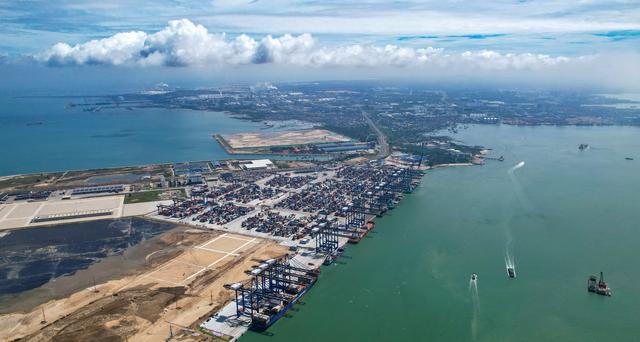
12月10日至11日,第六届"海洋合作与治理论坛"在海南三亚隆重召开。海南大学一带一路研 究院资深研究员、台湾中华妇女联合总会主任委员雷倩在"向海图强:蓝色伙伴关系与海南 自由贸易港建设"的分论坛上发表演讲,从地缘经济秩序、全球治理平台等角度畅想海南自 贸港的未来愿景。 本文整理自现场发言及会议摘要,未经本人审阅,仅供读者参考。 【文/雷倩】 2025年12月18日,海南自由贸易港(FTP)正式启动封关运作。这是南海地缘经济的重大转折点。 作为中国首个自由贸易港——关税大幅减免、通关高度便利、资本流动宽松、数字贸易规则扩容——海 南被定位为"海上丝绸之路"中一个民用、开放、以发展为导向的枢纽,海南的制度型开放,再叠加其雄 厚的海洋、生态能力,有望将南海叙事从"安全对抗"扭转为"合作发展"。 海南洋浦国际集装箱码头 新华社 "涨海声中万国商",历史上南海本是一条商贾云集的海上走廊。明、清时期,海南、广东、越南、吕宋 与马来等地凭借密集的贸易网络互通有无,形成了"共享海域、共享生计"的传统,这一遗产凸显了南海 作为商业与流动性空间的角色。 2024年3月18日,历时近两年,由中国铁建旗下中铁建设集团参与改造施工的 ...
中国铁建(01186.HKI):报表优化 分红提升 估值修复
Ge Long Hui· 2025-12-18 04:32
Group 1 - The industry investment is expected to stabilize by 2026, supported by orderly debt resolution by local governments and the implementation of central "dual" projects, with certain sub-sectors likely to receive higher investment elasticity aligned with national strategies [1] - The company has shown marginal improvement in new contract signings, with a total of 8.10 trillion yuan in hand contracts as of Q3 2025, ensuring long-term stable growth despite pressures in traditional business areas [1][2] - The company's balance sheet is continuously improving, with operational cash flow showing a reduction in outflow by 9.26 billion yuan in Q1-Q3 2025, and the aging structure of accounts receivable has improved significantly [2] Group 2 - The H-shares are trading at a significant discount compared to A-shares, with H-share dividend yield at 5.93%, making it more attractive for investors [2] - The company is initiating coverage with a "buy" rating, projecting net profits of 21.4 billion, 21.7 billion, and 22.3 billion yuan for 2025-2027, with a corresponding PE ratio of 3.1X for 2026 [3] - The estimated market value for the company based on 2026 data is 77.9 billion yuan, indicating a potential upside of 14.7% from the current market capitalization [3]
天溯计量发行结果公布 行业单项冠军扩充产业计量新领域
Zheng Quan Shi Bao Wang· 2025-12-18 04:11
Company Overview - Tian Su Measurement, established in 2009, is a national, comprehensive independent third-party measurement and testing service provider, specializing in calibration, testing, and certification services [1] - The company has developed into a national high-tech enterprise and has received various accolades, including being recognized as a "single champion enterprise" in Guangdong Province's manufacturing sector [1] Financial Performance - For the period from 2023 to the first half of 2025, Tian Su Measurement reported revenues of 726 million yuan, 800 million yuan, and 409 million yuan respectively, with net profits of 101 million yuan, 111 million yuan, and 55.576 million yuan [2] - The company has shown a positive growth trend in both revenue and net profit [2] Research and Development - From 2022 to the first half of 2025, the company invested a total of 108 million yuan in research and development [2] - As of August 31, 2025, Tian Su Measurement has obtained 133 patents, including 43 invention patents, showcasing its commitment to technological innovation [2] Market Position and Client Relationships - Tian Su Measurement has established long-term partnerships with major corporations such as Shougang Group, China Railway, and State Grid, resulting in a high client retention rate and stable revenue streams [2] - The company operates 27 laboratories across the country, enabling a grid-based market layout for rapid response and efficient service [2] Industry Trends - The measurement and calibration industry has seen growth from 607 institutions in 2016 to 791 in 2023, with a compound annual growth rate of 3.85% [3] - The total revenue of calibration institutions has increased from 5.668 billion yuan in 2016 to an estimated 11.604 billion yuan in 2024, reflecting a compound annual growth rate of 9.37% [3] - The industry is experiencing a trend towards concentration, with larger institutions benefiting from opportunities for branding and internationalization [3]
申万宏源晨会报告-20251218
Shenwan Hongyuan Securities· 2025-12-18 01:58
Core Insights - The report highlights that the construction industry is expected to stabilize in 2026, supported by local government debt management and the implementation of central projects, despite current pressures in infrastructure, manufacturing, and real estate investments [1][2] - The company has shown marginal improvement in new contract signings, with a robust backlog ensuring steady long-term growth. The cumulative new contracts from 2021 to 2025 Q1-3 show a mixed trend, with a notable improvement in the first three quarters of 2025 [1][2] - The company's balance sheet is undergoing continuous repair, with improved cash flow and optimized accounts receivable aging structure, despite revenue and profit pressures due to external economic factors [2][3] Summary by Sections Industry Overview - The fixed asset investment growth has slowed down in 2025, but the outlook for 2026 is optimistic due to government initiatives aimed at stabilizing investments [1] - The construction sector is expected to receive support from the implementation of key projects, which may lead to higher investment elasticity in certain sub-sectors [1] Company Performance - The company reported a total revenue of 728.4 billion RMB in 2025 Q1-3, a decrease of 3.9% year-on-year, with a net profit of 14.8 billion RMB, down 5.6% year-on-year [2] - New contract signings for 2025 Q1-3 showed a marginal improvement, with a total of 8.1 trillion RMB in backlog, ensuring long-term growth [1][2] Financial Health - The company has implemented a three-year plan to control financial metrics, resulting in a reduction of cash outflow by 9.26 billion RMB in 2025 Q1-3 [2] - The aging structure of accounts receivable has improved, with the proportion of long-term receivables decreasing, indicating better cash management [2] Valuation and Investment Recommendation - The report assigns an "Outperform" rating, projecting net profits of 21.4 billion RMB, 21.7 billion RMB, and 22.3 billion RMB for 2025-2027, with corresponding PE ratios of 3X [3] - The valuation comparison with peers indicates a significant discount for H-shares compared to A-shares, with a potential upside of 14.7% based on 2026 earnings estimates [3]

申万宏源研究晨会报告-20251218
Shenwan Hongyuan Securities· 2025-12-18 00:30
Core Insights - The report highlights that the investment in the industry is expected to stabilize in 2026, supported by the orderly debt resolution by local governments and the implementation of central "dual heavy" projects [1][15] - The company has shown marginal improvement in new contract signings, with a robust backlog ensuring long-term stable growth. The cumulative new contracts from 2021 to 2025Q1-3 show a mixed trend, with a notable improvement in the first three quarters of 2025 [2][15] - The company's balance sheet is continuously improving, with enhanced cash flow and optimized accounts receivable aging structure. Despite revenue and profit pressures, the company has implemented a three-year plan to control financial metrics, resulting in a significant reduction in cash outflow [3][15] Summary by Sections Industry Overview - The fixed asset investment growth has slowed down this year, affecting infrastructure, manufacturing, and real estate sectors. However, the outlook for 2026 suggests stabilization due to government initiatives [1][15] Company Performance - The company’s new contract amounts from 2021 to 2025Q1-3 are as follows: +10.39% in 2021, +15.09% in 2022, +1.51% in 2023, -7.80% in 2024, and +3.08% in 2025. The first three quarters of 2025 show a marginal improvement in new orders [2][15] - As of Q3 2025, the company has a backlog of contracts amounting to 8.10 trillion RMB, which is sufficient to support long-term growth [2][15] Financial Health - The company reported total revenue of 728.4 billion RMB in 2025Q1-3, a decrease of 3.9% year-on-year, and a net profit of 14.8 billion RMB, down 5.6% year-on-year. The company is focusing on financial recovery through a three-year plan [3][15] - The aging structure of accounts receivable has improved, with the proportion of long-term receivables decreasing, indicating better cash flow management [3][15] Valuation and Investment Recommendation - The report notes a significant discount for H-shares compared to A-shares, with H-share PE (TTM) at 3.6X and PB at 0.25X, making it more attractive for dividends, with H-share dividend yield at 5.93% [3][15] - The report initiates coverage with an "Outperform" rating, projecting net profits for 2025-2027 at 21.4 billion, 21.7 billion, and 22.3 billion RMB respectively, with a target market cap of 779 billion RMB based on a PE of 3.6X for 2026 [4][15]
中国布局了整整15年,终于对西方铁矿定价权,发动了致命一击
Sou Hu Cai Jing· 2025-12-17 18:05
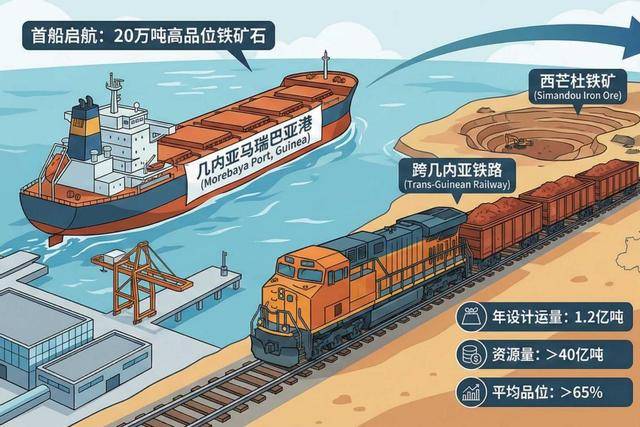
Core Viewpoint - The successful launch of the Simandou iron ore project marks a significant shift in China's iron ore supply strategy, potentially reducing reliance on Australian and Brazilian mining companies [1][16]. Group 1: Project Launch and Infrastructure Development - A cargo ship carrying 200,000 tons of high-grade iron ore departed from Guinea's Marrebaya port, indicating the official commencement of the Simandou iron ore project after 15 years of planning [1][3]. - The project benefited from China's infrastructure capabilities, with China Railway constructing a 650-kilometer railway and China Harbour Engineering building the Marrebaya deep-water port, which has a capacity of 120 million tons per year [5][8]. - The railway and port construction utilized modular construction techniques, significantly reducing the timeline for completion [5][7]. Group 2: Historical Context and Stakeholder Dynamics - Chinese companies gradually gained control over the Simandou project, starting with a 2010 agreement between Chalco and Rio Tinto, leading to the formation of a consortium in 2011 [12][14]. - A pivotal moment occurred in 2019 when a consortium of Chinese firms invested $14 billion to secure the northern block, marking the first time Chinese companies held a dominant position in the project [14]. - By 2024, China Baowu Steel purchased a 49% stake from the winning alliance, establishing a balance of power among Baowu, Rio Tinto, and the Guinean government [14][16]. Group 3: Market Impact and Strategic Significance - The Simandou project is expected to account for approximately 5% of global iron ore supply and 10% of China's imports, which could weaken the market dominance of Australian and Brazilian firms [16]. - Recent changes in pricing strategies, such as BHP accepting payments in RMB, indicate an increase in China's influence over iron ore pricing [16]. - The project enhances China's long-term steel supply security, allowing for potential exports to emerging markets in Southeast Asia and Africa in the future [18][20]. Group 4: Collaborative Model and Global Strategy - The success of the Simandou project is attributed not only to financial investment and technology but also to a balanced approach to local partnerships, creating jobs and improving infrastructure in Guinea [20][22]. - This model of cooperation helps avoid accusations of neo-colonialism while ensuring that local governments and communities benefit from resource development [20][22]. - The launch of the Simandou project exemplifies China's dual strategy of resource security and global governance, showcasing the evolution of Chinese companies from participants to leaders in international projects [22].

中铁建纳米科技(上海)有限公司成立
Zheng Quan Ri Bao Wang· 2025-12-17 13:41
Core Viewpoint - China Railway Construction Nanotechnology (Shanghai) Co., Ltd. has been established with a registered capital of 100 million yuan, focusing on advanced materials and manufacturing [1] Group 1: Company Overview - The newly established company is involved in the manufacturing of graphite and carbon products, synthetic materials, high-performance fibers, and composite materials [1] - The company also engages in general equipment manufacturing, new material technology research and development, and sales of cutting-edge new materials [1] Group 2: Shareholder Information - The shareholders of the company include China Railway Construction (601186), China Railway 11th Bureau Group Co., Ltd., Wuhan Wuchuang Institute Investment Co., Ltd., and Shanghai Taihong Technology Co., Ltd. [1]
港股收评:恒指涨0.92%、科指涨1.03%,航空股、有色金属及芯片股走高,金融股午后活跃
Jin Rong Jie· 2025-12-17 08:21
Market Performance - The Hong Kong stock market experienced a narrow fluctuation in the morning and a strong rally in the afternoon, with the Hang Seng Index rising by 0.92% to 25,468.78 points, the Hang Seng Tech Index increasing by 1.03% to 5,457.95 points, and the National Enterprises Index up by 0.98% to 8,843.57 points [1] - Major technology stocks mostly rose, with Alibaba up 1.25%, Tencent Holdings up 1.42%, JD Group up 1.26%, and Meituan up 1.81% [1] - The aviation sector showed strong performance, with China Southern Airlines rising over 5%, while financial stocks also saw gains, with China Life Insurance increasing over 4% [1] - The metals sector led the gains, with Tianqi Lithium up nearly 6%, Ganfeng Lithium up over 5%, and Luoyang Molybdenum up over 2% [1] - Semiconductor stocks also rose, with Shanghai Fudan up 4%, Huahong Semiconductor up nearly 3%, and SMIC up over 2% [1] Corporate News - China Energy Construction (03996.HK) announced the official operation of the first phase of the Zhongnengjian Songyuan Hydrogen Energy Industrial Park project [2] - China Pacific Insurance (02601.HK) reported that its cumulative original insurance premium income for the first 11 months reached RMB 250.32 billion, a year-on-year increase of 9.4%, while its property insurance premium income was RMB 187.68 billion, up 0.3% [2] - Hansoh Pharmaceutical (03692.HK) entered into a licensing agreement with Glenmark for Amivantamab, which includes an upfront payment and potential milestone payments exceeding USD 1 billion [2] Financing Activities - Yuexiu Property (00123.HK) secured a term loan financing of HKD 500 million [3] - China Railway Construction (01186.HK) plans to issue company bonds with a total amount not exceeding RMB 4 billion [4] - Genscript Biotech (01672.HK) increased its share buyback fund from a maximum of HKD 300 million to HKD 500 million [5] - Tencent Holdings (00700.HK) repurchased 1.067 million shares for approximately HKD 636 million at prices ranging from HKD 592.5 to HKD 602.5 [6] - Xiaomi Group (01810.HK) repurchased 7.2 million shares for HKD 294 million at prices between HKD 40.36 and HKD 41.00 [7] - Kuaishou Technology (01024.HK) repurchased 1.8231 million shares for HKD 116 million at prices from HKD 63.05 to HKD 64.4 [8] - Geely Automobile (00175.HK) repurchased 299,900 shares for approximately HKD 50.54 million at prices between HKD 16.72 and HKD 17.2 [9] Institutional Insights - According to China Merchants Securities, the recent weakness in the Hong Kong stock market is attributed to southbound capital returning to A-shares due to new public fund benchmark regulations, concerns over IPO financing, and the upcoming peak of stock unlocks [10] - Huatai Securities noted that while the market's downside is manageable, the upside potential has not yet opened up, with market sentiment indicators remaining in a pessimistic range [10] - China Merchants Securities also highlighted that the Hong Kong market has not stabilized after overseas interest rate cuts, primarily due to internal liquidity issues [10]
