香港交易所

Search documents
中国香港楼市到底凭借什么成功构筑“止跌企稳”平台并实现反弹?
GOLDEN SUN SECURITIES· 2026-01-27 03:31
Investment Rating - The report maintains an "Accumulate" rating for the real estate development sector in Hong Kong [4] Core Insights - The recovery of the Hong Kong real estate market in 2025 is characterized by a rebound in transaction volume, transaction value, and property prices after a period of adjustment, with key indicators showing synchronized growth [9][10] - The recovery is driven by multiple favorable factors including policy support, manageable inventory levels, and an influx of talent and financial sector recovery, which collectively enhance market demand [9] Summary by Sections 1. Recovery of the Hong Kong Real Estate Market in 2025 - In 2025, the Hong Kong real estate market shows signs of recovery with a significant increase in transaction volume and value, with first-hand residential transactions reaching 21,000 units, up 21% year-on-year, and transaction value at 220.83 billion HKD, up 14% [10] - Second-hand residential transactions also increased to 42,000 units, with a transaction value of 299.01 billion HKD, reflecting a 17% and 14% year-on-year growth respectively [10] - The Centaline City Leading Index shows a cumulative year-on-year increase of 4.7%, indicating a "first drop, then stabilization, and finally rebound" trend [10] 2. Core Support Factors for the Recovery A. Policy Support - Continuous policy support, including the "de-spicy" measures and tax reductions, has activated the Hong Kong real estate market. The government removed several restrictive measures and significantly reduced stamp duties for non-local buyers, stimulating market activity [22][23] - The budget proposal in February 2025 raised the property value cap for the 100 HKD stamp duty from 3 million HKD to 4 million HKD, easing the financial burden on small unit buyers and leading to a surge in transactions below 4 million HKD [22] B. Manageable Inventory Levels - The inventory level is relatively controllable, with the total number of first-hand residential units available for sale decreasing to 18,387 units, a reduction of 2.7% month-on-month and 15.2% year-on-year, marking a two-and-a-half-year low [2] - The absorption rate of inventory is approximately 10 months, indicating a balanced supply-demand structure that supports price stabilization [2] C. Talent Policies and Financial Sector Recovery - The introduction of talent policies has led to an influx of high-quality buyers, with over 570,000 applications received for talent entry programs, resulting in approximately 260,000 new residents, which bolsters housing demand [3] - The financial sector has seen a strong recovery, with the Hong Kong IPO market raising 82.6 billion USD in 2025, more than doubling from the previous year, which enhances consumer confidence and purchasing power in the housing market [3][46]
渣打:创新和地缘政治重塑资本市场 香港具全球联通优势
Zhi Tong Cai Jing· 2026-01-27 03:22
Core Viewpoint - Innovation and geopolitical factors are reshaping capital markets, with Hong Kong positioned as a globally connected hub [1] Group 1: Market Confidence and Policy Measures - Timely policy measures have enhanced market confidence in a changing environment [1] - The People's Bank of China and the Hong Kong Monetary Authority have expanded the RMB business funding arrangement to 200 billion RMB, laying the foundation for the next phase of connectivity development [1] - Confidence is reflected in economic, capital markets, and business activities, translating into tangible results [1] Group 2: Competition and Product Offerings - The Hong Kong Stock Exchange (HKEX) faces competition not only from traditional exchanges but also from emerging virtual platforms, necessitating deep and broad professional capabilities [1] - Investors are increasing their exposure to the Chinese market, prompting Hong Kong to offer product options beyond stocks [1] Group 3: Future Development of HKEX - The future development of HKEX relies on stablecoins, tokenization, and 24-hour trading [1] - HKEX will continue to invest in technology and is promoting infrastructure reforms, including shortening the new stock settlement cycle [1]

牧原赴港:估值落差下的全球化突围
Sou Hu Cai Jing· 2026-01-27 01:25
Core Viewpoint - Muyuan Foods, listed on the Shenzhen Stock Exchange in 2014, has passed the Hong Kong Stock Exchange listing hearing and is set to achieve A+H listing, with a current A-share market value of 249.1 billion RMB and a projected P/E ratio of 13.7 times for 2025 [1] Group 1: Business Overview - Muyuan Foods operates primarily in two segments: pig breeding and sales, and meat processing [2] - The company has established a complete industry chain covering pig breeding, raising, feed production, and sales, making it the world's largest pig breeding enterprise since 2021, with a global market share increasing from 2.6% in 2021 to 5.6% in 2024 [2] Group 2: Competitive Landscape - In the broader global and Hong Kong meat industry, Muyuan's valuation prospects post-listing require careful assessment, especially compared to competitors like WH Group, which has a market cap of just over 100 billion HKD and a dynamic P/E ratio below 10 times [3][4] - WH Group's business model, which includes downstream processing and sales, provides more stable profit margins compared to Muyuan's upstream focus, which is heavily influenced by commodity price fluctuations [3][4] Group 3: Valuation Comparisons - In the Hong Kong market, comparable companies such as Decon Agricultural and COFCO Joycome have long been valued at single-digit P/E ratios, reflecting market caution towards highly cyclical and asset-heavy industries like pig farming [5][6] - Both Decon and COFCO Joycome's market performance indicates that the Hong Kong market generally assigns lower valuation premiums to cyclical farming enterprises compared to their A-share counterparts [6] Group 4: Challenges and Strategic Path - Muyuan's upcoming Hong Kong listing aims to broaden international financing channels and enhance brand influence, but it faces the challenge of valuation disparity in a more mature market [7] - To attract international investors and align its valuation with its global leadership position, Muyuan must demonstrate its global expansion capabilities and the replicability of its cost advantages in Southeast Asia [7][8] Group 5: Globalization Strategy - The listing is a crucial step in Muyuan's global strategy, transitioning from a domestic leader to a globally recognized protein producer, which could shift market valuation logic from focusing solely on pig cycles to assessing global growth potential [8][9] - The long-term performance of Muyuan in the Hong Kong market will be a test of its cost management and execution of its globalization strategy, with its stock price dependent on international investors' confidence in its narrative of becoming a world-class player [9]

智通港股沽空统计|1月27日
智通财经网· 2026-01-27 00:24
Group 1 - The top short-selling ratios are recorded for China Resources Beer (100.00%), Anta Sports (100.00%), and Li Ning (100.00%) [1][2] - The highest short-selling amounts are for Pop Mart (1.209 billion), Xiaomi Group (1.075 billion), and Alibaba (0.974 billion) [1][2] - The highest deviation values are for CRRC (42.51%), Li Ning (38.82%), and Ping An Insurance (30.07%) [1][2] Group 2 - The top short-selling amounts list includes Pop Mart (1.209 billion), Xiaomi Group (1.075 billion), and Alibaba (0.974 billion) with respective short-selling ratios of 28.53%, 19.43%, and 8.66% [2] - The top short-selling ratio rankings show China Resources Beer, Anta Sports, and Li Ning all at 100.00% with short-selling amounts of 19.28 thousand, 9.50 thousand, and 10.09 thousand respectively [2] - The deviation values indicate that CRRC has a significant deviation of 42.51%, followed by Li Ning at 38.82% and Ping An at 30.07% [2][3]






智通ADR统计 | 1月27日
智通财经网· 2026-01-26 22:46
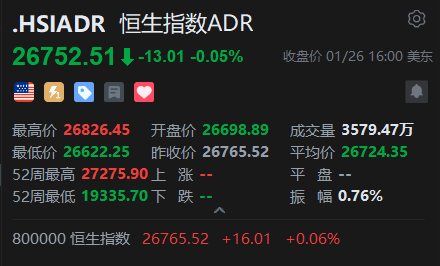
Market Overview - The Hang Seng Index (HSI) closed at 26,752.51, down by 13.01 points or 0.05% as of January 26, 16:00 Eastern Time [1] - The index reached a high of 26,826.45 and a low of 26,622.25 during the trading session, with a trading volume of 35.7947 million [1] - The 52-week high for the index is 27,275.90, while the 52-week low is 19,335.70, indicating a trading range of 0.76% [1] Blue-Chip Stocks Performance - HSBC Holdings closed at HKD 132.695, up by 1.29% compared to the Hong Kong market close [2] - Tencent Holdings closed at HKD 600.708, reflecting a slight increase of 0.2% from the Hong Kong market close [2] - Alibaba Group (BABA) saw a decline of 1.96%, closing at HKD 165.200 [3] - Xiaomi Group (01810) decreased by 2.81%, closing at HKD 35.220 [3] - AIA Group (01299) remained unchanged at HKD 83.050 [3] Notable Stock Movements - New World Development (00016) experienced a significant increase of 3.93%, closing at HKD 119.000 [3] - Kuaishou Technology (01024) fell by 3.26%, closing at HKD 78.600 [3] - JD.com (09618) rose by 1.05%, closing at HKD 116.000 [3] - Ctrip Group (09961) increased by 1.40%, closing at HKD 492.200 [3]




行业研究|行业周报|投资银行业与经纪业:政策推动行业长期稳定发展,看好非银板块绩优个股-20260126
Changjiang Securities· 2026-01-26 13:43
Investment Rating - The report maintains a "Positive" investment rating for the non-bank financial sector [7] Core Insights - The non-bank sector has shown weak overall performance this week, but some companies have disclosed high profit growth forecasts for 2025. The China Securities Regulatory Commission (CSRC) has issued guidelines to promote the return to fundamentals in the public offering securities investment fund industry, which is expected to drive long-term stable development [2][4] - The market trading volume has decreased, yet remains at historically high levels. The report suggests monitoring the sector's future performance [4] - In the insurance sector, the third-quarter reports have confirmed the logic of deposit migration, increased equity allocation, and improved new policy costs. The certainty of ROE improvement has increased, and valuations are expected to accelerate recovery [4] - The report highlights the increasing cost-effectiveness of overall allocations and ongoing revaluation in the sector [4] Summary by Sections Non-Bank Sector Performance - The non-bank financial index decreased by 1.5% this week, with an underperformance of 0.8% relative to the CSI 300, ranking 29th out of 31 sectors [5] - Year-to-date, the non-bank financial index has decreased by 1.6%, underperforming the CSI 300 by 3.1% [5] Market Overview - The average daily trading volume in the two markets was 27,988.78 billion yuan, down 19.23% week-on-week, with a daily turnover rate of 2.68%, down 68.47 basis points [5] - The leverage capital scale has rebounded, with a margin balance of 2.72 trillion yuan, up 0.23% [5] Insurance Sector Insights - The cumulative insurance premium income for November 2025 reached 57,629 billion yuan, a year-on-year increase of 7.56% [23] - Life insurance income was 41,472 billion yuan, up 9.06% year-on-year, while property insurance income was 16,157 billion yuan, up 3.88% [24] Company Recommendations - The report recommends companies with stable profit growth and dividend rates, including Jiangsu Jinzu, China Ping An, and China Pacific Insurance, due to their strong business models and market positions [4] - Additional recommendations include New China Life, China Life, Hong Kong Exchanges and Clearing, CITIC Securities, Dongfang Caifu, Tonghuashun, and Jiufang Zhitu Holdings based on performance elasticity and valuation levels [4]




港股26日涨0.06% 收报26765.52点
Xin Hua Wang· 2026-01-26 09:27
国企指数跌13.6点,收报9147.21点,跌幅0.15%。恒生科技指数跌72.02点,收报5725.99点,跌幅 1.24%。 蓝筹股方面,腾讯控股涨0.76%,收报599.5港元;香港交易所涨0.24%,收报423港元;中国移动跌 0.88%,收报78.8港元;汇丰控股涨0.77%,收报131港元。 香港本地股方面,长实集团涨3.14%,收报45.36港元;新鸿基地产涨3.93%,收报119港元;恒基地产涨 0.33%,收报30.3港元。 新华社香港1月26日电 香港恒生指数26日涨16.01点,涨幅0.06%,收报26765.52点。全日主板成交 2616.99亿港元。 中资金融股方面,中国银行涨0.22%,收报4.47港元;建设银行涨0.66%,收报7.66港元;工商银行涨 1.46%,收报6.24港元;中国平安涨1.64%,收报68.1港元;中国人寿涨2.03%,收报32.18港元。 石油石化股方面,中国石油化工股份涨2.94%,收报5.26港元;中国石油股份涨3.68%,收报8.73港元; 中国海洋石油涨4.01%,收报23.34港元。 【纠错】 【责任编辑:谷玥】 ...
李家超:香港目标3年内达2000吨以上黄金储备能力
智通财经网· 2026-01-26 06:00
Group 1 - The Hong Kong government has signed a cooperation agreement with the Shanghai Gold Exchange to launch a cross-border precious metals trading and clearing system, aiming to establish Hong Kong as a regional gold reserve center with a target of over 2,000 tons of reserve capacity within three years [1] - Hong Kong is exploring measures to deepen mutual benefits between mainland and Hong Kong financial markets and is accelerating the development of new growth areas, including the establishment of an international gold trading market and a commodities trading ecosystem [1] - A central clearing system for gold will be established to provide efficient and reliable clearing services for gold transactions that meet international standards, diversifying gold investment [1] Group 2 - As of now, Hong Kong has 15 warehouses in operation, holding over 20,000 tons of metal certificates to support the exchange in fulfilling contracts [1] - By the end of 2025, over 200 family enterprises are expected to establish or expand their businesses in Hong Kong, with a goal to attract at least 220 more by 2028, alongside optimizing the main approval systems for listings and product issuances [1] - The Hong Kong Stock Exchange is working to promote electronic holding and trading of securities and will propose a plan to shorten the settlement cycle for the Hong Kong cash stock market in the coming months [1]
智通港股沽空统计|1月26日
智通财经网· 2026-01-26 00:25
Group 1 - The top short-selling ratios are led by AIA Group (81299) and JD Health (86618) at 100.00%, followed by Baidu Group (89888) at 95.46% [1][2] - The highest short-selling amounts are recorded for Pop Mart (09992) at 1.3 billion, Alibaba (09988) at 1.26 billion, and Xiaomi Group (01810) at 1.064 billion [1][2] - The highest deviation values are for Baidu Group (89888) at 62.11%, Shenzhen Expressway (00548) at 37.02%, and SenseTime (80020) at 34.65% [1][2] Group 2 - The top ten short-selling ratios include AIA Group (81299) at 100.00%, JD Health (86618) at 100.00%, and Baidu Group (89888) at 95.46% [2] - The top ten short-selling amounts show Pop Mart (09992) leading with 1.3 billion, followed by Alibaba (09988) with 1.26 billion, and Xiaomi Group (01810) with 1.064 billion [2] - The top ten deviation values highlight Baidu Group (89888) at 62.11%, Shenzhen Expressway (00548) at 37.02%, and SenseTime (80020) at 34.65% [2]

港交所余学勤:港股IPO强劲势头将延续,多元与国际化驱动增长
Xin Lang Cai Jing· 2026-01-25 14:27
Core Insights - The Hong Kong IPO market is expected to maintain its strong momentum from 2025 into 2026, driven by market diversification, internationalization, and an active secondary market [1][13]. Group 1: IPO Market Recovery - In 2025, Hong Kong's capital market saw a full recovery with 119 companies listed, a 68% increase from 2024, and IPO fundraising exceeding 285.8 billion HKD, marking a 225% surge [3][15]. - The biotechnology sector was particularly notable, with a growth rate exceeding 60% in 2025, attracting significant international investor interest in Chinese tech companies [6][18]. Group 2: Internationalization and Market Activity - The active secondary market supported IPOs, with the average daily trading volume in 2025 increasing by over 90% compared to 2024, maintaining around 250 billion HKD [9][21]. - International companies from regions such as Thailand, Singapore, Kazakhstan, and the Middle East have begun listing in Hong Kong, with 12 companies raising approximately 400 million USD in early 2026 [10][22]. Group 3: Product Innovation and Connectivity - The Hong Kong Stock Exchange (HKEX) is focusing on product innovation to enhance market vitality, including the introduction of the Tech 100 Index and biotechnology index futures [11][23]. - Future expansions of the "connectivity" mechanism may include integrating Real Estate Investment Trusts (REITs) and promoting "Renminbi counter" inclusion in the Hong Kong Stock Connect [11][23]. Group 4: Future Outlook - The HKEX anticipates that diversification and internationalization will be key themes for the Hong Kong stock market in 2026, with growth expected across various sectors including technology, biotechnology, and international companies [12][24].