华创证券

Search documents
“长钱”入市,又一家险资私募获批
天天基金网· 2025-08-12 05:07
Core Viewpoint - The article discusses the acceleration of the pilot program for long-term investment reform of insurance funds in China, highlighting the establishment of private equity funds by insurance companies to enhance their investment capabilities in the capital market [1][4][5]. Group 1: Pilot Program Overview - The long-term investment pilot program for insurance funds was initiated in October 2023, with a total approved scale of 222 billion yuan [4]. - As of now, six insurance funds have entered operational status under this pilot program [2][5]. Group 2: Company Initiatives - China Pacific Insurance announced that its subsidiary, Pacific Asset Management, received approval from the National Financial Regulatory Administration to establish a private equity securities investment fund management company [1][5]. - The establishment of the private equity fund aims to respond positively to the long-term investment reform pilot, focusing on strict fund management and developing investment strategies that align with the characteristics of insurance funds [5]. Group 3: Market Interaction and Benefits - Industry experts believe that by setting up private equity funds, insurance companies can leverage their long-term capital advantages to support the capital market and mitigate profit volatility [6][7]. - The pilot program has received policy support in areas such as solvency and accounting, which is expected to enhance the willingness of insurance funds to enter the market [7]. - Compared to direct investments in the secondary market, investing through private equity funds can reduce the impact of market volatility on insurance companies' profit statements [7].


多家银行响应消费贷贴息,利率能降多少?
Mei Ri Jing Ji Xin Wen· 2025-08-11 12:59
Core Viewpoint - Multiple banks are responding to the State Council's meeting on July 31, which proposed the implementation of personal consumption loan interest subsidy policies and service industry loan interest subsidy policies, aiming to lower credit costs and stimulate consumption potential [2][3]. Group 1: Policy Implementation - The State Council's meeting emphasized that interest subsidies for personal consumption loans and service industry loans will help reduce financing costs and enhance market vitality [2]. - Banks like Industrial and Commercial Bank of China and Agricultural Bank of China are actively preparing to implement these policies, focusing on optimizing processes and ensuring efficient transmission of benefits to consumers [2][3]. - China Construction Bank has initiated a special action for consumer finance, aiming to facilitate access to policy benefits for market participants [2]. Group 2: Specific Actions by Banks - Bank of Communications has developed a "Support for Consumption Special Action Plan" with six major actions and 35 specific measures, focusing on key consumption areas such as automotive and home appliances [3]. - Postal Savings Bank aims to leverage its extensive network to reduce credit costs for urban and rural residents, ensuring timely and efficient delivery of policy benefits [3]. - China Everbright Bank is committed to optimizing financial services and ensuring effective use of funds while preventing risks in consumer finance [3]. Group 3: Regional Implementation Examples - Regions like Sichuan, Chongqing, and Hangzhou Yuhang District have already implemented personal consumption loan interest subsidies, with Sichuan's program starting in September 2023 and covering a wide range of consumer goods [5][6]. - In Sichuan, the subsidy is set at an annual rate of 1.5% for loans related to specific consumer goods, with a maximum subsidy of 3,000 yuan per loan [5]. - Different regions have varying subsidy standards, with Sichuan and Chongqing initially setting theirs at 1.5%, while Chongqing later increased it to 2% [6]. Group 4: Financial Mechanism and Impact - The subsidy policy is designed to create a positive feedback loop between demand and supply, enhancing consumer willingness and ability while alleviating liquidity pressure on service industry entities [6]. - The financial burden of the subsidy is shared between provincial and municipal governments, with specific ratios varying by region [6].
8月11日,新财富最佳分析师评选阶段性排名出炉!这些机构暂居前列,悬念留到最后揭晓
新财富· 2025-08-11 11:34
Group 1 - The article presents the rankings of various securities firms in different research categories as part of the 23rd New Fortune Best Analyst Awards [1][2][3] - The rankings are based on a phased statistical result as of August 11, indicating that they are not final [1][2] - The categories include macroeconomic research, strategy research, fixed income research, and sector-specific research such as real estate, food and beverage, and healthcare [1][2][3][4] Group 2 - In the macroeconomic research category, the top firms include GF Securities, Huachuang Securities, and Shenwan Hongyuan Securities [1] - For strategy research, the leading firms are CITIC Securities, GF Securities, and Shenwan Hongyuan Securities [2] - In fixed income research, the top firms are Huatai Securities, Shenwan Hongyuan Securities, and GF Securities [3] Group 3 - The rankings for specific sectors show that in real estate, the top firms are Longjiang Securities, Shenwan Hongyuan Securities, and GF Securities [6] - In the food and beverage sector, the leading firms are GF Securities, Shenwan Hongyuan Securities, and CITIC Securities [9] - For healthcare, the top firms include Industrial Securities, CITIC Securities, and Tianfeng Securities [7]




最新规模突破新高!红利低波ETF泰康(560150)近10日“吸金”近3300万元,稳定分红的高息股备受市场关注
Xin Lang Cai Jing· 2025-08-11 05:53
Group 1 - The core viewpoint of the news highlights the performance and growth of the Dividend Low Volatility ETF Taikang (560150), which has seen significant inflows and a rise in its scale to 917 million yuan, marking a new high since its inception [1][2] - The Dividend Low Volatility ETF Taikang closely tracks the CSI Dividend Low Volatility Index, which selects 50 securities based on liquidity, continuous dividends, moderate dividend payout ratios, positive growth in earnings per share, and low volatility [2] - The ETF has experienced a substantial increase in shares, with a growth of 28 million shares in the past two weeks, and has attracted a total of 32.97 million yuan in inflows over the last ten trading days [1] Group 2 - The current market environment has led to a shift in investment strategies, with a focus on a "barbell strategy" that combines high-dividend defensive assets with high-growth sectors, reflecting a unique resilience in the market [1] - There is a noted divergence in market performance, with the banking sector reaching new highs while cyclical sectors like coal have adjusted, indicating a shift in the market's demand for high-dividend assets towards sustainability of earnings [2]
军工成长新极显现!卫星产业ETF(159218)今年涨超20%
Sou Hu Cai Jing· 2025-08-11 03:14
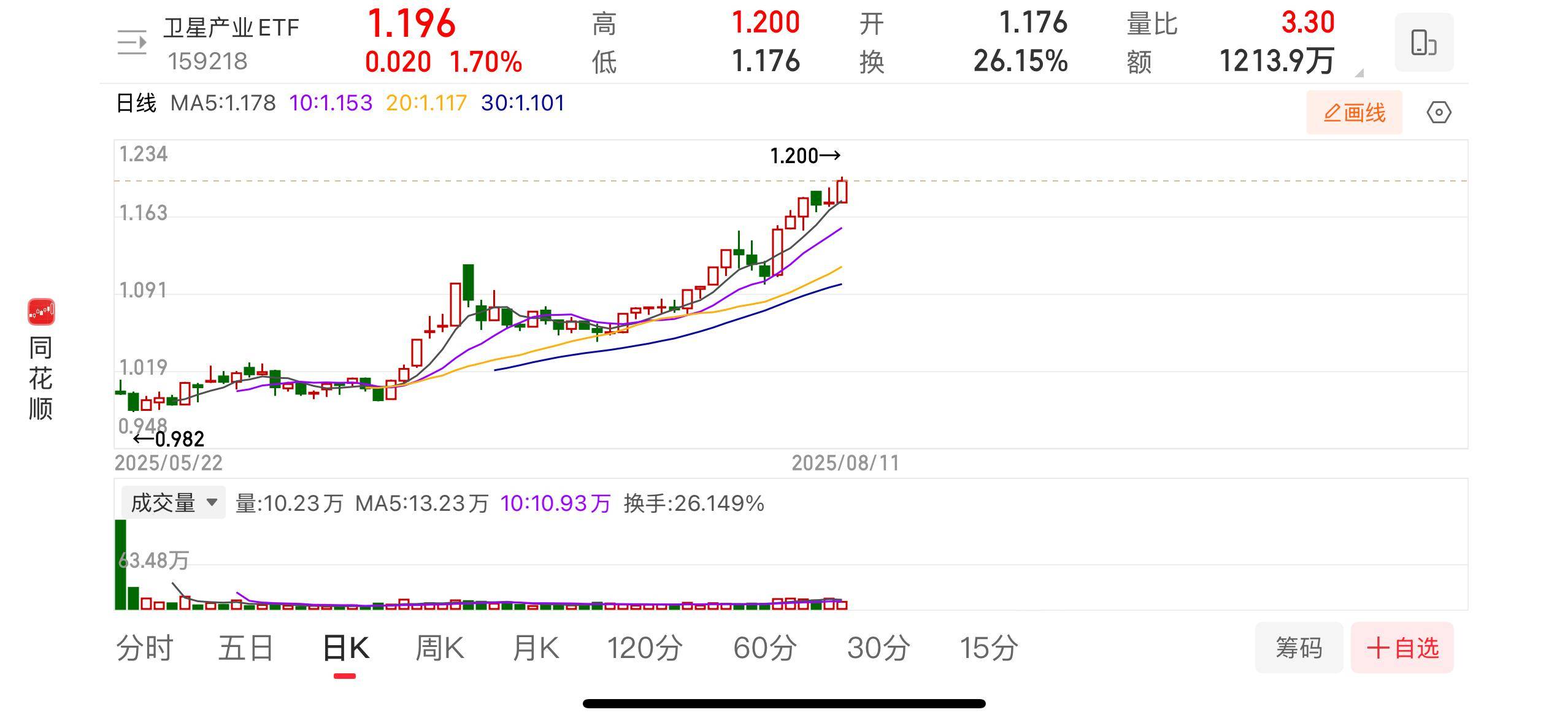
Group 1 - The satellite internet sector continues to strengthen, with significant stock price increases for companies like Electric Science Chip and New Ray Energy, indicating strong market interest [1] - The Satellite Industry ETF (159218) has risen 1.7%, reaching a historical high since its listing, with a net inflow of 13.9 million yuan over the past five days [1][7] - China's satellite launch activities are accelerating, with a recent achievement of nine consecutive satellite launches, showcasing the country's growing capabilities in commercial space launches [3] Group 2 - The GW constellation plans to launch a total of 12,992 satellites, with an expectation to complete 10% of these launches by 2030, and an average annual launch rate of 1,800 satellites post-2030 [3] - The commercial aerospace sector is experiencing continuous catalysis, with the successful completion of seven batches of satellite launches by XW, indicating a robust development in the industry [5] - The military industry is viewed as a promising investment opportunity, with improved earnings expectations for the second quarter and potential structural opportunities arising from upcoming industry catalysts [6]
港股早参丨南向资金年内净买入首破9000亿港元,机构称港股流动性望进一步改善
Sou Hu Cai Jing· 2025-08-11 02:27
【市场复盘】 【沽空数据】 上周五,港股三大指数集体回调。截至收盘,恒生指数跌0.89%,报24858.82点;恒生科技指数跌1.56%,报5460.30点;国企指数跌0.96%,报8895.28点。盘 面上,半导体产业链领跌,消费电子、AI应用、机器人题材走弱,有色金属、建筑等行业逆势走强。热点个股方面,美团跌近1%,快手、腾讯控股跌超 1%,阿里巴巴跌近2.5%,中芯国际跌超8%,蔚来涨近3%。热点ETF方面,恒生科技指数ETF(513180)随指数下行,跌幅超1.5%。周线上看,港股上周三 大指数集体走强,恒生指数累计上涨1.43%,恒生科技指数累计上涨1.17%,国企指数累计上涨1.03%。 【南向资金】 8月8日,南向资金净买入港股62.71亿港元。上周,南向资金累计净买入217.51亿港元,当周累计成交6500.55亿港元,约占同期恒指成交额的57.42%。截至8 月8日,今年以来南向资金累计净流入达9008亿港元,首次突破9000亿港元。 【隔夜美股】 隔夜美股三大股指全线收涨,道指涨0.47%,标普500指数涨0.78%,纳指涨0.98%,创收盘新高。苹果涨超4%,思科涨逾2%,领涨道指。万得 ...
资金进出节奏加快 龙头宽基ETF减持中芯国际
Zhong Guo Zheng Quan Bao· 2025-08-10 21:15
Core Viewpoint - The A-share market is experiencing active trading, particularly in leading broad-based ETFs, with significant fluctuations in holdings of major stocks like SMIC, reflecting the impact of fund inflows and outflows [1][2][3]. Group 1: ETF Holdings and Performance - The Huaxia SSE STAR 50 ETF increased its holdings in SMIC by 399,200 shares on July 11, but subsequently reduced its holdings by 651,800 shares on August 1 [1][2]. - From July 12 to August 1, the Huaxia SSE STAR 50 ETF rose by 4.20%, while experiencing a net outflow of over 3.1 billion yuan, ranking third among all ETFs in terms of outflows [3]. - As of July 31, SMIC was the largest weighted stock in the STAR 50 Index, with a weight of 10.09%, and the ETF held a market value of 8.44 billion yuan in SMIC shares, the highest in the market [3]. Group 2: SMIC's Financial Performance - SMIC reported a revenue of 2.209 billion USD for Q2 2025, a 1.7% decrease quarter-on-quarter but a 16.2% increase year-on-year, with a gross margin of 20.4% [4]. - The company expects a revenue growth of 5% to 7% for Q3 2025, with a projected gross margin between 18% and 20% [4]. - SMIC's capacity utilization rate was 92.5% in Q2 2025, with an 8-inch standard logic monthly capacity of 991,000 wafers, indicating strong demand that exceeds supply [4]. Group 3: Semiconductor Industry Outlook - The semiconductor cycle is currently in an upward trend, driven by strong growth in AI and a recovery in the industrial sector [5][6]. - AI is expected to be the primary growth driver for the semiconductor industry, with increasing demand from cloud AI and accelerating terminal AI applications [6]. Group 4: Passive Investment Trends - Passive investment, particularly through ETFs, is gaining significant influence, with leading broad-based ETFs becoming major shareholders in key stocks like SMIC [7][8]. - As of Q1 2025, four of SMIC's top ten shareholders were ETFs, highlighting the growing role of passive investment in the market [7]. - The market is witnessing a shift towards passive investment strategies, which are expected to play a crucial role in enhancing corporate governance and shareholder returns [8].

债基、货基2025Q2季报解读:债基拥挤度逐步提升,货基规模创新高
Huachuang Securities· 2025-08-10 11:59
1. Report Industry Investment Rating There is no information provided regarding the report's industry investment rating. 2. Core Viewpoints of the Report - In Q2 2025, the bond market environment was more favorable than in Q1. After the relaxation of funds, some bond varieties returned to a "positive carry" state, leading to an increased willingness among bond funds to add leverage, actively extend durations, and explore credit spreads, resulting in a rise in bond market congestion. The scale of money market funds reached a new high, and after the funds were relaxed, the risk of negative deviation significantly decreased. The product allocation preference shifted from fund lending to bank deposits [3][5]. - Looking ahead, due to factors such as the upcoming approval of policy - based financial instruments, continuous risk - preference disturbances, and insufficient expectations of interest rate cuts, bond market trading will enter a "hard mode". The 10 - year Treasury bond yield may rise slightly to a core fluctuation range of 1.65 - 1.75%. It is advisable to conduct bond swaps and take profits when market sentiment improves. In addition, although the market is relatively friendly in early August, there are still disturbances from factors such as expectations of broad - credit policies and risk preferences. During bond market adjustments, a fund redemption wave may be triggered, further amplifying market volatility. Institutions should maintain account liquidity and seize small - band trading opportunities [4][166]. 3. Summary by Relevant Catalogs 3.1 Bond Funds: Risk - Aversion Sentiment Drives Bond Market Recovery, Bond Fund Scale Resumes Expansion, and Performance Turns Positive 3.1.1 Asset Scale - In Q2 2025, the overall bond fund scale increased by 861.5 billion yuan. As of the end of Q2, there were 3,862 bond funds, accounting for 29.92% of all funds. The net issuance was 54 funds, and the asset net value increased to 10.93 trillion yuan. The share of bond funds mainly increased in pure - bond funds, while the share of convertible bond funds decreased slightly. Among them, passive index bond funds had the most significant scale increase, supported by the expansion of market - making credit bond ETFs [11][15][17]. 3.1.2 Subscription and Redemption - The redemption pressure on pure - bond funds in Q2 was significantly relieved compared to Q1. The net subscription ratio of short - term bond funds rebounded to 56.52%, the highest among all bond funds. The subscription sentiment of "fixed - income +" bond funds was weaker than that of pure - bond funds. The net subscription ratios of mixed first - tier and second - tier bond funds decreased, and the median net subscription - redemption rates also declined [31][35]. 3.1.3 Performance - The annualized return of bond funds in Q2 2025 increased to 4.10%. "Fixed - income +" bond funds performed better than pure - bond funds. The performance ranking was second - tier bond funds (5.21%) > first - tier bond funds (4.63%) > medium - and long - term pure - bond funds (3.82%) > passive index bond funds (3.63%) > short - term pure - bond funds (2.55%) [36]. 3.1.4 Leverage Ratio - In Q2 2025, due to the central bank's reserve requirement ratio and interest rate cuts, the funds' price center decreased, and some varieties returned to a "positive carry" state. The overall leverage ratio of bond funds increased by 1.29 percentage points to around 119.94%, and the leverage ratios of various types of bond funds also increased [43]. 3.1.5 Weighted Average Duration of Top - 5 Heavy - Position Bonds - In Q2 2025, after the rapid decline in bond market yields, institutions generally extended durations to seek returns. The weighted average duration of the top - 5 heavy - position bonds of existing bond funds increased by 0.69 years to 3.44 years. The durations of all types of funds increased [46][47]. 3.1.6 Asset Allocation - **Large - scale Asset Allocation**: In Q2 2025, bond funds mainly increased their bond holdings by 1.14 trillion yuan, with the proportion of bonds increasing to 96.51%. The proportions of stocks, bank deposits, and other assets decreased [62]. - **Bond Category Asset Allocation**: The proportion of credit bonds held by bond funds increased by 0.97 percentage points to 49.13%, while the proportion of interest - rate bonds decreased by 0.84 percentage points to 44.04% [88]. - **Rating Changes of Heavy - Position Bonds**: Overall, the bond funds' holdings of urban investment bonds and industrial bonds showed an obvious trend of concentration towards AAA - rated bonds. Pure - bond funds focused more on liquidity management, with both urban investment bonds and industrial bonds concentrating on AAA - rated bonds. "Fixed - income +" funds had more obvious credit - sinking, with an increased proportion of AA - rated and below bonds [106][107]. 3.2 Money Market Funds: "Deposit Migration" Drives Scale to a New High, and Allocation Demand Shifts to Deposits and Certificates of Deposit 3.2.1 Traditional Money Market Funds - **Asset Scale**: At the end of Q2 2025, the number of traditional money market funds remained at 364, and the scale exceeded 14 trillion yuan, an increase of 904.6 billion yuan from the previous quarter, a 6.8% increase [121]. - **Subscription and Redemption**: In Q2 2025, 52.47% of money market funds had net subscriptions. Both the retail and institutional ends had net subscriptions [127][130]. - **Performance**: The average 7 - day annualized yield of money market funds in Q2 was 1.26%, a decrease of 0.09 percentage points from Q1. The yields of Yu'E Bao and WeChat Licaitong fluctuated at a low level of 1.2 - 1.4% [136]. - **Leverage Ratio and Duration**: In Q2 2025, the average leverage ratio of money market funds increased by 1.82 percentage points to 105.78%, and the average remaining maturity increased by 7.05 days to 82.72 days [137]. - **Deviation**: In Q2 2025, the absolute - value average of money market fund deviations was basically the same as in Q1, but the number of funds with a minimum negative deviation decreased significantly [141]. - **Asset Allocation**: In terms of large - scale asset allocation, money market funds reduced fund lending and mainly increased bank deposit holdings. In terms of bond category asset allocation, they mainly increased their holdings of certificates of deposit [144][148]. 3.2.2 Floating - Net - Value Money Market Funds - In Q2 2025, the scale of floating - net - value money market funds decreased slightly. The average leverage ratio decreased to 101.54%, and the average remaining maturity decreased to 39.33 days. In terms of asset allocation, they mainly reduced bond and fund - lending holdings and increased bank deposit holdings. In terms of bond asset allocation, they mainly reduced their holdings of certificates of deposit. The yield performance was better than that of traditional money market funds [153][156]. 3.3 Main Conclusions - In Q2 2025, bond funds actively added leverage, extended durations, and explored credit varieties. Money market funds also added leverage, extended durations, and shifted their asset - allocation preferences from fund lending to bank deposits [164][165].
依米康(300249) - 300249依米康投资者关系管理信息20250808
2025-08-08 09:02
Group 1: Liquid Cooling Solutions - The company offers a comprehensive liquid cooling solution that includes intelligent engineering, key equipment, IoT software, and smart services, addressing the demand for liquid cooling deployment [1] - Key products include fluorine system cold plate systems, water-cooled cold plate systems, and liquid cooling containers, which have been successfully deployed in the Middle East [1] - The company emphasizes the importance of liquid cooling technology applications and market opportunities, aiming to convert orders quickly [1] Group 2: Overseas Expansion - In 2023, the company began its overseas expansion, initially following the lead of major players like Alibaba and ByteDance, and later shifting to a more proactive approach [2] - The company confirmed overseas order revenue of 47.72 million yuan in 2024, with established subsidiaries in Malaysia and coverage in Southeast Asia and the Middle East [2] - The strategy includes setting up local subsidiaries to meet the demands of expanding overseas markets [2] Group 3: Financial Performance and Strategy - The company has focused on the information data sector, resulting in a revenue increase of 42.84% to 1.145 billion yuan in 2024 and 26.44% to 318 million yuan in Q1 2025 [3] - The company ranks third in the Chinese data center air conditioning market as of 2024, reflecting the effectiveness of its focused strategy [3] - The management emphasizes a flat decision-making structure to quickly respond to key customer needs [4] Group 4: Key Clients and Future Goals - Major strategic clients include Alibaba, ByteDance, Huawei, and Tencent, with ongoing positive order conditions [5] - The company aims to enhance its professional capabilities and expand its strategic customer base and overseas markets in 2025 [5] - Key operational goals for 2025 include promoting refinancing projects, advancing R&D, and optimizing performance management systems [5]

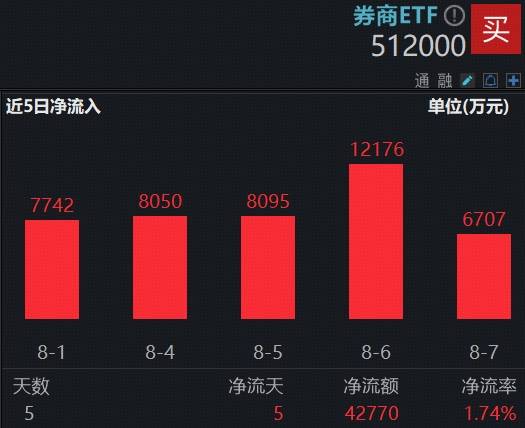
“牛市旗手”券商ETF(512000)连续5日吸金4.2亿元,机构:四重逻辑战略看多券商
Sou Hu Cai Jing· 2025-08-08 01:42
Core Viewpoint - The A-share market is experiencing a bullish trend, with significant inflows into the top broker ETF, indicating a positive outlook for the brokerage sector [1][3]. Group 1: Market Trends - The Shanghai Composite Index has seen four consecutive days of gains, reaching new highs, with the top broker ETF (512000) receiving a net inflow of 428 million yuan over the past five days [1]. - Recent market conditions have led to increased trading volumes and margin financing balances, contributing to a noticeable upward trend in brokerage stock prices [4]. Group 2: Brokerage Sector Outlook - Four key logical strategies support a bullish outlook for the brokerage sector: 1. Anticipated inflows of new capital are expected to benefit brokerage businesses across the board, as policies encourage long-term capital to enter the market [3]. 2. Adjustments in proprietary trading structures are likely to enhance performance elasticity, as the attractiveness of equity markets increases with lower long-term interest rates [3]. 3. Continuous improvement in asset quality is observed, with a reduction in impairment scales reflecting better asset management within brokerages [3]. 4. Revenue recovery and cost reduction strategies are expected to enhance profit elasticity, with the industry entering a phase of stable management costs and a decline in workforce numbers for the first time in a decade [4]. Group 3: Investment Opportunities - The brokerage ETF (512000) and its linked funds provide a diversified investment tool, covering 49 listed brokerage stocks, with nearly 60% of the portfolio concentrated in the top ten leading brokerages [5]. - The overall valuation of the brokerage sector remains at historically low levels, suggesting potential for recovery, while short-term market sentiment may drive beta performance [4][5].