
标普全球

Search documents
“聪明钱”押注锂板块复苏 机构对周期性矿企充满信心 明年黄金将成为澳第三大出口商品 铁矿石LNG出口或下降 澳能源业又现重大诉讼
Sou Hu Cai Jing· 2025-07-01 11:33
Group 1: Lithium Market Insights - The lithium market is currently at a cyclical low, but positive signs are emerging, with institutional investors showing confidence in mining and exploration stocks related to energy transition [1][2] - A global survey by Harbour revealed that around half of the institutional investors are looking for growth in natural resource stocks linked to energy transition [1][2] - Lithium has replaced copper as the second most likely commodity to attract institutional investment in Australia, Canada, the US, and the UK/Europe [2] Group 2: Demand Drivers for Lithium - Argonaut's report highlights several positive demand drivers for lithium, particularly from electric vehicles (EVs) and battery energy storage systems (BESS), with a projected 30% increase in global EV sales by 2025 [3][4] - The global sales of electric vehicles reached 1.6 million units in May, marking a 24% year-on-year increase [4][5] - Despite current oversupply in the lithium market, Argonaut predicts a rapid price recovery once a moderate shortage occurs, with expectations for lithium spodumene prices to peak at $1,500 per ton by the end of 2026 [7][9] Group 3: Future Price Projections - Argonaut forecasts that the lithium market will rebalance by 2027, with a long-term price projection of $1,600 per ton for lithium spodumene, significantly higher than current spot prices [9][10] - The report indicates that existing production capacity may be restarted in response to rising prices [8][9] Group 4: Broader Economic Context - The Australian government anticipates that gold will become the third-largest export commodity next year, driven by increased demand for safe-haven assets amid global uncertainties [15] - Overall, Australia's resource and energy export revenue is expected to decline by 4% in the coming year, influenced by global trade barriers and economic slowdowns [15][16]


每日机构分析:5月30日
Xin Hua Cai Jing· 2025-05-30 11:47
Group 1 - UBS forecasts global AI spending to reach $360 billion by 2025, a 60% increase from previous estimates, and further grow to $480 billion by 2026 [1] - Major global cloud platforms reported a strong 24% year-over-year revenue growth, indicating robust cloud business growth and increased adoption of AI across various industries [1] - UBS suggests balancing exposure between semiconductor and software stocks to manage volatility despite a positive long-term outlook on AI [1] Group 2 - The strong performance of the yen is unlikely due to low real interest rates, leading Japanese life insurance companies to reduce measures against potential losses from yen appreciation [2] - Japanese life insurers have shifted from buying to selling overseas stocks, reflecting a decrease in interest in foreign bonds despite higher yields compared to US, UK, Germany, and Australia [2] - PIMCO analysts expect Germany to have more fiscal space compared to other European countries, with overall European fiscal policy unlikely to expand significantly in the coming years [2] Group 3 - Tokyo's inflation rate rose to 3.6% in May, the highest since early 2023, exceeding market expectations, which may lead to a reassessment of the likelihood of a Bank of Japan rate hike [3] - If the Bank of Japan raises rates in July, it could support the yen and reduce hedging costs for Japanese investors in US assets [3] - The Federal Reserve may need to implement more accommodative monetary policy later this year to support the US economy, potentially leading to a weaker dollar [3] Group 4 - The iTraxx Europe Main index tracking euro investment-grade credit default swaps remained stable at 57 basis points, indicating no significant change in the market's view on the default risk of high-grade corporate debt in the eurozone [3]
越美将于5月7日举行首轮关税磋商
Shang Wu Bu Wang Zhan· 2025-05-07 16:28
Group 1 - The Vietnamese government is set to hold the first round of tariff negotiations with the United States on May 7, 2023, in response to the complex global situation and the negative impact of the US "reciprocal tariff" policy on the global economy and international supply chains [1] - The International Monetary Fund has revised down its global economic growth forecast for 2025 to 2.8%, a decrease of 0.5% from previous estimates, while Fitch Ratings predicts growth below 2%, down 0.4%, and S&P Global forecasts a growth of 2.2%, a reduction of 0.3% [1] - The Vietnamese government has taken proactive measures to address the challenges posed by the US tariff policy, achieving initial positive results [1] Group 2 - The Vietnamese government has actively communicated through various channels to promote cooperation agreements and expedite US investment projects, including issuing Decree No. 73 to reduce import taxes on multiple goods before the announcement of the "reciprocal tariff" [2] - Following the US announcement of the "reciprocal tariff," the Vietnamese government has held 10 consultation meetings and established a working group to adapt to the changes in US trade policy, with Vietnam being prioritized for negotiations among six countries [2] - The government has formed a negotiation delegation led by the Minister of Industry and Trade to develop a negotiation plan with the US, highlighting Vietnam's strategic importance in the economic dialogue [2] Group 3 - The Vietnamese government emphasizes the need to closely monitor domestic and international situations and to implement flexible and timely policy responses, particularly regarding the new US tariff policy [3] - Policies such as tax reductions and extensions are being proposed to support businesses and individuals affected by the US tariff policy, with a focus on maintaining Vietnam's legitimate rights [3] - The government aims to diversify markets, products, and supply chains while enhancing the quality and competitiveness of goods and services to adapt to global economic developments [3]
【环球财经】投资者担忧供需前景 国际油价29日明显下跌
Xin Hua Cai Jing· 2025-04-30 00:20
Group 1 - International oil prices have declined significantly due to concerns over supply and demand in the oil market, with WTI crude oil futures dropping by $1.63 to $60.42 per barrel, a decrease of 2.63%, and Brent crude oil futures falling by $1.61 to $64.25 per barrel, a decrease of 2.44% [1] - Ole Hansen from Saxo Bank highlighted that ongoing trade wars are likely to harm demand, increasing downward pressure on oil prices, as the market seeks a new equilibrium amid weakening demand and reduced supply from high-cost producers, particularly in the U.S. [1] - Barclays has revised its forecast for the average price of Brent crude oil futures in 2025 from $74 per barrel to $70 per barrel, anticipating a global oil supply surplus of 1 million barrels per day this year [1] Group 2 - Phil Flynn from Price Futures Group noted that oil prices are struggling as the market assesses the likelihood of OPEC increasing production, with a slowdown in oil demand potentially leading to lower U.S. crude production expectations [2] - Rystad Energy has cut its forecast for U.S. onshore crude production growth by more than half, predicting an increase of less than 150,000 barrels per day by the end of the year, down from an earlier estimate of around 300,000 barrels per day [2] - Analysts from S&P Global indicated that U.S. commercial crude oil inventories are expected to have increased by 200,000 barrels, while gasoline and distillate inventories are projected to decrease by 1.2 million barrels and 600,000 barrels, respectively [2]
通过对中国船征“港口费”来强迫使用美国船?美石油学会警告:不可能的任务
Huan Qiu Shi Bao· 2025-04-28 22:50
Group 1 - The American Petroleum Institute (API) warns that the U.S. oil industry cannot comply with President Trump's regulations on Chinese vessels, as there are currently no U.S.-built ships capable of transporting LNG [1] - The U.S. Trade Representative (USTR) announced that starting in 180 days, port fees will be imposed on Chinese vessels, with restrictions on foreign ships transporting LNG to the U.S. beginning in three years [1] - The USTR's measures are intended to encourage the use of U.S.-built ships over a 22-year period, but the API believes compliance is impossible due to the lack of suitable vessels [1] Group 2 - Analysts indicate that LNG producers will struggle to meet USTR's transportation standards due to higher costs of U.S. shipbuilding compared to foreign yards [2] - Currently, Chinese-built vessels account for approximately 7% of the global LNG fleet, but China holds about 28% of the global LNG vessel order volume [2] - The API expresses concerns that USTR's policy could harm the LNG export industry, which generates $34 billion annually, and may lead to future government actions that could suspend export licenses [2] Group 3 - The new USTR regulations have prompted lobbying from other exporters, warning that it will increase shipping costs [3] - Reports indicate that the cost for car carriers docking at U.S. ports could exceed $1 million, effectively acting as a new tariff on imported cars [3] - The Japanese Ministry of Land, Infrastructure, Transport and Tourism is assessing the impact of these regulations on Japanese car exports to the U.S. [3]
倒计时1天|2025企业可持续发展大会明日开幕!
第一财经· 2025-04-23 23:29
由第一财经与上海现代服务业联合会共同主办的2025企业可持续发展大会将于4月25日在上海中心 盛大召开。本次大会以"在乎者赢,行动者胜" 为主题,汇聚全球顶尖机构代表、跨国企业高管及可 持续发展领域先锋,共探双碳目标下的商业变革路径,解锁可持续实践与全球协作新机遇。 常启德 联合国驻华协调员 孙建平 联合会会长 李 蓉 上海现代服务业 上海广播电视台(上海文广集团 ) 副台长、副总裁 第一财经董事长 刘元春 上海财经大学校长 党委副书记 马克漫 格兰富中国区总裁 兰珍珍 欧莱雅北亚及中国 公共事务总裁 杨宇东 第一财经总编辑 简大年 上海现代服务业 联合会副会长 楼剑锋 巴斯夫大中华区董事长兼总裁 杨亦鸣 艺康集团高级副总裁 兼艺康大中华区机构 与专业服务事业群 总经理 刘 萌 联合国全球契约组织 亚太区总代表 张政伟 国际可持续发展准则理事会 (ISSB) 主席特别顾问 国际财务报告准则基金会 北京办公室主任 鲍嘉龙 中坚科技股份有限公司 副总经理 汪 钧 第一财经总经理 刘 宇 上海现代服务业联合会秘书长 洪湧翔 华侨银行中国 首席执行官 陈姿丹 晨光首席可持续发展官 杜坚 第一财经 常务副总经理 赵 嘉 ...
关税冲击,欧元区4月服务业PMI意外收缩,法国商业活动加速萎缩
Hua Er Jie Jian Wen· 2025-04-23 09:19
4月23日,标普全球公布4月欧元区、德国、法国PMI初值。 周三公布数据显示,受特朗普关税不确定性影响,欧元区、德国、法国服务业均意外收缩。法国综合 PMI指数也从48下降至47.3,服务业的降幅也大于制造业。 受服务业拖累,欧元区经济陷入停滞 欧元区4月商业增长停滞,欧元区占主导地位的服务业意外收缩,制造业低于荣枯线但有所改善: 欧元区4月综合PMI初值50.1,仅略高于50的荣枯分界线,预期50.2,前值50.9。 欧元区4月制造业PMI初值48.7,预期47.4,前值48.6。 欧元区4月服务业PMI初值49.7,预期50.5,前值51。 关税拖累服务业活动,4月德国私营部门陷入收缩 关税不确定性担忧导致服务业活动急剧下降,德国私营部门意外四个月内首次收缩。 根据标普全球周三公布的数据,德国4月综合PMI初值49.7,预期50.5,前值51.3,为去年12月来最低。 50是区分扩张与收缩的分界线。 "服务业活动不增反减,而这几乎是2024年2月以来首次出现的情况。这已将整个经济推入停 滞区域。" 更令人担忧的是,服务企业的乐观情绪大幅下滑,商业前景指数从57.8暴跌至53.1,创下自2020年新冠 疫情 ...
【环球财经】一周前瞻:经济前景不确定性加剧,市场或迎“血雨腥风”
Xin Hua Cai Jing· 2025-04-06 05:00
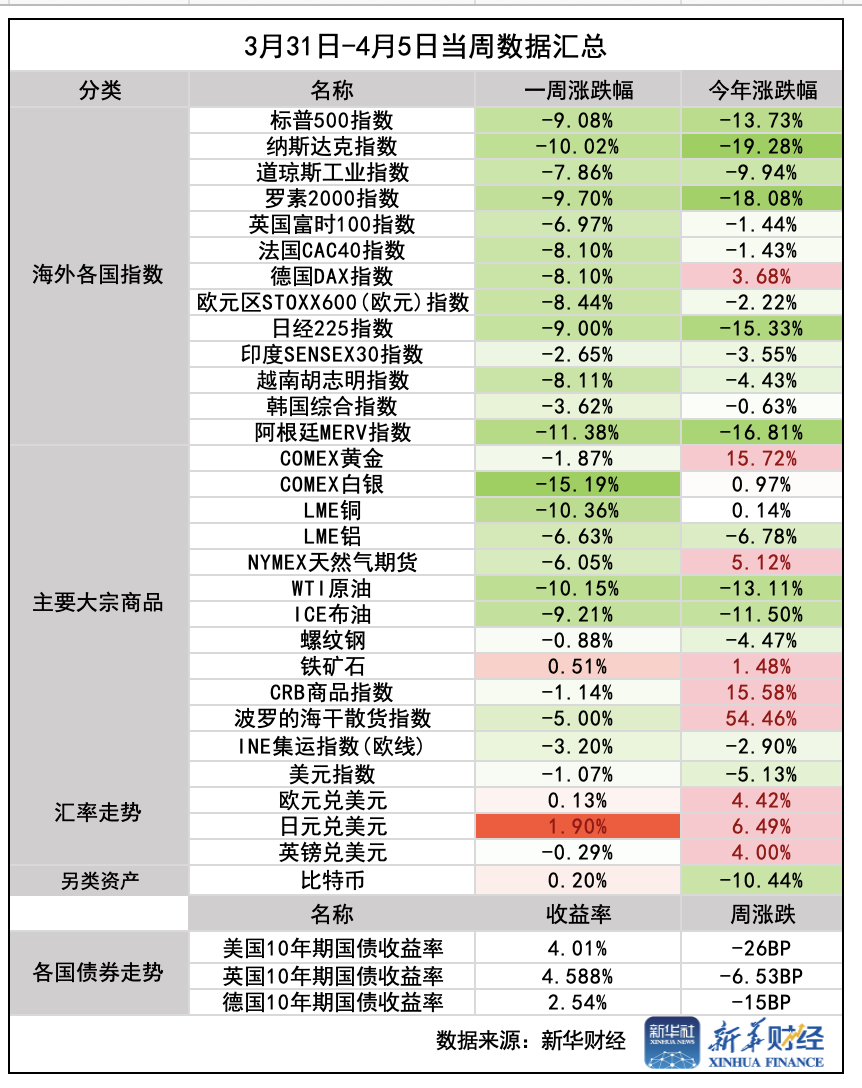
Market Overview - Global markets experienced a severe sell-off during the week of March 31 to April 5, with major stock indices and commodities facing significant declines, marking it as a "black week" [1] - The Nasdaq Composite fell over 10%, entering bear market territory, while the Dow Jones Industrial Average dropped 7.86%, and the S&P 500 fell 9.08% [1][4] - The Cboe Volatility Index (VIX) surged over 88%, reaching its highest level since March 2020, indicating heightened market fear [1] U.S. Stock Market - The "Big Tech" companies collectively lost $1.4 trillion in market value, the largest single-week decline on record, with notable drops in Nvidia, Apple, Meta, and Amazon, all down over 10% [1] - The S&P 500 index is down 13.73% year-to-date, while the Nasdaq is down 19.28% [4] European Stock Market - The Eurozone STOXX 600 index fell 8.44% for the week, marking its largest decline since 2020, and is down nearly 11.9% from its March 3 high [2] - Major European indices such as Germany's DAX and France's CAC40 both dropped 8.1% [2][4] Asia-Pacific Stock Market - The Nikkei 225 index fell below 34,000 points, with a weekly decline of 9%, while the South Korean Composite Index dropped 3.62% [2] - The Indian SENSEX30 index saw a decline of 2.65% for the week [2][4] Commodity Market - International crude oil prices hit four-year lows, with WTI crude down 10.15% to $62.32 per barrel, and Brent crude down 9.21% to $66.06 per barrel [3] - Precious metals experienced widespread declines, with gold down 1.52% and silver down 13.26% for the week [2][4] Economic Outlook - The probability of a recession in the U.S. has increased, with estimates rising from 25% to 30-35% according to S&P Global [7] - Concerns over the impact of tariffs on trade and economic growth have led to a cautious outlook among investors, particularly regarding corporate earnings forecasts [11][12]
财新周刊-第12期2025
2025-03-31 02:41
Summary of Key Points from the Conference Call Industry or Company Involved - The discussion primarily revolves around the **U.S. economy** and the impact of **Trump's economic policies** on various sectors, including manufacturing and consumer confidence. Core Points and Arguments 1. **Stock Market Performance**: Following Trump's inauguration, the U.S. stock market experienced significant declines, with the S&P 500 index dropping by 10.5% and the Nasdaq composite index falling by 14.3% from its peak [4][5]. 2. **Consumer Confidence Decline**: Consumer confidence has sharply decreased, with the University of Michigan's consumer confidence index falling to 57.9, a decline of 11% month-over-month and 27% year-over-year [5]. The Conference Board's consumer confidence index also showed a downward trend, recording 92.9, marking four consecutive months of decline [5]. 3. **Manufacturing Sector Weakness**: The manufacturing PMI fell back into contraction territory, attributed to rising material costs due to tariffs [6]. Although the services PMI improved, service producers' confidence in future prospects dropped to its second-lowest level since 2022 [7]. 4. **Economic Growth Forecasts**: The Federal Reserve's median GDP growth forecast for Q4 2025 was downgraded to 1.7% from a previous estimate of 2.1% [8]. The core PCE price index forecast was raised from 2.5% to 2.8%, complicating monetary policy decisions [8]. 5. **Trade Deficit Impact**: The U.S. trade deficit widened to $131.4 billion in January, a 34% increase month-over-month, negatively impacting GDP growth forecasts [10]. The Atlanta Fed's GDPNow model projected a 2.4% decline in Q1 GDP following this data release [10]. 6. **Long-term Economic Outlook**: Analysts predict a significant slowdown in U.S. economic growth, with estimates dropping from nearly 3% to around 1.5% over the next few years [12]. The uncertainty surrounding Trump's policies is expected to weigh on economic activity [13]. 7. **Government Spending Cuts**: The Trump administration has initiated substantial cuts to government spending, claiming to save taxpayers $115 billion, but these measures may not significantly reduce the federal deficit [17][24]. 8. **Tariff Policies**: Trump's administration has implemented aggressive tariff policies, raising average tariff rates from 2.5% to 8.4%, the highest level since 1946 [27]. This has sparked trade tensions with major partners like Canada, the EU, and China [27][31]. 9. **Global Trade War**: The U.S. is engaged in a trade war that could have negative repercussions for global economic growth, particularly affecting countries like Mexico and Canada [29][31]. The OECD forecasts a decline in global growth rates due to increased trade barriers [31]. 10. **Investor Sentiment**: The uncertainty surrounding tariffs and trade policies has led to a decrease in foreign direct investment in the U.S., with an estimated reduction of $40 billion annually due to heightened trade policy uncertainty [39]. Other Important but Possibly Overlooked Content 1. **Consumer Spending Trends**: Despite a decline in consumer confidence, consumer spending remained robust, influenced by strong performance during the previous shopping season [7]. 2. **Employment Market Resilience**: The job market has not yet shown signs of significant distress, with unemployment claims not spiking, indicating a lag in the impact of policy changes on employment [7]. 3. **Potential for Future Tax Cuts**: There is speculation about the possibility of new tax cuts being introduced, but their effectiveness in stimulating the economy remains uncertain [15][16]. 4. **Impact of Immigration Policies**: The administration's immigration policies, including the deportation of undocumented immigrants, have raised concerns about potential labor market tightness, although current deportation rates are lower than during the previous administration [22][23]. 5. **Long-term Economic Strategy**: The Trump administration's long-term economic strategy appears to focus on reducing the federal deficit through spending cuts and tax reforms, but the feasibility of these measures in the face of rising entitlement spending remains questionable [23][25].