比依股份

Search documents
AI眼镜概念异动拉升 比依股份触及涨停
Xin Lang Cai Jing· 2026-01-14 02:16
Group 1 - The core viewpoint of the article highlights the significant surge in the AI glasses concept, with companies like Biying Co., Ltd. hitting the daily limit up, and other firms such as Doctor Glasses and Mingyue Lens rising over 10% [1] - Meta Platforms is in discussions with EssilorLuxottica to double the production capacity of AI smart glasses by the end of this year, indicating a strong market interest and potential growth in this sector [1] - As sales of Ray-Ban Meta glasses increase, Meta has proposed to boost annual production capacity to 20 million units or more by the end of 2026, reflecting ambitious growth targets for the AI glasses market [1]


甲甲甲甲甲甲甲
Zi Jin Tian Feng Qi Huo· 2026-01-08 08:58
1. Report Industry Investment Rating - Methanol: Neutral to Bullish [3] - Thermal Coal: Bearish [3] - Domestic Supply: Bearish [3] - Imports: Bullish [3] - Downstream Demand: Neutral [3] - Upstream Profits: Bullish [3] - MTO Profits: Neutral [3] - Inventory: Bearish [3] 2. Core View of the Report - The short - term methanol price has rebounded significantly. On one hand, the shutdown of Iranian plants may lead to a reduction in imports. On the other hand, geopolitical factors have raised concerns about the return of Iranian plants, and the recent stabilization and rebound of olefin prices have provided momentum for methanol's rebound. In the short term, methanol is expected to be volatile and bullish, with a preference for long positions on pullbacks and positive spreads in calendar spreads [3]. 3. Summary According to Relevant Catalogs 3.1 Supply 3.1.1 Domestic Supply - As of the week ending January 1st, the national methanol plant operating rate was 77.7%, with coal - based methanol at 85.9%, coke oven gas - based at 60.1%, and natural gas - based at 34.1% [9]. - There are currently several domestic plants under maintenance. In late December, Inner Mongolia Heima and Zhongyuan Dahua were newly added to the list of maintenance plants. Attention should be paid to the restart time of natural gas - based methanol plants in China [12][15]. 3.1.2 Imports - Most Iranian plants are shut down. Since late December, Iranian shipments have decreased, and the volume in January has dropped significantly. It is expected that the reduction in imports will gradually materialize. However, recent US actions against Iran have raised concerns about the return of supply [17][18]. 3.2 Raw Material Prices - Coal prices have stabilized after a decline. Due to the increase in heating demand in the north, the daily consumption of domestic coal has rebounded significantly. In the short term, coal prices are expected to fluctuate within a narrow range [24]. 3.3 Profits 3.3.1 Upstream Profits - The profit of coal - based methanol has rebounded slightly but remains low. The profit of natural gas - based methanol remains in the red, and the profit of coke oven gas - based methanol fluctuates within a narrow range. As of January 5th, the profit of coal - based methanol in Inner Mongolia was - 214 yuan/ton, that of natural gas - based methanol in the southwest was - 200 yuan/ton, and that of coke oven gas - based methanol in Hebei was 95 yuan/ton [32]. 3.3.2 MTO Profits - MTO profits have declined slightly recently. The MTO operating rate has fluctuated within a narrow range. There are market rumors that some plants may reduce their loads due to low profits. Attention should be paid to the stability of operations under the background of continuous low profits [42]. 3.4 Downstream Demand 3.4.1 Traditional Downstream - The operating rate of traditional downstream industries has rebounded. The operating rates of acetic acid and MTBE have increased, while the operating rate of formaldehyde has decreased slightly. The profits of traditional downstream plants have remained stable at a low level recently and are relatively better compared to the same period last year. Traditional downstream enterprises' procurement is average as it is currently the off - season for traditional demand [51][56]. 3.4.2 Olefin Demand - Olefin enterprises have increased their procurement due to year - end inventory replenishment. The operation of MTO plants has not changed much, but there are rumors that some MTO plants may carry out maintenance and reduce loads due to low profits [44][56]. 3.5 Inventory - Port inventory: Last week, the port inventory was 140,000 tons, and the port's tradable inventory was 732,000 tons. Recently, due to slow unloading at the port, the inventory has been decreasing, but there are many floating storage positions at sea. It is expected that the unloading volume will increase this week, and the port will start to accumulate inventory again [77]. - Inland inventory: The inland inventory has remained at a low level, but with the recent restart of maintenance plants and the impact of snow and rain on transportation in the north, the inland inventory has started to accumulate [77]. - MTO sample enterprises' inventory: The inventory of MTO sample enterprises is at a high level but is decreasing. After the recent price rebound, the willingness to replenish inventory has declined. The raw material inventory of traditional downstream enterprises has not changed much [82]. 3.6 Price Spreads - Basis: The basis of the main contract in East China has fluctuated within a narrow range recently. The rebound of futures prices has slightly weakened the port basis, but the absolute price has followed the increase. In the short term, as the port inventory continues to decrease, the basis is expected to strengthen gradually [90]. - Calendar Spreads: The 5 - 9 spread has remained relatively strong recently, mainly because the near - end still has the expectation of inventory reduction, making the near - end stronger. The 2 - 5 and 3 - 5 spreads have increased significantly. In the short term, the positive spread trend is expected to continue [90]. 3.7 Balance Sheet - The report provides the balance sheet data of methanol from April 2025 to March 2026, including total production, imports, total supply, exports, consumption, and surplus, etc. [99]
资本为翼 赋能新质生产力 东元创投深耕宁波硬科技赛道
Zhong Zheng Wang· 2026-01-08 08:35
Core Viewpoint - Venture capital institutions are playing an irreplaceable role in empowering capital for technological innovation and industrial development, with Ningbo Dongyuan Venture Capital Co., Ltd. being a key player in this space since its establishment in 2005 [1][2]. Group 1: Company Overview - Ningbo Dongyuan Venture Capital Co., Ltd. is the first venture capital institution in Ningbo, having supported over 30 local enterprises and nurtured 8 companies to go public [1]. - The company has strategically invested in emerging industries such as advanced manufacturing, new energy, new materials, and semiconductors, becoming a hidden driver of Ningbo's new productivity [1][2]. Group 2: Investment Philosophy - The company emphasizes the concept of "patient capital," which includes not only financial investment but also value-added services such as supply chain integration and governance optimization [2]. - Dongyuan Venture Capital's investment strategy focuses on early-stage, small-scale, and technology-driven investments to provide comprehensive support during critical growth phases [2]. Group 3: Sector-Specific Investments - In the new energy sector, Dongyuan Venture Capital has successfully supported Jinlang Technology, which has become a global leader in photovoltaic string inverters, through multiple rounds of investment from 2007 to 2023 [1]. - The company has also enabled traditional home appliance firms like Deye and Biyi to pivot into new energy and smart manufacturing sectors, showcasing the advantages of Ningbo's manufacturing base [2]. Group 4: Future Outlook - Dongyuan Venture Capital plans to continue expanding its long-term capital supply and deepen its ties with Ningbo's industries, focusing on key segments of strategic emerging industries [3]. - The company aims to facilitate the transition from "manufacturing" to "intelligent manufacturing" by leveraging capital to integrate resources and support technological upgrades [2][3].


比依股份:目前可确定公司自主品牌露茉咖啡机可享受2026年“国补”
Zheng Quan Ri Bao Zhi Sheng· 2026-01-05 13:09
Core Viewpoint - The company, Biyi Co., focuses on smart home appliances, with its main products including air fryers, coffee machines, and water purifiers. The company confirmed that its proprietary brand, Lumo coffee machine, will benefit from the national subsidy until 2026, while the subsidy status for air fryers and water purifiers remains uncertain due to regional policy variations [1]. Group 1 - The main products of the company include smart home appliances such as air fryers, coffee machines, and water purifiers [1]. - The Lumo coffee machine is confirmed to receive national subsidies until 2026 [1]. - The subsidy status for air fryers and water purifiers is still under review due to differing regional policies [1].
招商证券家电行业2026年度策略:内需国补续期 出海科技成长
智通财经网· 2026-01-05 07:47
Group 1 - The core viewpoint is that the home appliance industry is expected to underperform the market in 2025 due to multiple factors including a preference for growth styles, a decline in domestic subsidies, and disruptions from overseas tariffs [1] - The home appliance sector achieved a positive return of 9% in 2025, ranking 22nd among all industries, influenced by the increasing share of TMT transactions and the reduction of domestic subsidies post-618 [1] Group 2 - For domestic sales in 2026, the government will continue to support the "trade-in" subsidy program, with an estimated total subsidy fund of 250-300 billion yuan, including 80 billion for home appliances [2] - The six major categories of home appliances will continue to receive subsidies, with new AI products being added to the 3C category [2] Group 3 - The company sees opportunities in technology exports, supply chain advantages, and hardware innovation in sectors like 3C consumption, consumer robotics, and 3D printing [3] - The transition to new national standards for power banks and the expected growth in the European balcony solar storage market are anticipated to drive hardware innovation in AI applications [3] Group 4 - Investment recommendations include focusing on high-dividend value leaders like Midea Group and Haier Smart Home, and paying attention to Gree Electric and other brands in the white goods sector [4] - For technology exports, companies like Anfu Technology and Anker Innovations are highlighted, along with opportunities in 3D printing and consumer robotics [4] - The tool export chain is recommended, with companies like Juxing Technology and Quanfeng Holdings being favored due to expected demand growth in North America [4]

双节消费亮点前瞻
2025-12-31 16:02
Summary of Key Points from Conference Call Records Industry or Company Involved - **Moutai**: Focus on stable supply and market demand - **Angel Yeast**: Benefiting from cost reductions and market improvements - **Yili**: Anticipating price recovery in dairy products - **Li Ning**: Strategies for inventory and product innovation - **Electric Bicycle Industry**: Focus on leading companies like Yadea and Aima - **Home Appliances**: Impact of subsidy policies - **Pork Farming Industry**: Current market conditions and investment opportunities - **Smart Glasses Market**: Growth expectations and product developments Core Points and Arguments - **Moutai's Strategy**: In 2026, Moutai will maintain stable total supply while reducing high-value product investments and increasing supply of Feitian Moutai to tap into mass market demand, which is expected to stabilize prices in the long term [1][3] - **Angel Yeast's Performance**: Expected to outperform the sector in 2026 due to lower sugar molasses procurement costs and improvements in the domestic restaurant chain [1][4][5] - **Yili's Growth**: Anticipated turning point in milk prices in Q2 and Q3 of 2026, with a focus on product innovation and high-end branding to achieve quality growth [1][5] - **Li Ning's Strategy**: Effective inventory management and product innovation, including new running shoes, are expected to drive revenue recovery, with a projected profit of 2.7 billion yuan in 2026 [1][6][7] - **Electric Bicycle Industry Outlook**: Leading companies like Yadea and Aima are currently undervalued, with a focus on spring sales data to assess market recovery [1][8][9] - **Home Appliance Subsidy Policy**: The renewal of the subsidy policy, totaling 250 billion yuan, is expected to positively impact related sectors, including smart glasses, with projected sales growth of 78% in 2025 [1][11][12] - **Pork Farming Industry**: Continuous reduction in breeding sow capacity presents a window for investment in quality pork stocks, despite recent price recoveries not changing the fundamental supply-demand dynamics [2][31][32] Other Important but Possibly Overlooked Content - **Smart Glasses Market**: Expected domestic shipment of 4.5 million units in 2025, indicating significant growth potential [1][12] - **Investment Recommendations**: Companies like Jimi Technology, TCL Electronics, and Anke Innovation are highlighted for their low valuations and growth potential in the context of new product lines and market recovery [1][14] - **Pork Industry Valuation**: Current valuations in the pork sector are considered severely undervalued, making it a prime area for investment [2][32] - **Poultry Industry Insights**: The yellow feather chicken market shows promising investment opportunities, while the white feather chicken market faces challenges due to seasonal factors [2][33] This summary encapsulates the essential insights and projections from the conference call records, providing a comprehensive overview of the discussed industries and companies.
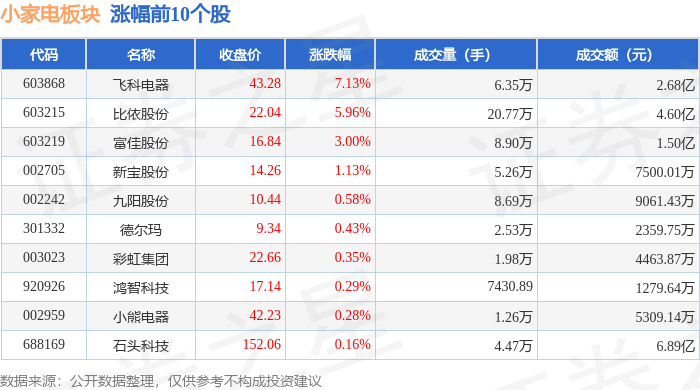
小家电板块12月31日涨0.44%,飞科电器领涨,主力资金净流入1638.99万元
Zheng Xing Xing Ye Ri Bao· 2025-12-31 08:59
Group 1 - The small home appliance sector increased by 0.43% on December 31, with Feike Electric leading the gains [1] - The Shanghai Composite Index closed at 3968.84, up 0.09%, while the Shenzhen Component Index closed at 13525.02, down 0.58% [1] - Key stocks in the small home appliance sector showed varied performance, with notable gainers including Liao Electric (up 7.13%) and Bi Yi Co. (up 5.96%) [1] Group 2 - The small home appliance sector experienced a net inflow of 16.39 million yuan from institutional investors, while retail investors saw a net outflow of 59.34 million yuan [2] - The trading volume and turnover for key stocks in the sector varied, with Bi Yi Co. achieving a turnover of 460 million yuan [2] - The net inflow and outflow of funds for specific stocks indicated a mixed sentiment among investors, with Bi Yi Co. attracting significant institutional investment [3]


2025年第51周:数码家电行业周度市场观察
艾瑞咨询· 2025-12-30 00:07
Industry Environment - In 2025, a stark contrast is observed between the "Six Little Dragons" in Hangzhou and the "Invisible Champions" in Shenzhen, with Hangzhou focusing on narrative and traffic operation while Shenzhen emphasizes technical refinement and a pragmatic approach [3] - The AI landscape is witnessing a competition akin to the Android vs. Apple battle, with the launch of the open-source AI Agent model AutoGLM by Zhiyu, which supports cross-device operations and aims to prevent AI monopolies [4] - The AI glasses market is experiencing intense competition, with major players like Google and Alibaba entering the fray, focusing on vertical scenarios and data control, despite consumer hesitance [5] - The evolution of IoT in China is shifting towards emotional value, driven by the "loneliness economy," with AI emotional products gaining traction among young consumers [6] - The humanoid robot sector is facing scrutiny over its reliance on remote control rather than autonomous intelligence, with significant discrepancies between market sentiment and actual order volumes [8] AI Transformation in Healthcare - The modern healthcare system is grappling with digital transformation challenges, necessitating a comprehensive overhaul of data governance and decision-making processes to effectively integrate AI [9] AI Unicorn IPO Race - Domestic AI unicorns MiniMax and Zhiyu are preparing for IPOs in Hong Kong, marking a shift from technology to commercialization, with significant backing from industry giants [10] AI Content Creation - The rise of "manga dramas" as a new content form is driven by AI technology, significantly lowering production costs and attracting major IP and platform players [12] AI Companion Toys Market - The AI companion toy market is rapidly growing but facing challenges of high return rates due to low emotional connection and user experience issues [13] Small Home Appliances Industry - The small home appliance sector is experiencing a bifurcation, with companies like Delmar adjusting strategies amid declining performance, while others expand production and explore overseas markets [14] AI Model Competition - The AI model landscape is diversifying into three camps, with ByteDance's Doubao leading in user engagement, DeepSeek excelling in technology, and Alibaba's Tongyi Qianwen focusing on practical applications [16] Future of AI - The year 2026 is projected to be pivotal for AI, transitioning to an "AI-native" era characterized by natural language interaction and autonomous task completion [17] AI Agent Development - The AI Agent market is expected to grow significantly, with applications across various sectors, although companies face challenges in implementation and compliance [18] Humanoid Robot Development - Japan is re-entering the humanoid robot development race, aiming for prototype release by 2030, intensifying global competition in the sector [19] AI Toys and Emotional Economy - Major tech companies are entering the AI toy market, which is projected to grow significantly, but face challenges related to pricing and user experience [21] AI Mapping Services - AI is becoming central to the mapping industry, with major players like Baidu and Gaode launching AI strategies, but user experience and privacy concerns remain critical issues [22] AI Investment Trends - The AI investment landscape is evolving, with figures like Duan Yongping advocating for rational participation and practical applications of AI technology [31] Apple’s Entry into Robotics - Apple is accelerating its entry into the humanoid robot market, aiming to leverage its brand and manufacturing capabilities, despite facing significant challenges [32] Robotics and AI Commercialization - Companies like Yundongchu Technology are securing funding to advance embodied intelligence technologies and expand market applications [34]



数码家电行业周度市场观察-20251227
Ai Rui Zi Xun· 2025-12-27 08:05
Investment Rating - The report does not explicitly provide an investment rating for the industry Core Insights - The digital home appliance industry is experiencing a bifurcation, with companies in Hangzhou focusing on traffic operations and storytelling, while Shenzhen companies emphasize technical refinement and practical innovation [4] - The AI eyewear market is witnessing intense competition among major players like Google and Alibaba, with a projected market size of $4.2 billion by 2025, although consumer sentiment remains cautious [6] - The rise of AI emotional products is driven by the "loneliness economy," with a market expected to reach 59.5 billion yuan by 2028, as young consumers seek emotional companionship [6] - The humanoid robot sector is facing scrutiny over its reliance on remote control rather than autonomous intelligence, with a projected global shipment of only 1.38 million units by 2035 [7] - The AI model IPO race is heating up, with companies like MiniMax and Zhizhu AI vying for the title of "first AI model stock" in Hong Kong, indicating a shift from technology to commercialization [9] Industry Trends - The Hangzhou "Six Little Dragons" and Shenzhen "Invisible Champions" are contrasting entrepreneurial philosophies, with the former focusing on narrative and the latter on technical prowess [4] - The AI eyewear market is characterized by a shift from hardware to vertical scene integration and data control, with major players competing for market share and future interaction interfaces [6] - The AI emotional product market is evolving from functional needs to emotional value, driven by the increasing demand for companionship among young consumers [6] - The humanoid robot market is currently in a speculative phase, with significant investment but limited actual orders and production capacity [7] - The competition among AI models is intensifying, with a focus on ecosystem building and commercial validation as companies prepare for IPOs [9] Brand Dynamics - The AI investment landscape is witnessing a rush to IPO, with companies like Moonlight Dark Side negotiating significant funding and facing increased competition [17] - Ideal Auto has launched AI glasses as part of its strategy to integrate AI into physical products, emphasizing multi-modal data integration [18] - Xiaomi is making significant investments in humanoid robotics, aiming to leverage its existing technology and supply chain capabilities [19] - Google is re-entering the smart glasses market after a long hiatus, planning to launch new products that face challenges in market acceptance [20] - The AI assistant from Doubao is facing privacy concerns and restrictions from major app ecosystems, highlighting the tension between innovation and regulatory compliance [22]



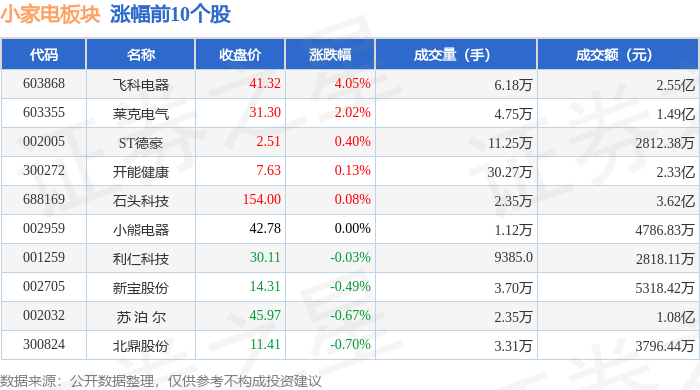
小家电板块12月26日跌0.28%,倍轻松领跌,主力资金净流出8784.11万元
Zheng Xing Xing Ye Ri Bao· 2025-12-26 09:07
Market Overview - The small home appliance sector experienced a decline of 0.28% on December 26, with Beikong leading the drop [1] - The Shanghai Composite Index closed at 3963.68, up 0.1%, while the Shenzhen Component Index closed at 13603.89, up 0.54% [1] Stock Performance - Notable gainers in the small appliance sector included: - Feike Shiqi (603868) with a closing price of 41.32, up 4.05% and a trading volume of 61,800 shares, totaling 255 million yuan [1] - Lek Electric (603355) closed at 31.30, up 2.02% with a trading volume of 47,500 shares, totaling 149 million yuan [1] - Conversely, Beikong (688793) saw a significant drop of 14.68%, closing at 22.61 with a trading volume of 69,700 shares, totaling 161 million yuan [2] Capital Flow - The small home appliance sector saw a net outflow of 87.84 million yuan from institutional investors, while retail investors contributed a net inflow of 44.81 million yuan [2] - The overall capital flow indicates a mixed sentiment, with institutional investors withdrawing funds while retail investors showed interest [2] Individual Stock Capital Flow - Key stocks and their capital flow include: - Feike Shiqi (603868) had a net outflow of 18.42 million yuan from institutional investors, while retail investors contributed a net inflow of 169,570 yuan [3] - Lek Electric (603355) experienced a net outflow of 1.89 million yuan from institutional investors, with retail investors contributing a net inflow of 405,930 yuan [3] - The data reflects varying levels of investor confidence across different stocks within the sector [3]