
迈瑞医疗

Search documents
外资深耕中国的深层逻辑(我眼中的中国)
Ren Min Ri Bao· 2026-02-24 22:25
Core Insights - The Chinese medical device industry has undergone significant transformation since the country joined the WTO in 2001, leading to the establishment of a comprehensive network of sales, service, and training by multinational manufacturers [1][2] - The domestic production of medical devices has increased dramatically, with the localization rate of monitoring devices exceeding 85%, and the market share of Chinese medical devices in the global market is on the rise [2][3] - China's medical device sector is projected to grow, with over 35,000 production companies expected by the end of 2025 and a market size estimated to reach 1.22 trillion yuan [2] Industry Development - The medical device sector is a crucial pillar of healthcare, alongside medical services and pharmaceuticals, encompassing a wide range of products including diagnostic equipment and implants [1] - The emergence of numerous startups focused on independent research and development of medical devices has been driven by market demand [1] - The Chinese manufacturing industry has developed capabilities across nearly all categories of medical devices, with significant advancements in innovative products such as ECMO [3] Technological Advancements - The integration of advanced technologies such as artificial intelligence and 5G is expected to drive the next wave of innovation in medical devices, enabling new diagnostic and treatment methods [4] - The establishment of research and development centers by foreign companies in China highlights the strategic importance of the local market and supply chain [3] Market Dynamics - China's large population and diverse health needs are accelerating the pace of technological iteration in the global medical device industry [2] - The shift from "following" to "competing" and even "leading" in certain areas reflects the industry's evolution and the rise of "China Intelligent Manufacturing" [3]
设备白送,耗材翻5倍!医疗采购\"1元中标\"的隐秘生意经还能持续多久?
Xin Lang Cai Jing· 2026-02-24 11:06
Core Viewpoint - The recent notice from Hubei Province addresses the issue of "abnormally low bidding" in government procurement, particularly targeting bids as low as "1 yuan" or "0.01 yuan" [1][19]. Group 1: Government Procurement Issues - The focus on abnormally low bids is not new, with previous regulations implemented in regions like Jiangxi, Guangxi, and Jiangsu, emphasizing scrutiny on bids below 50% of the average price or 45% of the maximum limit [2][10]. - A notable case involved a hospital with a budget of 3 million yuan for medical equipment, which was awarded to a bid of only 1,000 yuan, leading to increased costs for consumables later on [2][19]. Group 2: Market Dynamics and Company Performance - Companies like Wandong Medical have seen high bidding rates in 2025, with CT, MR, and DR equipment winning bids at rates of 47%, 56%, and 50% respectively, but this has come at the cost of profitability [3][20]. - Wandong Medical forecasts a net loss of 199 million to 257 million yuan for 2025, marking the worst annual performance since its listing, while Mindray's gross margin has dropped by 4.59 percentage points to 61.21% [3][15][28]. Group 3: Competitive Strategies and Industry Trends - The intense competition in the in-vitro diagnostics (IVD) sector has led to a significant reduction in the number of companies, from 2,320 to 1,530 between 2023 and 2025, with many resorting to extreme pricing strategies to capture market share [5][23]. - Companies often employ a bundling strategy, offering low-priced equipment while charging high prices for consumables, leading to increased overall costs for hospitals [6][24]. Group 4: Regulatory Responses - The national government has begun to take serious measures against low-cost bidding practices, with new regulations set to take effect in 2026 that will enforce scrutiny on bids significantly below average prices [9][25]. - Hubei Province has established specific thresholds for triggering reviews of abnormally low bids, which may be adjusted based on actual circumstances [11][27]. Group 5: Future Directions for the Medical Equipment Market - Companies are increasingly focusing on international markets and developing differentiated products to navigate the pressures of price competition [16][29]. - The need for innovation is emphasized as the industry shifts from a manufacturing to a creative approach, highlighting the importance of driving growth through new product development [30][31].



脑机接口行业有望迎来DeepSeek时刻,医疗创新ETF(516820)备受关注
Sou Hu Cai Jing· 2026-02-24 06:01
数据显示,截至2026年1月30日,中证医药及医疗器械创新指数(931484)前十大权重股分别为药明康 德、迈瑞医疗、恒瑞医药、爱尔眼科、片仔癀、新和成、华东医药、康龙化成、艾力斯、甘李药业,前 十大权重股合计占比63.9%。 风险提示:基金有风险,投资需谨慎。基金管理人承诺以诚实信用、勤勉尽责的原则管理和运用基金资 产,但不保证本基金一定盈利,也不保证最低收益。基金管理人提醒投资人基金投资的"买者自负"原 则,在做出投资决策后,基金运营状况与基金净值变化引致的投资风险,由投资人自行负担。基金的过 往业绩及其净值高低并不预示其未来业绩表现,基金管理人管理的其他基金的业绩不构成对本基金业绩 表现的保证。投资人购买基金,既可能按其持有份额分享基金投资所产生的收益,也可能承担基金投资 所带来的损失。投资人应当认真阅读《基金合同》《招募说明书》等基金法律文件,全面认识本基金的 风险收益特征和产品特性,并根据自身的投资目的、投资期限、投资经验、资产状况等判断基金是否和 投资人的风险承受能力相适应,理性判断市场,谨慎做出投资决策。本材料中相关信息来源于基金管理 人认为可靠的公开资料,相关观点、评估和预测仅反映当前的判断, ...

创业板50ETF(159949)半日成交6.62亿领跑!人形机器人引爆节后科技行情,机构看好三大主线!
Xin Lang Cai Jing· 2026-02-24 04:18
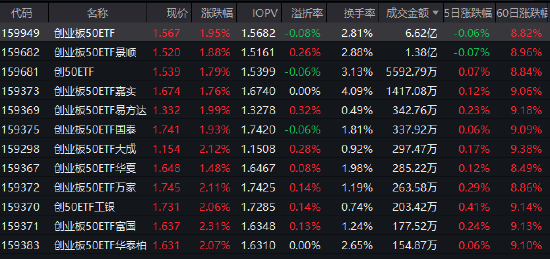
2月24日,市场早盘高开回落后震荡回升,三大指数午盘均涨超1%,创业板指半日上涨1.76%,全市场 超4200只个股飘红。在此带动下,创业板50ETF(159949)午盘收涨1.95%,报1.567元,换手率 2.81%,半日成交额6.62亿元,成交规模居同类ETF首位。 | 代码 | 名称 | 现价 | 涨跌幅 IOPV | 溢折率 | 换手率 | | 成交金额 ▼ 5日涨跌幅 60日涨跌幅 | | | --- | --- | --- | --- | --- | --- | --- | --- | --- | | 159949 | 创业板50ETF | 1.567 | 1.95% 1.5682 | -0.08% | 2.81% | 6.62 Z | -0.06% | 8.82% | | 159682 | SIZINESDELL 当前 | 1.520 | 1.88% 1.5161 | 0.26% | 2.88% | 1.38亿 | -0.07% | 8.96% | | 159681 | SUSOETF | 1.539 1.79% | | 1.5399 -0.06% | 3.13% | 5592.79万 | 0 ...

手术机器人板块迎来密集催化,医疗创新ETF(516820)多空胶着
Sou Hu Cai Jing· 2026-02-24 02:41
Core Viewpoint - The medical device sector is experiencing a turning point, driven by performance recovery and innovation in overseas markets, with a focus on surgical robots, brain-computer interfaces, AI medical technology, and high-potential innovative devices like PFA, RDN, and TAVR [1] Group 1: Market Performance - As of February 24, 2026, the CSI Medical and Medical Device Innovation Index (931484) rose by 0.25%, with notable increases in component stocks such as Aier Eye Hospital (up 2.23%), Yingke Medical (up 1.96%), and Xingqi Eye Medicine (up 1.45%) [1] - The Medical Innovation ETF (516820) is currently in a state of market tension, with the latest quote at 0.36 yuan [1] Group 2: Industry Developments - Recent developments in the surgical robot sector, including successful bids from MicroPort Robotics and Aikang Medical, have significantly raised market expectations for the commercialization of related equipment [1] - Continued funding interest in cutting-edge areas such as AI medical technology and brain-computer interfaces is noted, alongside a U.S. court ruling that deemed tariff policies illegal, further strengthening the logic for medical device exports [1] Group 3: Index Composition - As of January 30, 2026, the top ten weighted stocks in the CSI Medical and Medical Device Innovation Index include WuXi AppTec, Mindray Medical, and Hengrui Medicine, collectively accounting for 63.9% of the index [2]
强化基础研究战略性、前瞻性、体系化布局 不断夯实高水平科技自立自强根基
Ren Min Ri Bao· 2026-02-20 01:24
Group 1 - Strengthening basic research is an urgent requirement for achieving high-level technological self-reliance and building a world-class scientific power [1] - The emphasis on basic research has led to significant achievements, with over half of the top ten scientific advancements in China for 2025 stemming from basic research [1] - The development of quantum computing in China illustrates the importance of foundational issues in advancing technology [2][3] Group 2 - Basic research serves as the theoretical foundation for technological breakthroughs and is a driving force for industrial transformation [4] - The establishment of collaborative frameworks between enterprises and research institutions is crucial for advancing basic research [5][9] - The integration of enterprises into the national basic research system allows for a collaborative innovation mechanism where companies can propose scientific challenges [6][7] Group 3 - The cultivation of young scientific talent is essential for the future of basic research, with significant support being provided to young researchers [10][11] - A high percentage of funded projects are led by researchers aged 45 and below, indicating a focus on nurturing young talent in the scientific community [12] - The National Natural Science Foundation has funded a substantial number of projects, contributing significantly to foundational scientific advancements [12]
强化基础研究战略性、前瞻性、体系化布局——不断夯实高水平科技自立自强根基
Ren Min Ri Bao· 2026-02-19 22:17
Group 1 - Strengthening basic research is an urgent requirement for achieving high-level technological self-reliance and building a world-class scientific power [1] - The emphasis on basic research has led to significant achievements, with over half of the top ten scientific advancements in China for 2025 stemming from basic research [1] - The development of quantum computing in China demonstrates the importance of addressing foundational scientific issues to meet national strategic needs [2][3] Group 2 - Basic research serves as the theoretical foundation for technological breakthroughs and is a driving force for industrial transformation [4] - The establishment of collaborative frameworks between enterprises and research institutions is crucial for advancing basic research [5][9] - The integration of enterprises into the national basic research system allows for a collaborative innovation mechanism where companies can propose scientific challenges to be addressed by research teams [6][7] Group 3 - The cultivation of young scientific talent is essential for the future of basic research, with significant support being provided to young researchers [10][12] - The National Natural Science Foundation has funded numerous projects led by researchers aged 45 and below, indicating a strong focus on nurturing young talent [12] - The foundation has supported a total of 880,000 research projects over 40 years, with funding amounting to 460.8 billion yuan, contributing to a wealth of foundational and original scientific achievements [12]
谁是中国AI“第一城”?
机器人圈· 2026-02-14 09:48
Core Insights - The article highlights the rapid growth and development of China's artificial intelligence (AI) industry, showcasing significant user adoption and innovation across various sectors [3][4][14][24][31]. Group 1: AI Industry Growth - By the end of 2025, China's generative AI user base is projected to reach 602 million, a 141.7% increase from the end of 2024, with a penetration rate of 42.8%, up 25.2 percentage points year-on-year [3]. - The AI industry in Beijing has surpassed 2,400 companies, including 46 listed firms and 36 unicorns, accounting for over half of the national total [4]. - Shanghai's AI industry is expected to exceed 550 billion yuan in scale by the end of 2025, with a year-on-year growth rate of over 30% [14]. Group 2: Key Players and Innovations - Major companies leading the AI sector include ByteDance, Baidu, and Huawei, focusing on areas such as large models, AI algorithms, and smart driving [5][24]. - Shenzhen has seen a 22.6% year-on-year growth in its core AI industry, with a total scale reaching 368.5 billion yuan in 2024, indicating a shift towards source innovation [24]. - Hangzhou's AI industry is projected to grow from 300 billion yuan in 2023 to 399 billion yuan in 2024, with 84 listed companies and 10 unicorns by the end of 2025 [31]. Group 3: Data and Infrastructure - Beijing has registered 123 large model products and established a data foundation with over 150 petabytes of data [4]. - Shanghai has completed 137 registrations for generative AI services, building a workforce of 300,000 in the AI sector [14]. - Shenzhen's AI industry encompasses a full range of the supply chain, from chips to applications, with 2,887 related enterprises [24].






医药行业专题报告:25Q4持仓调整筑底,2026年医药板块有望迎来修复性机会
Guoxin Securities· 2026-02-14 00:45
Investment Rating - The investment rating for the pharmaceutical and biotechnology sector is "Outperform the Market" (maintained) [2] Core Insights - The pharmaceutical sector underperformed the market in Q4 2025, with the overall sector down by 9.3% compared to a slight decline of 0.2% in the CSI 300 index. Notably, the pharmaceutical commercial segment showed a positive performance with a 5.3% increase, while other segments like medical services and biological products experienced significant declines [4][8] - The total net asset value of pharmaceutical funds decreased to 358.4 billion yuan, a 9.0% decline quarter-on-quarter. This marks the first time since 2019 that passive pharmaceutical funds (181.8 billion yuan) surpassed active funds (176.5 billion yuan) [4][14] - The overall pharmaceutical holdings across all funds dropped to 7.97%, a decrease of 1.71 percentage points. Active pharmaceutical funds maintained a high concentration with a holding ratio of 97.45% [23] Summary by Sections 1. Market Review - In Q4 2025, the pharmaceutical and biotechnology sector lagged behind the CSI 300 index, with a decline of 9.3%. The chemical pharmaceuticals segment fell by 9.6%, biological products by 12.4%, and medical devices by 10.6% [8] 2. Pharmaceutical Fund Size - As of Q4 2025, the net asset value of pharmaceutical funds was 358.4 billion yuan, down 9.0% from the previous quarter. Active funds accounted for 176.5 billion yuan, a 14.6% decrease, while passive funds reached 181.8 billion yuan, down 2.8% [14] 3. Pharmaceutical Holdings Ratio - The pharmaceutical holdings ratio for all funds was 7.97%, down 1.71 percentage points. Active pharmaceutical funds had a holding ratio of 97.08%, while passive funds had 97.83% [23] 4. Holdings Structure Analysis - The highest sub-sector holding in Q4 2025 was chemical preparations at 37.5%, followed by other biological products at 20.8%. The largest increases in holdings were seen in traditional Chinese medicine (+0.98 percentage points) and chemical preparations (+0.62 percentage points) [29] 5. Additions and Reductions in Holdings - The top three pharmaceutical stocks by the number of funds holding them were Heng Rui Medicine (498 funds), WuXi AppTec (408 funds), and Mindray Medical (204 funds). Notably, Heng Rui Medicine saw a reduction of 236 funds, while Ying En Biological-B experienced an increase of 47 funds [84][88]
脑机接口迎来新突破,医疗创新ETF(516820)交投活跃
Xin Lang Cai Jing· 2026-02-13 05:40
Group 1 - The core viewpoint of the news highlights the mixed performance of the constituents of the CSI Pharmaceutical and Medical Device Innovation Index, with Pizhou Pharmaceutical leading the gains at 1.08% and Xinhengcheng leading the losses [1] - The Medical Innovation ETF (516820) is currently priced at 0.36 yuan, with a turnover rate of 0.63% and a transaction volume of 11.7 million yuan during the trading session [1] - Over the past month, the average daily transaction volume of the Medical Innovation ETF reached 62.8 million yuan [1] Group 2 - Brain Tiger Technology has successfully implanted a fully wireless brain-computer interface in its first clinical patient, who can now perform daily activities such as shopping and sending red envelopes through thought control [1] - According to Jiao Yin International Securities, the pharmaceutical industry is expected to continue shifting towards innovative drugs and high clinical value products due to ongoing medical insurance cost control and centralized procurement [1] - The market sentiment has improved, and significant business development transactions are driving strong performance in the pharmaceutical sector, with a stable outlook expected to continue into 2026 despite potential short-term volatility [1] Group 3 - The CSI Pharmaceutical and Medical Device Innovation Index consists of 30 publicly listed companies with good profitability, growth potential, and research innovation capabilities, reflecting the overall performance of profitable and growth-oriented pharmaceutical and medical device companies [2] - As of January 30, 2026, the top ten weighted stocks in the index include WuXi AppTec, Mindray Medical, and Hengrui Medicine, accounting for a total of 63.9% of the index [2]