
荣盛石化

Search documents
石油化工行业周报:关注委内瑞拉潜在风险,地缘与供需博弈持续-20251213
SINOLINK SECURITIES· 2025-12-13 13:07
Investment Rating - The report does not explicitly provide an investment rating for the industry Core Insights - Oil prices have weakened this week due to ongoing geopolitical tensions and supply-demand dynamics, with WTI closing at $57.44 and Brent at $62.55, reflecting declines of $2.64 and $2.23 respectively [3][14][16] - The EIA report indicates a decrease in U.S. commercial crude oil inventories by 1.812 million barrels, while gasoline inventories increased by 639.7 thousand barrels [3][14] - The average operating rate of domestic refineries rose by 0.4% to 94.5%, with U.S. oil production reaching a record high of 13.853 million barrels per day [3][14] - The polyester sector is expected to see a decline in weaving operating rates due to some factories planning early holidays, while PTA processing fees remain low at 165.86 yuan/ton [3][14] - Ethylene prices in the domestic market have shown a slight decline, with the average price at 6172 yuan/ton, while propylene prices have increased to 6090 yuan/ton [3][14] Summary by Sections Market Review - The petrochemical sector underperformed against the Shanghai Composite Index, with a decline of 3.52% [9][10] - The oil and gas resource index fell by 1.17%, while the refining and chemical index dropped by 3.70% [9][10] Oil and Gas Sector - Oil prices are under pressure from geopolitical events, including the situation in Venezuela and potential peace talks between Russia and Ukraine [3][14][16] - U.S. oil production is projected to reach record levels, contributing to concerns about oversupply in the market [3][14][16] Refining and Chemical Sector - The average refining margin for major refineries increased to 645.47 yuan/ton, while independent refineries saw margins at 443 yuan/ton [3][13] - The processing fee for PTA remains low, indicating challenges in the polyester sector [3][14] Ethylene and Propylene Market - Ethylene prices have decreased slightly, while propylene prices have shown a modest increase, reflecting mixed market conditions [3][14]



2025年1-10月中国燃料油产量为3517.6万吨 累计下降2.6%
Chan Ye Xin Xi Wang· 2025-12-13 02:42
2020-2025年1-10月中国燃料油产量统计图 数据来源:国家统计局,智研咨询整理 知前沿,问智研。智研咨询是中国一流产业咨询机构,十数年持续深耕产业研究领域,提供深度产业研 究报告、商业计划书、可行性研究报告及定制服务等一站式产业咨询服务。专业的角度、品质化的服 务、敏锐的市场洞察力,专注于提供完善的产业解决方案,为您的投资决策赋能。 上市企业:中国石化(600028),中国石油(601857),上海石化(600688),恒逸石化(000703),荣盛石 化(002493),华锦股份(000059),龙宇股份(603003),泰山石油(000554),国际实业(000159),广 聚能源(000096) 相关报告:智研咨询发布的《2026-2032年中国燃料油行业市场全景调研及投资前景研判报告》 根据国家统计局数据显示:2025年10月中国燃料油产量为320万吨,同比下降3.5%;2025年1-10月中国 燃料油累计产量为3517.6万吨,累计下降2.6%。 ...


2025年1-10月中国石脑油产量为6673.7万吨 累计下降0.5%
Chan Ye Xin Xi Wang· 2025-12-13 02:42
2020-2025年1-10月中国石脑油产量统计图 数据来源:国家统计局,智研咨询整理 上市企业:中国石化(600028),荣盛石化(002493),东华能源(002221),中泰化学(002092),泰达股 份(000652),华锦股份(000059),阳煤化工(600691),宇新股份(002986),北部湾港(000582),沈 阳化工(000698) 相关报告:智研咨询发布的《2026-2032年中国石脑油行业市场供需态势及未来趋势研判报告》 根据国家统计局数据显示:2025年10月中国石脑油产量为722万吨,同比下降0.1%;2025年1-10月中国 石脑油累计产量为6673.7万吨,累计下降0.5%。 知前沿,问智研。智研咨询是中国一流产业咨询机构,十数年持续深耕产业研究领域,提供深度产业研 究报告、商业计划书、可行性研究报告及定制服务等一站式产业咨询服务。专业的角度、品质化的服 务、敏锐的市场洞察力,专注于提供完善的产业解决方案,为您的投资决策赋能。 ...

2025年1-10月中国石油焦产量为2617.4万吨 累计下降4%
Chan Ye Xin Xi Wang· 2025-12-13 02:42
根据国家统计局数据显示:2025年10月中国石油焦产量为268万吨,同比下降0.5%;2025年1-10月中国 石油焦累计产量为2617.4万吨,累计下降4%。 2020-2025年1-10月中国石油焦产量统计图 上市企业:华锦股份(000059),远兴能源(000683),上海石化(600688),华西能源(002630),万华化 学(600309),恒力石化(600346),荣盛石化(002493),新奥股份(600803),中油资本(000617) 相关报告:智研咨询发布的《2026-2032年中国石油焦行业发展形势分析及投资潜力研究报告》 数据来源:国家统计局,智研咨询整理 知前沿,问智研。智研咨询是中国一流产业咨询机构,十数年持续深耕产业研究领域,提供深度产业研 究报告、商业计划书、可行性研究报告及定制服务等一站式产业咨询服务。专业的角度、品质化的服 务、敏锐的市场洞察力,专注于提供完善的产业解决方案,为您的投资决策赋能。 ...

荣盛石化旗下舟山新材料公司增资至100亿元
Mei Ri Jing Ji Xin Wen· 2025-12-12 07:11
Core Viewpoint - Rongsheng New Materials (Zhoushan) Co., Ltd. has increased its registered capital from 5 billion RMB to 10 billion RMB, marking a 100% increase, indicating significant growth and potential expansion in its operations [2]. Company Information - Rongsheng New Materials (Zhoushan) Co., Ltd. was established on January 28, 2022, and is wholly owned by Rongsheng Petrochemical Co., Ltd. [2][3]. - The legal representative of the company is Xiang Jiong Jiong, and it operates in the chemical raw materials and chemical products manufacturing industry [3][4]. - The company has a registered address in Zhoushan, Zhejiang Province, and employs between 500 to 899 people [3]. Business Scope - The company's business scope includes the sale and manufacturing of petroleum products (excluding hazardous chemicals), synthetic materials manufacturing, and various chemical product sales [3][4]. - It also engages in the research and development of new materials, technical services, and import-export activities [4].

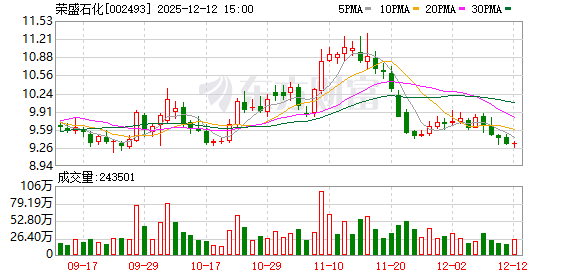
荣盛石化旗下舟山新材料公司增资至100亿
Bei Ke Cai Jing· 2025-12-12 07:01
Core Viewpoint - Rongsheng New Materials (Zhoushan) Co., Ltd. has increased its registered capital from 5 billion RMB to 10 billion RMB, marking a 100% increase [1] Company Summary - Rongsheng New Materials was established in January 2022 and is fully owned by Rongsheng Petrochemical (002493) [1] - The company's business scope includes the sale and manufacturing of petroleum products and synthetic materials [1]
信达证券:2026年原油基本面见底有望 石化产业链有望迎来共振周期
Zhi Tong Cai Jing· 2025-12-12 06:42
Group 1 - The core view is that the oil market is expected to bottom out in 2026, with oil prices likely to fluctuate between $55 and $65 per barrel due to multiple factors [1] - On the supply side, OPEC+ is shifting to a moderate production increase model, while U.S. shale oil production growth is weak, leading to a tightening supply environment [1] - Global oil demand is entering a plateau phase before peaking, with a slow but resilient growth of approximately 800,000 to 1,000,000 barrels per day [1] Group 2 - The refining supply structure is accelerating optimization, with the government promoting the elimination of backward production capacity and optimizing supply structure in the petrochemical industry [2] - The domestic demand for refined oil has peaked, and the transition in oil consumption structure is deepening, while chemical oil demand remains in a long-term growth channel [2] - The refining industry is expected to enter an upward cycle due to improved supply structure and steady demand recovery [2] Group 3 - Investment recommendations include upstream companies with strong dividend attributes such as CNOOC, PetroChina, and Sinopec, as well as oil service companies like CNOOC Services and Haiyou Engineering [3] - In the downstream refining sector, recommendations focus on large private refining companies with scale advantages and rich product layouts, such as Hengli Petrochemical and Rongsheng Petrochemical [3] - Companies with enhanced industrial chain synergy, like Tongkun Co. and Xin Fengming, are also suggested for attention [3]

2026 年石化行业策略报告:上游油价触底、下游供给侧优化加速,产业链有望迎来共振周期-20251212
Xinda Securities· 2025-12-12 05:09
Group 1 - The report indicates that the upstream oil price is expected to bottom out in 2026, with a shift from a clear surplus to marginal tightening in the oil market, while still remaining in a loose environment. The average oil price for 2026 is projected to fluctuate between $55 and $65 per barrel, influenced by various factors including geopolitical risks and OPEC+ market stabilization actions [3][40][43] - The demand for global crude oil is expected to grow at a rate of approximately 80,000 to 100,000 barrels per day in 2026, with the growth primarily driven by developing economies, while demand in developed regions like North America and Europe is nearing its peak [38][39] - The refining supply structure is undergoing optimization, with a focus on eliminating outdated capacity and enhancing the quality of production. The report highlights that the domestic refining capacity is projected to reach 1 billion tons by 2025, with a significant portion of this capacity being concentrated in large-scale refineries [46][51][62] Group 2 - The report recommends investment in private refining enterprises with scale advantages and a long chemical industry chain, such as Hengli Petrochemical and Rongsheng Petrochemical, as well as polyester filament leaders like Tongkun Co. and Xin Fengming [2][3] - The report emphasizes the importance of the chemical oil demand, which is expected to continue its long-term growth trajectory, with the share of chemical oil consumption in total oil consumption projected to rise to 50% by 2026 [62][64] - The report notes that the refining industry is likely to enter a period of stock competition, with a significant amount of outdated refining capacity facing potential elimination, particularly among smaller refineries [51][54][59]
2026年大化工行业投资策略:稳健配置+涨价品种,聚焦四大投资方向
Soochow Securities· 2025-12-11 11:29
Investment Direction 1: Dividend Strategy - Recommended companies include China National Offshore Oil Corporation (CNOOC), China Petroleum & Chemical Corporation (Sinopec), and China National Petroleum Corporation (PetroChina) with an expected Brent oil price range of $60-70 per barrel in 2026 [2][3] - CNOOC is committed to maintaining a dividend payout ratio of no less than 45% from 2025 to 2027, while PetroChina benefits from domestic natural gas market reforms [2][3] Investment Direction 2: Capital Allocation to Undervalued Chemical Leaders - Recommended companies include Wanhua Chemical, Baofeng Energy, Satellite Chemical, and Hualu Hengsheng, which are expected to benefit from industry barriers related to cost, technology, and market [2][3] - The report suggests prioritizing capital allocation to chemical ETFs and leading companies as their performance is expected to stabilize [2][3] Investment Direction 3: Price Increases Driven by Downstream Demand - Traditional demand sectors such as food additives, pesticides, and fertilizers are highlighted, with companies like New Hope Liuhe and Jiangshan Chemical expected to benefit from stable growth in demand [2][3] - Emerging demand in phosphorous and fluorine chemicals is driven by the needs of new energy battery and AI cooling applications, with companies like Chuanheng Chemical and Juhua Co. being key players [2][3] Investment Direction 4: Domestic Anti-Competition Driving Price Increases - The report emphasizes the focus on large refining and chemical companies such as Hengli Petrochemical and Rongsheng Petrochemical, which are expected to benefit from anti-competitive measures in the domestic market [2][3] - The organic silicon sector is entering the end of its expansion cycle, with major companies like Sinan Silicon Material adjusting industry operating rates [2][3] - The soda ash industry is facing capacity controls and the need to phase out outdated production, with companies like Boyuan Chemical under observation [2][3] Oil Price Analysis - The report anticipates a Brent oil price range of $60-70 per barrel in 2026, with a slight oversupply expected [11][12] - OPEC+ has postponed production increases for Q1 2026, indicating a cautious approach to market conditions [11][12] - The report highlights geopolitical factors, including the ongoing Russia-Ukraine conflict and U.S.-Venezuela relations, which may impact oil supply dynamics [12][13] Three Major Oil Companies Insights - CNOOC is focused on increasing reserves and production while reducing costs, while PetroChina is benefiting from natural gas market reforms [34][36] - Sinopec is concentrating on domestic refining and chemical anti-competition developments [34][36] - The overall profitability of the three major oil companies is expected to be supported by the anticipated oil price stabilization [34][36]


高质量发展中的期货力量——期现联动赋能产业突围系列|PTA期货进化史:从避险工具到聚酯产业链“...
Xin Lang Cai Jing· 2025-12-10 11:25
Core Viewpoint - The PTA industry has evolved significantly, with the introduction of PTA futures in China's market providing essential tools for risk management and price stabilization, benefiting both upstream and downstream sectors of the polyester industry [1][2][7]. Group 1: Industry Evolution - The PTA industry has transitioned from a reliance on imports to becoming a net exporter, reflecting a shift from scarcity to abundance [2]. - The period from 2007 to 2010 was characterized as a "golden era" for the PTA industry, with high demand and profitability, which later faced challenges due to oversupply from new production facilities [2][3]. - The introduction of PTA futures in 2006 marked a new chapter for the industry, allowing companies to explore innovative trading models and risk management strategies [1][2]. Group 2: Risk Management and Trading Strategies - Companies like Yisheng Petrochemical have successfully utilized futures to lock in profits and manage inventory, particularly during off-peak seasons [3]. - The shift from a seller's market to a pricing model based on futures has transformed the trade pricing system within the industry [3]. - The use of cross-commodity operations, such as buying crude oil and PX futures while selling PTA futures, has enabled companies to secure profits amid low processing fees [4][5]. Group 3: Practical Applications of Futures - PTA futures have become an indispensable tool for price risk management across the polyester supply chain, with participation from a majority of PTA producers and nearly all major traders [4][5]. - Companies have optimized inventory management and reduced costs by adjusting inventory levels in response to market price fluctuations through the futures market [5]. - The ability to stabilize cash flow through hedging operations has provided a solid foundation for ongoing business development, even during market volatility [5][6]. Group 4: Industry and Futures Market Integration - The integration of futures into the polyester industry has created a symbiotic relationship, enhancing both market liquidity and the efficiency of price discovery [7][8]. - The launch of PX futures has further solidified the reliance of leading companies on futures for risk management, with firms like Rongsheng Petrochemical adopting these tools as essential components of their operations [7][8]. - The ongoing expansion of futures products related to the polyester supply chain is expected to enhance risk management capabilities and support high-quality industry development [8][9].
