
上海家化

Search documents
上海抛出全国最大力度美妆新政 资源资金已备全
Zhong Guo Jin Rong Xin Xi Wang· 2025-09-25 13:39
Core Insights - Shanghai has officially released measures to promote high-quality development in the cosmetics industry, emphasizing technological empowerment, digital intelligence, and regulatory efficiency, making it the most supportive initiative in the country [1] Group 1: Technological Innovation and Support - The measures encourage technological innovation, with government departments actively enhancing service systems, including support for raw material innovation and application, accelerating research paradigm transformation, and promoting innovation through regulation [1] - Financial support is provided for the registration and filing of new cosmetic raw materials, with a maximum of 2 million yuan for registered materials and 500,000 yuan for filed materials, significantly boosting local companies' innovation capabilities [1] - Companies like Shanghai Jahwa, which has been developing herbal extracts since 1990, view the financial support as nearly double that of other provinces, stimulating deep innovation [1] Group 2: AI and Resource Integration - Shanghai's AI innovation advantages are supporting the local beauty industry, with companies like Rongxiushengsheng leveraging AI solutions for uniformity in essential oil extraction, thus enhancing production efficiency [2] - The measures promote the integration of artificial intelligence and multi-omics to drive innovations in organoids, 3D skin models, and cosmetic manufacturing processes, supported by unique AI resource incentives [2] Group 3: Regulatory Support and Industry Development - The measures aim to accelerate innovation through regulatory support, with the regulatory department providing proactive guidance to cosmetic companies developing medical devices, thus reducing the likelihood of application rejections [3] - Emphasis is placed on strengthening industrial infrastructure, with plans to add 30 million square meters of "smart manufacturing space" from 2023 to 2025, facilitating vertical factory developments for cosmetics companies [3] Group 4: Market Position and Brand Development - Shanghai holds a leading position in the high-end cosmetics industry, with 17 brands listed in the top 50 Chinese makeup brands by Hurun Research Institute, surpassing other cities [4] - Notable companies in Shanghai include Up Beauty, Shanghai Jahwa, and Lin Qingxuan, with some planning IPOs in Hong Kong [4]


化妆品板块9月25日跌0.34%,嘉亨家化领跌,主力资金净流出4989.87万元
Zheng Xing Xing Ye Ri Bao· 2025-09-25 08:44
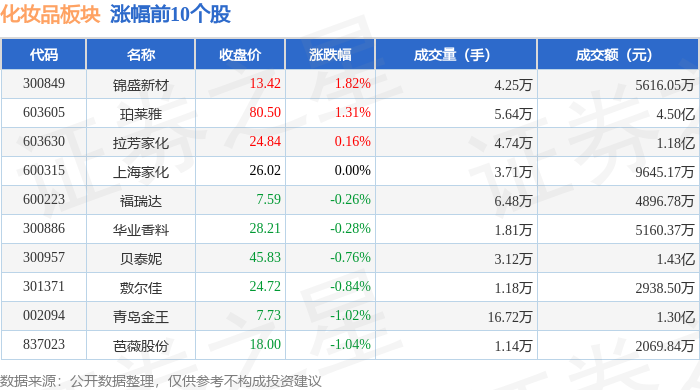
Market Overview - On September 25, the cosmetics sector declined by 0.34%, with Jiaheng Jiahua leading the drop [1] - The Shanghai Composite Index closed at 3853.3, down 0.01%, while the Shenzhen Component Index closed at 13445.9, up 0.67% [1] Individual Stock Performance - Notable gainers included: - Jinsheng New Material (300849) with a closing price of 13.42, up 1.82% [1] - Tiancaiya (603605) with a closing price of 80.50, up 1.31% [1] - Major decliners included: - Jiaheng Jiahua (300955) with a closing price of 27.90, down 2.04% [2] - Wanmei Biological (603983) with a closing price of 39.81, down 1.87% [2] Trading Volume and Capital Flow - The cosmetics sector experienced a net outflow of 49.89 million yuan from main funds, while retail investors saw a net inflow of 29.38 million yuan [2] - The trading volume for key stocks included: - Shanghai Jahwa (600315) with a trading volume of 37,100 shares and a turnover of approximately 96.45 million yuan [1] - Qingdao Kingway (002094) with a trading volume of 167,200 shares and a turnover of approximately 130 million yuan [2] Fund Flow Analysis - Main fund inflows and outflows for selected stocks: - Shanghai Jahwa had a main fund net inflow of 3.17 million yuan, while retail investors contributed a net inflow of 3.43 million yuan [3] - Jiaheng Jiahua saw a main fund net outflow of 393,800 yuan, with retail investors contributing a net outflow of 387,720 yuan [3]




力度全国最大 上海以真金白银、服务体系、AI优势全力支持——打响“上海制造”化妆品领域品牌
Jie Fang Ri Bao· 2025-09-25 01:53
Group 1 - The Shanghai government has officially released measures to promote high-quality development in the cosmetics industry, emphasizing technological innovation, digital intelligence, and regulatory efficiency, making it the most supportive initiative in the country [1] - The measures include financial support for the registration and filing of new cosmetic raw materials, with a maximum of 2 million yuan for registered materials and 500,000 yuan for filed materials, aimed at reducing reliance on imported core ingredients [1] - The initiative encourages local companies to innovate and develop new raw materials, with the goal of enhancing the competitiveness of Shanghai's cosmetics brands [1] Group 2 - Shanghai's AI innovation is boosting the local beauty industry, with companies like Rongxiusheng leveraging AI solutions for natural essential oil extraction, which helps in achieving cost advantages and product uniformity [2] - The measures promote the integration of AI and multi-omics to drive innovations in cosmetic manufacturing processes, including the development of organoids and 3D skin models [2] - The initiative also includes support for AI resources such as computing power vouchers, which are unique advantages for companies in Shanghai [2] Group 3 - The measures aim to accelerate innovation through regulatory support, with the government providing guidance to cosmetic companies developing medical devices, thus reducing the likelihood of application rejections [3] - The initiative emphasizes the construction of industrial spaces, with plans to add 30 million square meters of "smart manufacturing space" from 2023 to 2025, facilitating vertical factories for cosmetics companies [3] - E-commerce platforms are encouraged to promote Shanghai beauty brands, with project support amounts reaching up to 30 million yuan [3] Group 4 - Shanghai holds a leading position in the high-end cosmetics industry in China, with 17 brands listed in the top 50 Chinese color cosmetics brands according to Hurun Research Institute [4] - The city is home to listed companies such as Shiseido and Shanghai Jahwa, with others like Lin Qingxuan planning to go public in Hong Kong [4]
2025年第37周:跨境出海周度市场观察
艾瑞咨询· 2025-09-25 00:03
Group 1: Long Video Overseas Expansion - The Southeast Asian streaming market is intensifying, with an expected market size of $6.8 billion by 2030. Chinese platforms like iQIYI, WeTV, and Youku are challenging Netflix through differentiated strategies, such as high-budget local original content and flexible subscription models [3][4] - iQIYI focuses on high-budget local original content and flexible subscription models, while WeTV emphasizes idol cultivation to enhance user engagement. Youku exports mature variety show formats [3] - Chinese platforms are leveraging low subscription prices, deep localization, and local payment advantages to capture market share, particularly in Thailand where their share exceeds 40% [3][4] Group 2: New Energy Heavy Trucks Going Global - The global new energy heavy truck sector is undergoing significant transformation, with Chinese manufacturers making breakthroughs in overseas markets. The year 2025 is seen as a "breakout year" for Chinese new energy heavy trucks, with exports increasing by 200% from January to July this year [5] - Companies like DeepWay and Weitu Technology have successfully entered markets in the Middle East, Europe, and Southeast Asia through technological innovation and flexible mechanisms [5] - Key competitive advantages include technological breakthroughs and customized products, such as DeepWay's battery swap system and high-temperature resistant models [5] Group 3: Home Furnishing Industry Going Global - The Chinese home furnishing industry is shifting towards a "strategic deep cultivation" approach, with the global furniture retail market expected to reach $800 billion by 2025. North America remains the primary target market, while emerging markets like Southeast Asia and the Middle East are also gaining attention [7][8] - Companies face challenges from trade changes and supply chain adjustments, making traditional price competition unsustainable. Key strategies include supply chain integration, R&D investment, and precise marketing to enhance competitiveness [7][8] Group 4: Chinese Brands Globalization - Chinese tea brands are rapidly rising in Southeast Asia, with Mixue Ice City as a standout performer. The region's cultural proximity and young population make it an ideal market for tea brands [9] - Mixue Ice City has become a leading brand in Southeast Asia within five years, achieving revenue of 14.87 billion yuan in the first half of 2025 and over 50,000 global stores [9] - The success of Mixue's strategy includes supply chain cost reduction, localized IP, and refined operations, with its coffee brand also leveraging the same approach for global expansion [9] Group 5: Robotics Industry Going Global - Chinese robotics products are rapidly expanding in overseas markets, with some leading companies achieving over 50% of their revenue from abroad. However, data security and privacy issues pose significant challenges for startups [10] - Companies are adopting AI tools for vulnerability scanning and traffic monitoring to enhance security. Emphasis is placed on "entering the sea" rather than merely "going out," integrating into international ecosystems [10] Group 6: Xiaomi's Globalization Strategy - Xiaomi has transitioned from product export to "model export," covering over 100 markets since its global journey began in 2014. The company plans to open 10,000 Xiaomi Home stores overseas in the next five years [11][12] - Xiaomi's strategy includes high-end positioning in Europe and maintaining market share in emerging markets, with significant growth in high-end smartphone sales [11][12] Group 7: Domestic Beauty Brands Accelerating Global Expansion - Domestic beauty brands are seeking new growth through multi-brand matrices and overseas investments, with top companies like Proya and Shiseido leading the way [13] - The beauty industry is shifting focus from domestic competition to international collaboration, with brands needing to enhance their brand power and supply chain capabilities for successful globalization [13] Group 8: Flying Book's Globalization Efforts - Flying Book, a global office platform, integrates AI and collaboration capabilities to assist companies in their overseas expansion. It addresses organizational management and compliance challenges for multinational enterprises [14] Group 9: iFLYTEK's AI Global Strategy - iFLYTEK achieved a revenue of 10.911 billion yuan in the first half of 2025, with a 38% growth in C-end business. The company emphasizes the importance of self-control in its strategic direction [15][16]


轻工、美护板块三季报前瞻:看好国货品势能向上,关注降息带动出口需求
HUAXI Securities· 2025-09-24 12:46
Investment Rating - Industry rating: Recommended [4] Core Views - The home furnishing sector remains under pressure, but government subsidy policies and the increasing demand for home renovation are expected to boost consumer willingness [6][8] - The paper and packaging sector is entering a traditional peak season, with anticipated recovery in downstream demand, particularly for cost-leading companies [6] - The light industry consumer segment is seeing a recovery in stationery procurement and growth in domestic brands in the cosmetics sector [2][9] - The export chain is expected to benefit from interest rate cuts, enhancing demand and improving the competitive landscape for leading companies [7][8] Summary by Relevant Sections Home Furnishing - The sector is facing significant pressure due to a decline in new housing starts and sales, with new construction area down 18.3% year-on-year [6][12] - Government subsidies are expected to stimulate consumer demand, while the trend of upgrading existing homes is gaining traction [6] - AI applications are enhancing product differentiation in smart home products [6] Paper and Packaging - September marks the beginning of the traditional peak season for paper, with expectations of demand recovery [6] - The metal packaging sector is at a breakeven point, and mergers among leading companies may improve the competitive landscape [6] Light Industry Consumption - In the stationery market, procurement is gradually recovering, and domestic brands are gaining market share in cosmetics due to their affordability and positive reputation [2][9] - The jewelry sector is experiencing high growth, particularly in mid-range brands focusing on traditional gold products [2][9] Export Chain - Anticipated interest rate cuts from the Federal Reserve are expected to boost export demand [7] - Leading companies are mitigating tariff impacts through capacity transfer and efficiency improvements [7] Electric Two-Wheelers - The industry is entering a traditional peak season, with positive growth expected in Q3 due to proactive inventory stocking [8] - The new national standards are likely to drive structural changes in consumer preferences and enhance average selling prices [8] Beauty and Personal Care - Domestic brands are expected to achieve steady growth due to their competitive pricing and effective marketing strategies [2][9]
申万宏源:美容护理业绩分化 新消费逆势双击
智通财经网· 2025-09-24 06:17
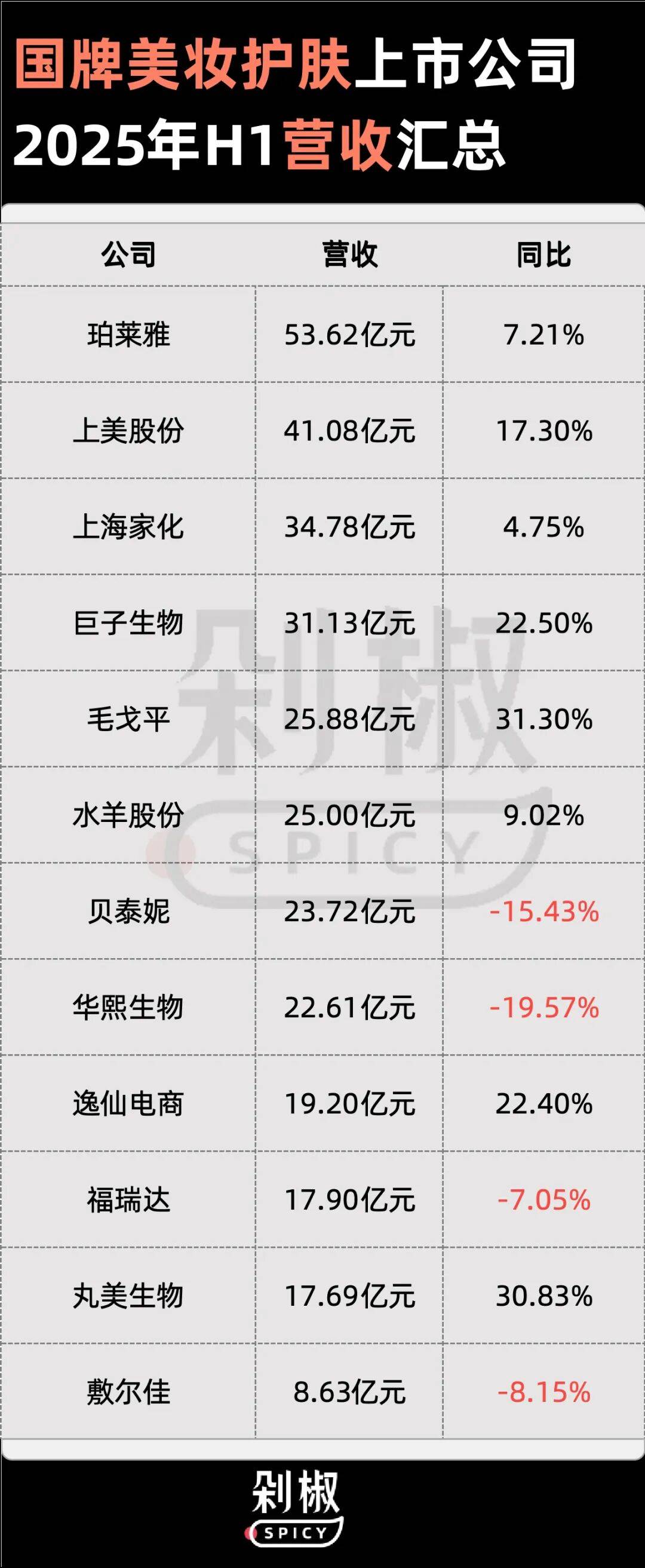
Group 1 - The core viewpoint is that in H1 2025, the cosmetics retail sales growth has reversed its decline, achieving a growth rate of 2.9% due to consumption-boosting policies and improved income expectations [1][2] - The demand for cosmetics is expected to remain strong in H2 2025, with the off-peak season in July and August showing increased growth, indicating positive demand expectations [1][2] - The competitive landscape is improving, with domestic brands making significant progress, and leading domestic brands are now sharing market share equally with international brands [2] Group 2 - In the cosmetics sector, the revenue growth rate for key covered companies in H1 2025 is around 8%, with net profit growth slightly lower than revenue growth [2] - Specific companies in the cosmetics sector include: - Shiseido: H1 2025 revenue of 4.11 billion yuan, up 17.3%, net profit of 520 million yuan, up 30.6% [2] - Proya: H1 2025 revenue of 5.36 billion yuan, up 7.2%, net profit of 800 million yuan, up 13.8% [2] - Water Sheep: H1 2025 revenue of 2.5 billion yuan, up 9.0%, net profit of 123 million yuan, up 16.5% [2] - Marubi: H1 2025 revenue of 1.77 billion yuan, up 30.8%, net profit of 190 million yuan, up 5.2% [2] Group 3 - The second category of companies is capitalizing on consumer trends, with notable performances including: - Mao Geping: H1 2025 revenue of 2.59 billion yuan, up 31.3%, net profit of 670 million yuan, up 36.1% [3] - Juzi Biotechnology: H1 2025 revenue of 3.11 billion yuan, up 22.5%, net profit of 1.18 billion yuan, up 20.2% [3] - The third category includes companies showing marginal improvements or initial signs of strategic transformation, such as Shanghai Jahwa, Huaxi Biological, and Betaini [3] Group 4 - In the personal care sector, two companies reported revenue and net profit growth, indicating a strong market potential: - RuYuchen: H1 2025 revenue of 1.32 billion yuan, up 67.6%, net profit of 70 million yuan, up 85.6% [3] - Runben: H1 2025 revenue of 900 million yuan, up 20.3%, net profit of 190 million yuan, up 4.2% [3] Group 5 - In the medical beauty sector, the performance is mixed, with some companies experiencing declines: - Aimeike: H1 2025 revenue of 1.3 billion yuan, down 21.6%, net profit of 790 million yuan, down 29.6% [4] - Langzi: H1 2025 revenue of 2.79 billion yuan, down 4.3%, net profit of 270 million yuan, up 64.1% [4] - Overall, the medical beauty sector reported a revenue of 1.333 billion yuan, down 6.1%, with a gross margin of 54.54% [4]

美容护理行业25H1业绩回顾:美容护理业绩分化,新消费逆势双击
Shenwan Hongyuan Securities· 2025-09-23 11:45
Investment Rating - The report maintains a "Positive" outlook on the beauty and personal care industry, highlighting the resilience of domestic brands and the impact of new consumption trends [2]. Core Insights - The beauty and personal care sector experienced a robust recovery in H1 2025, with a retail sales growth of 2.9%, reversing the previous decline due to favorable consumption policies and improved income expectations [5][6]. - Domestic brands are gaining market share, with top local brands now competing closely with international counterparts, indicating a significant shift in consumer preferences [10][11]. - The report categorizes companies into three groups based on performance: those with strong brand matrices benefiting from multi-brand strategies, those capitalizing on consumer trends like domestic brands and collagen products, and those showing signs of strategic improvement [20][23]. Summary by Sections Industry Overview - The beauty market is projected to grow steadily, with a forecasted retail sales decline of 1.1% in 2024, followed by a recovery in H2 2025 [5][6]. - The domestic market share is expected to increase, with local brands achieving significant breakthroughs in both skincare and makeup segments [10][11]. Company Performance - **Cosmetics Sector**: - Major companies like Up Beauty and Proya reported revenue growth of 17.3% and 7.2% respectively in H1 2025, with net profits increasing by 30.6% and 13.8% [20][21]. - Other notable performers include Marubi and Water Sheep, with revenue growth of 30.8% and 9.0% respectively [21][22]. - **Personal Care Sector**: - Companies like Ruibin and Zhenjia showed remarkable growth, with Ruibin's revenue increasing by 67.6% and Zhenjia's by 157.11% in H1 2025 [5][20]. - **Medical Aesthetics Sector**: - Companies like Aimeike and Langzi reported mixed results, with Aimeike's revenue declining by 21.6% while Langzi's net profit surged by 64.1% [20][24]. Investment Recommendations - The report recommends investing in companies with strong brand matrices and low PE multiples, such as Up Beauty and Proya, as well as those benefiting from the Douyin traffic boost like Marubi and Water Sheep [20][24]. - It also suggests focusing on high-value segments and innovative products from brands like Ruibin and Furuida, and highlights opportunities in the maternal and infant sector with companies like Shengbeila and Haiziwang [20][24].





重用“明星”,狠抓“渠道”:美妆品牌“不强则死”?
Hu Xiu· 2025-09-23 06:13
Group 1 - The overall performance of domestic beauty and skincare companies in the first half of 2025 remains stable, with Proya and Shiseido maintaining their positions as industry leaders, while Juzhibio leads in profit [1][2] - Proya's main brand shows a slight decline, indicating a near ceiling for single-brand growth in the domestic market, while Maogeping has entered the top five, representing the high-end trend in domestic beauty [2][10] - The financial performance of major companies shows varied results, with Proya reporting revenue of 5.362 billion yuan (up 7.21%), Shiseido at 4.108 billion yuan (up 17.30%), and Juzhibio at 3.113 billion yuan (up 22.50%) [3][4] Group 2 - Juzhibio's profit reached 1.182 billion yuan, a 20.60% increase, while Proya's profit was 799 million yuan (up 13.80%) and Maogeping's profit was 670 million yuan (up 36.10%) [5][6] - The beauty industry is facing challenges with brand positioning and organizational restructuring, particularly for established companies like Huaxi Biological and Beitaini, which have seen significant declines in performance [25][30] - Maogeping has successfully expanded into high-end skincare and fragrance markets, with a focus on diversifying its business to reduce reliance on single products [20][23] Group 3 - The emergence of new active ingredients, such as ergothioneine, is gaining attention in the beauty industry, with companies investing in research and development to innovate [39][42] - Marketing strategies are shifting towards brand strength and celebrity endorsements, with companies like Proya and Marubi actively engaging high-profile brand ambassadors [51][53] - Companies are increasingly focusing on building comprehensive sales channels that integrate online and offline strategies, as well as domestic and international markets, to adapt to changing consumer behaviors [58][60]


美容护理行业今日跌1.36%,主力资金净流出2.23亿元
Zheng Quan Shi Bao Wang· 2025-09-22 10:24
Market Overview - The Shanghai Composite Index rose by 0.22% on September 22, with 11 sectors experiencing gains, led by the electronics and computer sectors, which increased by 3.71% and 1.70% respectively [1] - The total net outflow of capital from the two markets was 18.892 billion yuan, with only four sectors seeing net inflows [1] Sector Performance - The electronics sector had the highest net inflow of capital, amounting to 9.357 billion yuan, coinciding with its 3.71% increase [1] - The computer sector followed with a net inflow of 2.081 billion yuan and a daily increase of 1.70% [1] - The power equipment sector experienced the largest net outflow, totaling 4.662 billion yuan, while the pharmaceutical and biological sector saw a net outflow of 3.371 billion yuan [1] Beauty and Personal Care Industry - The beauty and personal care sector declined by 1.36%, with a net outflow of 223 million yuan [2] - Out of 29 stocks in this sector, 8 rose while 21 fell [2] - The top three stocks with the highest net outflow included Aimeike, Pola, and Qingdao King, with outflows of 73.5801 million yuan, 27.1153 million yuan, and 24.1188 million yuan respectively [2] Capital Flow in Beauty and Personal Care - The top stock with net inflow in the beauty sector was Shuiyang Co., with an inflow of 13.0672 million yuan [3] - Other notable inflows were from Runben Co. and Jinsong New Materials, with inflows of 4.8789 million yuan and 2.4414 million yuan respectively [3] - The overall capital flow data indicates a challenging environment for the beauty and personal care sector, with significant outflows from major companies [2][3]

35股今日获机构买入评级
Zheng Quan Shi Bao Wang· 2025-09-22 10:15
市场表现方面,机构买入型评级个股今日平均上涨1.07%,表现强于沪指。股价上涨的有14只,涨停的 有大洋电机等。涨幅居前的有芯原股份、香农芯创、灿芯股份等,今日涨幅分别为17.34%、13.07%、 8.23%。跌幅较大的个股有上海家化、乖宝宠物、天齐锂业等,跌幅分别为2.84%、2.78%、2.53%。 行业来看,电子行业最受青睐,汉朔科技、香农芯创等5只个股上榜机构买入评级榜。汽车、食品饮料 等行业也较受机构关注,分别有4只、3只个股上榜。(数据宝) 今日获机构买入型评级个股中,共有14条评级记录中对相关个股给出了未来目标价。以公布的预测目标 价与最新收盘价进行对比显示,共有9股上涨空间超20%,高伟达上涨空间最高,9月22日东吴证券预计 公司目标价为51.50元,上涨空间达98.76%,上涨空间较高的个股还有大洋电机、日联科技等,上涨空 间分别为61.81%、61.11%。 从机构评级变动看,今日机构买入型评级记录中,有17条评级记录为机构首次关注,涉及灿芯股份、大 洋电机等17只个股。 35只个股今日获机构买入型评级,特变电工最新评级被调高,17股机构首次关注。 机构今日买入型评级记录 证券时报·数据 ...